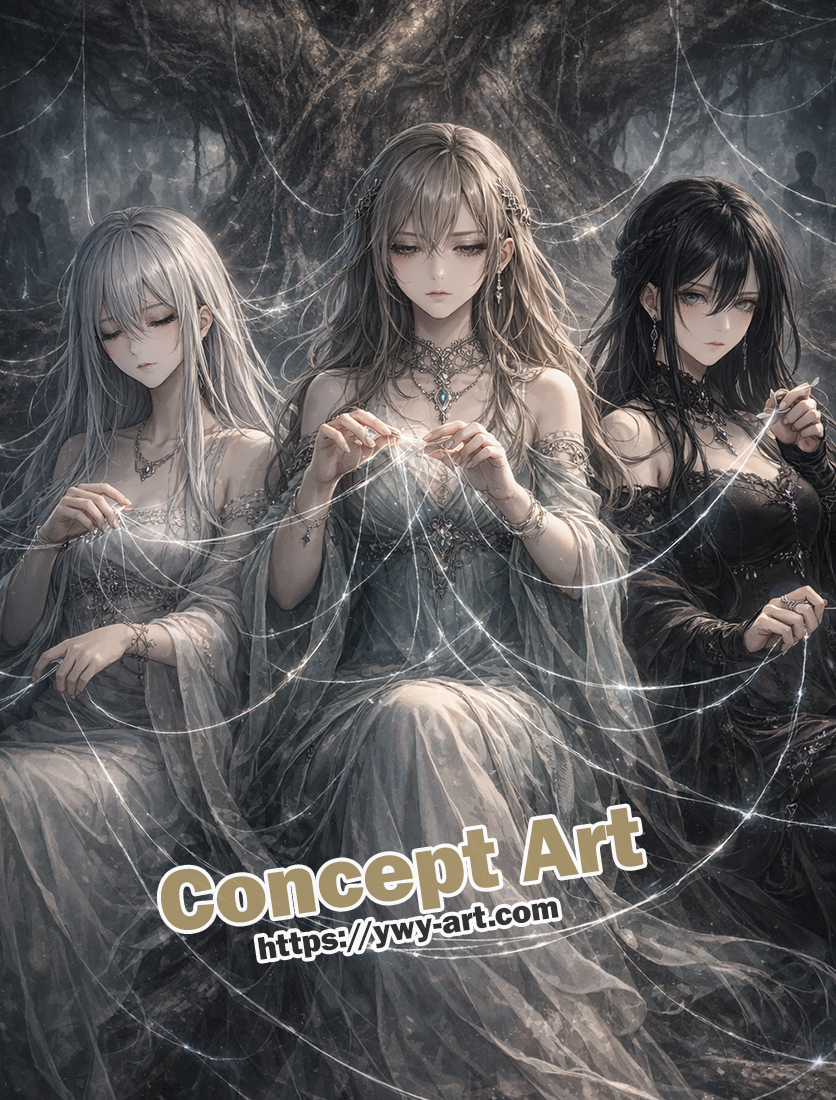
Threads of Fate – Norns
Before gods act and before mortals choose, the Norns have already woven what must come. They do not predict fate. They define its structure.
Basic Profile
| Name | Norns (Urd, Verdandi, Skuld) |
|---|---|
| Mythology | Norse Mythology |
| Gender | Female (often depicted as three women) |
| Region | Scandinavia |
| Era | Viking Age and earlier oral traditions |
| Domain | Fate, Time, Destiny, Cosmic Order |
| Symbol | Threads, weaving, roots of Yggdrasil |
| Culture / Religion | Norse Paganism |
| Main Role | Weavers and determiners of fate for gods and humans |
| Associated Deity | Odin, Yggdrasil (cosmic connection) |
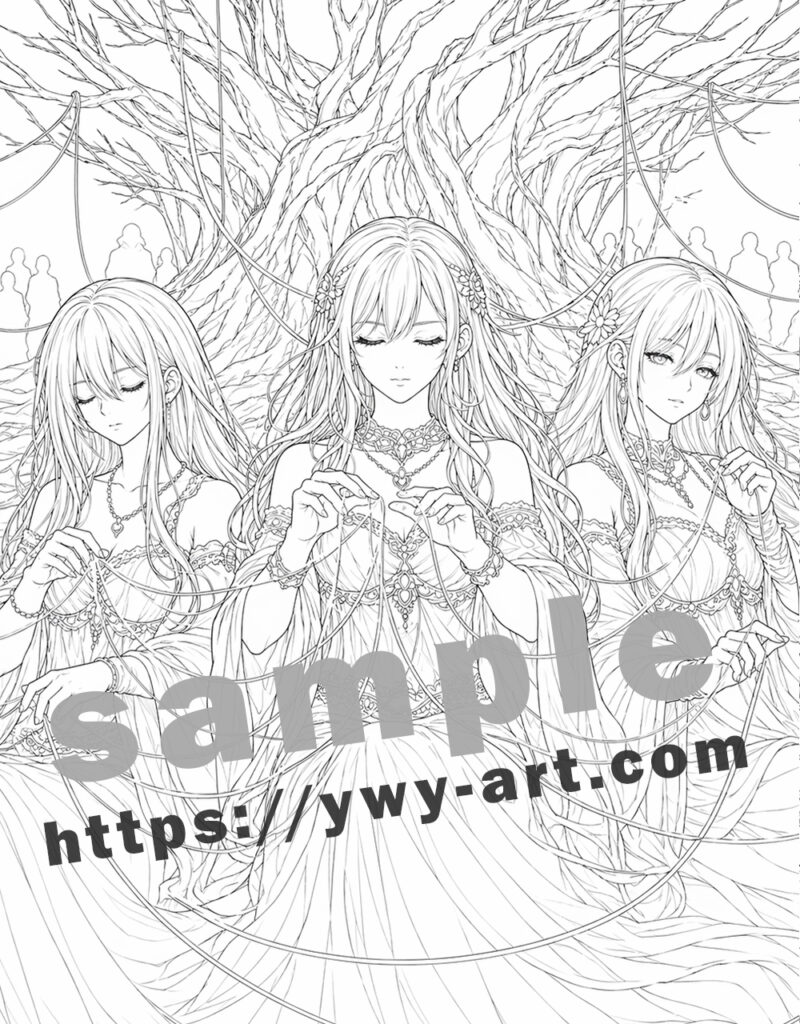
| Common Depiction | Three women weaving or handling threads of fate beneath a great tree |
| Alignment | True Neutral |
| Creative Reference | Triple figures, fate weaving, timeless stillness, cosmic inevitability |
Overview
The Norns are primordial beings in Norse mythology who govern the fate of all existence. They are not simply observers of time, but entities that structure it, binding past, present, and future into a single continuous thread.
They reside beneath Yggdrasil, the World Tree, where they tend its roots and weave the destinies of both gods and mortals. Their influence extends beyond individual lives, shaping the unfolding of the cosmos itself.
Characteristics
- Exist outside the authority of gods, including Odin
- Represent past (Urd), present (Verdandi), and future (Skuld)
- Weave and maintain the threads of fate for all beings
- Operate without emotion, judgment, or preference
- Symbolize inevitability and the unchangeable nature of destiny
Symbolism and Meaning
The Norns embody the concept that time is not a sequence of choices, but a structured continuum. Their weaving represents the idea that all events are interconnected, forming patterns that cannot be undone once set in motion.
The threads they hold are not possibilities but certainties. Each strand carries a life, and its path is neither random nor negotiable, reinforcing the Norse belief in an inevitable fate that even the gods must accept.
Quick Creative Reference
| Best For | Fate-driven narratives, symbolic compositions, philosophical themes |
|---|---|
| Visual Keywords | Threads, weaving hands, three figures, tree roots, glowing lines |
| Mood | Silent, inevitable, detached, contemplative |
| Useful Themes | Time, destiny, inevitability, connection, cosmic structure |
Compare with Similar Deities
| Name | Mythology | Main Domains | Overall Image |
|---|---|---|---|
| Moirai (Fates) | Greek | Fate, Life Thread | Three sisters controlling life span through thread |
| Parcae | Roman | Destiny, Birth and Death | Roman counterparts to the Fates |
| Ananke | Greek | Necessity, Inevitability | Embodiment of unavoidable destiny |
The Structure of Time
The Norns are not bound by linear time. Instead, they exist within a structure where past, present, and future coexist simultaneously. This allows them to weave fate not as a prediction, but as a fixed system.
Urd preserves what has already occurred, Verdandi manages what is unfolding, and Skuld defines what is yet to come, ensuring continuity across all layers of existence.
Fate Beyond Choice
In Norse belief, fate is not shaped by human decisions but revealed through them. The Norns do not alter outcomes; they maintain them.
This perspective removes the illusion of control, presenting destiny as something already embedded within reality itself.
The Role of Yggdrasil
The World Tree serves as the foundation of existence, and the Norns sustain it by tending to its roots. Their presence at its base signifies their role in maintaining the structure of reality.
Their actions ensure that all realms remain connected and that the flow of time continues without disruption.
Visual Interpretation of Fate
The depiction of glowing threads emphasizes the visibility of destiny as a tangible force. Each line represents a life path that intersects with others, forming an intricate network.
The stillness of the figures contrasts with the complexity of the threads, reinforcing the idea that fate operates without emotion or urgency.
Coloring Variations
- Temporal Contrast: Use pale tones for the past, balanced tones for the present, and darker tones for the future.
- Monochrome Fate: Keep a limited color palette to emphasize structure over emotion.
- Thread Emphasis: Highlight the threads with brighter colors to make them the focal point.
Coloring Tips
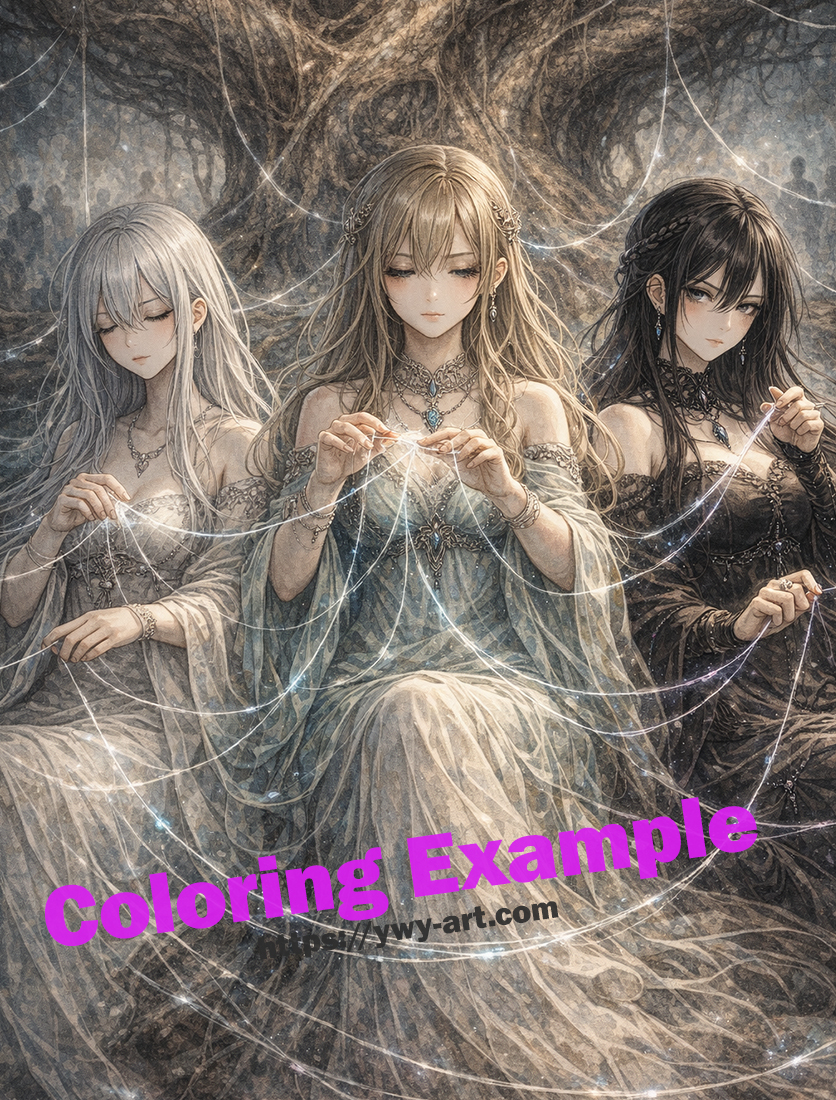
Separate the three figures using subtle color differences to clarify their roles.
Keep the threads lighter or slightly glowing to maintain visual hierarchy.
Use muted tones in the background to ensure the figures and threads stand out clearly.
Japanese Summary
ノルンは北欧神話において、すべての存在の運命を司る原初的な存在です。神々ですらその支配から逃れることはできず、時間そのものを構造として維持しています。
過去・現在・未来をそれぞれ担当する三柱が、ユグドラシルの根元で運命の糸を紡ぎ続けることで、世界は成立しています。
時間という構造
ノルンは時間の流れの中にいるのではなく、その構造そのものを扱う存在です。
過去・現在・未来は分離されたものではなく、同時に存在するものとして織り込まれています。
選択と運命
人間の選択が運命を変えるのではなく、運命が選択として現れるという考え方が根底にあります。
ノルンはそれを変えることなく維持する役割を持っています。
ユグドラシルとの関係
世界樹の根元に存在することで、全世界の構造を支えています。
その働きにより、すべての存在が繋がり続けています。
塗りのポイント
三人の役割が分かるように色を分けることで、構造が理解しやすくなります。
糸は明るめに塗り、背景は落ち着かせると視線が整理されます。
Explore Our Coloring Book Series
Discover mythological beings that shape reality itself through powerful symbolic imagery.
Each illustration offers a deeper narrative beyond the visual.
Step into the world of mythology..
Available on Amazon Dark Ritual Goddesses of Mythology Coloring Book Open in a new tab
コメント