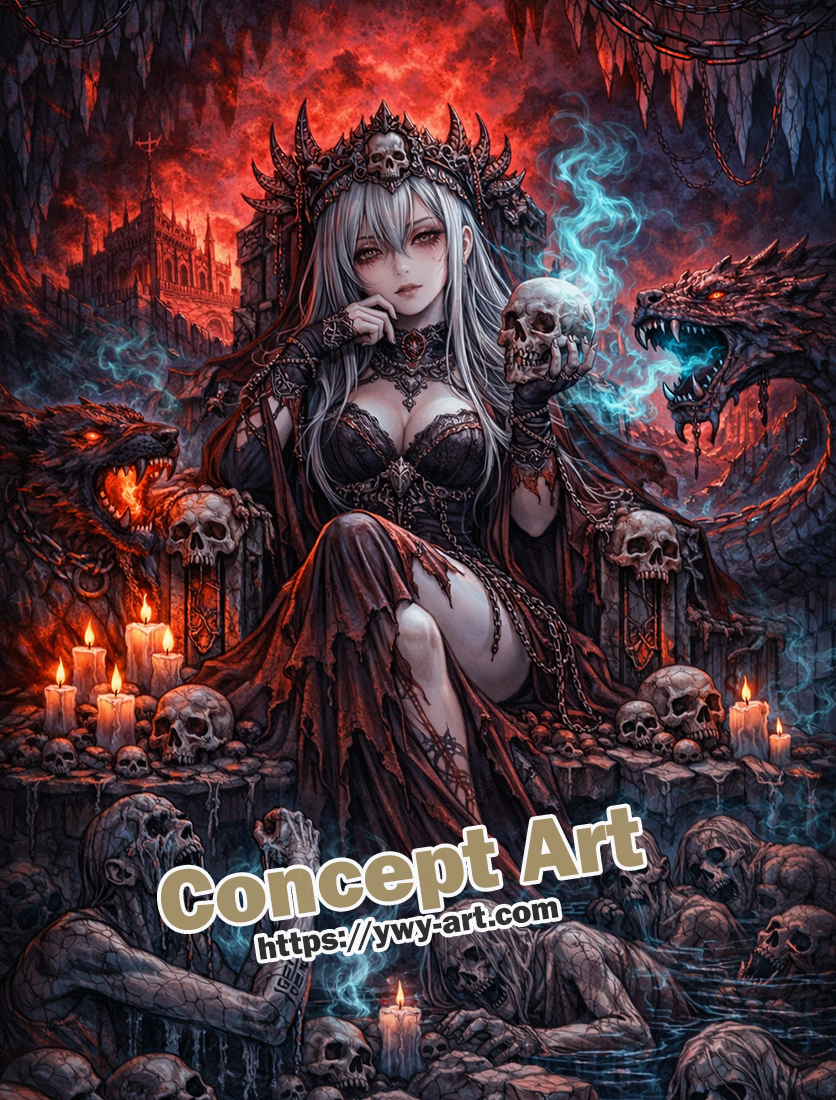
Hel is the Norse goddess who rules Helheim, embodying silence, inevitability, and the still judgment that comes after all struggle has ended.
- Basic Profile
- Overview
- Characteristics
- Symbolism and Meaning
- Quick Creative Reference
- Compare with Similar Deities
- The World of Helheim
- The Meaning of Silent Judgment
- The Scene Depicted in This Artwork
- Symbolism and Visual Elements
- Coloring Variations
- Coloring Tips
- Japanese Summary
- ヘルという存在
- 静かなる裁きの意味
- このイラストの表現意図
- 塗りのポイント
- 掲載中の塗り絵本シリーズ
Basic Profile
| Name | Hel |
|---|---|
| Mythology | Norse |
| Gender | Female |
| Region | Ancient Scandinavia |
| Era | Ancient |
| Domain | Death, Helheim, Judgment, Finality |
| Symbol | Skull, throne, underworld beasts, cold flame |
| Culture / Religion | Norse mythology |
| Main Role | Ruler of Helheim and judge of souls who do not enter Valhalla |
| Associated Deities | Loki, Angrboda, Odin |
| Common Depiction | A pale and emotionless queen seated in the realm of the dead |
| Alignment | Neutral / Final |
| Creative Reference Use | Underworld queens, silent judgment, gothic death rulers, post-battle fate archetypes |
Overview
Hel is the ruler of Helheim in Norse mythology, a realm that exists beyond glory, beyond battle, and beyond redemption. While warriors who die heroically may be taken elsewhere, Hel receives those who arrive after quieter, less celebrated endings.
She is not driven by cruelty or passion. Instead, Hel represents the still certainty that remains after choice has ended. This makes her especially compelling as a mythology reference for themes of inevitability, judgment, and the calm authority of death.
Characteristics
- Ruler of Helheim, the realm of the dead outside heroic glory
- Represents stillness, finality, and acceptance rather than violence
- Often depicted with restrained or emotionless expression
- Associated with judgment after death rather than the act of dying itself
- Embodies a form of power that is absolute because it does not need to prove itself
Symbolism and Meaning
Hel symbolizes the moment after all resistance has ended. She is not the terror of death in motion, but the quiet condition that follows it. Her silence is central to her meaning: she does not need to threaten, because her realm is already final.
In mythological interpretation, Hel stands for the truth that not every ending is glorious. Some are cold, still, and inescapable. That makes her especially effective in visual storytelling where judgment, emotional distance, and irreversible fate are important themes.
Quick Creative Reference
| Best For | Underworld queens, gothic judgment scenes, silent authority, death-themed character design |
|---|---|
| Visual Keywords | Skull, pale skin, cold flame, ruins, bone throne, red shadow, blue spirit fire |
| Mood | Silent, cold, distant, inevitable, absolute |
| Useful Themes | Judgment, finality, acceptance, post-battle fate, stillness after death |
Compare with Similar Deities
| Name | Mythology | Main Domains | Overall Image |
|---|---|---|---|
| Hel | Norse | Death, Helheim, Judgment | Silent ruler of unavoidable endings |
| Ereshkigal | Mesopotamian | Underworld, Finality, Silence | Absolute queen of sealed death |
| Persephone | Greek | Underworld, Renewal | Dual-world queen of descent and return |
The World of Helheim
Helheim is not portrayed as chaotic, but as a realm where movement slows and voices fade. It is a place defined by certainty rather than confusion, where judgment is already implied in the atmosphere itself.
This makes Hel different from deities associated with destruction or punishment. Her world is not one of violent action, but of fixed consequence.
The Meaning of Silent Judgment
The title “Goddess of the Silent Judgment” reflects the nature of Hel’s authority. She does not rage, nor does she plead. She simply receives, observes, and decides. Her judgment does not need spectacle, because it is final without force.
This concept is especially effective artistically because silence creates tension. The absence of visible emotion makes the viewer confront the certainty of the scene more directly.
The Scene Depicted in This Artwork
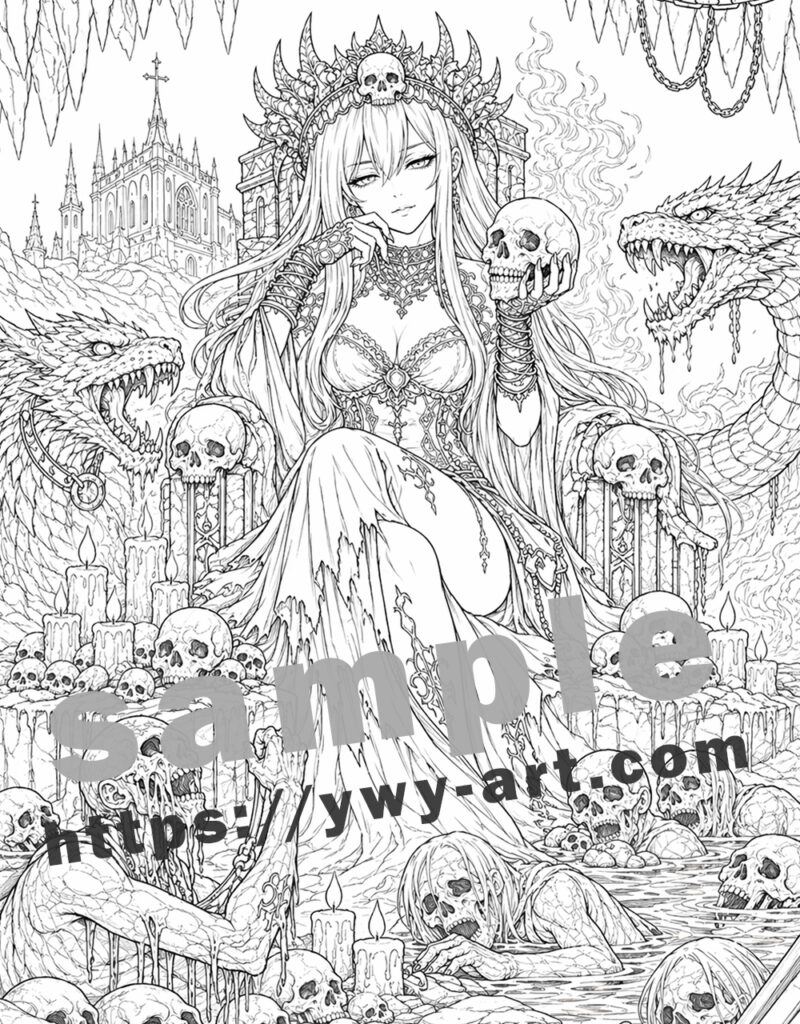
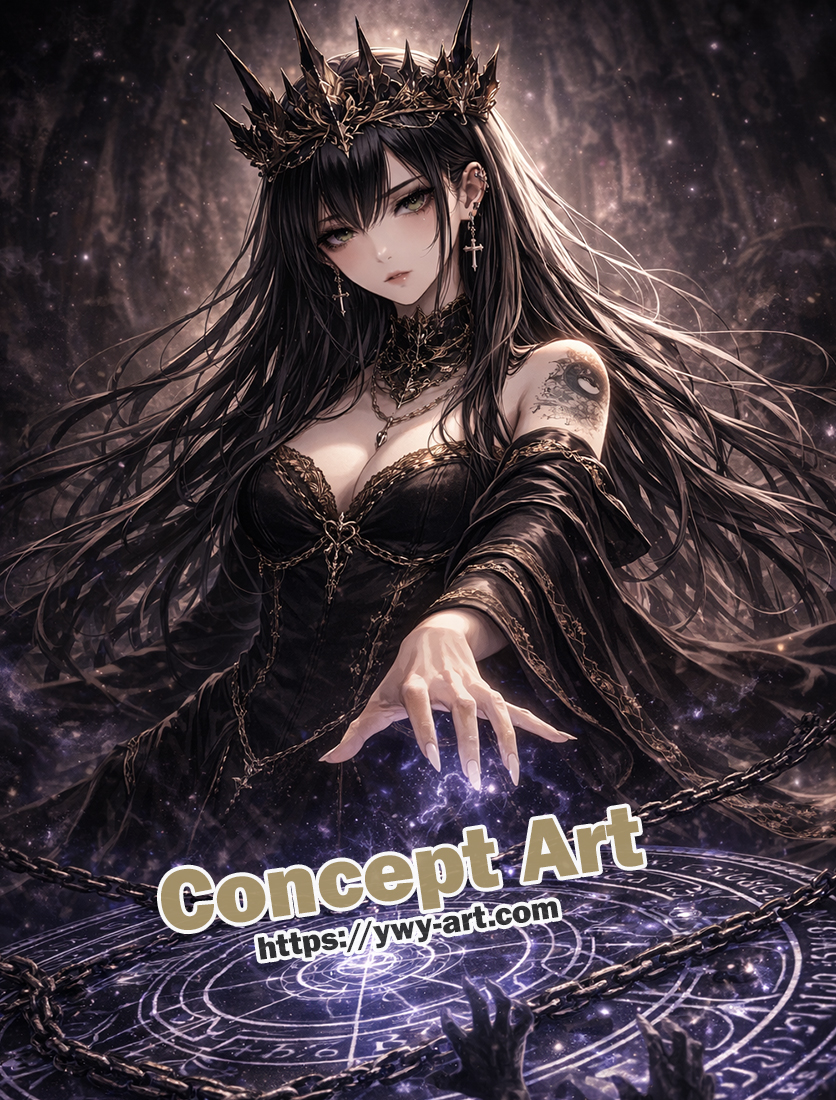
This illustration captures Hel seated upon her throne in Helheim, surrounded by skulls, ruins, spirits, and monstrous presences that reinforce the boundaries of her realm. Her posture is relaxed, yet entirely controlled.
The skull in her hand symbolizes more than death itself. It represents the conclusion of uncertainty. This is not the moment of dying, but the moment after—when all choices have already ended and judgment remains.
Symbolism and Visual Elements
The throne establishes Hel as a sovereign rather than a victim of the realm she inhabits. The skulls and decaying architecture frame her authority, while the beasts and spectral flames suggest a world where death has already spread into every layer of existence.
Her pale tones and subdued expression separate her from the surrounding chaos, making her feel even more distant and absolute. This contrast is essential to the visual identity of Hel.
Coloring Variations
- Silent Gothic Style: Use black, muted crimson, and pale skin tones for a cold royal atmosphere.
- Spirit Flame Style: Use blue-green fire selectively against dark reds and browns for stronger focal contrast.
- Ruined Underworld Style: Use charcoal, bone white, rust, and desaturated shadow tones for a heavier Helheim mood.
Coloring Tips
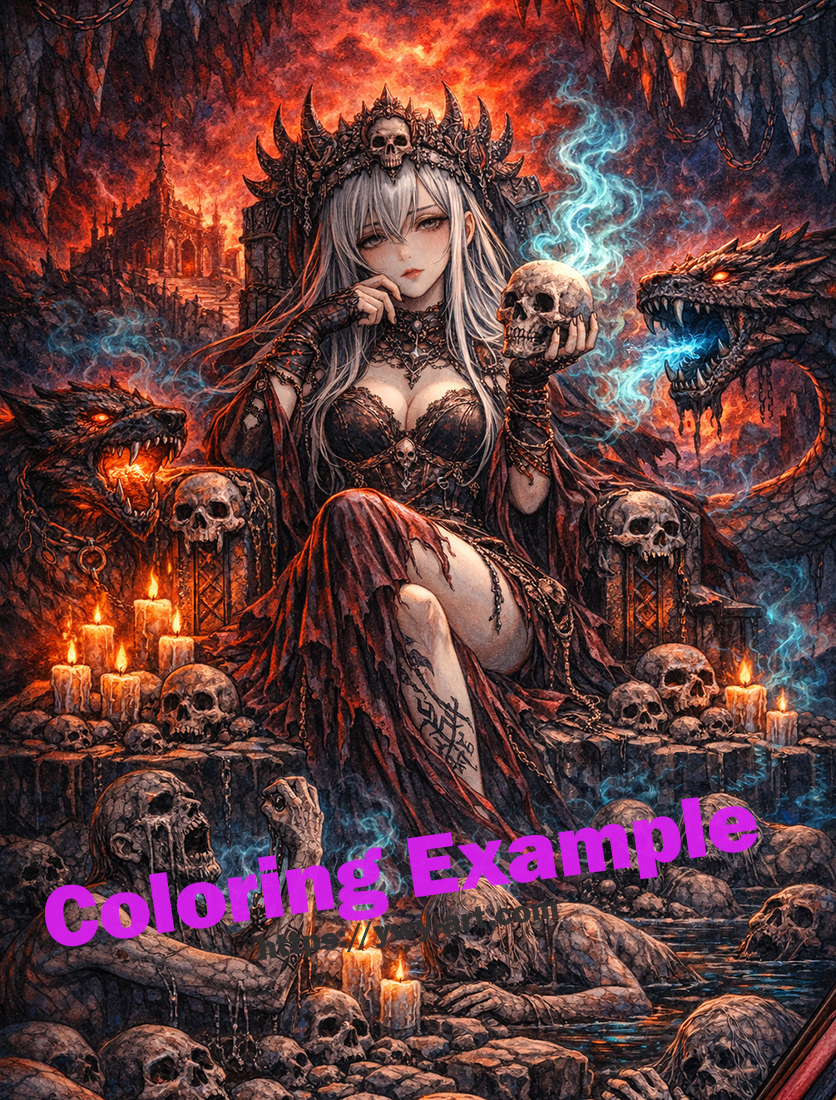
Focus on controlled contrast rather than bright saturation. Hel herself works best with pale, desaturated skin tones mixed with subtle gray or violet to create an inhuman beauty. Her hair can be enriched with layered cool grays and soft blue tones for depth.
For the environment, build richness through dark reds, browns, muted shadows, and bone tones. Blue-green spirit flames are especially effective when used only in selected areas, because they create natural focal points without weakening the quiet authority of the scene.
Avoid relying on flat black. Layering darker tones gradually will create a more organic, immersive, and refined finish, especially in the throne, ruins, and beasts surrounding Hel.
Japanese Summary
ヘルは北欧神話においてヘルヘイムを支配する女神であり、戦場の栄光ではなく、その後に訪れる静かな終わりを象徴する存在です。彼女の力は怒りや暴力ではなく、逃れられない判断と、すでに確定した運命の静けさにあります。
そのためヘルは、単なる死の象徴ではなく、「すべてが終わったあとに残るもの」を体現する神として非常に独特です。創作資料としても、冷たさ、距離感、終焉、静かな支配といったテーマに強く結びつけやすい神格です。
ヘルという存在
ヘルは死者を追い立てる神ではありません。彼女はただ受け入れ、見つめ、判断します。その無感情さがかえって絶対性を強めており、感情ではなく結果そのもので支配する存在として描かれます。
ここにヘルの強さがあります。彼女は力を誇示する必要がなく、すでに逃れられない場所にいるからこそ、静かで重い威圧感を持っています。
静かなる裁きの意味
この作品における「Silent Judgment」は、声高な裁きではなく、すでに決まってしまった結論の静けさを意味しています。怒りも慈悲もなく、ただ最終的な判断だけが残る状態です。
だからこそ、ヘルの世界は混乱していません。むしろ動きが少ないことで、終わりの確定性がより強く伝わる構造になっています。
このイラストの表現意図
本作では、ヘルが玉座に座し、死者の国を静かに見下ろす場面を通して、冷たく揺るがない支配を表現しています。手にした頭蓋は死の象徴であると同時に、選択の終わりそのものでもあります。
周囲の異形や霊体、朽ちた建造物は、死後の世界の境界を視覚的に補強しています。主役であるヘル自身はあえて感情を抑え、その無表情さで場の重さを支える構図になっています。
塗りのポイント
ヘルの存在感を出すには、肌を薄いベージュや灰色寄りの色でまとめ、ほんの少し紫や青を混ぜると生気のない美しさが出しやすいです。髪も白一色ではなく、青やグレーを重ねることで立体感が生まれます。
背景は赤や茶系で重さを出しつつ、彩度を少し抑えると主役が引き立ちます。青緑の炎や霊体はアクセントとして限定的に使うと効果的です。黒はベタにせず、層を重ねて深さを作ると高級感のある仕上がりになります。
掲載中の塗り絵本シリーズ
Explore the full series and discover more goddesses.
Step into the world of mythology..
Available on Amazon Dark Ritual Goddesses of Mythology Coloring Book Open in a new tab




コメント