Divine protection made visible as armor, authority, and terror.
- Athena
- Gorgoneion
- Protection
- Terror
- Zeus
- Origin
- Creation
- Major Appearance
- Later Tradition
- Legacy
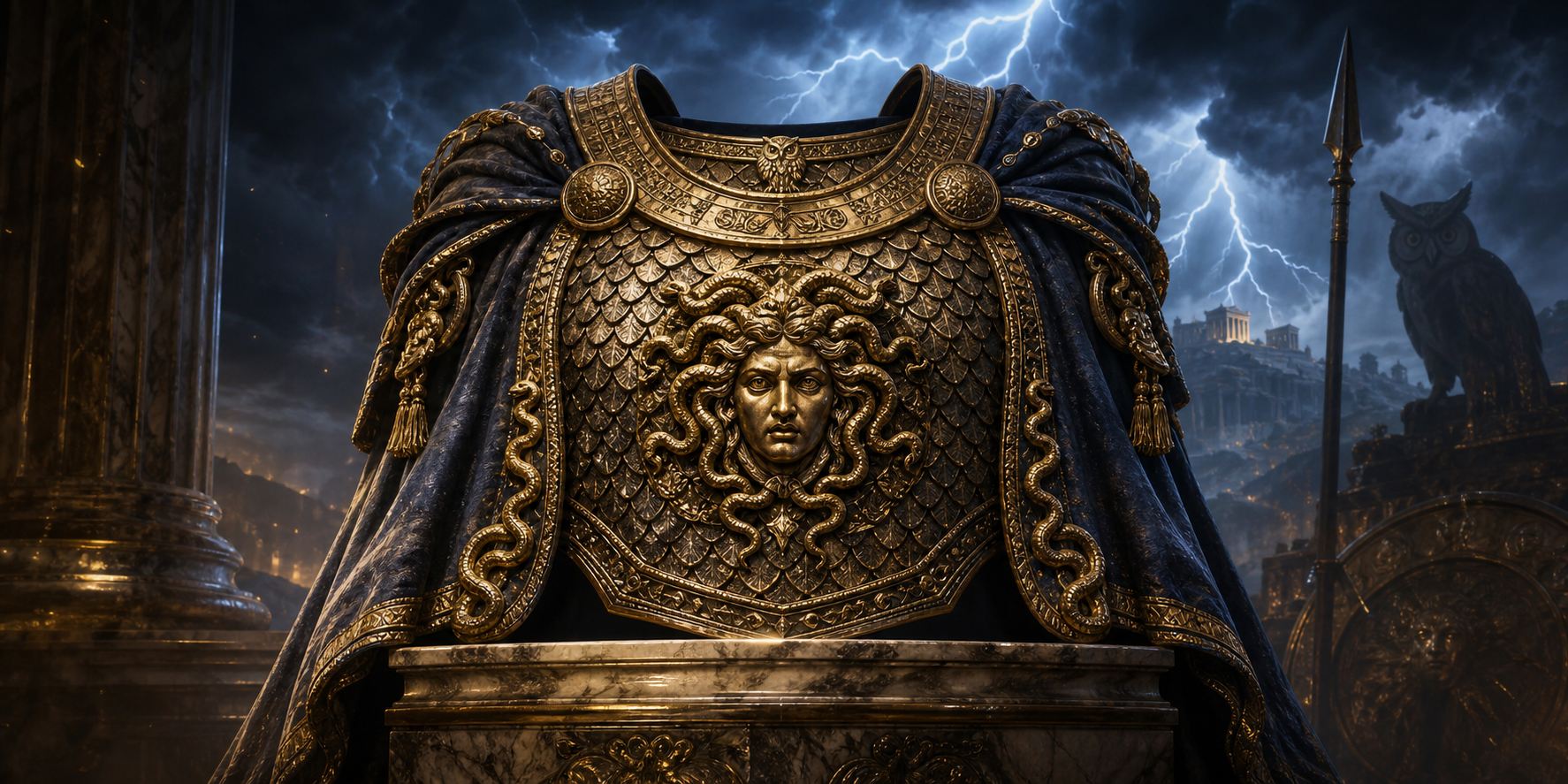
The Aegis is not simply Athena’s shield. Ancient poetry and art present it as a divine mantle, breast covering, or shield-like protection associated with Zeus and most famously borne by Athena. Often centered on the Gorgoneion, it protects its bearer by projecting sacred terror toward enemies.
The Aegis does not wait passively for a blow. When it enters battle, armies recoil before the weapon beneath the weapon: the sight of divine protection made terrifying. Across poetry and art it may hang like a mantle, cover the breast, or take on the shape of a shield, but its meaning remains larger than any single object.
More Than a Shield
Modern summaries often call the Aegis Athena’s shield. That description is useful only if treated as one form among several. Greek poetry can present it as a tasselled protective object worn or carried, while ancient artists render it as a goatskin mantle, a scaled breast covering, or a shield-like piece of armor. The word’s history and exact material remain debated.
If the Aegis changes shape, what makes it the same sacred object? Its identity lies in function and presence: it marks divine authority, offers overwhelming protection, and sends terror through those who face it.
Zeus, Athena, and Apollo
The Aegis belongs first to the power of Zeus in many poetic formulas; he is the aegis-bearing god. Yet Athena is its most famous visible bearer. In the Iliad, she puts on Zeus’s tasselled Aegis before entering battle. Elsewhere Zeus orders Apollo to take it and shake it before the Achaeans, breaking their courage.
This shared use resists a simple answer to the question who owns the Aegis? Zeus can be understood as the source of its sovereign authority, while Athena embodies and deploys it as a warrior goddess. Apollo’s temporary use shows that it can also act as a delegated instrument of Zeus’s will.
Protection That Creates Terror
The Aegis protects not by hiding its bearer but by making divine power impossible to ignore. Homer associates Athena’s Aegis with Fear, Strife, Valor, and Pursuit. When Apollo shakes it, the sight contributes to panic. Defense and intimidation are therefore not opposites; the enemy’s terror becomes part of the protection it gives.
This double action explains why the object matters beyond equipment. A mortal shield blocks an attack. The Aegis can change the emotional field before the attack lands. It announces that the bearer stands within the authority of Olympus.
The Gorgoneion
In art, the face of the Gorgon often occupies the center of the Aegis. This emblem, called the Gorgoneion, is apotropaic: its frightening appearance wards off danger. The association with Medusa deepens the object’s union of protection and fear. A threatening image is turned outward so that terror defends the one who bears it.
Traditions differ on how Medusa’s head came to Athena and how it was fixed to her equipment. Those stories should be followed through Medusa and the Gorgoneion rather than collapsed into a single universal account. The important continuity is visual and ritual: the dangerous gaze becomes a guardian sign.
Goatskin, Breastplate, or Crafted Armor
Some ancient and later explanations connect the Aegis with a goat skin. Artists also adapt it to the changing forms of armor, placing scaled or serpent-edged protection across Athena’s chest. Still other representations make it resemble a conventional shield. No one reconstruction can claim every tradition.
Hephaestus is a natural path for readers interested in divine craftsmanship, but ancient sources do not consistently name him as the maker of every Aegis. A careful profile can list the creator as varying by tradition and keep the question open. The uncertainty is not a flaw; it reveals how sacred objects accumulate meanings across centuries.
Aegis and the Gigantomachy
In the Gigantomachy, Athena’s martial identity reaches monumental scale. Ancient images of the battle repeatedly show gods confronting earth-born Giants, and Athena’s equipment helps distinguish her as a defender of Olympian order. The Aegis and Gorgoneion make protection visible even amid a crowded divine war.
The event also clarifies why the Aegis belongs beside the Thunderbolt in the Project Mythos network. Zeus’s weapon strikes; Athena’s emblem protects, commands, and terrifies. Both translate Olympian authority into an image that later artists could recognize instantly.
From Battlefield to Civic Emblem
Athena’s Aegis did not remain confined to stories of cosmic combat. In Greek art and civic imagery, it could signal the goddess’s protection over a community. The Gorgoneion appeared on armor, architecture, vessels, and other objects where its warding force mattered.
Why place a frightening face on something meant to protect? The answer lies in direction. Fear shown inward would threaten the wearer; fear displayed outward confronts hostile forces. The Aegis turns danger into a boundary.
Reading a Shape-Shifting Relic
The most responsible way to read the Aegis is to resist forcing every poem and image into one blueprint. It is associated with Zeus, embodied by Athena, temporarily wielded by Apollo, and represented as several kinds of protective equipment. Its center may bear the Gorgon’s face, while its edges may carry tassels, scales, or serpentine forms.
What persists is a divine logic: true protection does not always look gentle. Follow the Aegis toward Athena, Medusa, the Gigantomachy, and Mount Olympus, and an object that first appears to be armor becomes a map of authority, fear, and sacred guardianship.
The Aegis as an Image That Acts
Ancient viewers did not need every Aegis to share the same construction before recognizing its force. Scale patterns, tassels, serpents, and the Gorgoneion could announce Athena even when the object merged with her clothing. The emblem worked through recognition: to see it was to understand that ordinary combat had entered a divine register.
This visual power helps explain its long life in art. A crafted object can break, but an image can be repeated on pottery, sculpture, architecture, and armor. The Aegis survives as both thing and sign, carrying the memory of protection into places where the original divine equipment could never literally stand.
Trivia
- Homer repeatedly calls Zeus the aegis-bearer even though Athena is the object’s most familiar visual bearer.
- Apollo uses the Aegis under Zeus’s command in the Iliad to terrify opposing warriors.
- The Gorgoneion served as a protective emblem far beyond the Aegis, appearing throughout ancient Greek art.