The ten-year war that ended the rule of Cronus and established the Olympian order
- Cosmic Order
- Divine Weapons
- Olympians
- Tartarus
- Titans
- Cronus Rules
- Zeus Returns
- Divine Weapons
- Olympian Victory
- Titans Imprisoned
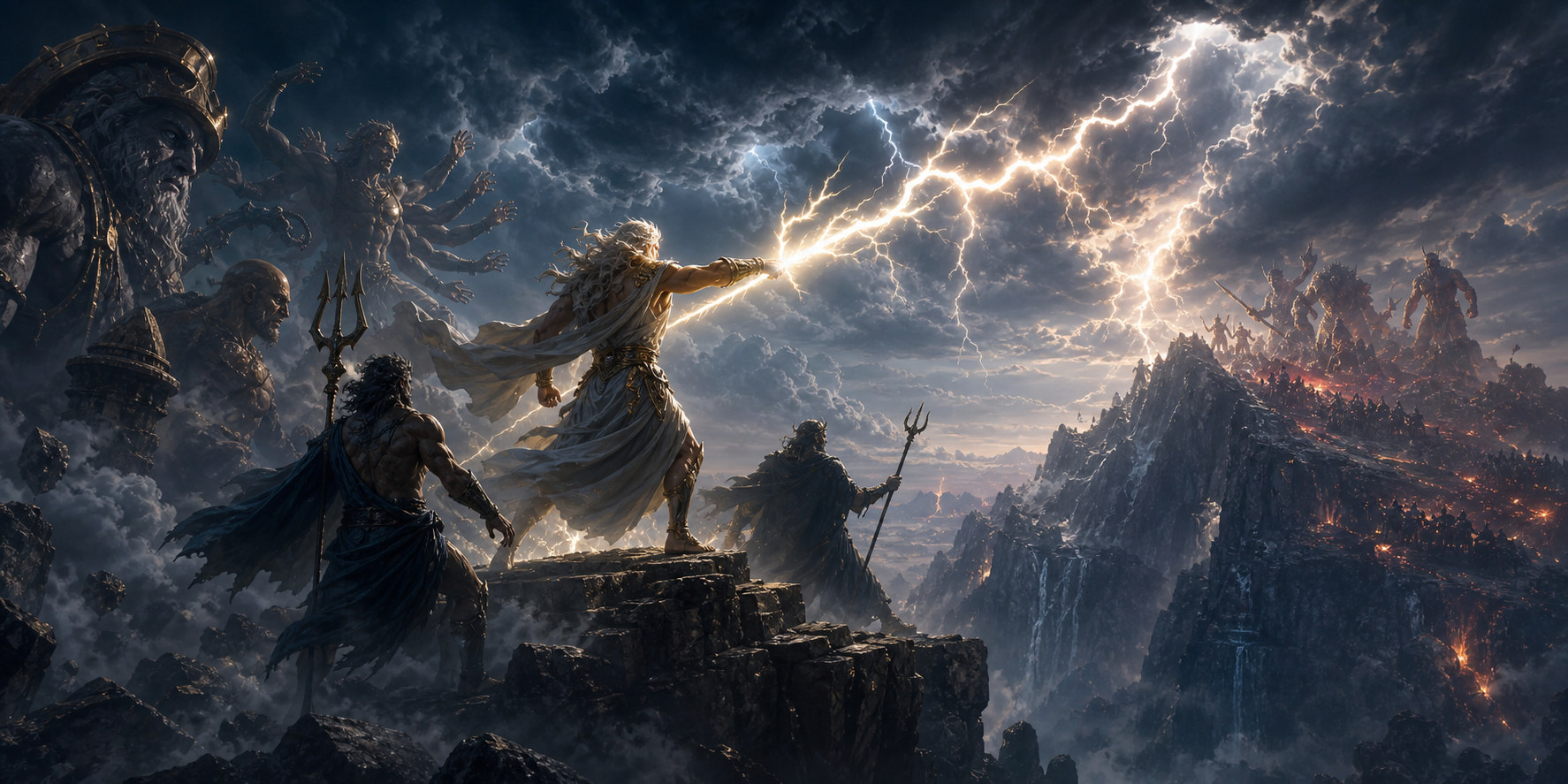
The Titanomachy was the ten-year war between the younger gods led by Zeus and the ruling Titans led by Cronus. The deadlock ended when Zeus freed the Cyclopes and Hundred-Handers, gained powerful allies and divine weapons, and built the coalition that established Olympian rule.
The War That Created the Olympian World
The Titanomachy was the great divine war between the younger gods led by Zeus and the older ruling generation associated with Cronus. It was not merely a battle for a throne. The conflict explains why Zeus rules the sky, why Poseidon carries the trident, why Hades possesses the helmet of invisibility, why defeated Titans are linked with Tartarus, and why Mount Olympus becomes the center of divine government.
The war belongs to a repeating succession story. Uranus feared his children and forced dangerous powers beneath the earth. Cronus overthrew Uranus, then repeated the same fear by swallowing his own children. Zeus escaped that cycle long enough to challenge it—but his victory depended on a choice neither earlier ruler had made: he released prisoners and turned them into allies.
Why Cronus Feared His Children
Cronus had gained power by attacking his father Uranus with the adamantine sickle given to him by Gaia. Yet prophecy warned that one of Cronus’s own children would overthrow him. He therefore swallowed Hestia, Demeter, Hera, Hades, and Poseidon as soon as they were born.
Rhea saved the youngest child, Zeus, by hiding him and giving Cronus a stone wrapped like an infant. When Zeus reached adulthood, Cronus was forced to release the swallowed gods. The family Cronus had tried to erase became the core of the coalition that would end his reign.
Two Divine Strongholds
Tradition places the younger gods on Mount Olympus and the Titans on Mount Othrys. Between them stretched a battlefield imagined on a cosmic scale. Hesiod describes earth, sea, and sky resounding under the violence of the struggle. The war was said to last ten years, and for much of that time neither side could secure victory.
The stalemate matters because Zeus did not win simply by being stronger than Cronus. Divine power was already divided across generations. The decisive question was who could gather it into an alliance.
The Prisoners Beneath the Earth
Gaia advised Zeus that victory would come only if he freed the beings imprisoned in Tartarus. These included the Cyclopes and the Hundred-Handers. Earlier rulers had treated them as threats too dangerous to exist freely. Zeus treated them as potential allies.
The Cyclopes rewarded their release by arming the three brothers. Zeus received thunder, lightning, and the Thunderbolt. Poseidon received the Trident. Hades received the Helmet of Invisibility. The gifts were not interchangeable. Each anticipated the realm and identity of its bearer: sky and judgment for Zeus, sea and earth-shaking force for Poseidon, concealment and the unseen world for Hades.
The Hundred-Handers Break the Deadlock
The Hundred-Handers—Cottus, Briareus, and Gyges—brought overwhelming force to the battlefield. Each was imagined with one hundred arms and fifty heads. As Zeus hurled celestial fire, they cast enormous volleys of stones against the Titans.
This is the true turning point of the war. The Thunderbolt is visually spectacular, but Zeus’s victory is collective. It depends on Gaia’s counsel, the craft of the Cyclopes, the strength of the Hundred-Handers, and the loyalty of his siblings. That raises the next question at the heart of Project Mythos: was Zeus destined to rule, or did he become king because he understood how to build a coalition?
The Defeat and Imprisonment of the Titans
The Olympian alliance prevailed. Many defeated Titans were cast into Tartarus, where the Hundred-Handers became their guards. Atlas received a separate punishment and was made to bear the sky. Ancient sources do not present every Titan as an identical enemy, however. Some figures of Titan ancestry stand apart from Cronus’s faction, and later traditions preserve divided loyalties rather than a single fixed roster.
The victory therefore ended the government of Cronus, not the existence of the Titan generation. Titans continued to appear in genealogies, local cults, and later myths.
How the Cosmos Was Divided
After victory, Zeus, Poseidon, and Hades cast lots for their major realms. Zeus received the sky, Poseidon the sea, and Hades the underworld. The earth and Olympus remained shared in important ways, while Zeus emerged as the presiding king of the gods.
This settlement transformed victory into order. Without it, the Titanomachy would be only another violent succession. With it, the war becomes the foundation of the familiar mythological world: gods with defined domains, a divine court on Olympus, and a network of honors and responsibilities centered on Zeus.
Why the Titanomachy Still Matters
The Titanomachy asks whether power can escape the pattern that created it. Uranus imprisoned his children. Cronus swallowed his heirs. Zeus won by releasing captives, sharing honors, and accepting help—yet later myths repeatedly test whether he will become another fearful ruler.
The event also opens several paths of discovery. Why were the Cyclopes imprisoned in the first place? What made their weapons different from ordinary divine objects? Why did Mount Olympus become the seat of the new order rather than merely a battlefield fortress? Each answer leads deeper into the same connected mythic world.
Do Not Confuse It with the Gigantomachy
The Titanomachy and Gigantomachy are separate conflicts. The Titanomachy concerns the overthrow of Cronus and the transfer of rule from Titans to Olympians. The Gigantomachy is a later challenge by the Giants against the already established Olympian gods. Later art and modern retellings sometimes blend them, but their mythological functions are different.
Did You Know?
- The war was said to last ten years. The long stalemate emphasizes that the new divine order could not be created by Zeus alone.
- The three brothers received different divine weapons. The Thunderbolt, Trident, and Helmet of Invisibility anticipate the cosmic realms they later ruled.
- Not every Titan was treated as the same kind of enemy. Ancient traditions preserve exceptions, divided loyalties, and figures of Titan ancestry who remained active after the war.