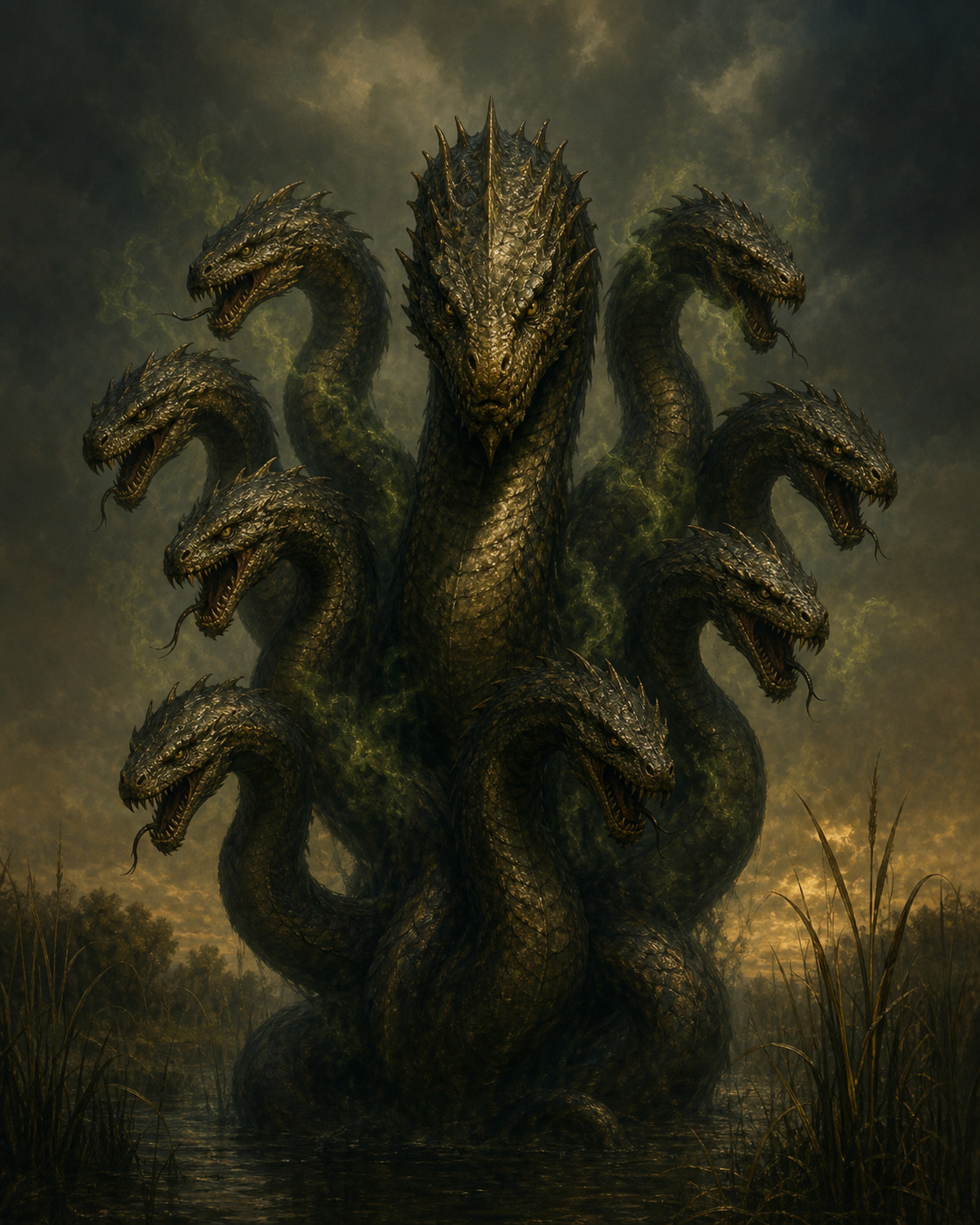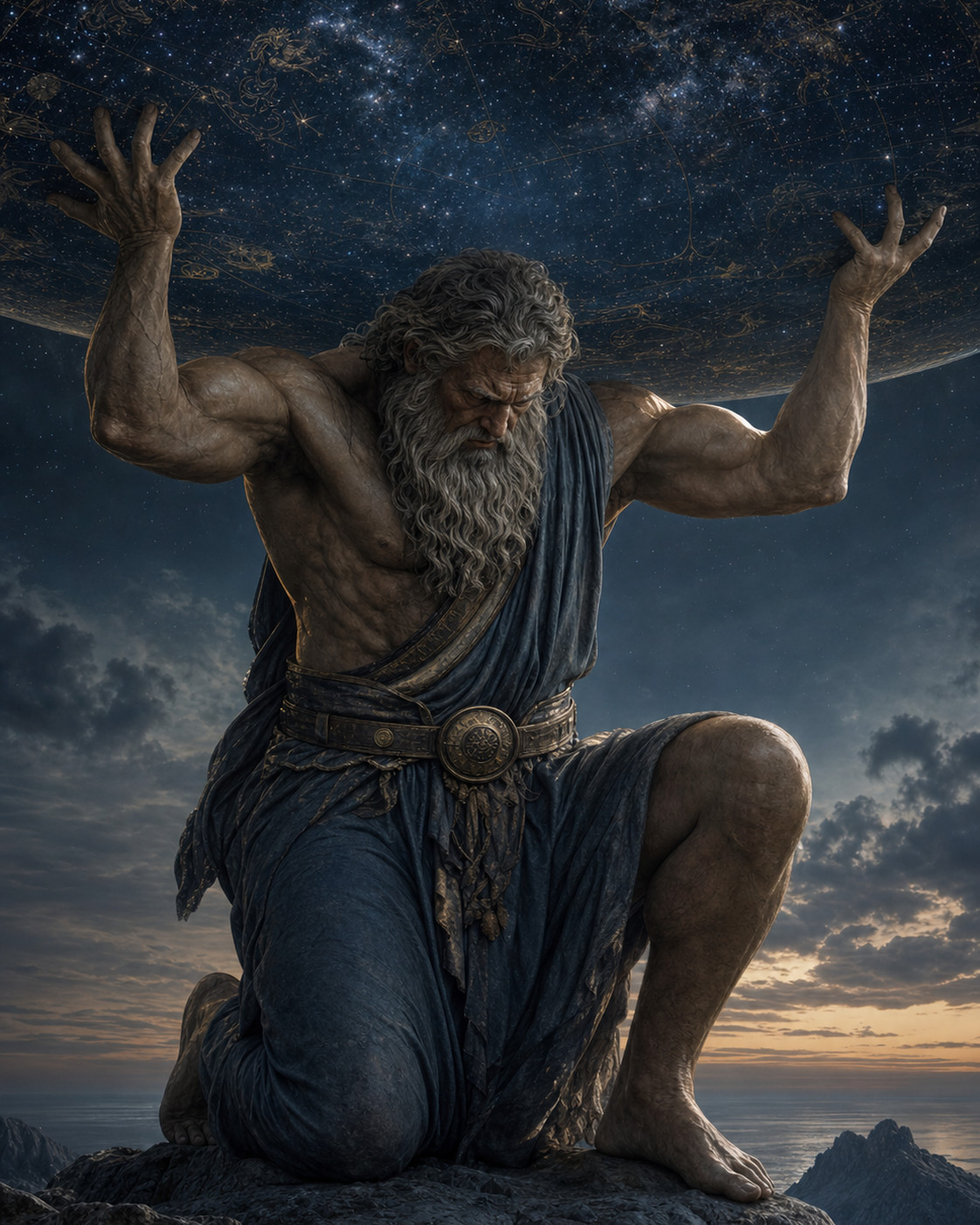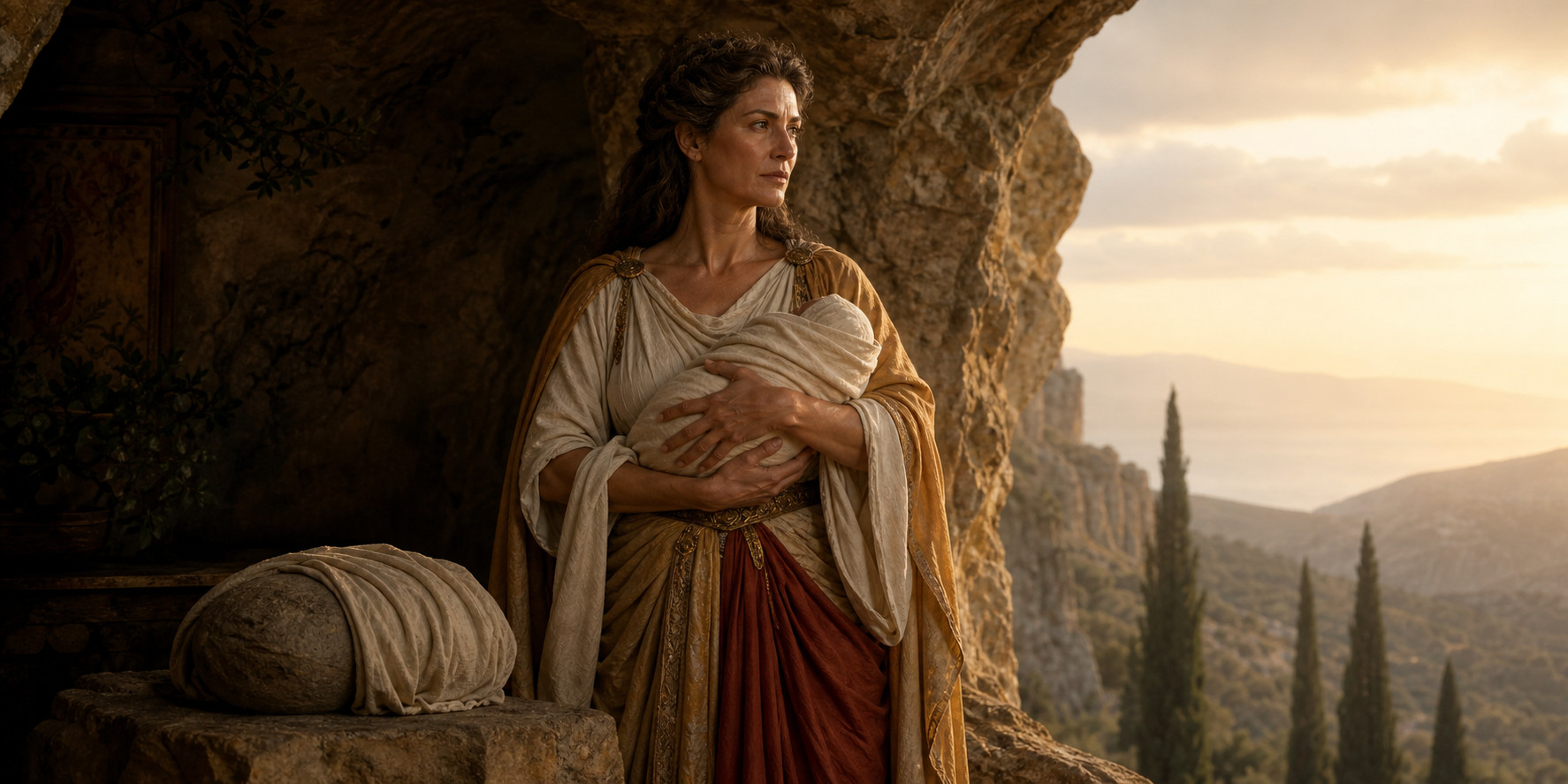
The mother whose hidden birth and wrapped stone give the swallowed generation a future.
- Crete
- Cronus
- Divine Succession
- Mother of the Olympians
- Wrapped Stone
- Zeus
- Primordial Age
- Titan Age
- Olympian Age
- Heroic Age
- Trojan Cycle
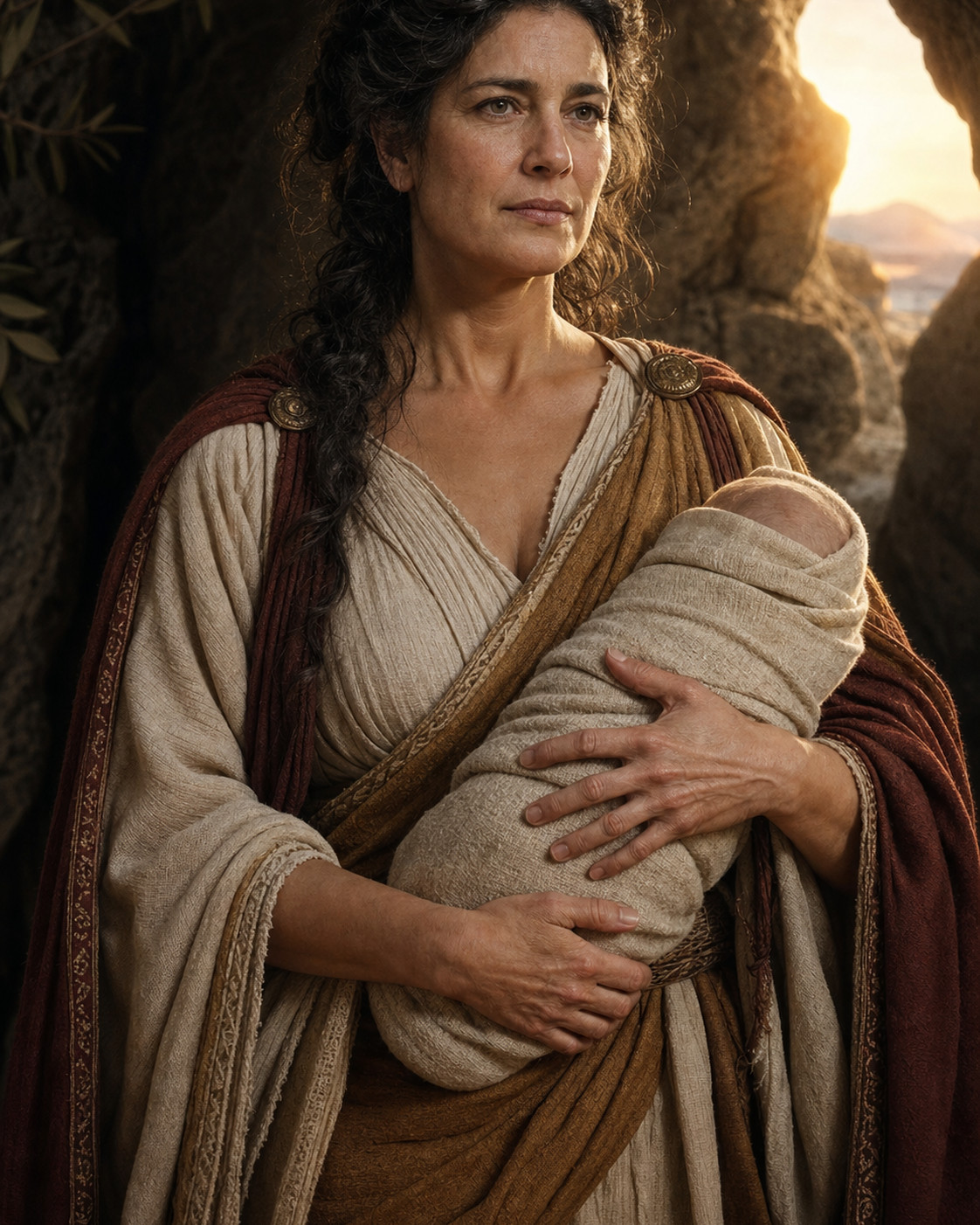
Rhea is the Titan mother of the major Olympian siblings. By hiding Zeus on Crete and giving Cronus a wrapped stone, she interrupts the cycle of swallowed heirs and makes the Olympian succession possible.
Rhea changes Greek myth through an act that looks small beside the wars it makes possible. She cannot openly defeat Cronus, who has swallowed each of their children to prevent a prophecy of succession. Instead, she hides the newborn Zeus, substitutes a stone wrapped like an infant, and gives the next generation time to survive. Her story is about motherhood, secrecy, inherited violence, and the first interruption of a ruler’s attempt to make change impossible.
Daughter of Earth and Sky
Hesiod names Rhea among the twelve Titans born from Gaia and Uranus. She belongs to the same divine generation as Oceanus, Hyperion, Themis, Mnemosyne, Iapetus, and Cronus. That genealogy places her before the Olympian order, but her importance is not limited to being an ancestor. Through her children, the older world carries its powers into the new one.
Rhea becomes the consort of Cronus after he overthrows Uranus. The union produces Hestia, Demeter, Hera, Hades, Poseidon, and Zeus. These children will later govern hearth, grain, marriage, the dead, the sea, and the sky. Before they become a pantheon, however, they are a threatened family trapped inside their father’s effort to stop succession.
Cronus Swallows the Children
Gaia and Uranus warn Cronus that one of his own sons will overthrow him. The prophecy repeats the pattern by which Cronus displaced Uranus, and the new ruler answers fear with containment. As each child reaches Rhea’s knees, Cronus swallows it. The act prevents the children from taking a place in the world while keeping them unnaturally alive within the body of power.
Hesiod describes unceasing grief seizing Rhea. She is not merely the passive mother listed between two reigns. The poem makes her suffering the emotional pressure that drives the succession story forward. Cronus treats birth as a political threat; Rhea responds by turning childbirth, concealment, and kinship into instruments against a ruler who controls open force.
The Hidden Birth of Zeus
When Zeus is about to be born, Rhea appeals to her parents, Gaia and Uranus, for a plan. They send her to Crete, where the infant is received and hidden in a remote cave. Ancient and later local traditions identify different Cretan mountains, caves, nurses, and guardians. The shared core is that Zeus survives outside his father’s sight because a network of older powers shelters him.
Stories of the Curetes clashing weapons to conceal the infant’s cries, the goat Amalthea nursing him, or nymphs tending him develop the hidden childhood in different ways. They should not be forced into one exact nursery scene. Each version explains how a vulnerable future ruler can grow beyond Cronus’s surveillance until concealment can become resistance.
The Stone in Swaddling Clothes
Rhea gives Cronus a large stone wrapped in swaddling cloth. He swallows it without recognizing the substitution. The deception is powerful because it uses the ruler’s own habit against him: Cronus is so committed to consuming each newborn that he no longer looks closely at what he takes. The wrapped stone becomes a compact symbol of fear made blind by repetition.
Later tradition connected the stone with Delphi, where it could be shown, anointed, or explained as the object Cronus had swallowed. Mythic narrative and sacred landscape therefore meet in a physical reminder of the trick. Whether encountered in poetry or cult explanation, the stone marks the moment when appearance protects life and power accepts a false victory.
Release and the Titanomachy
After Zeus matures, Cronus disgorges the swallowed children, though sources differ about the mechanism and the helper who provides it. Rhea’s deception has preserved the one child able to return for the others. The rescue then expands into the Titanomachy, in which Zeus and his siblings challenge the older divine regime and gain the aid of the Cyclopes and Hundred-Handers.
Rhea does not become a battlefield commander in the standard account. Her action belongs earlier in the chain of cause. Without concealment there is no returning son, no release, and no coalition of Olympians. Project Mythos therefore treats her connection to the war as foundational rather than martial: she creates the future from which resistance becomes possible.
Mother of Opposing Generations
Rhea is both a Titan and the mother of the Olympians. That position complicates any simple division between an evil older generation and a good younger one. The Olympian order emerges through members and resources of the Titan family itself: Rhea protects Zeus, Gaia gives counsel, Themis later stands within Olympian society, and other Titans follow different paths.
Her children also do not form a permanently harmonious household. Zeus rules, Hera contests his relationships, Poseidon and Hades hold their own realms, and Demeter’s grief can threaten the human world. Rhea’s motherhood guarantees survival, not moral perfection. What she preserves is the possibility of a new order, with all the conflicts that order will contain.
Rhea, Cybele, and the Mother of the Gods
In Greek and Roman religious history, Rhea was increasingly associated with the Anatolian Mother of the Gods, commonly called Cybele. Poetry and art could share mountain settings, drums, attendants, and lions. The identification became influential, but it should not erase the different origins and cult histories that met within it.
Roman authors sometimes connect Rhea with Ops or with the Great Mother under other names. These associations explain why later images may look different from the quiet strategist of Hesiod’s succession myth. One figure can carry genealogical, local, and imported religious meanings without every symbol belonging to the earliest narrative.
What Rhea Means
Rhea’s power lies in refusing the ruler’s claim that the future can be swallowed. She cannot guarantee what Zeus will become, yet she acts before certainty is available. Her courage is practical: seek counsel, move the child, prepare a substitute, and allow time to do what direct confrontation cannot. The myth makes preservation the first stage of revolution.
The deception also breaks a family pattern without fully ending it. Uranus imprisons children, Cronus swallows children, and Zeus later fears challenges to his own rule. Rhea’s intervention shows that succession myths are not only contests between fathers and sons. Mothers, hidden places, objects, and alliances determine whether a threatened generation reaches the moment when it can act.
Where the Story Leads
Follow Cronus to the prophecy that turns rule into panic, Zeus to the hidden child who becomes king, and Gaia to the older intelligence guiding both rebellion and renewal. Demeter, Hera, Poseidon, Hades, and Hestia reveal the children preserved inside Cronus before their domains reorganize the cosmos.
The Titans and Mount Othrys open the world of the older regime, while the Titanomachy shows the military consequence of Rhea’s earlier choice. Crete, the Curetes, Amalthea, and Delphi remain valuable future paths. Each asks a different question: who shelters power before it is strong, and how does a secret become a new public order?
Trivia
- Rhea is a Titan and also the mother of the major Olympian siblings.
- Ancient traditions disagree about the exact Cretan place and guardians of the infant Zeus.
- The wrapped stone later acquired an important connection with Delphi.