The lawful but fearful king whose commands turned punishment into twelve Labors.
- Hera
- Heracles
- Kingship
- Mycenae
- Twelve Labors
- Primordial Age
- Titan Age
- Olympian Age
- Heroic Age
- Trojan Cycle
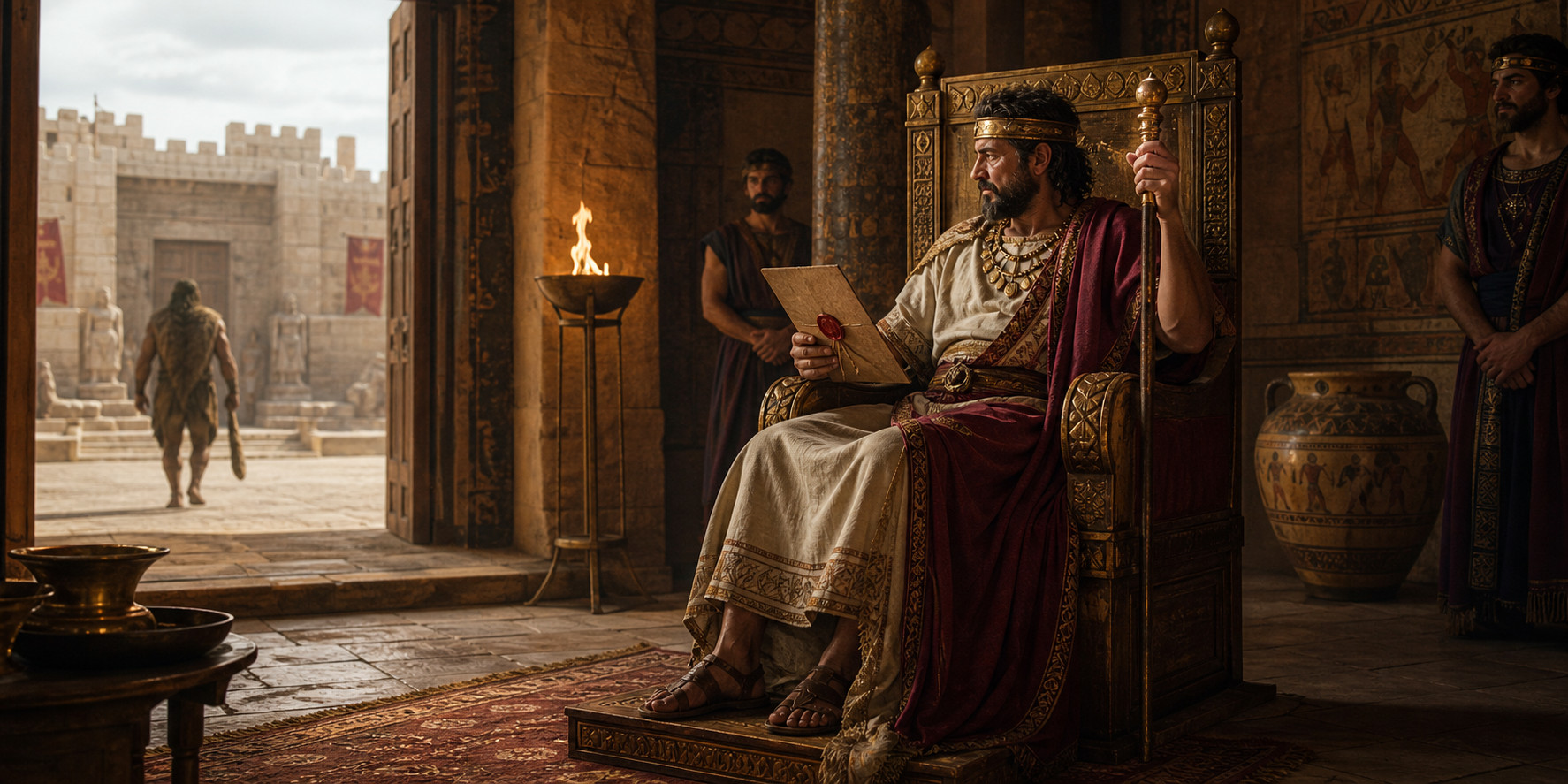
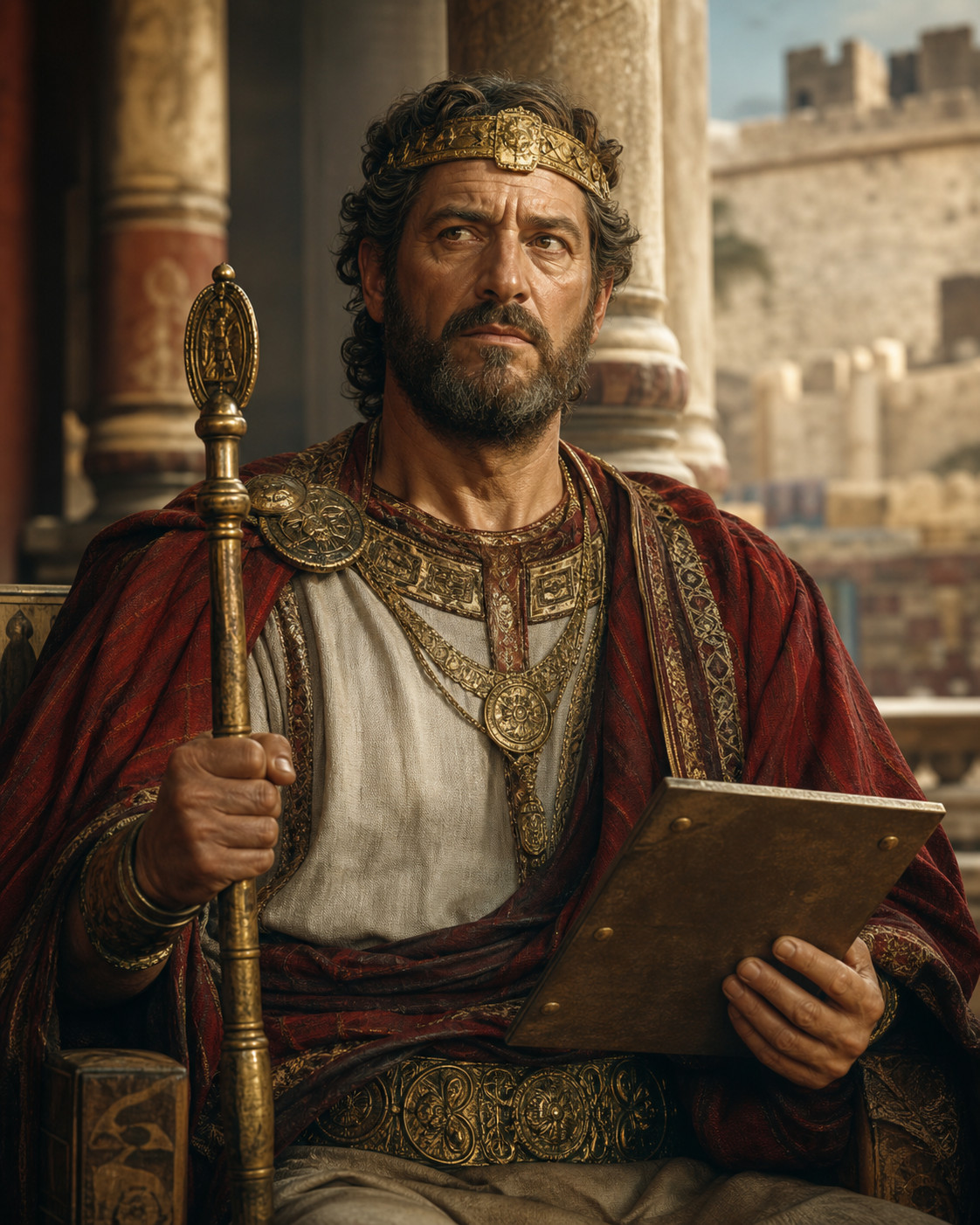
Eurystheus is the Perseid king whose birth Hera hastens so that he rules before Heracles. He assigns the Labors, rejects two tasks, and makes the cycle twelve. Ancient art often shows him hiding in a storage jar, but his authority supplies the rules that structure Heracles's fame.
Eurystheus is remembered as the king who sends Heracles into danger, but his role is more important than a list of commands. A divine maneuver makes him ruler before the stronger hero can be born; royal authority then forces extraordinary power into service. Through Eurystheus, Greek myth asks whether holding a throne and deserving heroic honor are the same thing.
A Kingship Won Before Birth
Both Eurystheus and Heracles descend from Perseus. In the Iliad, Zeus boasts that a descendant of Perseus about to be born will rule the surrounding people. Hera makes him swear to the declaration, then delays Alcmene’s labor and hastens the birth of Eurystheus. The weaker child arrives first and receives the kingship intended by Zeus’s boast. Zeus cannot undo his oath.
This episode places Eurystheus inside the conflict between Zeus and Hera before either man can act. He is not a usurper who personally steals a crown; he benefits from divine timing and an incautious promise. Heracles is born with unmatched strength but under the authority of a relative whose status rests on precedence. The contrast between capacity and office will organize the Labors.
Why Heracles Must Serve
Sources give different sequences for the catastrophe, purification, oracle, and period of service that bind Heracles to Eurystheus. In the familiar account summarized by Apollodorus, madness associated with Hera leads Heracles to kill his children. After purification he consults Delphi and is ordered to live at Tiryns while completing tasks set by Eurystheus. The service is punishment, cleansing, and a route toward immortal fame, but it remains humiliating because the commanding king appears less courageous than the commanded hero.
Eurystheus begins with ten tasks. He rejects the Hydra because Iolaus helped cauterize its multiplying necks, and he rejects the Augean Stables because Heracles sought or received payment. Two additional commands produce the canonical twelve. This accounting makes Eurystheus more than a messenger. He interprets the rules, decides what counts, and turns a finite obligation into the cycle remembered across the mythic world.
The King Behind the Commands
The Labors expand from nearby threats to the edges of geography and death: the Nemean Lion, Hydra, hind, boar, stables, birds, bull, mares, Amazon queen’s belt, cattle of Geryon, apples of the Hesperides, and Cerberus. Eurystheus rarely shares the danger. His power lies in directing it. Each command converts Heracles’s violent capacity into a public action that removes monsters, crosses borders, negotiates with rulers, or brings back proof.
Comic fear is part of Eurystheus’s ancient image. When Heracles brings the Erymanthian Boar, vase painters show the king hiding in a great storage jar while the hero presents the living animal. Literary traditions also have him recoil from the Nemean Lion’s skin or command that trophies be displayed outside the gates. These scenes make excellent comedy, but they also visualize an unstable political relationship: the ruler must verify achievements whose performer can physically overwhelm him.
Hera’s Instrument, Not Her Equal
Eurystheus benefits from Hera’s hostility toward Zeus’s son, yet he is not a god and does not control the full divine plan. He occupies a position created by Hera’s intervention and protected by legitimate kingship. That makes him useful to the goddess without making him her partner. Athena, Hermes, and other helpers repeatedly enable Heracles to satisfy commands that mortal administration alone could never manage.
The king’s caution can therefore be read on several levels. It is a comic foil for heroic courage, a realistic fear of creatures brought to his doorway, and a sign that institutional authority depends on the very force it tries to regulate. Eurystheus can order the descent for Cerberus, but he cannot cross the Underworld boundary himself.
After Heracles
Eurystheus’s hostility continues after the Labors and after Heracles’s death. In traditions dramatized by Euripides’ Children of Heracles, he persecutes the hero’s descendants, who seek refuge near Athens. The conflict becomes a story about asylum, civic courage, and the inheritance of hatred. Eurystheus leads an attack and is defeated. Accounts differ over who kills him and how his body or head is treated.
Euripides gives him a striking final function: once buried in Attic ground, he will become a protective presence against future enemies from the Peloponnese. A former persecutor can thus become, through death and local cult logic, a guardian for the community that resisted him. The reversal is characteristic of Greek heroic tradition, where the dangerous dead may protect the land that properly receives them.
Mycenae, Tiryns, and Dynasty
Eurystheus is associated with Mycenae and Tiryns, although ancient authors arrange Perseid territories and successions differently. His family connection to Perseus matters more than a single modern political map. Heracles and Eurystheus are not unrelated opposites; they are rival outcomes within one dynasty. Their relationship exposes how inherited legitimacy, divine interference, and personal excellence can pull in different directions.
After Eurystheus, the Perseid hold on Mycenaean kingship gives way to the line associated with Atreus in major traditions. This transition connects the Labors backward to Perseus and forward toward the royal house behind the Trojan War. Eurystheus stands at a junction between two huge heroic networks even though he is rarely treated as their most glamorous figure.
What Eurystheus Means
Reducing Eurystheus to a coward misses the structural work he performs. He is the lawful inferior: less powerful than Heracles, yet able to command him. The mismatch creates comedy, resentment, and the framework that turns disconnected feats into a coherent cycle. His rejected tasks also raise a recurring question about heroic credit. Does assistance diminish achievement? Does payment corrupt service? Who has the authority to decide?
Heracles gains the lasting fame, but Eurystheus supplies the imposed limits against which that fame is measured. A hero who simply chooses every victory would tell a different story. Service makes strength answer to rules, humiliation, repetition, and proof. The king’s fear and strict accounting become part of the machinery of apotheosis.
Where the Story Leads
Follow Heracles for the suffering and achievement inside the service, Hera for the divine timing behind Eurystheus’s throne, and the Twelve Labors for the full command cycle. Perseus reveals their shared dynasty; Cerberus and the Underworld show the final boundary the king orders another man to cross.
Trivia
- Eurystheus and Heracles are both descendants of Perseus.
- Hera secures Eurystheus’s kingship by changing the order of two births.
- His hiding in a great jar became a popular scene in ancient vase painting.