The imprisoned smiths whose freedom armed the Olympian gods.
- Divine Craft
- Liberation
- One-Eyed
- Primordial
- Thunder
- Primordial Age
- Titan Age
- Olympian Age
- Heroic Age
- Trojan Cycle
The Hesiodic Cyclopes—Brontes, Steropes, and Arges—were primordial one-eyed divine smiths imprisoned by Uranus and again by Cronus. Freed by Zeus during the Titanomachy, they forged the Thunderbolt, Trident, and Helmet of Invisibility. Their story must be distinguished from the wild shepherd Cyclopes encountered by Odysseus.
The Cyclopes enter the struggle for the cosmos from below it. Before Zeus possessed lightning, before Poseidon shook the sea, and before Hades could move unseen, three one-eyed brothers waited in a prison their own family had made. Their freedom would not simply add three fighters to an army. It would give the younger gods the weapons by which a new divine order could become possible.
Children Feared by the Sky
In Hesiod’s Theogony, the divine smiths are Brontes, Steropes, and Arges, children of Gaia and Uranus. Each has a single eye set in the middle of the forehead, and their names evoke thunder, lightning, and brightness. They are not introduced as wandering beasts. They belong to the first dangerous generation of divine children, beings whose strength and unusual form make Uranus fear what he has fathered.
Uranus hides them deep within Gaia. This first imprisonment creates a question that follows their story: was their appearance truly the danger, or was it the power their father could not control? Gaia suffers under the burden, and the conflict within the first divine household helps set the succession myth in motion.
Cronus Repeats the Prison
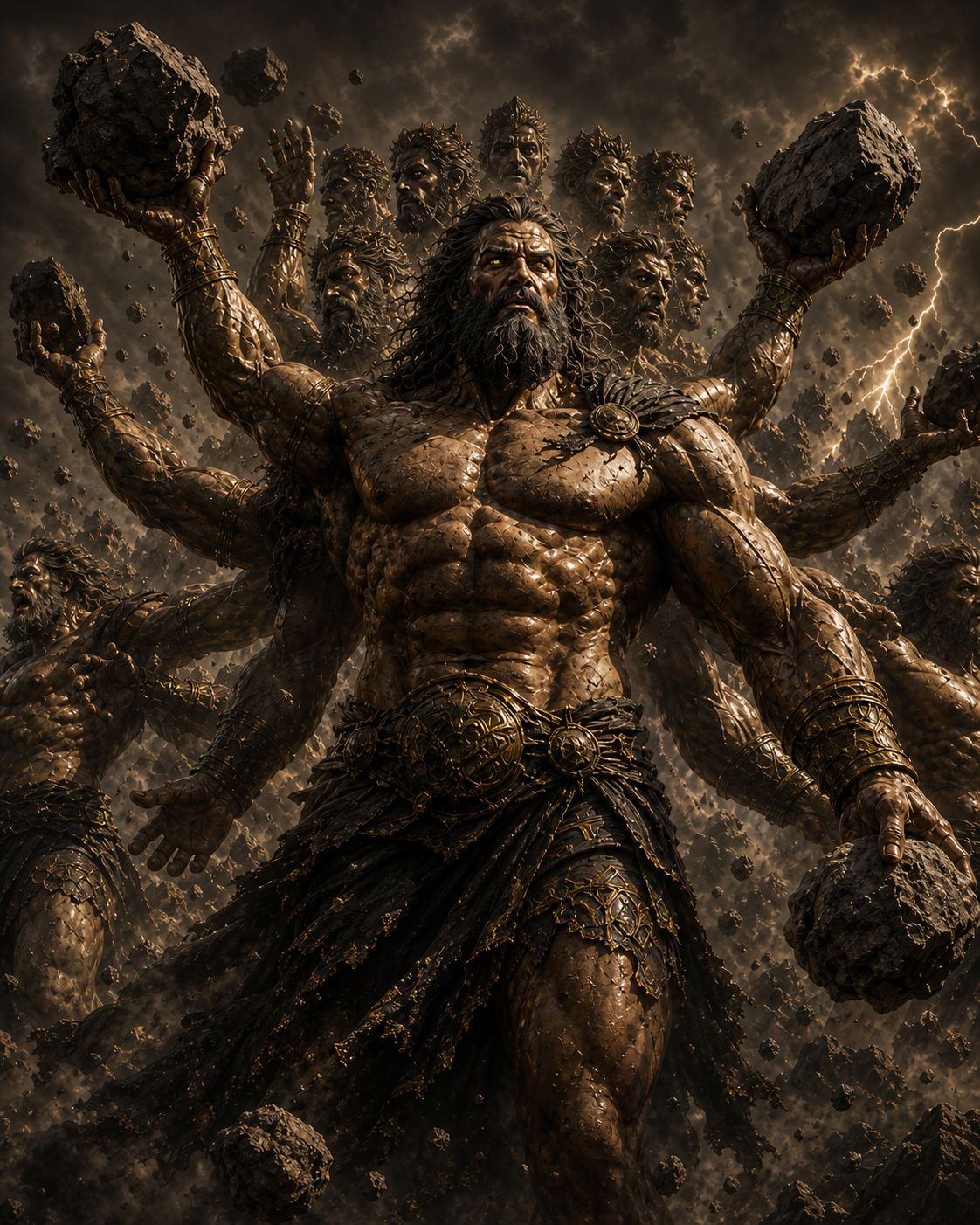
Cronus overthrows Uranus with Gaia’s help, but freedom does not last for every captive. Ancient mythographic tradition tells that Cronus confines the Cyclopes again, along with the Hundred-Handers, in Tartarus. The son who rebelled against a fearful father becomes another ruler unwilling to trust powers outside his command.
This repetition matters. It prevents the rise of Zeus from becoming a simple story of young gods defeating old gods. Cronus has inherited the logic of confinement. Why did he not recognize the imprisoned brothers as natural allies? The myth offers no private explanation, but the pattern suggests that control, once secured, can make a rebel resemble the ruler he replaced.
Zeus Opens Tartarus
When war between the Titans and the children of Cronus reaches a deadlock, Zeus takes a different risk. On Gaia’s counsel, he releases the Cyclopes and the Hundred-Handers. Liberation is therefore both an ethical reversal and a strategy. Zeus wins trust where Uranus and Cronus relied on chains.
The choice raises the most important discovery hook in their story: why were the Cyclopes willing to arm Zeus? Ancient accounts emphasize gratitude for release. Yet the alliance also joins complementary powers. Zeus can lead and strike, but the smiths understand how primordial force can be shaped into an instrument.
The Three Gifts
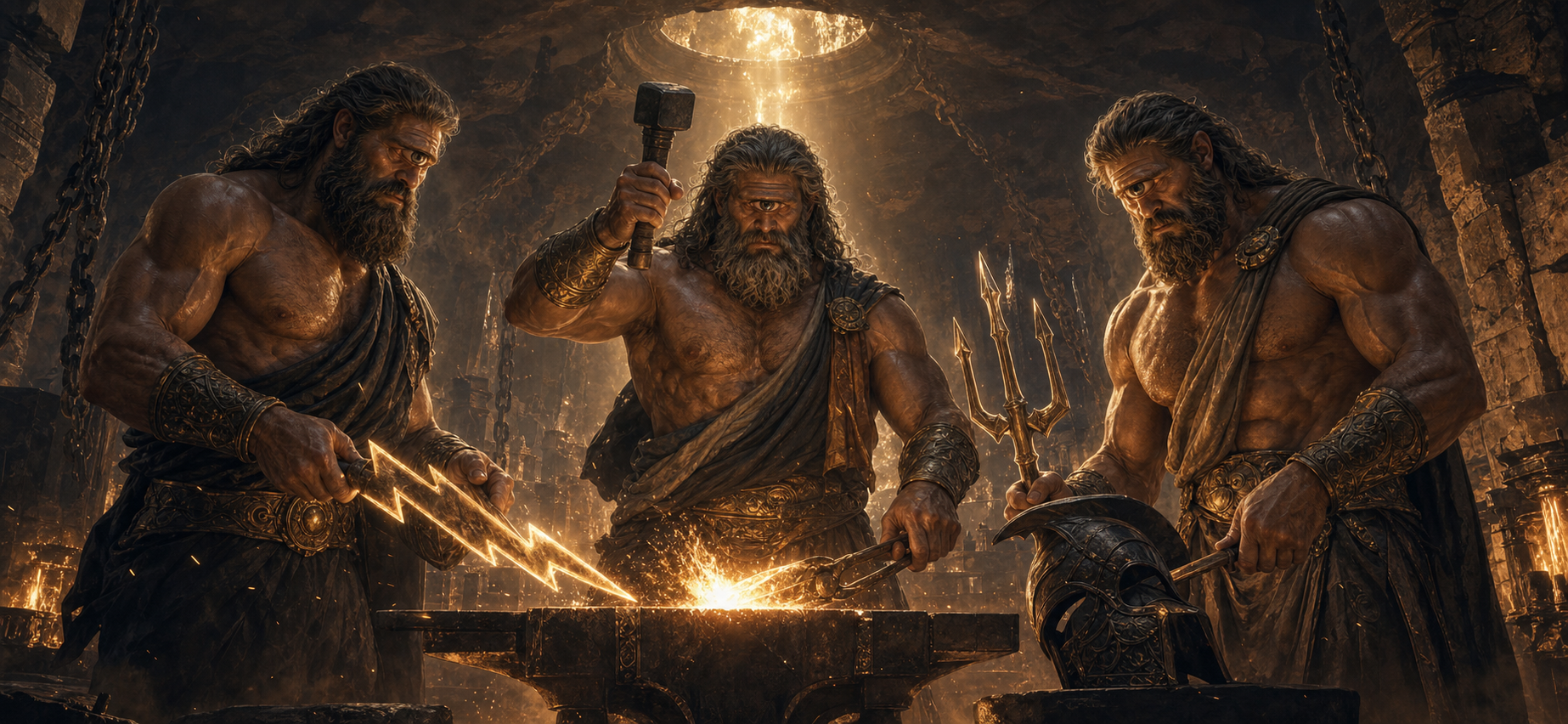
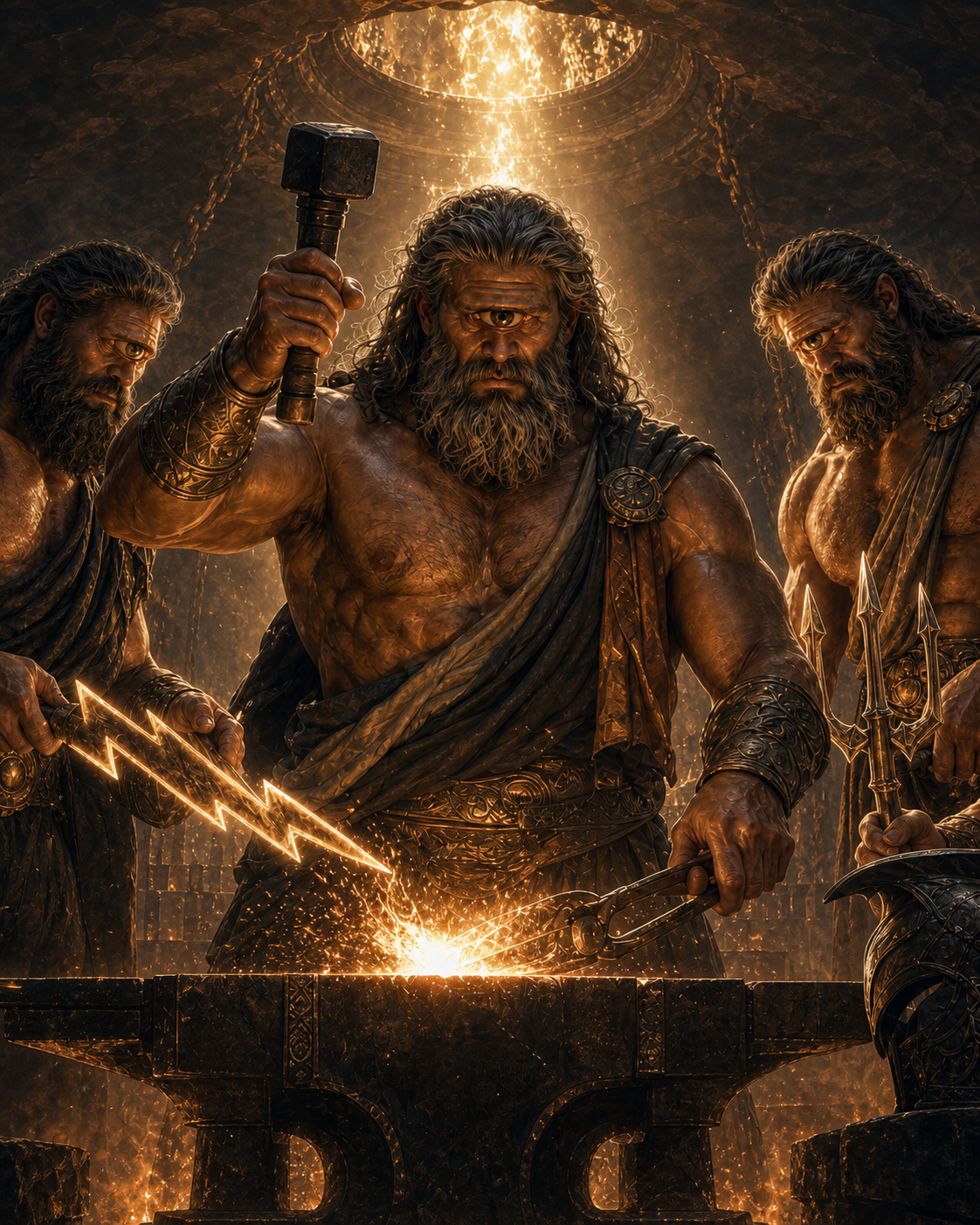
The Cyclopes give Zeus thunder and the thunderbolt, Poseidon the trident, and Hades the helmet that grants invisibility. These are not interchangeable prizes. Each weapon clarifies the god who receives it: the sky ruler commands the storm, the sea god bears a weapon that can churn or split, and the lord of the dead moves beyond ordinary sight.
Their workmanship changes the Titanomachy because it converts raw cosmic power into directed action. Lightning existed as a phenomenon before Zeus held it as authority. The Cyclopes make power usable, memorable, and personal. Follow the Thunderbolt, Trident, and Helmet of Invisibility and the war can be read through three crafted solutions rather than through strength alone.
Why Divine Smiths Matter
Hesiod says that the Cyclopes taught Zeus thunder and made the thunderbolt. Their craft is therefore closer to sacred knowledge than to ordinary metalwork. Later traditions connect Cyclopes with enormous building works and with divine workshops, including stories associated with Hephaestus. These later images should not be folded carelessly into the earliest account, but they preserve the same intuition: some creations exceed mortal scale because their makers stand near the foundations of the world.
Their single eye also became a powerful visual signature. Ancient texts do not explain it as a technical tool, and modern interpretations should not be presented as fact. It can nevertheless guide the reader toward a theme of concentrated sight: three beings ignored as monstrous become the ones who see how the gods can win.
Not Every Cyclops Is the Same
Greek tradition contains more than one Cyclopean family. The divine smiths of Hesiod are not the same narrative group as the wild pastoral Cyclopes encountered by Odysseus in Homer’s Odyssey. Polyphemus and his neighbors live without assemblies or shared law, tending flocks in isolated households. They do not forge the Olympian weapons.
Later literature and art sometimes bring Cyclopean traditions closer together, but a clear reading begins by keeping them distinct. One lineage belongs to divine succession and sacred craft; another belongs to the dangerous edge of the human voyage. The shared eye does not erase the difference in ancestry, setting, or role.
After the Titanomachy
Once Zeus and his allies win, the weapons remain far more visible than their makers. That imbalance is part of the Cyclopes’ fascination. Every flash of Zeus’s thunderbolt recalls an act of liberation and craft, even when the smiths themselves are outside the scene. Their legacy is embedded in the equipment of sovereignty.
Some later traditions tell of the Cyclopes’ deaths, especially in stories involving Apollo and the thunderbolt that killed Asclepius. Those accounts belong to a later and variable layer of myth. The primary succession story ends more cleanly: prisoners become artisans of victory, and the gods who free them inherit a world their gifts helped shape.
Craft as a Form of Alliance
The exchange between Zeus and the Cyclopes is one of Greek myth’s clearest demonstrations that making can be as decisive as fighting. Zeus does not take their knowledge by force. The smiths respond to liberation with gifts, and those gifts remain bound to the identities of the recipients. Their alliance is expressed through objects that will continue to act long after the first battle ends.
This pattern invites a final question: did Zeus win because he was strongest, or because he recognized powers that earlier rulers had excluded? The story never requires one answer. Leadership, gratitude, craft, and force operate together. That is why the Cyclopes belong beside the gods they armed, not in a footnote beneath the Thunderbolt. Their freedom is part of the weapon’s meaning.
Trivia
- The names Brontes, Steropes, and Arges are associated with thunder, lightning, and brightness.
- The adjective Cyclopean was later applied to massive masonry believed too great for ordinary builders.
- The Cyclopes’ three famous gifts connect directly to Zeus, Poseidon, and Hades, creating one of Greek myth’s strongest networks between makers, weapons, and divine domains.