The Attic sanctuary where a goddess's search became a road, a gathering, and a guarded promise.
- Attica
- Demeter
- Eleusinian Mysteries
- Persephone
- Sacred Way
- Telesterion
- Origin
- Divine Occupation
- Major Myths
- Cult / Tradition
- Legacy
Eleusis was the Attic settlement and sanctuary where Demeter's search for Persephone became the foundation of the Eleusinian Mysteries. Its wells, Sacred Way, and Telesterion joined mythic place with a long-lived initiatory institution.
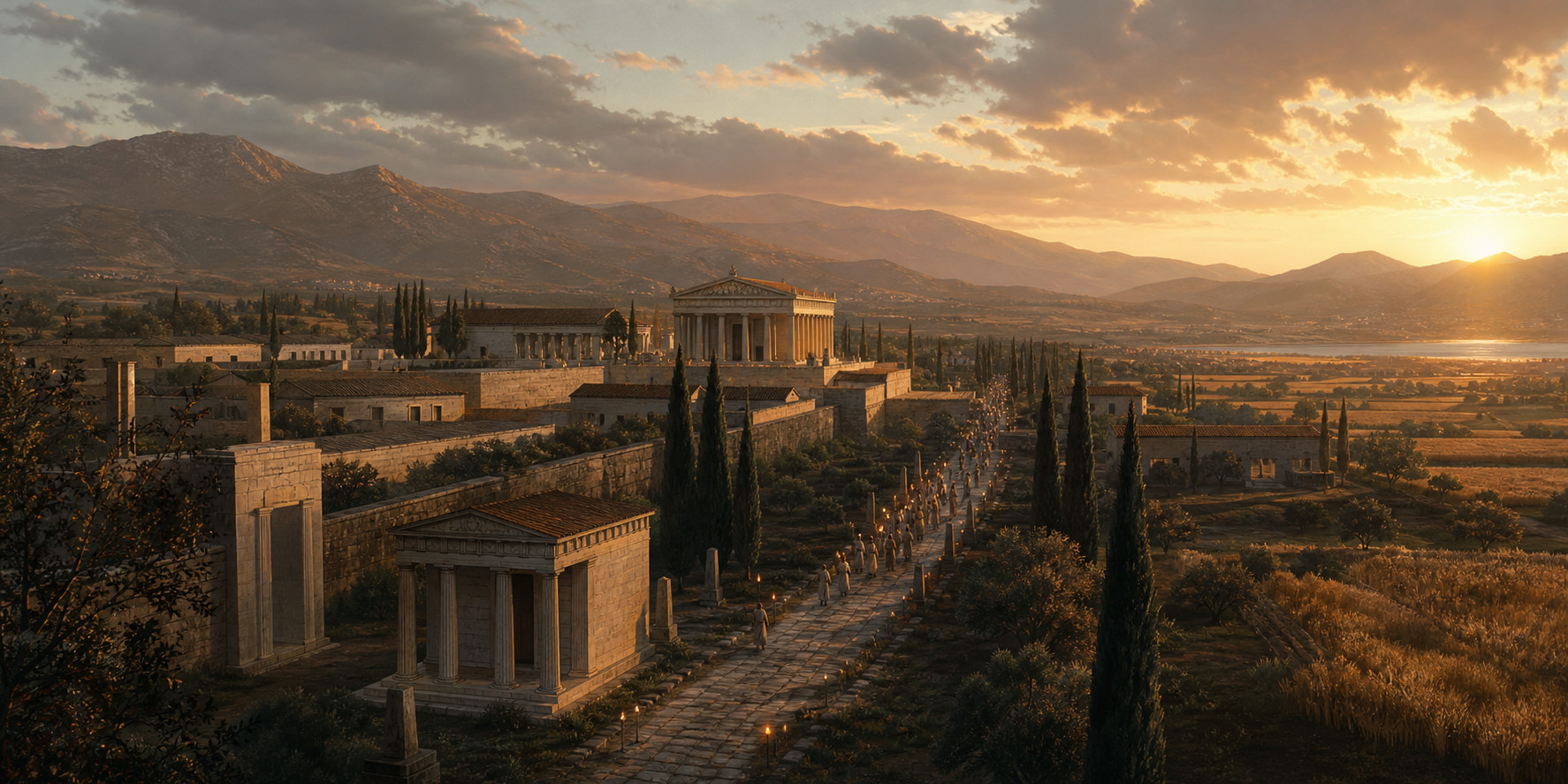
Eleusis was both a real settlement west of Athens and the mythic place where Demeter’s search for Persephone became a sacred institution. Its identity joins cultivated plain, processional road, royal household, ancient sanctuary, and guarded initiation. To understand the Eleusinian Mysteries, a reader must first see the place that organized movement from ordinary civic space toward a promised encounter.
A City on the Thriasian Plain
Eleusis stood near the Saronic Gulf beyond the pass from Athens, overlooking a fertile plain important for grain. Geography made the settlement a natural home for Demeter, yet myth and cult developed together over centuries rather than beginning as a simple illustration of agricultural scenery.
The ancient town belonged to the borderland between Attica and Megara. Roads, defensive concerns, farming, and access to the sea shaped daily life around the sanctuary. Sacred fame did not remove Eleusis from politics or economics.
Demeter Arrives in Disguise
In the Homeric Hymn to Demeter, the grieving goddess reaches Eleusis disguised as an old woman and rests near the Maiden Well. The daughters of King Celeus meet her and bring her into the royal household to nurse the infant Demophon.
This episode makes hospitality the first human response to divine grief. The young women do not recognize Demeter, but they offer place, work, and social connection. Eleusis becomes sacred through an encounter that begins outside the palace with a stranger sitting beside water.
Demophon and the Interrupted Gift
Demeter attempts to make Demophon immortal by anointing him with ambrosia and placing him in fire at night. His mother Metaneira interrupts in terror. The goddess reveals herself, rebukes the household, and commands the Eleusinians to build her a temple.
The failed transformation parallels Persephone’s incomplete return. Human fear interrupts one passage, while divine negotiation limits the other. Eleusis holds both loss and revelation rather than a simple miracle.
Foundation of the Rites
After Persephone returns and fertility is restored, Demeter teaches sacred rites to Eleusinian leaders. The hymn names figures including Triptolemus, Diocles, Eumolpus, and Celeus. Their exact roles expand in later local tradition, but the foundation joins divine disclosure with authorized human transmission.
Secrecy is built into the story. The rites are august and not to be violated or publicly explained. Eleusis becomes influential precisely because thousands can travel there while the central experience remains restricted.
The Sacred Way
The route from Athens to Eleusis was part of the festival. Initiates did not simply arrive at a destination; they processed along a landscape marked by shrines, bridges, boundaries, ritual speech, and collective movement. Distance helped transform participants before entry into the sanctuary.
The road also demonstrates Athenian involvement. Eleusis retained local priestly traditions while the larger polis organized and protected the festival. Place and institution were connected through movement between two civic centers.
The Telesterion
The Telesterion was the great initiation hall rebuilt in several phases to hold a large gathered body. Its inward-facing arrangement differed from a conventional temple focused on an exterior altar and cult statue. Architecture served a shared but guarded experience.
A central structure known as the Anaktoron held special significance within the hall. Archaeology can reveal foundations, sightlines, capacity, and rebuilding, but it cannot recover a complete script of the secret rites. Responsible reconstruction stops where evidence stops.
Sanctuary Through History
Eleusis grew from early settlement and cult place into a sanctuary supported by Athens, Hellenistic rulers, and Roman emperors. War and destruction led to rebuilding. Political sponsorship increased monumental scale without making the sanctuary merely decorative.
Initiation remained attractive across the Mediterranean. Participants could include women, foreigners, and enslaved people who met ritual requirements. The place offered a prestigious shared route that crossed several ordinary civic divisions.
End, Ruins, and Memory
The sanctuary declined and closed during the religious transformations and conflicts of late antiquity. No single dramatic date explains every stage. Buildings were damaged, institutions lost support, and Christian imperial policy changed the environment in which traditional cult operated.
Modern excavation made Eleusis visible again as architecture and artifact, but tourism can create the illusion that ruins alone explain the Mysteries. The broken site is evidence of a once-active landscape of sound, procession, authority, food, fear, and hope.
What Eleusis Means
Eleusis shows how myth becomes place without becoming fixed. Demeter’s grief is attached to wells, roads, halls, fields, and a royal house, enabling participants to move physically through a story of concealment and return.
The sanctuary also teaches caution. Its public history is richly documented, while its central revelation was protected. Good interpretation respects both abundance and absence instead of filling secrecy with confident invention.
Where the Story Leads
Follow Demeter and Persephone into the sacred narrative, the Eleusinian Mysteries into the annual institution, and Hecate into torch-lit accompaniment. Athens and the Sacred Way explain the procession; Triptolemus opens the spread of grain and teaching.
Demophon reveals the failed attempt at immortality, while Eumolpus and the priestly families reveal the human custodians of divine knowledge. The Underworld provides the mortal horizon against which Eleusis offered a different hope.
Trivia
- Eleusis was a real Attic settlement as well as a mythic sacred place.
- The Homeric Hymn places Demeter at a well before she enters Celeus’s household.
- The Telesterion was designed for a large initiatory gathering.