A shifting lower realm of memory, boundary, judgment, and the rule of Hades and Persephone.
- Cerberus
- Dead
- Hades
- Persephone
- Rivers
- Origin
- Divine Occupation
- Major Myths
- Cult / Tradition
- Legacy
The Greek Underworld is the realm of the dead ruled by Hades and Persephone. Its entrances, rivers, and regions vary across ancient sources. It must be distinguished from Tartarus, the deeper cosmic abyss and prison. Living visitors such as Odysseus and Heracles reveal different routes, rituals, and rules governing return.
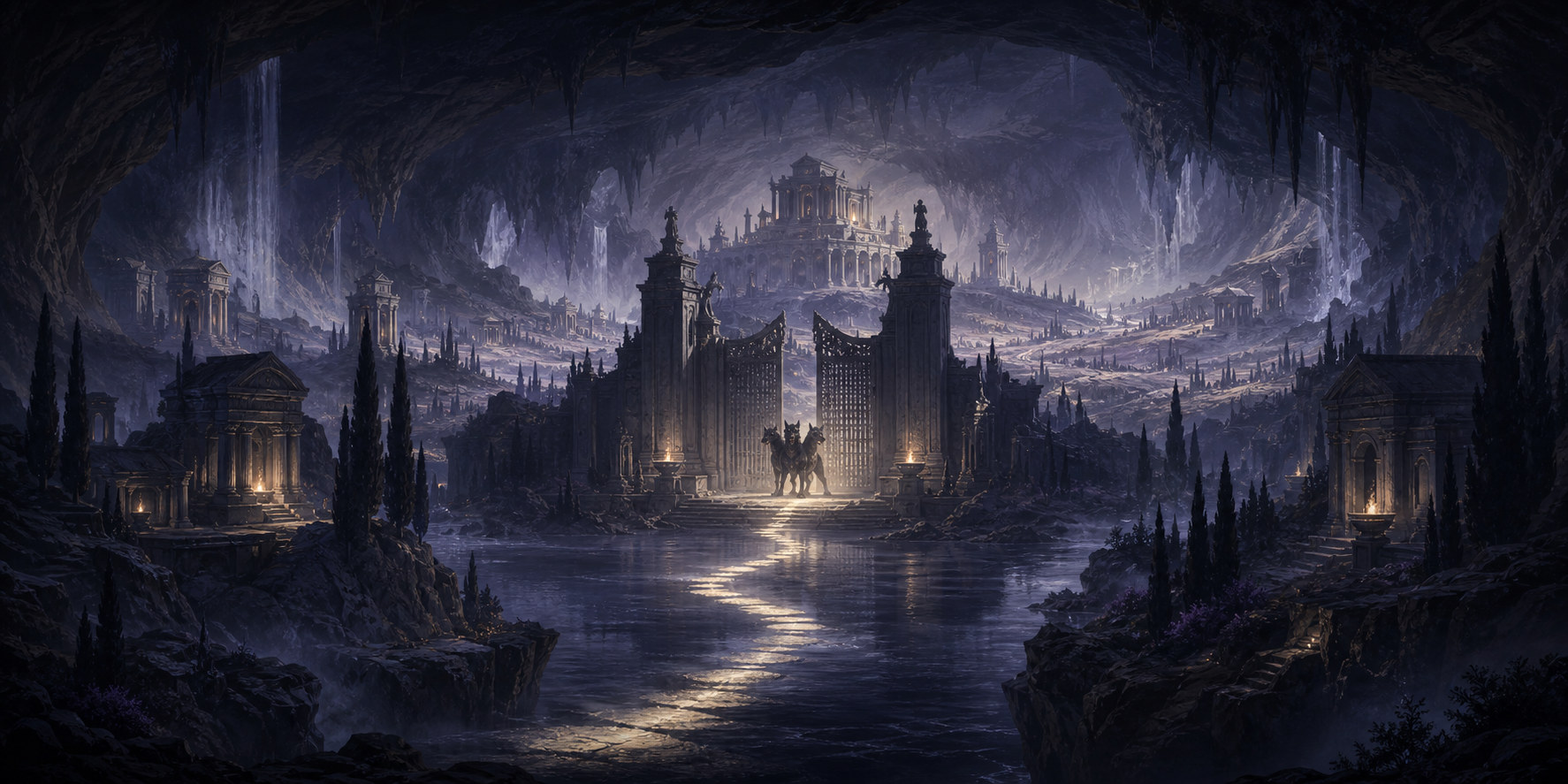
The Greek Underworld is not one room beneath the earth. It is a kingdom, a route, a boundary, and a collection of places whose geography changes with the question a poet asks. Odysseus reaches the dead beyond Ocean; Heracles descends for Cerberus; Persephone moves between darkness and her mother’s world. No single map contains every journey.
Realm, Ruler, and Deepest Abyss
Hades can mean the god, his house, or the realm of the dead. The Underworld is the broader modern label for that realm. Tartarus is not simply another name for all of it: Hesiod presents Tartarus as a primordial power and an extreme depth where defeated Titans are confined.
Separating these terms prevents one of the most common confusions in Greek mythology. Hades rules the dead; Tartarus describes a deeper cosmic prison and boundary within or beneath the imagined lower world.
How the Dead Reach It
Ancient texts do not give one universal entrance. In the Odyssey, Odysseus sails beyond Ocean to a distant land of darkness and performs rites that draw the dead toward blood. Other myths place descents at caves, lakes, capes, or local sanctuaries understood as openings below.
This variety reflects the Underworld’s double nature. It is impossibly far away and directly beneath familiar ground. A ritual, a landscape feature, or divine guidance can make the boundary briefly accessible.
Hades and Persephone
The ruler is Hades, but Persephone is not a decorative queen. The Homeric Hymn to Demeter makes her movement between worlds central to the settlement that restores fertility. She spends part of the year below and returns to Demeter for the rest, binding the Underworld to seasonal absence and return.
Their halls form a royal center within a realm that no ordinary political map can measure. To approach them is to approach authority over the condition of the dead and the rules governing passage.
Rivers, Gates, and Guardians
Later tradition organizes the lower world through rivers such as Styx, Acheron, Cocytus, Phlegethon, and Lethe, though their number and placement vary by author. Hesiod places cosmic waters, Night, Sleep, Death, and the halls of Hades near the remote roots and limits of creation.
Cerberus guards the exit. Hesiod’s hound welcomes those entering but prevents the dead from leaving. This reversal is important: the greatest danger is not that no one can enter, but that the order of mortality forbids return.
What Becomes of Ordinary Souls?
Homeric poetry often portrays the dead as shades whose diminished existence contrasts with embodied life. Odysseus must allow spirits to drink sacrificial blood before they can recognize him and speak clearly. The scene emphasizes distance, memory, and the cost of knowledge.
Not every soul is shown undergoing a detailed moral trial. Elaborate systems of judges, rewards, punishments, and divided destinations become more prominent in particular poetic, philosophical, mystery, and later traditions. These should be layered rather than treated as one timeless doctrine.
Tartarus and Exceptional Punishment
In Hesiod, Tartarus is first crucial as the prison of primordial beings and defeated Titans. Famous mortal offenders such as Tantalus, Sisyphus, and Ixion become strongly associated with exemplary punishments in the lower world, but authors differ about where and how those punishments occur.
The distinction between the ordinary dead and exceptional cosmic offenders helps explain why the Underworld can appear muted in one story and spectacularly punitive in another.
Living Visitors
A small number of heroes cross the boundary alive. Odysseus seeks prophecy from Tiresias. Heracles brings Cerberus to the upper world as the last of his Twelve Labors. Orpheus descends through music in an attempt to recover Eurydice. These journeys have different rules and should not be merged into one standard route.
What makes return possible? Divine permission, ritual knowledge, heroic strength, or an exceptional gift may open the way, but every successful entrance tests the law that the dead remain below.
Burial, Memory, and the Living
Stories of unburied dead show that the Underworld also depends on actions performed above. Funeral rites, offerings, tombs, and continued remembrance shape the relationship between living families and those who have crossed the boundary.
The realm is therefore not isolated from society. It gives weight to mourning, inheritance, oath, and obligation. The living cannot abolish death, but they can fail or fulfill the duties that make passage meaningful.
Mapping Without Forcing One Map
Ancient poetry accumulates gates, rivers, meadows, palaces, judges, islands, and prisons across centuries. A useful guide asks which source and journey a feature belongs to instead of drawing every name into one false diagram.
This source-aware approach does not make the realm less vivid. It turns apparent contradiction into a reading tool: the Underworld seen by a prophet-seeking sailor need not look exactly like the realm crossed by a divine bride or a hero sent to seize its guardian.
Follow Hades for the ruler, Persephone for movement between worlds, Tartarus for the deepest prison, and the Twelve Labors for the hero who must bring the guardian upward. Each path reveals a different Underworld because each visitor asks something different of death.
Trivia
- Greek texts can use the name Hades for both the god and his realm.
- Odysseus reaches the dead by sailing beyond Ocean rather than walking through one universal cave entrance.
- Cerberus primarily prevents departure, preserving the boundary between the dead and the living.