The serpent-bodied power whose assault tested the newly established Olympian order.
- Echidna
- Etna
- Serpents
- Storm
- Thunderbolt
- Zeus
- Primordial Age
- Titan Age
- Olympian Age
- Heroic Age
- Trojan Cycle
Typhon is the immense serpentine challenger born after the Titanomachy. Zeus defeats him with the Thunderbolt, while later traditions place him beneath Mount Etna. With Echidna he fathers many of Greek myth's most famous monsters.
Typhon is the challenge that arrives after Zeus seems to have won. The Titans have fallen and the Olympian order appears secure when a storm-shaped adversary rises with serpentine limbs, many voices, and fire in his eyes. His battle with Zeus tests whether kingship founded through one succession war can survive a final assault from the powers of earth and abyss.
The Last Great Challenger
Hesiod makes Typhon the child of Gaia and Tartarus, born with Aphrodite’s help after the defeat of the Titans. Other genealogies and motives appear later, including traditions in which Hera produces him independently. These accounts should remain distinct. The Hesiodic birth makes him a product of the deepest cosmic regions and a response to Zeus’s new rule.
Typhon is not simply another Titan. He belongs to a later phase of the succession narrative. His appearance proves that victory over an older generation does not exhaust disorder. The cosmos can still produce a being whose body and voice exceed stable classification.
A Body Made of Storm and Serpents
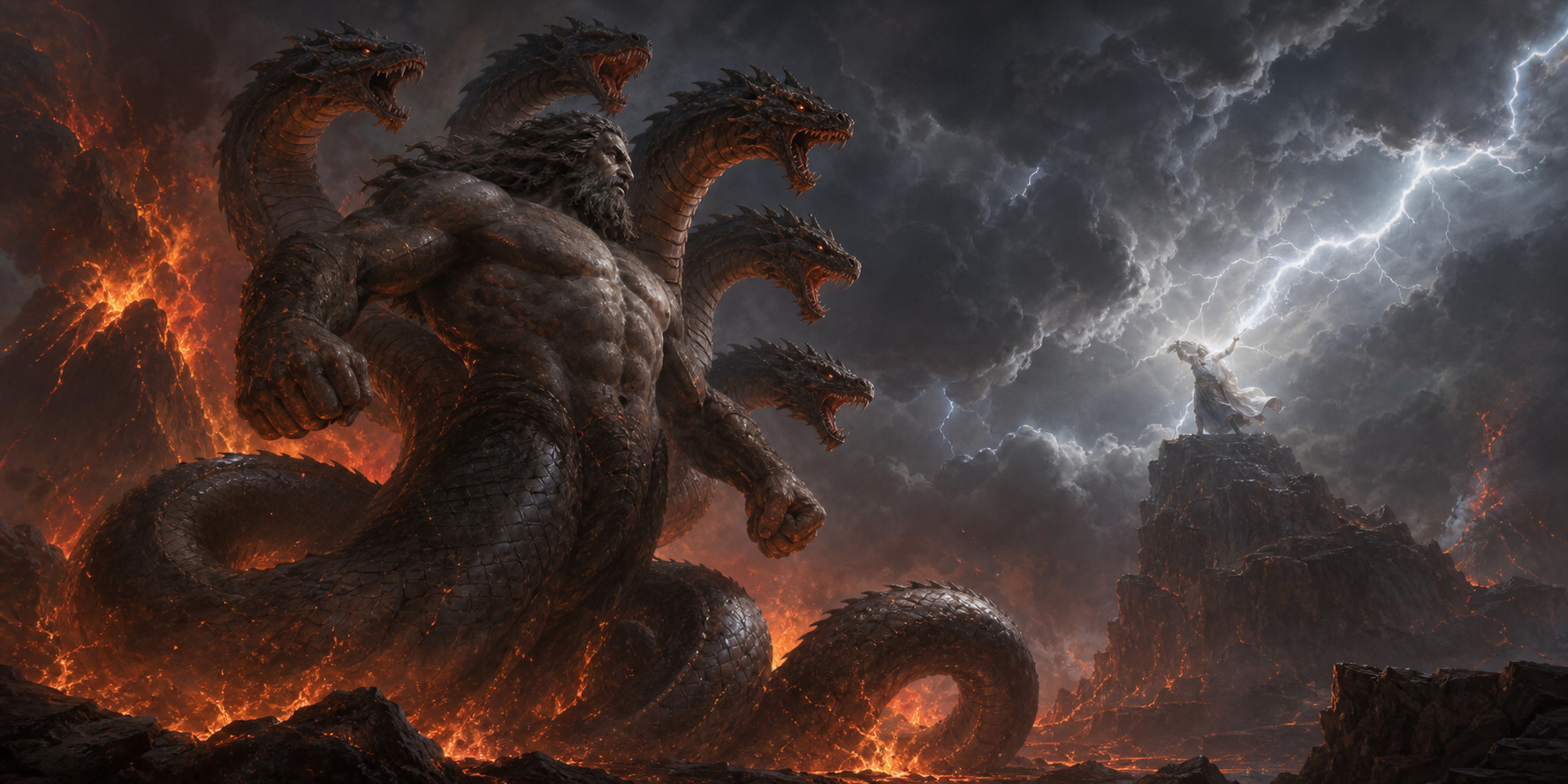
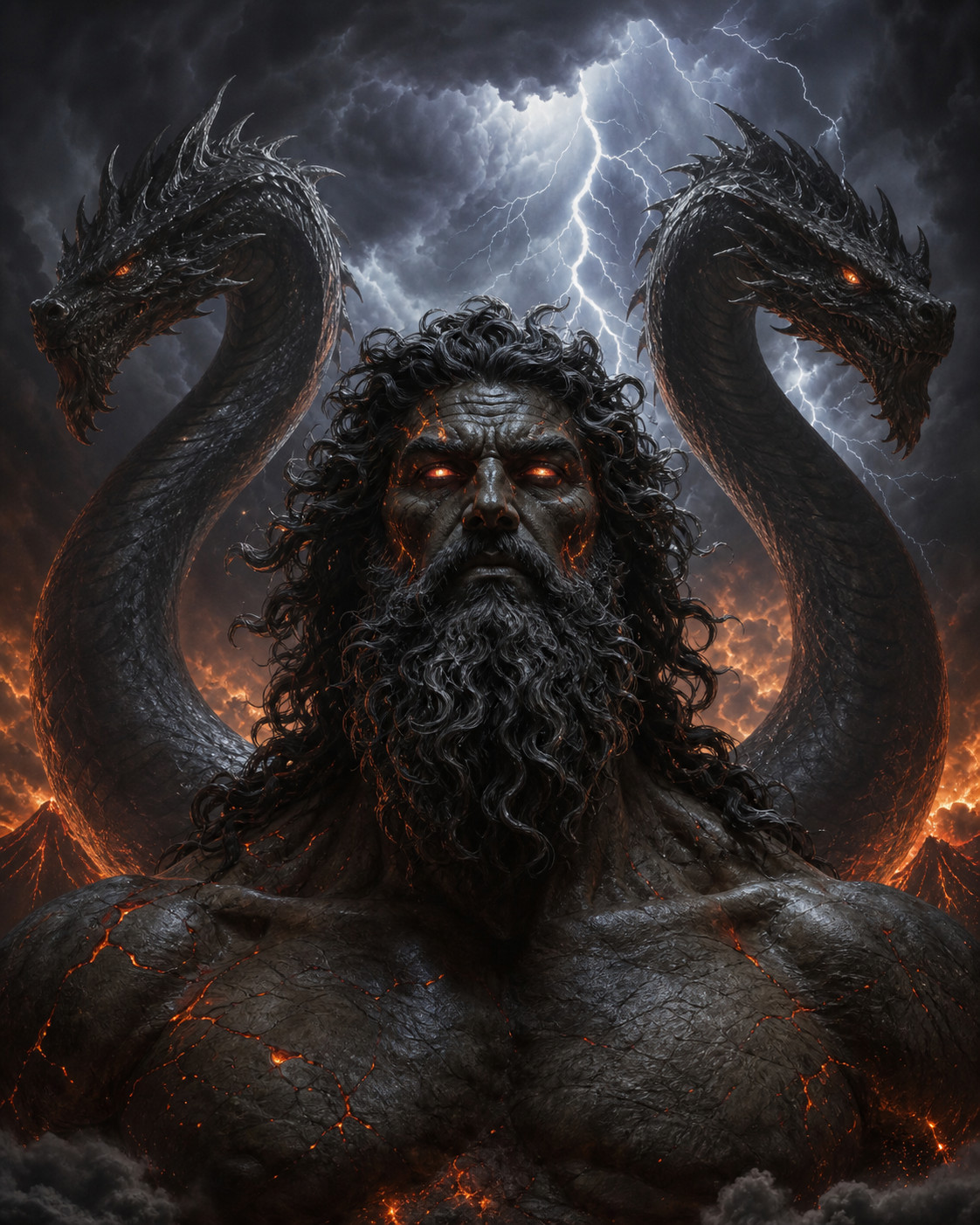
Descriptions vary dramatically. Hesiod gives Typhon a hundred snake heads, flashing fire, and voices that sound at different moments like gods, bulls, lions, puppies, or hissing serpents. Later authors imagine enormous humanlike height, wings, coils, and heads touching the stars. No single illustration can combine every ancient feature without choosing among traditions.
The changing body expresses scale more than anatomy. Typhon contains incompatible sounds and forms, as though the categories organized by divine rule have become one attacking organism. His name was associated in antiquity and later scholarship with violent winds, though the exact linguistic history is debated.
Battle with Zeus
In Hesiod, thunder shakes the cosmos when Zeus attacks with his full power. Fire burns across earth, sea, and sky. Zeus strikes Typhon’s heads with the thunderbolt and hurls the defeated enemy into Tartarus. The battle reaffirms the weapon forged by the Cyclopes and the prison realm already central to the Titanomachy.
Apollodorus preserves a more extended struggle. Typhon drives the gods toward Egypt, grapples with Zeus, cuts the sinews from the god’s hands and feet, and hides them in a cave under the guard of Delphyne. Hermes and Aegipan recover them. Restored, Zeus pursues Typhon and finally crushes him beneath Mount Etna. This version makes Olympian victory precarious rather than immediate.
Etna and Volcanic Imagination
Greek and Roman writers place Typhon beneath volcanic landscapes, especially Etna. Eruptions, smoke, and earthquakes become signs of the imprisoned adversary. Other locations also claimed parts of the pursuit or burial. Myth maps cosmic conflict onto unstable ground, turning geology into continuing evidence that defeated force remains active.
Typhon’s confinement resembles other divine punishments without being identical to them. He is not reconciled into Olympian society. The mountain functions like a lid, while fire from below recalls the thunderous conflict above.
Father of Monsters
With Echidna, Typhon fathers famous monsters. Hesiod names Orthrus, Cerberus, the Hydra, and the Chimera within this family network, though later genealogies expand and rearrange it. Their children guard thresholds or create heroic crises across different regions: the Underworld gate, Lerna’s marsh, Lycian mountains, and Geryon’s cattle.
This genealogy links Zeus’s cosmic opponent to later heroic labor. Heracles and Bellerophon do not fight Typhon directly, but they encounter distributed forms of his monstrous line. The transition from divine war to heroic quest is therefore genealogical as well as chronological.
Typhon and the Winds
Hesiod distinguishes beneficial directional winds from destructive storm winds that descend from Typhon. These violent blasts wreck ships and crops and scatter human work. The distinction converts genealogy into an explanation of weather: ordered winds can participate in the world, while irregular devastation inherits the defeated monster’s force.
Later comparison connected Typhon with the Egyptian god Seth, especially through stories of the gods’ flight to Egypt. Such identifications belong to ancient cross-cultural interpretation, not to a claim that the Greek and Egyptian gods were originally identical in every context.
The flight story also reverses the usual image of secure immortals. Gods disguise themselves as animals and retreat while the challenger advances. Even when told with humor or cultural explanation, the episode magnifies Typhon by showing that Olympian identity itself can become defensive before Zeus restores the balance.
What Typhon Means
Typhon is the limit case of Olympian order. Zeus wins not because the challenger is trivial but because every level of the world seems vulnerable. Thunder, prison, allies, and recovered bodily power all matter. Sovereignty must prove itself against something that cannot be absorbed into a neat family office.
Yet defeat does not mean disappearance. Storms and volcanoes preserve the enemy as pressure within the ordered cosmos. Greek myth often imagines stability this way: not the elimination of violence, but its containment beneath institutions, landscapes, and repeated stories.
Where the Story Leads
Follow Zeus and the Thunderbolt through the decisive contest, Gaia and Tartarus through Typhon’s birth, and Echidna into the monstrous dynasty. Cerberus and the Twelve Labors show how that dynasty enters heroic narrative, while future paths to the Hydra, Chimera, Etna, Hermes, and Delphyne open individual battles and local landscapes.
Trivia
- Hesiod gives Typhon voices ranging from divine speech to animal cries.
- Apollodorus says Zeus briefly loses his sinews during the battle.
- Volcanic activity at Etna was explained through the monster imprisoned below.