The unseen weapon of Hades that hides its wearer even from the eyes of gods
- Concealment
- Hades
- Invisibility
- Perseus
- Underworld
- Origin
- Creation
- Major Appearance
- Later Tradition
- Legacy
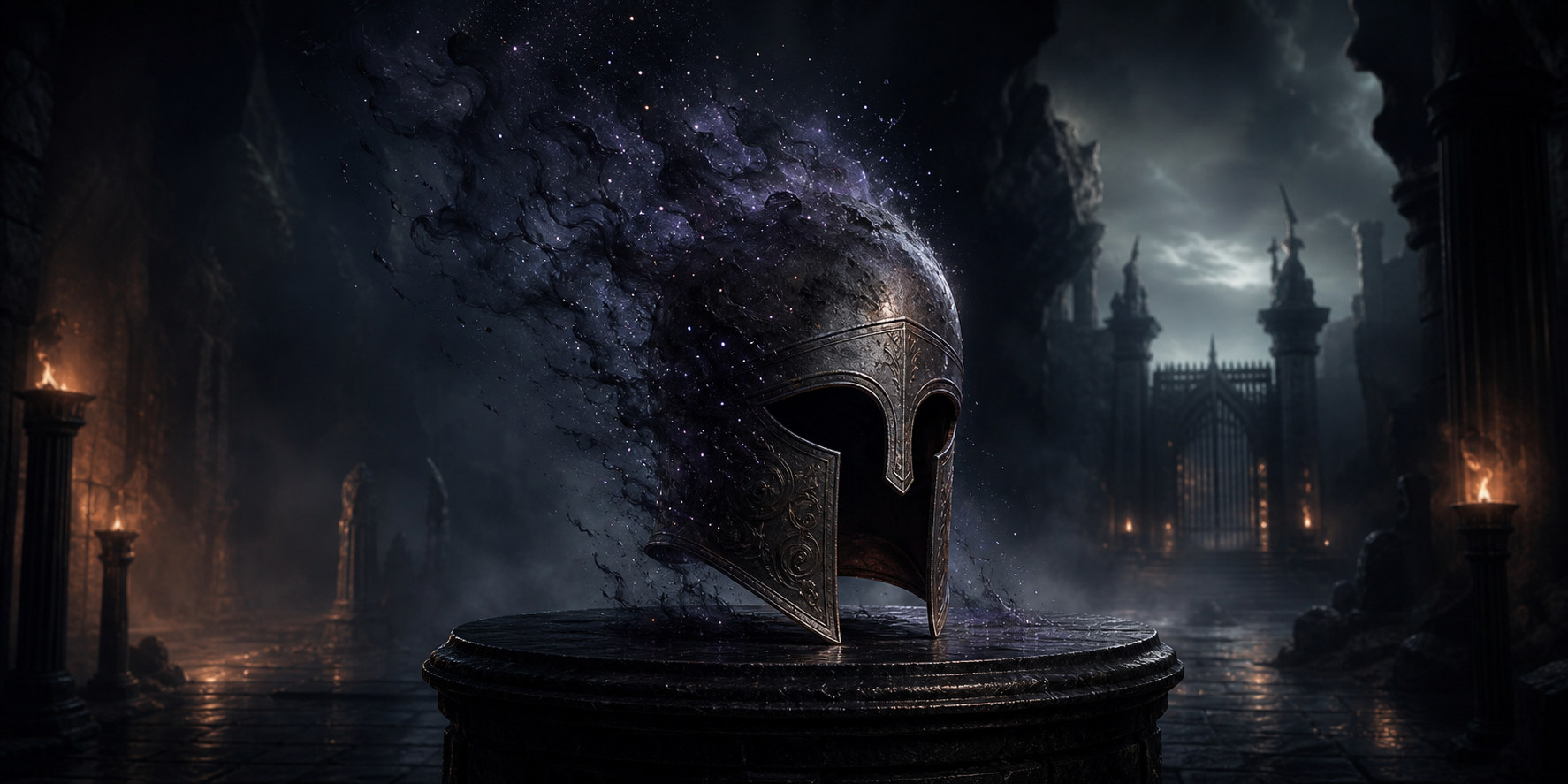
The Helmet of Invisibility is the divine helm associated with Hades. Forged by the Cyclopes for the Titanomachy, it conceals its wearer even from gods and later passes through the hands of heroes and deities, making unseen power one of Greek mythology’s most reusable strategic tools.
Power That Cannot Be Seen
The Helmet of Invisibility is the defining artifact of Hades, but unlike the Thunderbolt or Trident, it does not announce its power. It removes the wearer from sight. That difference perfectly suits a god whose realm lies beneath the earth and whose name is associated with the unseen.
The artifact is sometimes called the Helm of Hades, Cap of Hades, or Cap of Invisibility. Ancient terminology and later retellings vary between helmet and cap, but the essential power remains the same: the wearer becomes indiscernible, even to divine eyes.
Forged for the Titanomachy
Pseudo-Apollodorus places the helm beside the other gifts of the Cyclopes. Zeus receives thunder and the Thunderbolt, Poseidon receives the Trident, and Hades receives the helmet.
Why give concealment to Hades? The object anticipates more than military strategy. Hades will become ruler of a domain every mortal eventually enters but none can normally see. The weapon makes his future realm visible through absence.
How Invisibility Changed the War
The surviving accounts do not narrate every battlefield maneuver performed with the helmet during the Titanomachy. Its strategic value, however, is obvious. An unseen god could move through enemy lines, avoid attack, gather information, or strike without warning.
This creates an important contrast with Zeus. The Thunderbolt wins attention; the helmet removes it. One rules through terrifying visibility, the other through inaccessible presence.
Hades and the Meaning of the Unseen
The name Aidoneus is linked in tradition with the idea of the unseen. Hades himself rarely appears in the upper world, and mortals avoid speaking his name too freely. His realm is hidden, his wealth lies beneath the ground, and his subjects have vanished from ordinary life.
The helmet therefore feels less like an accessory and more like a condensed statement of his identity. It asks whether the deepest power is always the power most clearly displayed.
Perseus Borrows the Helm
The artifact’s story expands far beyond Hades when Perseus undertakes the impossible task of beheading Medusa. Traditions describe the hero receiving divine equipment that includes winged sandals, a special bag, a reflective shield, an adamantine sickle, and the helmet that makes him invisible.
After Medusa’s death, invisibility helps Perseus escape the surviving Gorgons. The episode transforms the helm from a weapon of cosmic war into a tool of heroic survival. It also creates a remarkable chain of links: Hades to Perseus, Perseus to Medusa, Medusa to Athena, and the helmet to another adamantine blade.
Gods Also Use the Cap
The power was not restricted to Hades and Perseus. In the Iliad, Athena uses the cap of Hades so that Ares cannot see her as she intervenes in battle. Later tradition also gives the invisible covering to Hermes in the Gigantomachy.
This reuse makes the artifact unusual. The Thunderbolt remains overwhelmingly Zeus’s weapon, but the helmet functions almost like a divine technology that can be lent when a mission requires secrecy.
Helmet, Cap, or Identity?
Modern art often imagines a metal war helmet, but ancient references can suggest a cap or covering rather than one fixed design. That uncertainty leaves room for changing visual traditions.
It also shifts attention from appearance to function. The object can look different because the central idea is not what it shows—it is what it prevents others from seeing.
The Ethics of Invisibility
Invisibility creates freedom from observation. In myth, that freedom may protect a hero, enable divine intervention, or create unfair advantage. The helmet therefore opens a question that extends beyond Greek mythology: what happens to responsibility when no witness can see the act?
Hades uses unseen power as part of cosmic order. Perseus uses it to survive. Athena uses it to alter a battlefield. The same ability changes meaning with each wearer.
Questions That Open the Next Path
- Why did Perseus need so many divine objects? His quest links the helmet with Medusa, Athena, Hermes, and the adamantine sickle.
- Why could Athena borrow an artifact of Hades? The Iliad reveals how divine equipment crosses personal domains.
- What else lies hidden beneath the earth? Hades’s invisible helm connects to the underworld’s souls, gates, treasures, and secret wealth.