The divinely aided rider whose impossible victories ended in a forbidden ascent.
- Athena
- Chimera
- Golden Bridle
- Hubris
- Lycia
- Pegasus
- Primordial Age
- Titan Age
- Olympian Age
- Heroic Age
- Trojan Cycle
Bellerophon is the Corinthian hero who masters Pegasus with Athena's golden bridle, kills the Chimera, and survives campaigns meant to destroy him. His later attempt to reach Olympus ends in a fall and lonely wandering.
Bellerophon is the hero who truly rides Pegasus in ancient Greek tradition. With Athena’s bridle and the winged horse beneath him, he defeats the fire-breathing Chimera and survives a chain of deadly assignments. Yet victory does not teach him where heroic honor ends. His attempt to rise to Olympus turns the master of impossible journeys into a solitary wanderer.
A Hero with a Troubled Name
Bellerophon’s ancestry varies. He is commonly called the son of Glaucus, king of Corinth, while divine paternity may be assigned to Poseidon. His earlier name is sometimes given as Hipponous. Ancient explanations connected “Bellerophon” with the killing of a figure named Bellerus, but the linguistic and narrative history remains uncertain.
A killing or pollution drives him from Corinth to the court of Proetus at Tiryns. There he receives purification and hospitality. The pattern resembles other Greek tales in which a displaced noble depends on a host’s protection, making the host’s household both sanctuary and source of danger.
The Rejected Queen and the Sealed Message
Proetus’s wife, called Stheneboea or Anteia in different traditions, desires Bellerophon. When he refuses her, she accuses him of attempting to violate her. Proetus believes the charge but avoids killing a guest directly. He sends Bellerophon to Iobates, king of Lycia and the queen’s father, carrying a folded message that asks for the bearer’s death.
The letter is one of Greek myth’s famous destructive messages. Iobates first welcomes the stranger for nine days, then reads it. Bound by hospitality, he also avoids immediate murder and instead assigns tasks expected to be fatal. The hero becomes trapped inside elite rules that preserve appearances while transferring violence elsewhere.
Athena’s Bridle and Pegasus
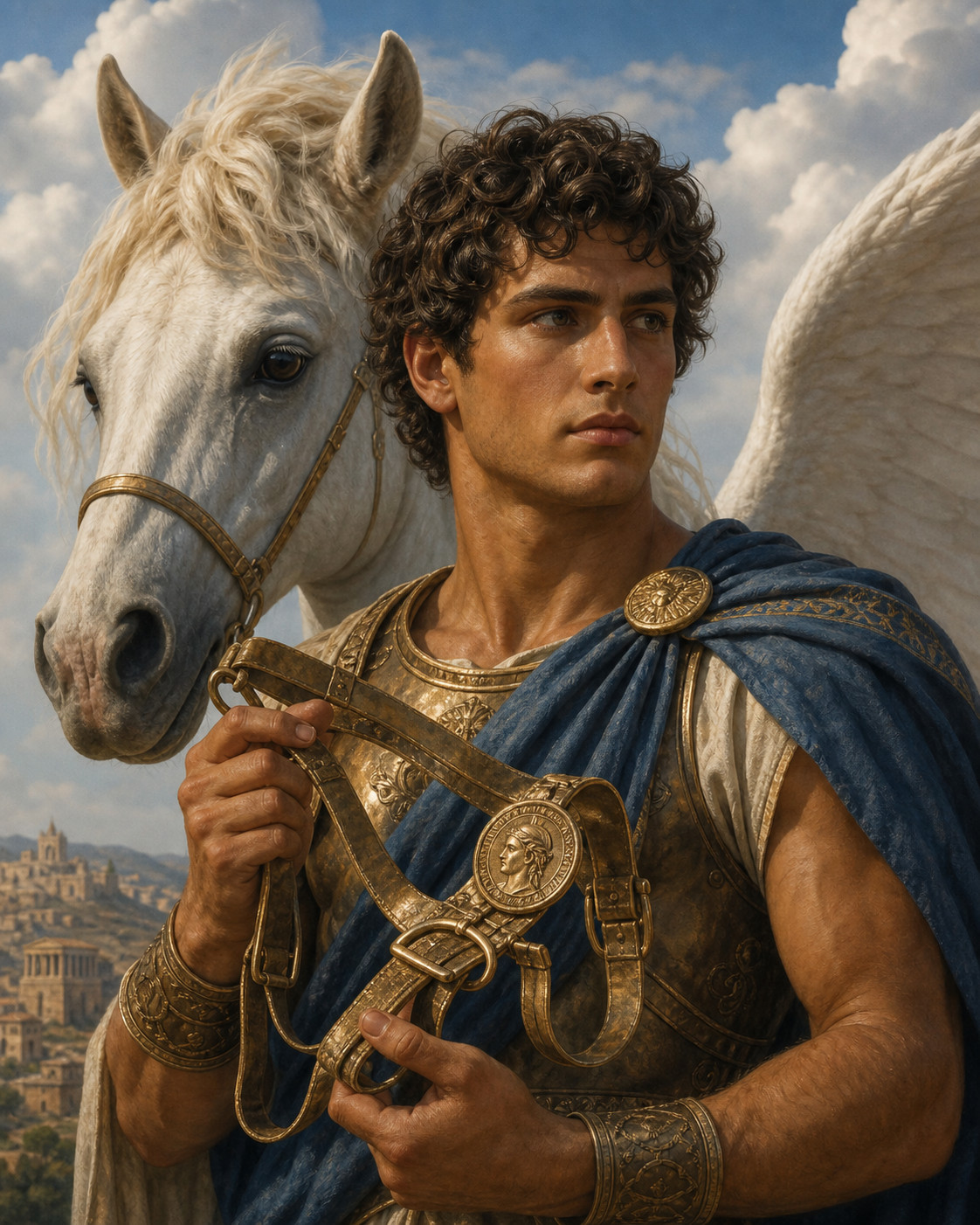
Pindar tells how Bellerophon longed to capture Pegasus. The seer Polyidus advised him to sleep at Athena’s altar. The goddess appeared in a dream and gave him a golden bridle; after waking, he found the object and offered sacrifice. With the bridle he mastered the winged horse.
Accounts differ about the exact capture and about how much help came from Athena or Poseidon. The central point is stable: Pegasus is not an ordinary animal conquered by strength alone. Divine equipment and ritual preparation make partnership possible. This is also why replacing Bellerophon with Perseus as Pegasus’s rider erases the hero’s defining relationship.
The Chimera
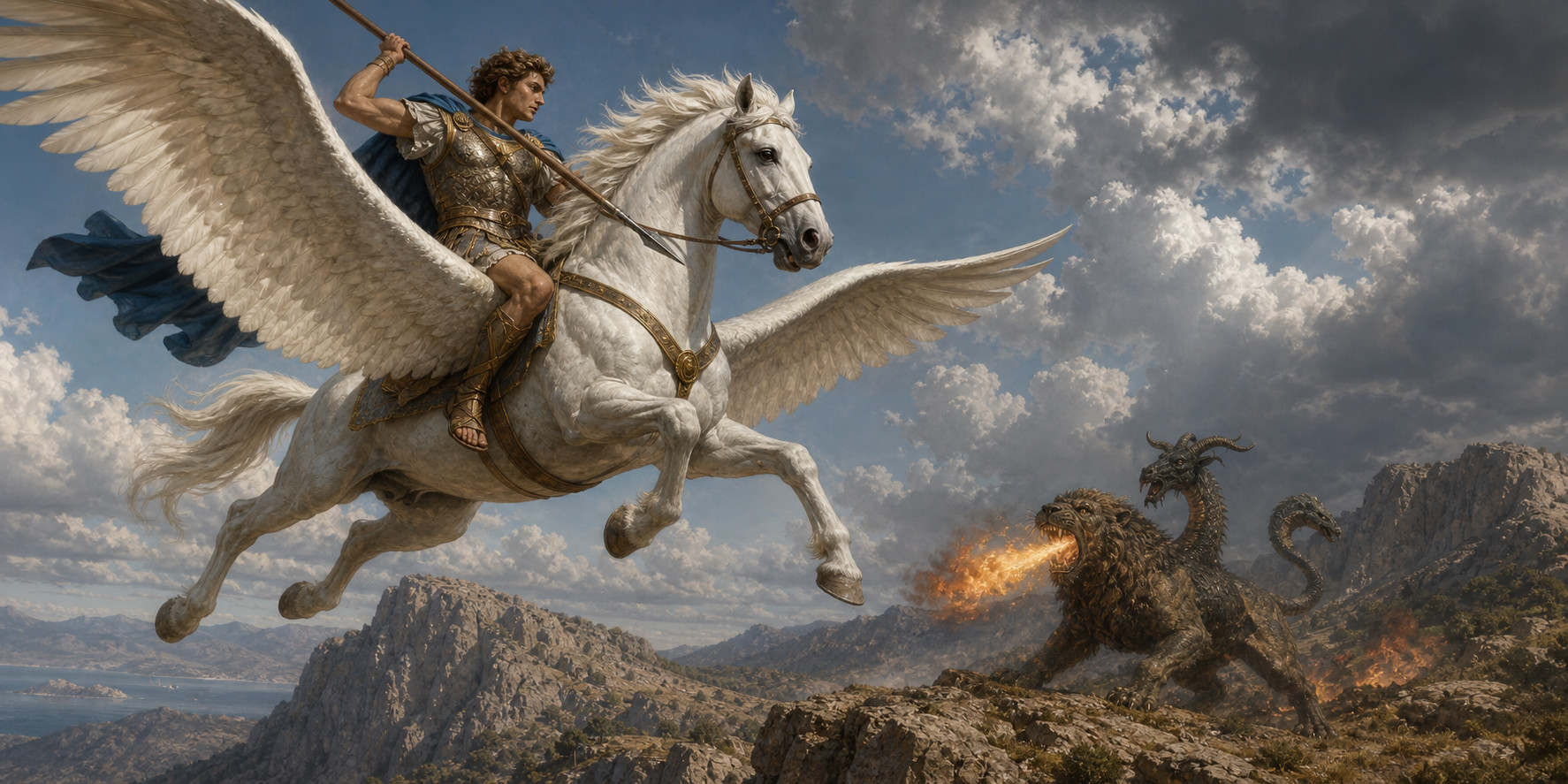
Iobates orders Bellerophon to kill the Chimera, a hybrid creature associated with Lycia. Homer describes it as lion in front, serpent behind, goat in the middle, and breathing fire. Pegasus gives the hero a decisive advantage by carrying him above the monster’s attack. Later art and retellings imagine a spear thrust or a lump of lead melted by the creature’s breath.
Ancient sources do not preserve one technical battle script. What matters is the union of aerial mobility, divine favor, and courage against a body that violates ordinary animal categories. The victory joins Bellerophon to Echidna’s monstrous family and makes Pegasus a participant rather than decorative transport.
More Impossible Tasks
The Chimera’s death does not free Bellerophon. Iobates sends him against the Solymi and then the Amazons. He defeats both. The king next arranges an ambush by selected Lycian warriors, but Bellerophon kills them as well. At last Iobates recognizes divine support, shows him the letter, offers a daughter in marriage, and grants him a share of royal power.
In some versions Bellerophon takes revenge on Stheneboea; details differ and may include a fatal flight on Pegasus. These later developments should not be flattened into Homer’s shorter account. Across versions, the false charge initiates a sequence in which indirect execution repeatedly becomes public proof of heroic worth.
The Flight toward Olympus
Bellerophon’s ending is famous but unevenly preserved. Later tradition says he tried to ride Pegasus to Olympus. Zeus sent a gadfly or otherwise caused the attempt to fail. Pegasus continued to the gods, while Bellerophon fell and wandered apart from humanity. Homer already knows him as hated by the gods and devouring his own spirit on the Aleian plain, though it does not explain the celestial attempt.
The fall gives the story its final measure. Divine assistance permits extraordinary action but not automatic equality with the gods. Pegasus can enter Zeus’s service; the mortal rider cannot claim the same destination.
What Bellerophon Means
Bellerophon combines justified confidence with catastrophic overreach. He survives plots designed by rulers who refuse direct responsibility and wins recognition through tasks intended to hide a murder. His competence is real. That reality makes his final error more instructive, not less.
His myth also asks who owns a heroic success. The rider depends on Pegasus, the bridle, Athena, hospitality, and divine ancestry. Glory emerges from a network. When Bellerophon imagines ascent as a private entitlement, the network breaks.
Where the Story Leads
Follow Pegasus as divine partner and later servant of Zeus, Athena as giver of the bridle, and Echidna as mother of the Chimera. Zeus defines the boundary the hero cannot cross, while future entries for the Chimera, Lycia, the Amazons, and Stheneboea open the monster, landscape, campaigns, and accusation.
Trivia
- Bellerophon, not Perseus, is Pegasus’s principal ancient rider.
- The sealed letter he carries asks its recipient to kill the bearer.
- Homer describes his lonely wandering without narrating the later famous flight to Olympus.