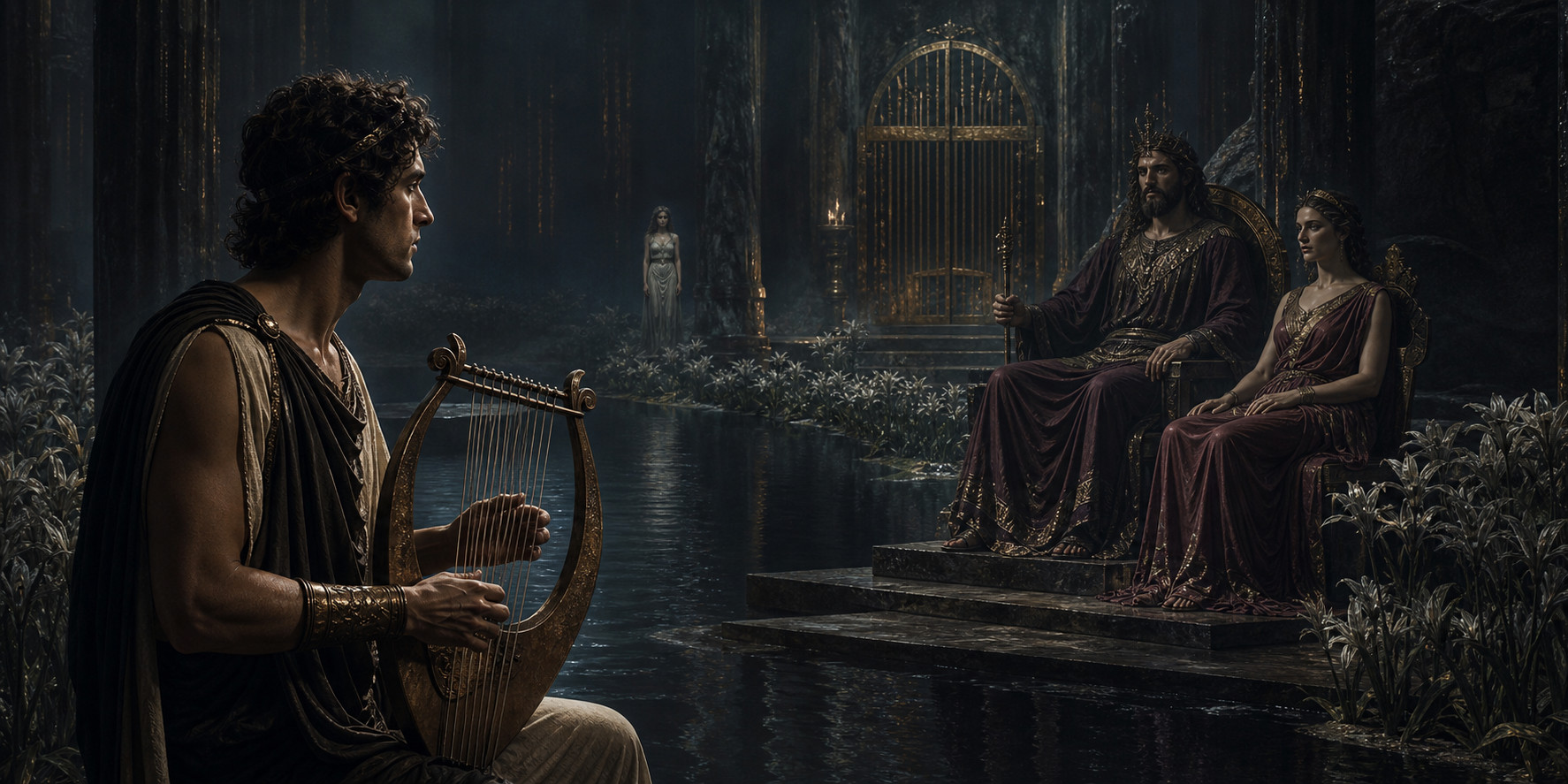
The musician whose song opened death's gate but could not make trust visible.
- Argonaut
- Eurydice
- Hades
- Lyre
- Orphic
- Persephone
- Primordial Age
- Titan Age
- Olympian Age
- Heroic Age
- Trojan Cycle
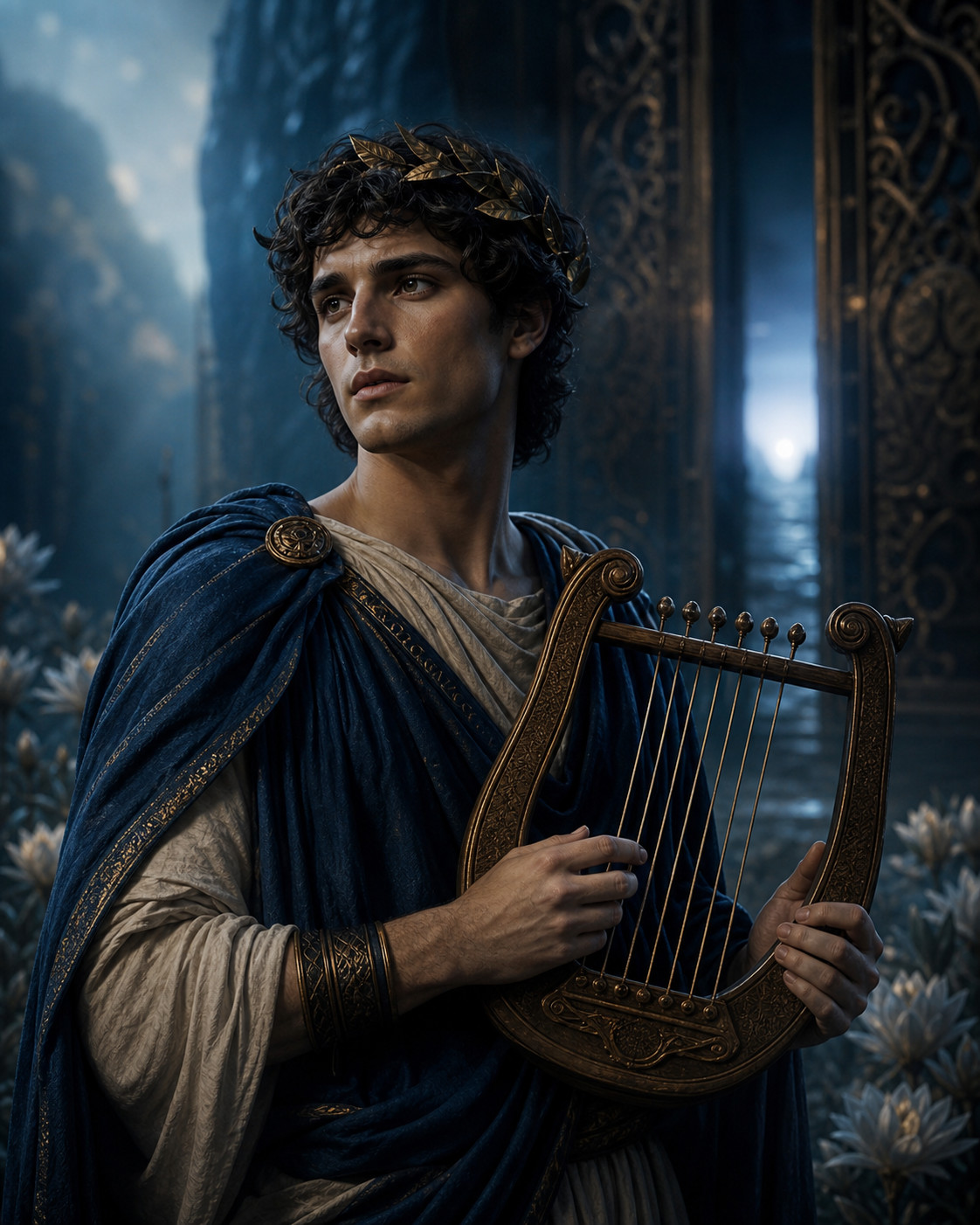
Orpheus is the Thracian singer whose music moves nature and persuades Hades and Persephone to release Eurydice. He loses her by looking back before they leave the Underworld. Ancient traditions also make him an Argonaut and an authority for varied initiatory texts.
Orpheus enters the Underworld with no weapon stronger than a song. His music persuades trees, stones, animals, and finally the rulers of the dead to listen. Yet the permission he wins comes with one condition, and the backward glance that breaks it makes his story less a simple romance than a meditation on art, trust, ritual, and the limits of return.
The Singer from Thrace
Orpheus is associated with Thrace and is commonly made a son of the Muse Calliope, though fathers and details vary. Apollo is sometimes named as his father or teacher, strengthening the link between lyre music, prophecy, and divine order. From early references onward, Orpheus is not merely talented. His song changes the behavior of the world around him.
During the voyage of the Argonauts, he keeps time for the rowers, performs rites, and counters the Sirens. Their song pulls sailors toward destruction; Orpheus answers with a music powerful enough to hold his companions to their course. The contest presents art as navigation and protection rather than decoration.
Eurydice and the Sudden Loss
Orpheus marries Eurydice, who dies from a snakebite. Later authors elaborate the circumstances, sometimes involving pursuit by Aristaeus. The loss occurs almost at the threshold of marriage, turning celebration into mourning before the new household can begin. Orpheus refuses to accept that music can move every listener except death.
The fullest surviving versions of the descent are Roman, especially Virgil and Ovid, while Greek references show the tradition existed earlier and did not always end identically. Plato even gives a hostile interpretation in which the gods show Orpheus only an image because he lacks courage to die for love. The myth’s meaning was debated in antiquity rather than fixed once for all.
Singing Before the Dead
Orpheus passes into the Underworld and performs before Hades and Persephone. The shades stop, punishments pause, and the royal pair agree to release Eurydice. Cerberus too is charmed in later retellings. The scene makes the lower realm a court capable of hearing a petition, but not a place whose laws disappear under emotion.
The condition is precise: Orpheus must walk ahead and not look back until both have reached the upper world. Eurydice follows unseen or unheard behind him. Near the exit, uncertainty overcomes him. He turns, sees her, and loses her a second time. She is drawn back before the restoration is complete.
Why Does He Look Back?
Ancient texts and later readers supply many answers: doubt that she follows, fear of deception, overpowering love, impatience, forgetfulness, or the artist’s need to see what only faith can sustain. The condition transforms the return into a test of trust. Orpheus can move the rulers through performance, but he cannot control the silent interval after the song.
Eurydice’s perspective also matters. In Virgil she reproaches the madness that destroys them; in Ovid her final response is gentler. Later adaptations increasingly give her a voice and question why her life depends on a rule announced to her husband. The myth remains productive because the glance can express love and failure simultaneously.
Death of Orpheus
After the second loss, Orpheus rejects other relationships or turns exclusively toward male love in Ovid’s account. Thracian women, often identified as Maenads, attack and dismember him. His severed head and lyre travel down the river Hebrus, still singing, and reach Lesbos. Traditions connect the island with lyric poetry and oracular power.
The murder creates a sharp parallel with his art. A body can be torn apart while the voice continues. Apollo or the Muses preserve the remains, the lyre enters the stars, and Orpheus is finally reunited with Eurydice among the dead in Ovid. The return he could not secure while living becomes possible only when he accepts the mortal route.
Orphic Authority and Initiation
Ancient Greeks attributed poems, hymns, theogonies, and ritual teachings to Orpheus. “Orphic” is a modern umbrella for varied texts and practices rather than evidence of one centralized church founded by the legendary singer. Gold tablets buried with initiates in several regions preserve instructions for the soul’s journey, while the Derveni Papyrus interprets an Orphic poem allegorically.
These materials connect Orpheus with purification, divine genealogy, Dionysus, and hopes concerning the afterlife. Their dates and doctrines differ. Responsible description should not force them into a single secret system, but the association makes sense: the singer who returned alive from Hades would be an ideal authority on the road the dead must travel.
What Orpheus Means
Orpheus demonstrates art’s extraordinary reach without claiming art is omnipotent. Music opens the gate, quiets Cerberus, and wins a concession from Hades and Persephone. It cannot remove the condition, guarantee trust, or abolish mortality. The failure is not proof that the song was useless; the impossible journey came within one glance of success.
His myth also separates persuasion from possession. Orpheus can cause listeners to pause and feel, but Eurydice is not an object produced by his performance. Her return requires law, consent, and her own passage. That tension keeps the story alive in opera, poetry, film, and theater.
Where the Story Leads
Follow the Underworld for the route Orpheus crosses, Hades and Persephone for the judgment he changes, and Cerberus for the guardian calmed by music. Future entries for Eurydice, Calliope, Apollo, Dionysus, and the Argonauts open the marriage, parentage, ritual authority, violent death, and earlier voyage.
Trivia
- The best-known complete descent narratives survive in Roman poets Virgil and Ovid.
- Orpheus also sails with the Argonauts and counters the Sirens through music.
- Ancient “Orphic” texts represent varied traditions, not one simple institution.