The guided hero who survived an impossible gaze and returned to protect his mother.
- Andromeda
- Athena
- Divine Equipment
- Medusa
- Reflection
- Primordial Age
- Titan Age
- Olympian Age
- Heroic Age
- Trojan Cycle
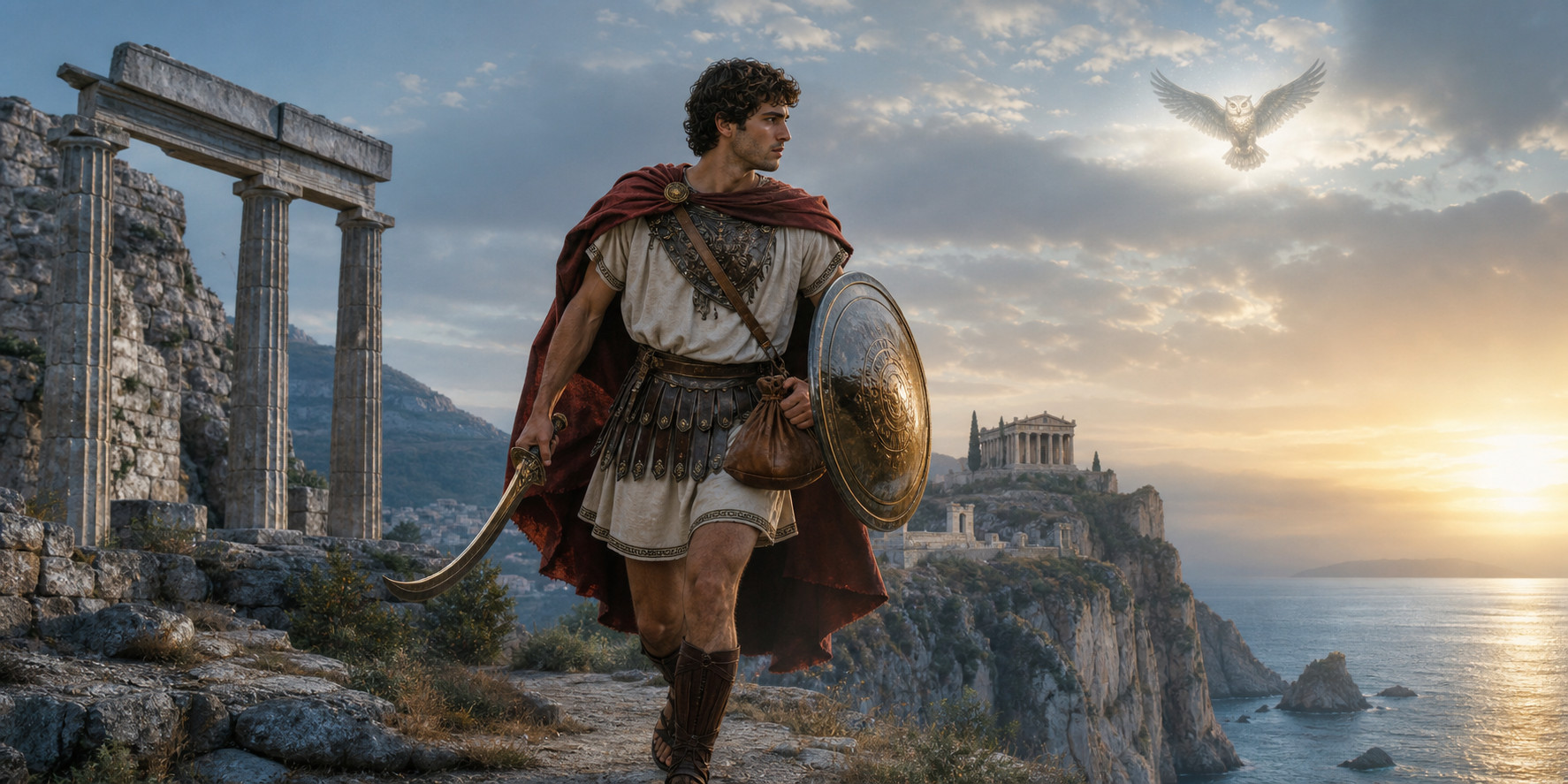
Perseus is the son of Zeus and Danae, sent by Polydectes to obtain Medusa's head. With Athena's and Hermes's guidance he uses reflection, divine equipment, and careful timing. He later rescues Andromeda, protects Danae, and fulfills the oracle concerning Acrisius by accident.
Perseus enters Greek myth under a death sentence disguised as a quest. King Polydectes asks for Medusa’s head because the task should be impossible, yet the young hero survives by combining divine gifts, careful guidance, and the discipline never to look directly at the power he must confront. His story links a threatened mother, a Gorgon, a rescued princess, and the founding memory of Mycenae.
A Child Shut Away
Acrisius, king of Argos, learns from an oracle that a son of his daughter Danae will kill him. He confines Danae, but Zeus reaches her as a shower of gold and Perseus is born. Acrisius refuses to kill them directly. He seals mother and child in a chest and casts it into the sea. The fisherman Dictys receives them on Seriphos and raises Perseus. The attempt to defeat prophecy has instead sent its future agent into another kingdom.
Dictys’s brother Polydectes rules the island and desires Danae. When the grown Perseus becomes an obstacle, the king arranges a demand for gifts and maneuvers him into promising the head of Medusa. Accounts differ in their framing, but the political logic is consistent: an impossible heroic boast becomes a convenient way to remove a protector from his mother.
Finding What Cannot Be Found
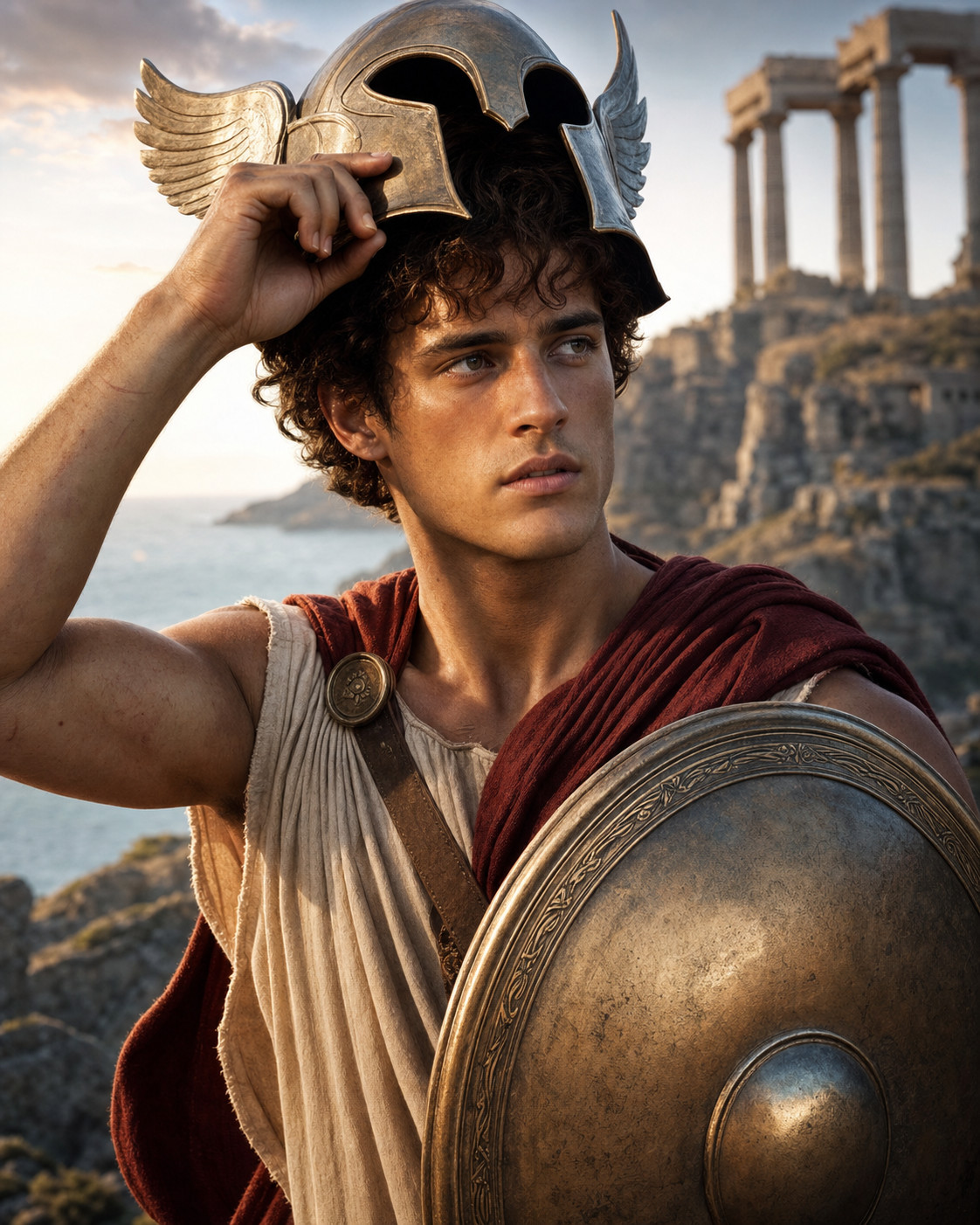
Medusa lives beyond ordinary routes with her immortal Gorgon sisters, Stheno and Euryale. Athena and Hermes guide Perseus, but ancient sources distribute the equipment differently. He receives or acquires a curved blade, a polished shield, winged sandals, the helmet of invisibility, and the kibisis, a special bag able to contain the dangerous head. In Apollodorus, Perseus first reaches the Graeae, sisters who share one eye and one tooth, and compels them to reveal the way to the nymphs who hold crucial gear.
The equipment turns the quest into a lesson in mediated sight. Perseus does not overpower Medusa through a stronger gaze. He watches her reflection in Athena’s shield and strikes while she sleeps. The helmet conceals his escape, the sandals overcome distance, and the bag contains a power that remains active after death. Each gift solves a specific boundary: finding, seeing, striking, carrying, and escaping.
Medusa and the Living Head
Hesiod names Medusa as the only mortal Gorgon and says Poseidon lay with her in a meadow. When Perseus cuts off her head, Pegasus and Chrysaor emerge. Later authors reshape Medusa’s earlier life, most famously Ovid, who tells of a beautiful maiden transformed after an encounter with Neptune in Minerva’s temple. That influential Roman account should be distinguished from the earlier Greek genealogy rather than projected backward as the only version.
Perseus uses the head during his return. The petrifying gaze defeats threats without becoming his personal, ordinary weapon: it is carried under ritual and material control. Eventually he gives it to Athena, who places the Gorgoneion on her aegis or shield. The quest therefore transforms Medusa’s face from a guarded danger at the world’s edge into a protective emblem displayed by the goddess who guided the hero.
Andromeda at the Shore
On the journey home Perseus finds Andromeda exposed to a sea monster because her mother Cassiopeia boasted against sea divinities. Perseus bargains to rescue and marry her, kills or petrifies the monster depending on the telling, and defeats the rival claimant Phineus when conflict erupts at the wedding. This episode brings Poseidon’s anger, royal responsibility, and the hero’s dangerous trophy into one scene.
Modern images frequently place Perseus on Pegasus during the rescue, but the ancient hero is more securely associated with winged sandals. Pegasus has his own later bond with Bellerophon. Separating those traditions preserves the distinctive equipment and identity of both heroes.
Return, Justice, and Prophecy
Back on Seriphos, Perseus finds Danae and Dictys threatened by Polydectes. He reveals Medusa’s head to the hostile court and makes Dictys king. The action completes the motive of the quest: the son sent away to protect his mother returns with the power to protect her decisively.
Perseus later travels toward Argos. Acrisius, still afraid of the oracle, has withdrawn. At athletic games Perseus throws a discus that accidentally kills his grandfather. The prophecy is fulfilled without deliberate murder, showing how evasion can shape the very route by which fate arrives. Unwilling to inherit the kingdom of the man he killed, Perseus exchanges realms and becomes associated with Tiryns and the founding or fortification of Mycenae. His descendants, the Perseids, lead eventually to Heracles and to Eurystheus, making his family central to the heroic age.
What Makes Perseus a Hero
Perseus succeeds through cooperation more than solitary force. Athena supplies a way to see safely; Hermes supplies direction and equipment; the nymphs preserve tools that cross impossible distances and boundaries. Dictys offers humane fosterage, while Danae gives the quest its personal stakes. Even the final transfer of the head matters: Perseus does not keep every power he acquires. He returns the equipment and gives the Gorgoneion to Athena, allowing a lethal object to become civic and divine protection.
Where the Story Leads
Follow Medusa to the Gorgon genealogy, Athena to the strategy of indirect sight, and the Gorgoneion to the afterlife of the severed face. The Helmet of Invisibility and future pages for the Graeae, Andromeda, Pegasus, and Mycenae open the quest’s equipment, companions, consequences, and dynasty.
Trivia
- Perseus is an ancestor of Heracles through the Perseid royal line.
- Ancient versions associate him with winged sandals, not a ride on Pegasus.
- The accidental discus death fulfills the oracle Acrisius tried to escape.