The older dynasty whose divided loyalties shaped the rise of Olympus.
- Cronus
- Gaia
- Mount Othrys
- Rhea
- Succession
- Uranus
- Primordial Age
- Titan Age
- Olympian Age
- Heroic Age
- Trojan Cycle
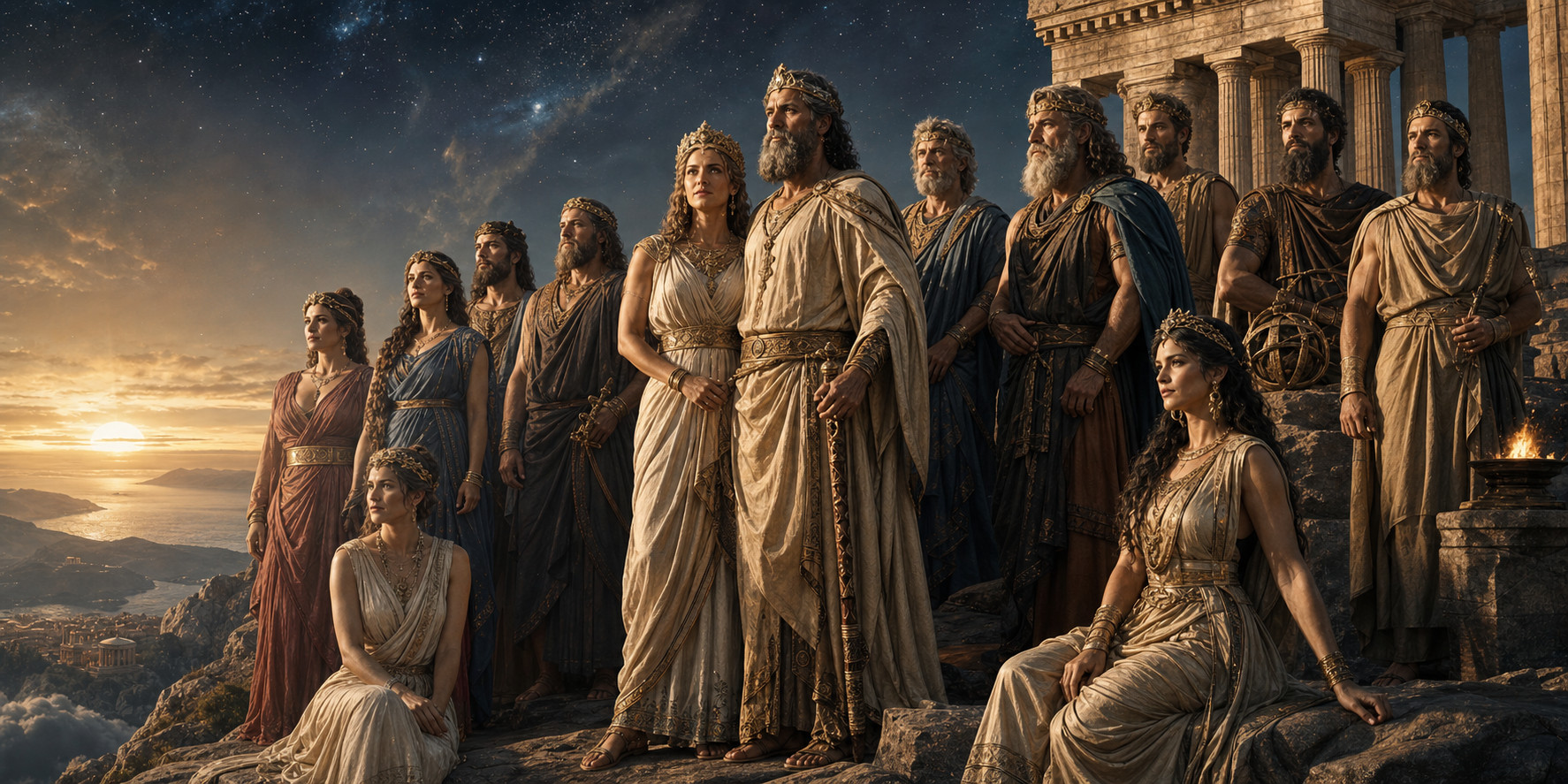
The Titans are the twelve children of Gaia and Uranus in Hesiod's genealogy and the older generation associated with Cronus's rule. They are not the Giants, and they do not all oppose Zeus: several remain neutral, aid the Olympian cause, or become essential parts of the new order.
Before the Olympians became the familiar rulers of Greek myth, an older divine generation held the center of the cosmos. The Titans are not merely oversized monsters waiting for Zeus to defeat them. In Hesiod’s Theogony they are the twelve children of Earth and Sky, a family whose powers, marriages, and divided loyalties shape the transition from primordial creation to Olympian government.
The Children of Earth and Sky
Gaia and Uranus produce six male Titans—Oceanus, Coeus, Crius, Hyperion, Iapetus, and Cronus—and six female Titans—Theia, Rhea, Themis, Mnemosyne, Phoebe, and Tethys. Ancient lists and later usage are not perfectly uniform, and writers sometimes call important descendants Titans as well. The core Hesiodic twelve nevertheless provide the clearest starting point. They personify or govern structures larger than an ordinary divine office: the encircling river Ocean, heavenly light, memory, divine law, generation, and the lineages from which stars, rivers, gods, and mortals emerge.
The name therefore describes both a generation and a network of cosmic functions. Oceanus and Tethys become parents of rivers and Oceanids. Hyperion and Theia stand behind Helios, Selene, and Eos. Coeus and Phoebe lead through Leto to Apollo and Artemis. Iapetus fathers Atlas, Prometheus, Epimetheus, and Menoetius, connecting the Titan family to human origins, fire, punishment, and endurance. Themis and Mnemosyne later join Zeus and become mothers of the Hours, Fates in one tradition, and Muses. The new order does not erase everything Titan; it absorbs indispensable Titan powers.
Cronus and the First Rebellion
Uranus forces some of his children back into Gaia, turning the divine household into a pressure that Earth can no longer bear. Gaia creates an adamantine sickle and asks her children to act. Only Cronus accepts the ambush. When Uranus descends to Gaia, Cronus strikes, separates Sky from Earth, and opens room for a new age. This deed makes him ruler, but it also establishes the pattern that will destroy him: a son can overturn a father who tries to prevent succession.
Not every Titan is presented as Cronus’s accomplice. Hesiod emphasizes Cronus’s action, while later accounts elaborate different roles. The Titans should therefore not be imagined as a single political party from the beginning. Their family contains rulers, neutrals, allies of Zeus, and defeated opponents. That distinction becomes essential during the Titanomachy.
A Divided Generation
Cronus marries Rhea and swallows each child she bears because Gaia and Uranus have warned him that his own son will overthrow him. Rhea saves Zeus, who eventually frees his siblings. The resulting war is often summarized as Olympians against Titans, yet the alliances are more complicated. Oceanus remains outside the hostile core in important traditions; his daughter Styx brings her children to Zeus. Prometheus, a son of Iapetus, is remembered as advising Zeus. Themis becomes an intimate figure in Olympian law and counsel. The label Titan marks ancestry, not automatic guilt.
Hesiod places the fighting gods on opposing mountains and makes the war last ten years. Victory arrives only when Zeus releases the Cyclopes and Hundred-Handers from confinement. The Cyclopes provide thunder, lightning, and the thunderbolt; the Hundred-Handers unleash an overwhelming storm of stones. Cronus and the defeated combatants are cast into Tartarus under guard. Atlas receives a separate burden, holding the sky at the world’s edge. The new reign is built through alliance with powers the older ruler kept imprisoned.
After the Titanomachy
Defeat does not make the Titan generation disappear. Oceanus continues to encircle the world. Helios drives the sun, Selene marks the moon, and Eos opens dawn. Themis represents an order Zeus must honor, while Mnemosyne makes cultural memory and song possible. Even traditions about Cronus can soften: some later Greek and Roman texts imagine him ruling a blessed Golden Age or dwelling over the Isles of the Blessed. Roman Saturn inherits and transforms this memory through agriculture and festival.
Ancient sources also vary about imprisonment and release. Pindar can imagine Cronus ruling among blessed heroes, while other traditions keep the defeated Titans beneath the earth. These alternatives are not errors to be forced into one timeline. They reveal how poets used the Titan past to think about political order, lost abundance, justice, and whether reconciliation can follow cosmic violence.
What the Titans Mean
The Titans make Greek divine succession more than a simple battle of good and evil. Cronus ends Uranus’s oppression but repeats its fear. Zeus wins because he frees allies, distributes honors, and draws older powers into a broader settlement, though his reign has conflicts of its own. The story asks what makes authority stable: strength, prophecy, kinship, justice, or the ability to share power.
Art and modern retellings often portray every Titan as colossal, but ancient Greek art did not require a uniform giant anatomy. The Giants belong to a different genealogy and a different war, the Gigantomachy. Keeping Titans and Giants separate clarifies two major conflicts: the Titanomachy establishes Olympian succession, while the Gigantomachy tests the order after it has been established.
Where the Story Leads
Follow Uranus and Gaia to the first divine household, Cronus and Rhea to the endangered children, and Zeus to the strategy that changes the war. The Titanomachy shows the divided generation in conflict; Tartarus shows the cost of defeat. Prometheus, Atlas, Helios, Themis, and Mnemosyne open future paths into humanity, endurance, celestial order, law, and memory.
Trivia
- The familiar twelve Titans are six sons and six daughters of Gaia and Uranus in Hesiod.
- Titans and Giants are separate groups with different wars.
- Several Titans or Titan descendants support, advise, or later join Zeus rather than fighting him.