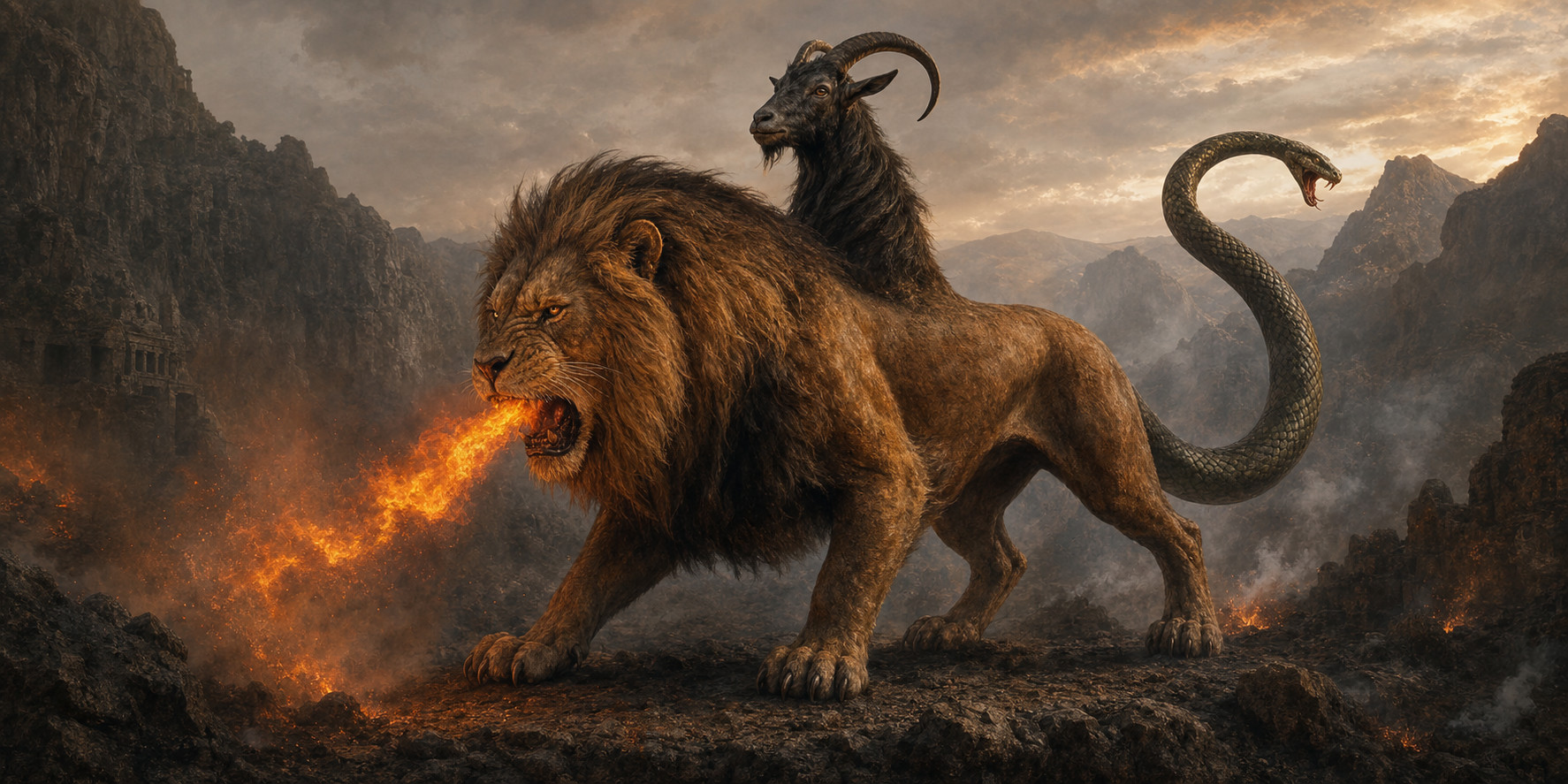
The lion, goat, and serpent whose ravaging of Lycia required a battle from the sky.
- Bellerophon
- Echidna
- Fire
- Lycia
- Pegasus
- Typhon
- Primordial Age
- Titan Age
- Olympian Age
- Heroic Age
- Trojan Cycle
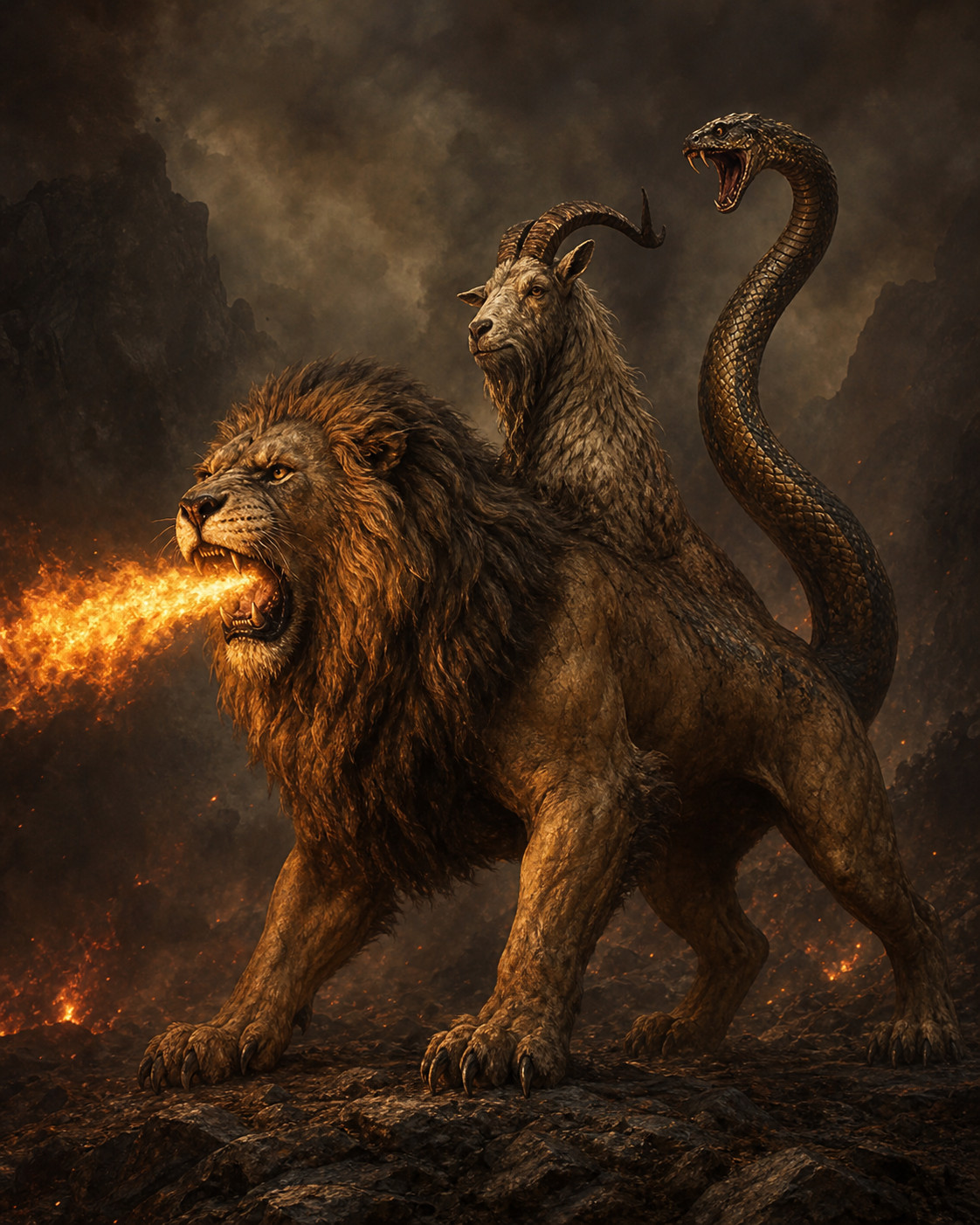
The Chimera is the fire-breathing hybrid of lion, goat, and serpent defeated in Lycia by Bellerophon riding Pegasus. Ancient art and poetry make it a particular monster, not merely a generic name for any composite creature.
The Chimera is one of Greek myth’s most concentrated images of impossible danger: lion in front, goat rising from the middle, serpent behind, and fire issuing from a living body. It rules no kingdom and speaks no challenge. Its narrative purpose is to make Lycia uninhabitable until Bellerophon, Pegasus, and divine assistance combine distance, speed, and tactical invention.
A Monster Described by Homer
The Iliad gives the earliest surviving literary account within the story of Bellerophon. The Chimera is of divine stock, lion in front, serpent behind, goat in the middle, and breathes terrible fire. Homer’s compact description became the foundation for later poets and artists, even as they adjusted how the three animals joined.
The word chimaira can mean a she-goat, but the mythic creature is not merely a goat enlarged. Its composite anatomy violates ordinary categories. Ancient painters often show a lion body with a goat head emerging from its back and a snake for a tail, creating a silhouette readable even on small pottery surfaces.
Child of Typhon and Echidna
Hesiod places the Chimera within the monstrous lineage of Typhon and Echidna, though the syntax around parentage has encouraged discussion. The family also includes or connects with Cerberus, Orthrus, the Hydra, and the Nemean Lion. Genealogy turns separate heroic monsters into one counter-order at the edges of divine and human settlement.
This lineage does not mean the creatures act as a coordinated army. Each occupies a distinct landscape and tests a different hero. Their kinship instead explains recurrence: serpentine bodies, multiple forms, poisonous or fiery force, and the need for exceptional weapons or helpers when ordinary combat fails.
Lycia Under Threat
King Iobates sends Bellerophon against the Chimera because he expects the mission to kill him. The monster ravages Lycia, making the task both public service and concealed execution. The hero cannot refuse without losing honor, yet success undermines the plot against him by proving that divine favor accompanies the supposed criminal.
Ancient sources do not offer a detailed ecological map of the ravaging. Later imagination supplies caves, volcanic ground, and scorched valleys. Those settings fit the fire-breathing body, but they should be recognized as interpretation rather than a complete landscape preserved by Homer.
Pegasus Changes the Battle
Pegasus allows Bellerophon to fight from above, beyond claws and flame. Pindar emphasizes Athena’s golden bridle and the divine means by which the horse is mastered. The victory therefore belongs to a partnership: Bellerophon’s courage, Pegasus’s flight, and Athena’s gift together transform an impossible ground encounter.
Later accounts add the tactic of fixing lead to a spear. Heated by the Chimera’s breath, the metal melts into its throat and kills it. The detail is memorable but not present in every early telling. It shows mythographers turning a famous victory into a problem solved by material intelligence.
The Shape in Ancient Art
Corinthian pottery made Bellerophon and the Chimera a recognizable visual pair. Artists balanced the winged horse against the hybrid beast, often freezing the instant before the spear strikes. The scene could identify local pride, heroic control, and the triumph of ordered form over an unstable body.
Images vary in the size and position of the goat component. Some emphasize a second head; others let the goat emerge like an entire forepart. The serpent tail may bite upward or extend behind. Variation is evidence of an active visual tradition, not failure to know one official design.
From Creature to Concept
Because the monster combines incompatible animals, the word chimera later came to mean an impossible fabrication, deceptive hope, or composite organism. Modern biology uses chimerism for an organism containing genetically distinct cells. These later meanings preserve the ancient idea of joined difference while moving far beyond Lycia.
Modern fantasy sometimes turns Chimera into a general category for any hybrid. In Greek myth, however, the capitalized Chimera is a particular creature with lineage, place, and opponent. Keeping that distinction protects the narrative from dissolving into a monster-design label.
What the Chimera Means
The Chimera materializes a danger that cannot be met on its own terms. Fighting at ground level accepts the monster’s advantages; flight changes the geometry. The story praises courage, but it also insists that divine equipment and an altered viewpoint are necessary for success.
Its body joins predator, herd animal, serpent, and flame. Familiar creatures become terrifying through combination, suggesting a world whose boundaries can fail. Bellerophon’s ordered alliance with Pegasus answers the disorder, though his later attempt to ride to Olympus shows that mastery of one boundary can encourage violation of another.
Where the Story Leads
Follow Bellerophon to the exile and royal intrigue that place him in Lycia, Pegasus to Athena’s bridle and aerial combat, and Typhon and Echidna to the lineage behind the monster. The Nemean Lion, Hydra, Cerberus, and Orthrus reveal how the same family tests different heroic cycles.
Lycia provides the human landscape that suffers and then honors the victorious hero. A future path to Iobates can explore hospitality and delegated violence, while Corinth and Athena explain why the rider possessed the one partner capable of changing the battle.
Trivia
- Homer already describes the creature as lion, goat, and serpent.
- The molten-lead killing tactic belongs to later accounts rather than every version.
- Ancient art often pairs the Chimera directly with Bellerophon on Pegasus.