The blade Gaia placed in Cronus’s hands—and the weapon that began the cycle of divine succession
- Adamant
- Cronus
- Gaia
- Harvest
- Rebellion
- Uranus
- Origin
- Creation
- Major Appearance
- Later Tradition
- Legacy
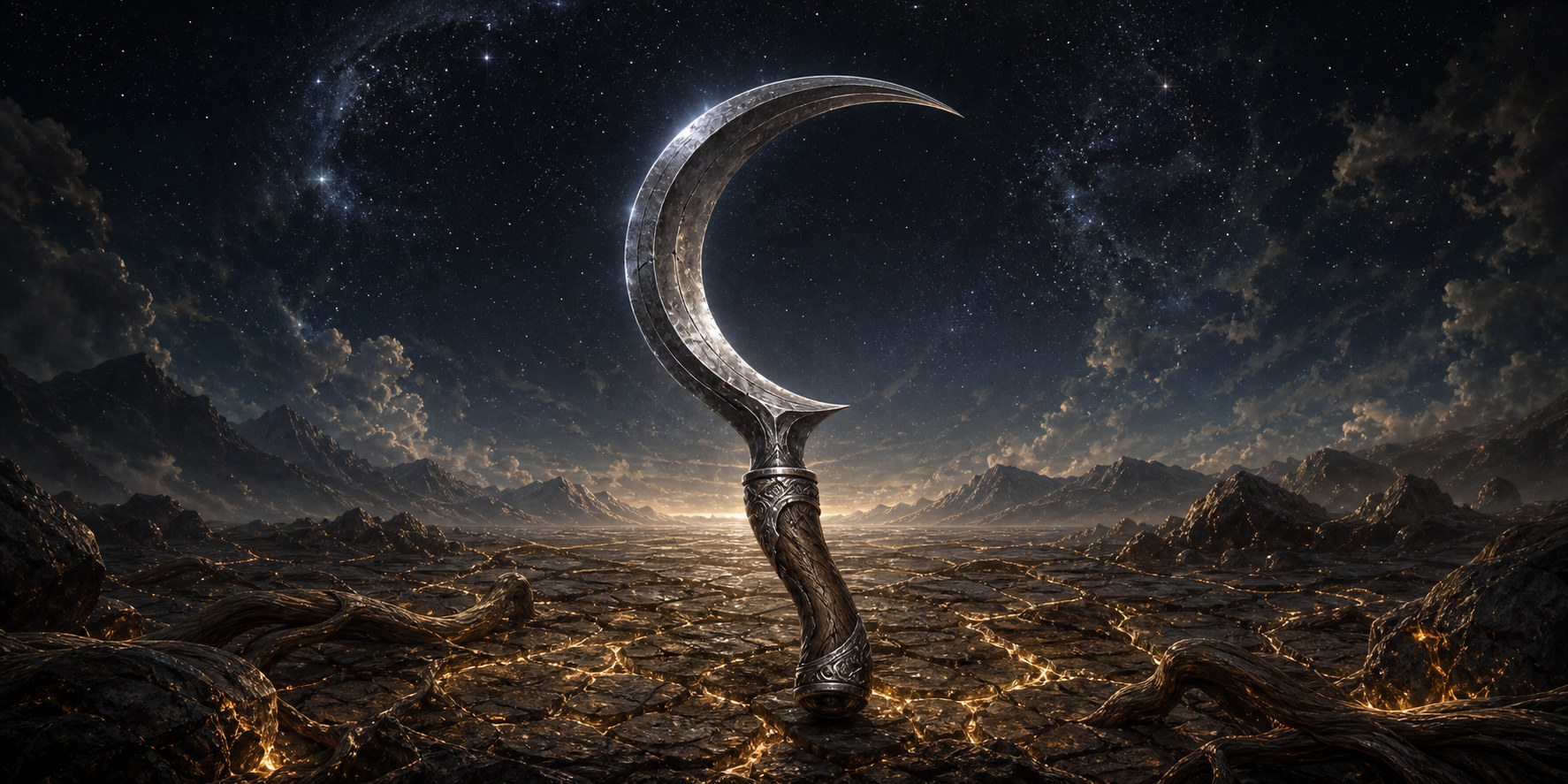
The Adamantine Sickle is the weapon Gaia gave Cronus to overthrow Uranus. With one strike it ended the first divine kingship, separated sky from earth, and began the succession cycle that would eventually bring Zeus to power.
The First Weapon of Divine Revolution
The Adamantine Sickle is one of the earliest and most consequential weapons in Greek mythology. Long before Zeus received the Thunderbolt, Gaia fashioned a curved blade and asked her children to rise against Uranus, the sky god who pressed down upon her and imprisoned powerful offspring within the earth.
Cronus accepted the weapon. His ambush ended Uranus’s rule and opened space for a new cosmic age. Yet the strike also began a pattern: the son who overthrows a fearful father becomes a fearful father himself.
Why Gaia Made the Sickle
Uranus hated or feared some of his children, especially the Cyclopes and Hundred-Handers, and forced them into the depths of Gaia. Earth suffered under their confinement. She therefore devised a plan of rebellion and fashioned the sickle from adamant.
The weapon is born from pain inside the cosmos. It is not created for conquest abroad, but to cut open a family structure that has become unbearable.
What Is Adamant?
Adamant in ancient literature is not one precisely identified modern substance. It signifies extreme hardness, something unbreakable or impossible to resist. Later imagination often turns it into a miraculous metal, but its mythic function is more important than its chemistry.
An adamantine weapon can wound what ordinary material cannot. The sickle must be strong enough to cut divine flesh and alter the architecture of the universe.
The Ambush of Uranus
Gaia hid Cronus in ambush while Uranus descended over the earth. In Hesiod’s account, Cronus reached out with his left hand and used the great sickle in his right. The attack severed Uranus and ended his immediate rule.
Later traditions expand the scene by placing other Titans at the corners of the world to hold the sky fast. Whether imagined as a solitary strike or coordinated rebellion, the act separates heaven from earth and creates room for the generations that follow.
What Emerged from the Wound
The violence produces new life. From the blood falling upon Gaia arise the Erinyes, the Giants, and the Meliae in Hesiod’s account. The severed part cast into the sea becomes connected with the birth of Aphrodite.
This is one of Greek mythology’s most unsettling creative patterns: separation, violence, and generation occur together. Clicking from the sickle to Aphrodite reveals that even a goddess of beauty can emerge from a brutal succession myth.
From Liberator to Devouring King
Cronus initially appears as the child willing to confront Uranus. Yet after taking power, he receives a prophecy that his own child will overthrow him. He responds by swallowing his children.
The sickle thus becomes an ironic symbol. It gave Cronus freedom from his father, but it could not free him from fear. The weapon changed the ruler; it did not change the logic of rule.
The Sickle and the Harvest
A sickle is an agricultural tool used to cut grain. Cronus’s later Roman identification with Saturn strengthened associations with sowing, harvest, abundance, and the Golden Age.
The dual meaning is powerful. The same curved blade can harvest life or mutilate a god. Myth places agricultural rhythm beside political succession: growth requires cutting, and every age eventually yields to another.
Where Did the Sickle Go?
Later geographic traditions claimed that Cronus threw the sickle into the sea near a place named Drepanon, a name connected with the Greek word for sickle. Other craftsmen, including the Telchines, were sometimes associated with making a sickle for Cronus.
These variations turn the weapon into a map. A primordial act leaves traces in coastlines, place names, local claims, and competing traditions about divine craftsmanship.
Another Adamantine Sickle
Perseus also receives an adamantine sickle or curved blade for the beheading of Medusa. It is not always treated as the same object, but the echo is important. In both myths, an impossible body can be cut only with an impossible blade.
That parallel opens a path from Cronus to Perseus and from cosmic rebellion to heroic quest.
Questions That Open the Next Path
- Why did Gaia later oppose Cronus as well? Her alliances reveal that Earth supports no ruler unconditionally.
- How did Aphrodite emerge from the aftermath? Her birth connects beauty, sea foam, and primordial violence.
- Was Perseus’s sickle the same weapon? The recurring adamantine blade links the fall of Uranus with the death of Medusa.