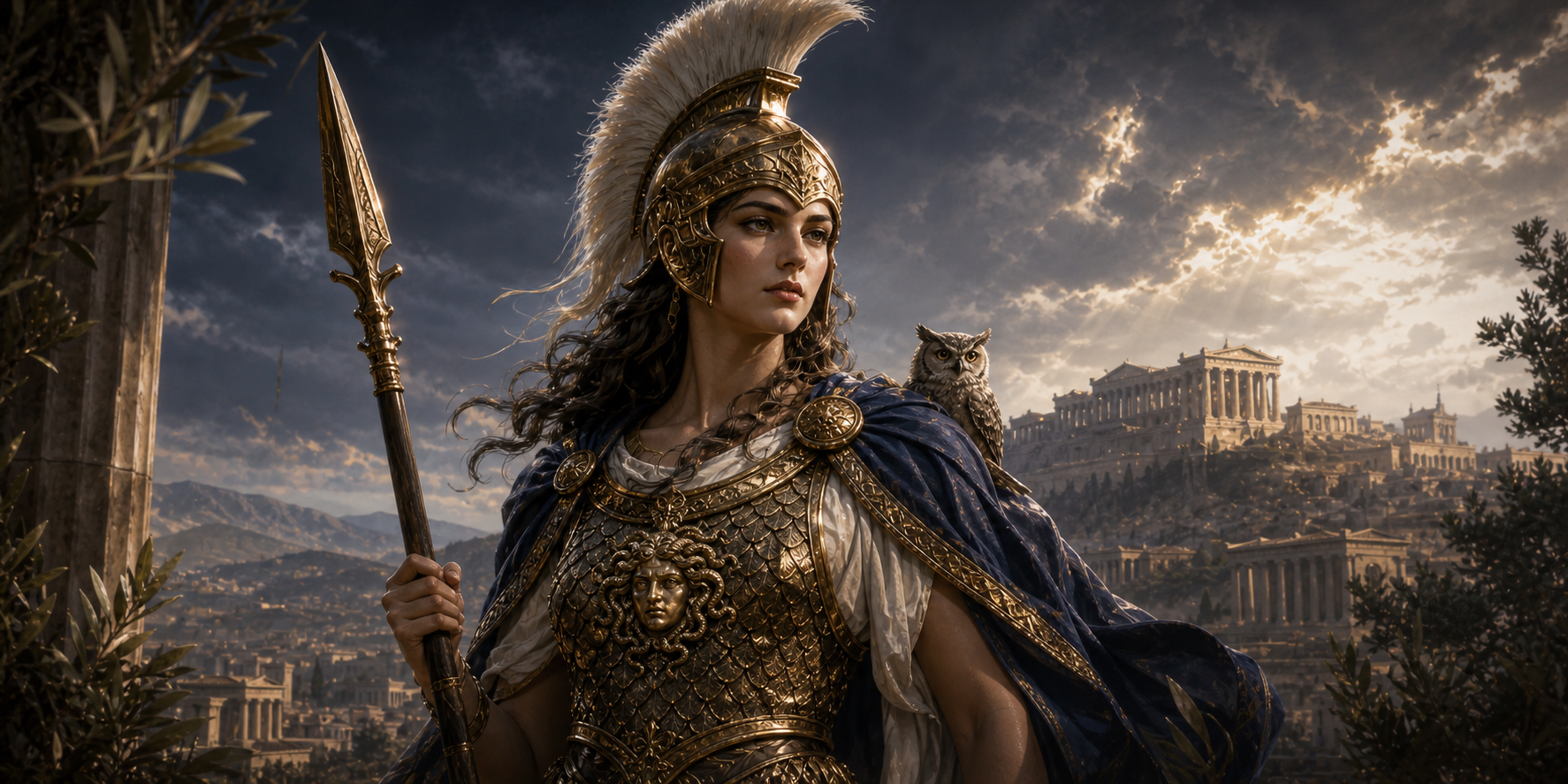
The armored intelligence that turns divine power into strategy, craft, and civic order.
- Aegis
- Gorgoneion
- Olive
- Owl
- Strategy
- Wisdom
- Primordial Age
- Titan Age
- Olympian Age
- Heroic Age
- Trojan Cycle
Athena sprang fully armed from Zeus after he swallowed the pregnant Metis. Goddess of wisdom, strategy, craft, and cities, she bears the Aegis and protects Athens through disciplined civic power. In the Gigantomachy she guides Heracles, showing how her warfare differs from Ares’s uncontrolled fury.
A crack opened in the sovereignty of Zeus, and from it stepped a goddess already armed. Athena’s birth from her father’s head is one of Greek myth’s most startling images: wisdom, strategy, and civic power arrive not as an infant to be protected, but as a force ready to take her place beside the ruler of Olympus.
Primary Tradition: Born from Zeus
Hesiod names Metis, a goddess of counsel, as Athena’s mother. A prophecy warned that after bearing a remarkable daughter, Metis might bear a son destined to rule heaven. Zeus swallowed her, repeating the succession fears that shaped Uranus and Cronus. When the time came, Athena emerged from Zeus, and later accounts describe Hephaestus or Prometheus splitting his head with an axe.
Why is Athena often described as motherless when Metis stands behind the story? Her visible birth is from Zeus alone, and Olympian ideology emphasizes her closeness to her father. Yet the swallowed Metis preserves a hidden maternal source for the wisdom Athena embodies.
Wisdom, Strategy, and Craft
Athena governs intelligent action: counsel, planning, skilled making, and the disciplined defense of communities. Weaving is among her most famous crafts, but her domain extends beyond a single technique. She represents knowledge applied under pressure, whether a city needs institutions, a hero needs a plan, or an artisan needs mastery.
This is why her wisdom is rarely detached contemplation. Athena enters councils, battlefields, workshops, and journeys. She asks what action will work, what order can endure, and which tool fits the problem.
A Different War from Ares
Athena and Ares both belong to war, but they do not symbolize the same experience. Ares is often associated with the fury, bloodshed, and destabilizing appetite of combat. Athena more often represents formation, restraint, defense, timing, and strategic intelligence. Ancient stories can complicate both gods, yet the contrast remains one of the clearest paths between them.
Can a goddess of wisdom also be a war goddess? For Athena there is no contradiction. A city survives only when judgment can organize force. Her martial identity is political because it protects a community rather than celebrating violence for its own sake.
The Aegis and Gorgoneion
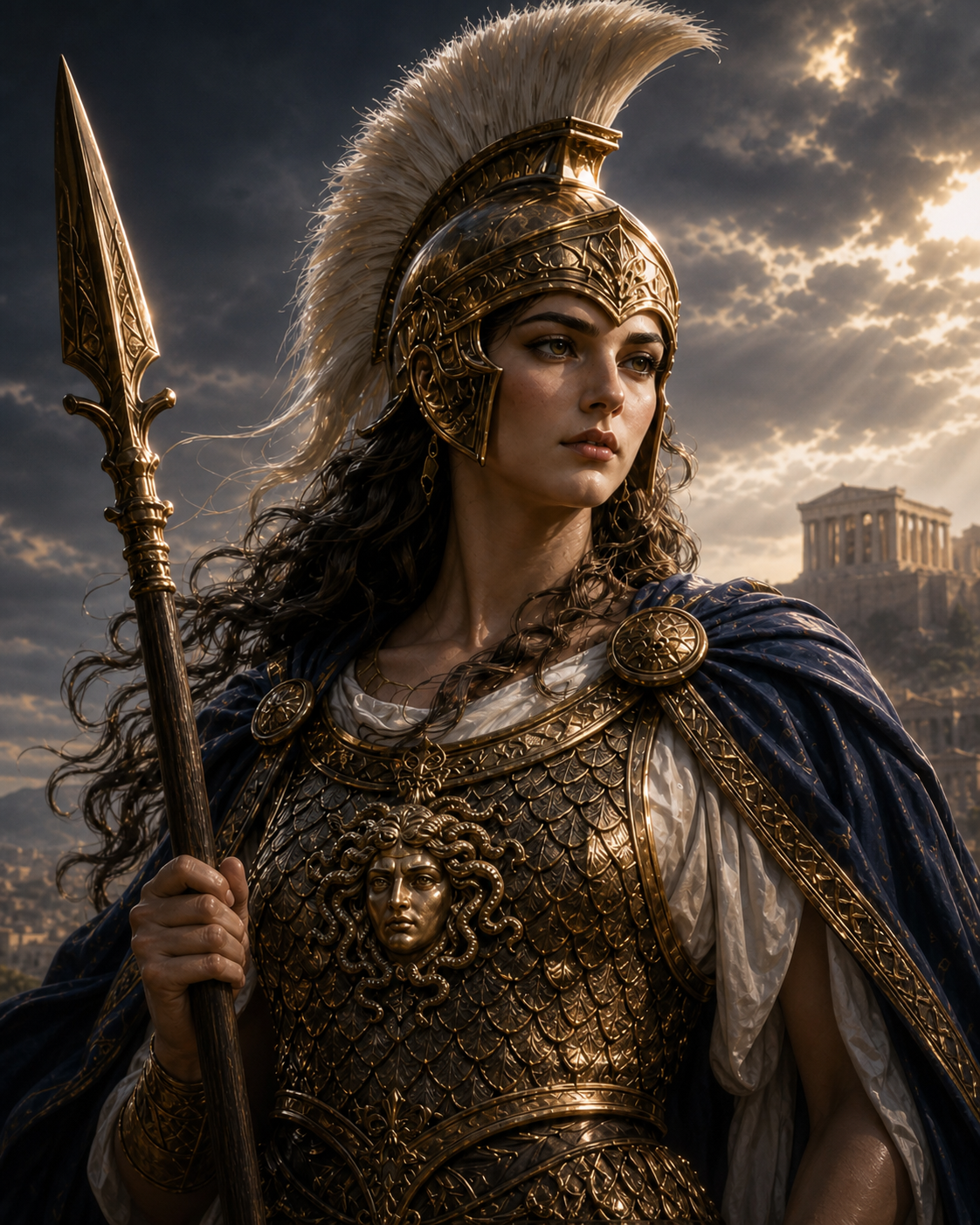
Athena’s most recognizable protection is the Aegis, often bearing the Gorgoneion, the frightening face of Medusa. The Aegis should not be reduced to a simple shield owned only by Athena. Poetry also links it strongly to Zeus, while art shows it as a mantle, breast covering, or shield-like form.
Athena makes the emblem visible in action. Its terror guards the bearer and unsettles opponents. The Gorgoneion turns a dangerous face outward, showing how the goddess converts threat into protection.
Athena in the Gigantomachy
During the Gigantomachy, Athena stands near the center of the Olympian defense. Apollodorus makes her the adviser who tells Heracles to drag Alcyoneus away from the land that sustains his immortality. He also describes her crushing Enceladus beneath Sicily and using the skin of Pallas in battle.
The details vary across literature and art, but Athena’s function remains consistent: she identifies conditions that strength alone cannot solve. Heracles supplies the mortal power required by prophecy; Athena directs that power toward victory.
The Contest for Athens
Athena and Poseidon competed for the patronage of Attica. Poseidon produced a sign associated with seawater or, in later versions, the horse. Athena offered the olive. The judges and exact sequence vary, but Athena’s gift won, and the city took her name.
Why would an olive defeat the sign of a sea god? The tree joined food, oil, wood, light, trade, and cultivated continuity. The myth imagines civic identity as a choice about what kind of power sustains a community. Poseidon’s continued importance to Athens shows that divine rivalry did not erase dependence on the sea.
Helper of Heroes
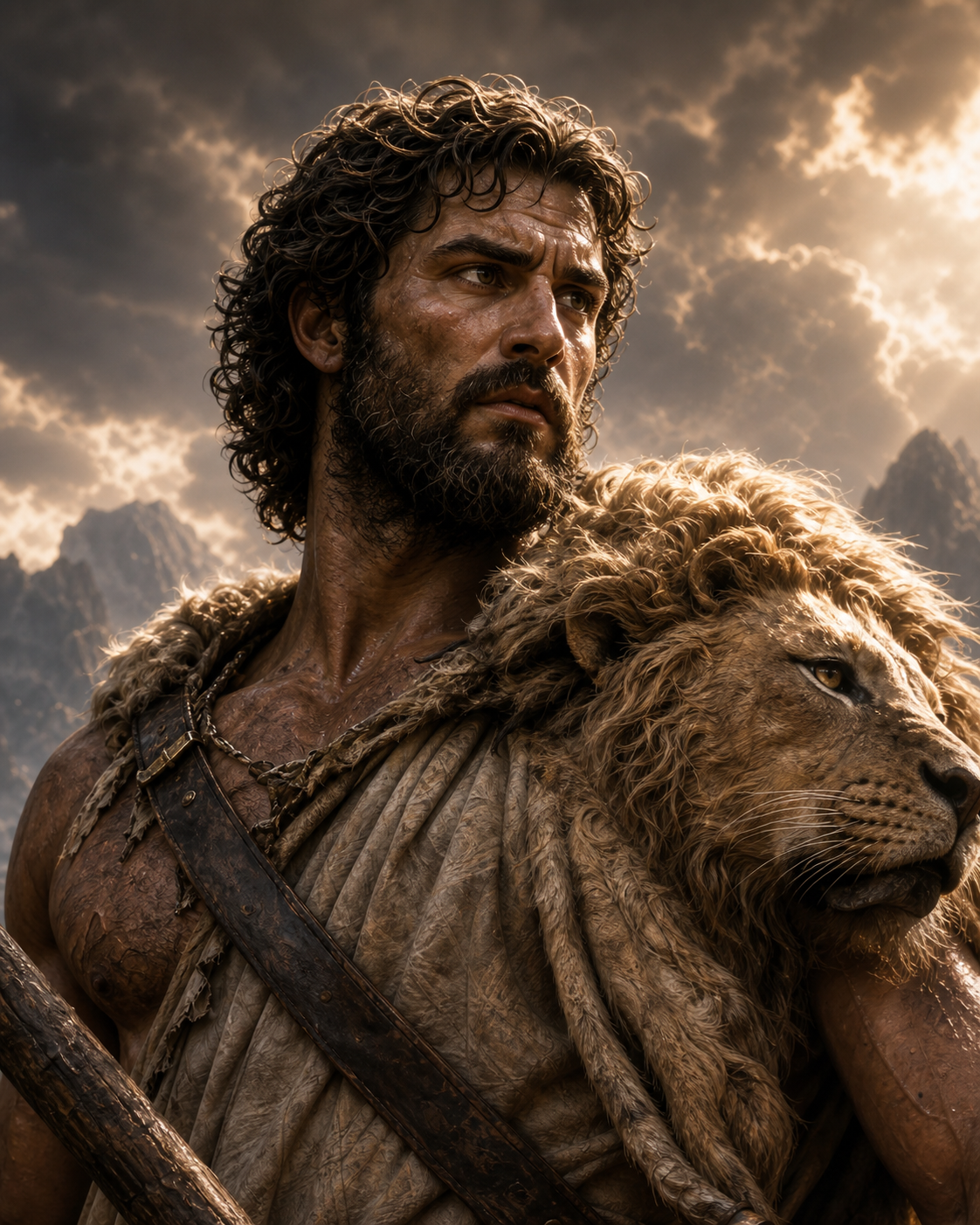
Athena guides heroes who can combine courage with thought. She assists Perseus against Medusa, supports Heracles during his labors and the Gigantomachy, and stands beside Odysseus through concealment, counsel, and return. Her help does not remove danger; it makes survival depend on perception and disciplined choice.
These alliances reveal her standards. Athena favors capability that can listen. A hero who accepts guidance becomes more than a strong body, while a clever hero learns when intelligence requires restraint.
Alternative Traditions
Athena’s birthplaces, helpers at her emergence, and local titles vary. Some traditions connect her strongly with the river Triton or call her Tritogeneia. Stories about Pallas also differ: the name may belong to a companion, an opponent, or a title whose origin ancient writers explained in several ways.
Responsible reading preserves these differences. The goddess was worshiped across the Greek world, and local communities did not need every title or origin story to fit a single biography.
Symbolism and Civic Meaning
Helmet, spear, owl, olive, snake, Aegis, and Gorgoneion form a visual language of watchfulness and protected order. As Athena Polias, she belongs to the city itself; as Athena Parthenos, she embodies an independent divine authority not organized around marriage.
For Athens, her patronage was cultural and political. Festivals, temples, and civic imagery made the goddess a way of imagining the community’s intelligence, military defense, craftsmanship, and claimed place in the Greek world.
Legacy and Paths Forward
Athena remains one of antiquity’s most durable images of strategic intelligence. Roman tradition identified her with Minerva, while later art and political allegory repeatedly used her armored wisdom to personify cities, learning, and disciplined power.
Follow Metis to the hidden cost of Athena’s birth, Ares to the opposite face of war, Poseidon to the contest for Athens, Medusa to the origin of the Gorgoneion, and Heracles to the mortal strength Athena learned how to direct. Each path turns a familiar warrior goddess into a larger map of divine government.
Her network also explains why no single label is enough. “Wisdom” without craft misses the hands that make a city possible; “war” without civic protection misses what she fights to preserve; “virgin goddess” without Metis misses the hidden mother inside Zeus. Athena joins these tensions without dissolving them. Her intelligence lies in maintaining distinctions and then discovering how they can work together.
That pattern makes her an ideal guide through Project Mythos. Her spear leads toward war, the olive toward civic life, the owl toward watchful intelligence, and the Aegis toward Zeus, Medusa, and sacred protection. Each symbol opens a different route, but all return to deliberate action.
Trivia
- The owl and olive became among Athena’s best-known signs, especially in Athenian civic imagery.
- Athena is frequently shown fully armed even though she is also a patron of weaving and other crafts.
- Roman writers and worshipers identified Athena with Minerva, but the two traditions were not identical in every detail.