Medusa's confronting face transformed into a guardian against danger.
- Aegis
- Athena
- Gorgon Face
- Medusa
- Protection
- Origin
- Creation
- Major Appearance
- Later Tradition
- Legacy
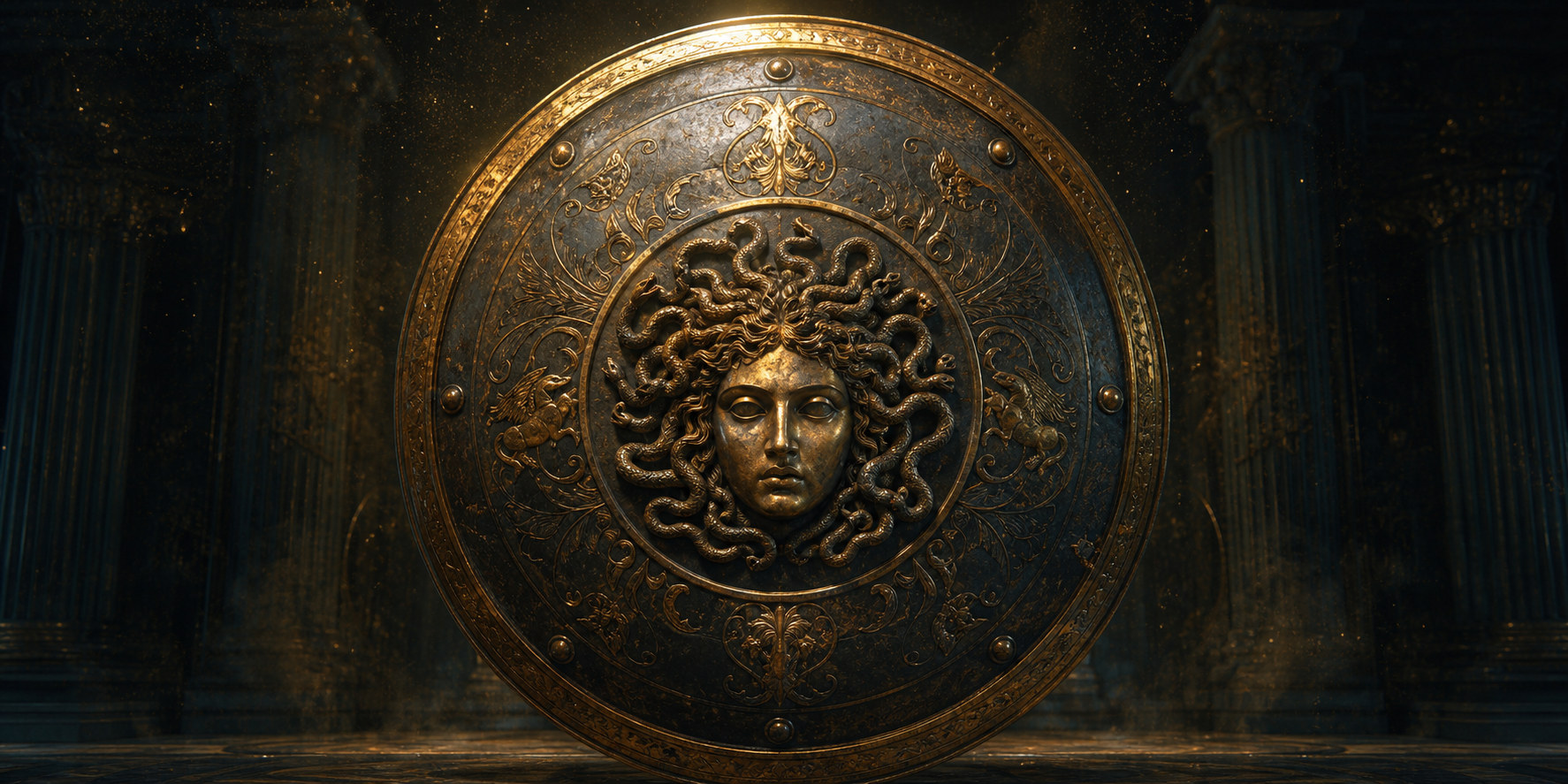
The Gorgoneion is the frontal head or face of a Gorgon used as a protective emblem. Myth links it to Medusa's severed head, given by Perseus to Athena and placed on her shield or Aegis. In art it stares outward from armor, temples, vessels, coins, and jewelry to turn danger against danger.
A face stares directly from the center of divine protection. It has no body, yet it carries the danger of Medusa; it belongs to a defeated monster, yet gods and mortals use it to guard themselves. The Gorgoneion is the point where a mythic character becomes an artifact without losing the force of her story.
What Is a Gorgoneion?
A Gorgoneion is the frontal head or face of a Gorgon used as an emblem. It is related to Medusa but not identical to every image of her. A narrative scene may show Perseus approaching the sleeping Gorgon; a Gorgoneion isolates the face and directs its gaze outward toward the viewer.
This distinction explains why the emblem can appear far beyond illustrations of the quest. It functions on armor, buildings, vessels, coins, and jewelry as a concentrated sign of danger and protection.
From Medusa to Athena
In Apollodorus, Perseus gives the severed head to Athena after completing his quest. The goddess places it at the center of her shield. This story supplies a narrative origin for the emblem’s transfer from a mortal Gorgon to a divine bearer.
The exchange also completes the cooperation that made the quest possible. Athena guided the fatal strike; Perseus returns the most powerful result to her. Is the Gorgoneion a captured weapon, an offering of gratitude, or both?
The Gorgoneion and the Aegis
The Gorgoneion often appears on Athena’s Aegis, but the Aegis is more than the face itself. Ancient poetry and art variously imagine the Aegis as a mantle, goatskin, breast covering, or shield-like form associated with Zeus and Athena. The Gorgoneion may occupy its center as the focal sign of terror.
Keeping the two artifacts distinct creates a clearer reading path. The Aegis is the field of divine protection and authority; the Gorgoneion is the confronting face that can be placed upon it.
Older Than One Explanation
Gorgon faces appear in Greek art in contexts that do not require a viewer to know one standardized account of Perseus handing the head to Athena. Myth and image developed together, and the protective use of frightening faces is broader than a single literary origin story.
Project Mythos therefore treats the Perseus narrative as a powerful explanation, not as proof that every ancient Gorgoneion was designed from one text. Objects can preserve ritual and visual habits that literature later organizes into story.
How the Face Confronts the Viewer
Archaic Gorgoneia often use round eyes, bared teeth or tusks, a protruding tongue, curling hair, and strong frontality. These features resist the calm side-facing convention of many Greek figures. The emblem seems to look out of the object rather than remain inside a scene.
The frontal gaze makes the owner secondary. On a shield or breast, the enemy meets the Gorgon before meeting the bearer. On a temple, a visitor encounters a supernatural guardian before crossing the architectural boundary.
Apotropaic Power
The usual term for this protective use is apotropaic: intended to turn away harm. The logic is not that Medusa has become gentle. Her threat remains active and is redirected. Terror guards against terror.
This makes the Gorgoneion different from a decorative portrait or a memorial of Perseus’s victory. Its value depends on continued agency. The head still does something: it watches, warns, freezes, or symbolically repels what approaches.
Divine Authority and Mortal Use
Athena is the most famous bearer, and Zeus can also be associated with an Aegis marked by Gorgon terror. Yet Gorgoneia spread across mortal objects as well. Soldiers, households, worshippers, and cities could place the face where protection was desired.
The movement from divine armor to everyday scale helps explain the emblem’s longevity. A myth about an edge-of-the-world monster becomes a portable technology of boundary-making.
Changing Images of Medusa
Over time, artists often softened the grotesque early face, producing a beautiful or sorrowful Medusa with snakes woven into human hair. Roman art and later European traditions expanded this transformation, while modern artists frequently return attention to violence, survival, and the ownership of the gaze.
The Gorgoneion can therefore carry conflicting meanings: conquered enemy, divine shield, protective watcher, tragic victim, or symbol of defiance. Its history is powerful precisely because no single reading exhausts the face.
Its placement always matters. At the center of armor it protects a moving body; above an entrance it holds a fixed threshold; on a small ornament it brings a monumental supernatural warning into intimate scale. The same frontal design can therefore change its emphasis without losing its basic work of confronting what approaches.
Where the Story Leads
Follow Medusa to recover the mortal Gorgon behind the emblem, Perseus to understand how the head was obtained, Athena to see who receives and deploys it, and the Aegis to explore the larger protective form. From there, the Gigantomachy shows divine armor acting within a cosmic conflict rather than resting in a museum case.
Trivia
- Gorgoneion refers specifically to the Gorgon head or face used as an emblem.
- The face is frequently shown frontally even when nearby figures appear in profile.
- Gorgoneia appear on objects ranging from monumental architecture to small pieces of jewelry.