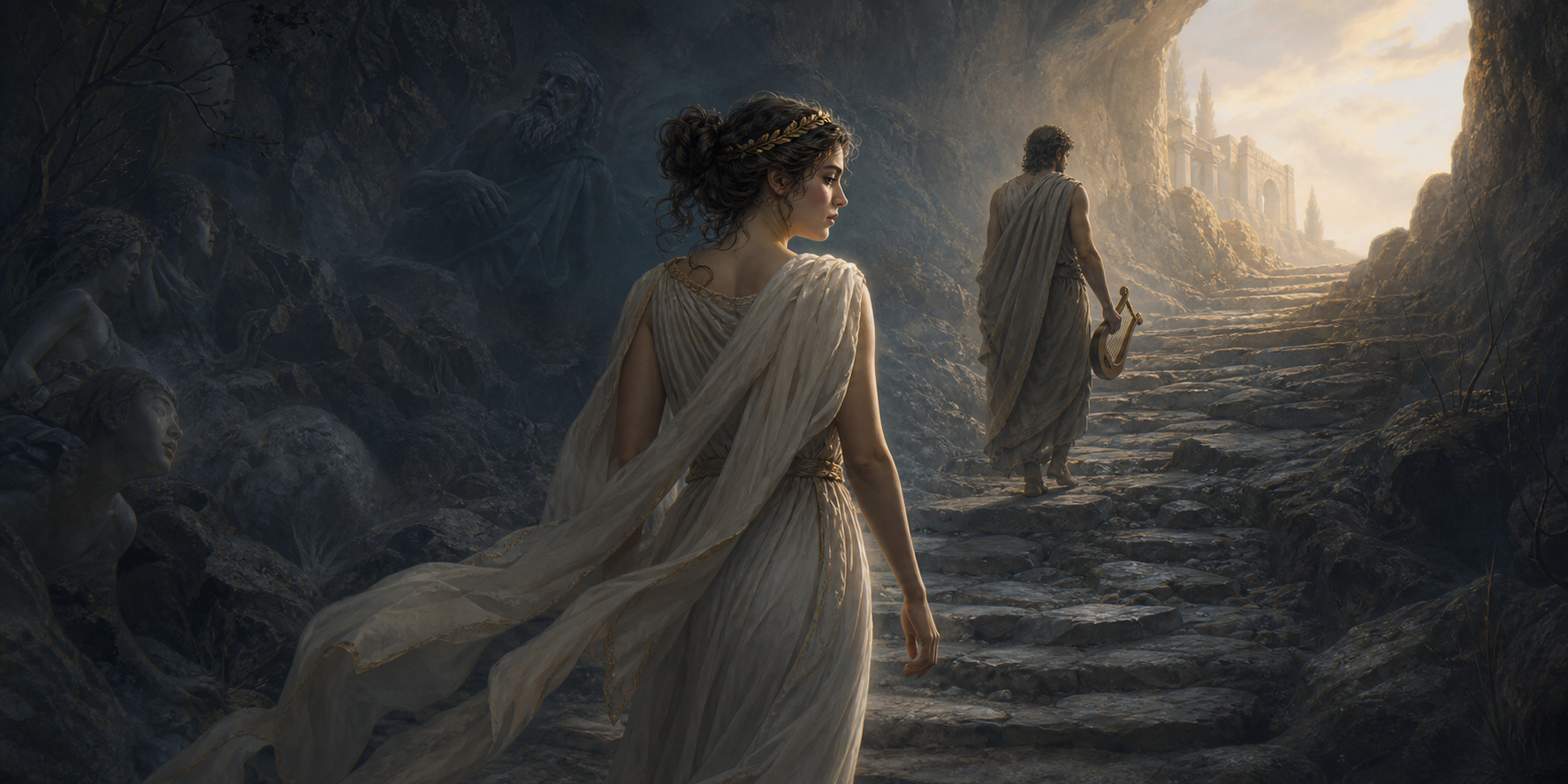
The twice-lost wife whose silent ascent turns love, trust, and sight into one test.
- Backward Glance
- Hades
- Orpheus
- Persephone
- Serpent
- Underworld

- Primordial Age
- Titan Age
- Olympian Age
- Heroic Age
- Trojan Cycle
Eurydice is the wife whom Orpheus attempts to recover from the Underworld. Hades and Persephone permit her return if he does not look back, but the condition fails near the upper world and she is lost a second time.
Eurydice is remembered through a disappearance and a second disappearance. Soon after marriage she dies, and Orpheus enters the Underworld to recover her. His music wins an exception from Hades and Persephone, but the return depends on a condition: he must not look back until both have reached the upper world. He turns, and Eurydice is lost again.
A Figure Shaped by Fragmentary Traditions
Early evidence for Orpheus’s attempt to retrieve a wife is limited, and the name Eurydice is not equally secure in every early reference. The fullest surviving narratives are Roman, especially Virgil’s Georgics and Ovid’s Metamorphoses. They agree on the fatal backward glance but differ in tone, detail, and emphasis.
This history requires caution. There was no single complete Greek “original” preserved behind every later adaptation. Eurydice’s modern familiarity is built from fragments, Roman poetry, opera, painting, drama, and new retellings that repeatedly give the silent or briefly speaking wife a larger interior life.
The First Death
Virgil connects Eurydice’s death to Aristaeus. Fleeing his pursuit, she steps on a snake and dies. Ovid gives the wedding itself ominous signs and has the bride die from a serpent bite while walking with naiads. Other summaries omit a pursuer. The variations change how responsibility is distributed around the loss.
The snake makes death sudden, natural, and chthonic at once. Eurydice does not choose a heroic descent. She becomes the reason another person crosses the boundary. This difference matters when comparing her with Persephone, whose divided residence is imposed through abduction and divine negotiation.
The Song before the Underworld Rulers
Orpheus reaches the land of the dead and sings before Hades and Persephone. He does not claim permanent victory over mortality. In Ovid, he argues that all living people eventually belong to the Underworld and asks only for Eurydice’s life to be restored before its proper term. The song stills punishments and moves the dead to tears.
The rulers agree, demonstrating that the Underworld is governed rather than mechanically sealed. Yet their exception has a rule. Eurydice must follow behind, unseen, until the journey is complete. The arrangement makes trust and sequence as important as musical power.
The Backward Glance
Near the upper boundary Orpheus looks back. Ancient poets offer overlapping motives: love, fear that Eurydice is not there, desire to see her, or a moment of madness. The condition fails regardless of motive. Because Eurydice still stands within the lower realm, she is pulled away.
Virgil gives her a reproachful final speech; Ovid makes her last word a farewell that contains no complaint because she was loved. These are distinct interpretations of the same vanishing. Modern retellings often ask whether the rule was cruel, whether Eurydice chose to follow, or whether a relationship dependent on silence could ever return unchanged.
Eurydice’s Perspective
Ancient narratives mostly organize the episode around Orpheus’s artistry and grief. Eurydice walks behind him and receives little opportunity to act. That imbalance has made her especially productive for later writers. Giving her a voice does not merely add dialogue; it changes the central question from “Why did he turn?” to “What did return mean for her?”
Some modern versions imagine memory fading in death, the upper world becoming frightening, or Eurydice choosing between identities. These developments belong to reception rather than ancient consensus, but they expose a genuine gap in the inherited plot. The woman recovered as an object of love is also the only person asked to cross death’s border twice.
After the Second Loss
Orpheus tries to return but is refused. He withdraws from ordinary relationships and is later killed, often by Thracian women or Maenads. After his death, some traditions reunite him with Eurydice among the dead. The reunion is bittersweet: the journey could not cancel mortality, but mortality eventually places them in the same realm.
Her story therefore does not end only at the glance. It continues through Orpheus’s mourning, death, and the artistic traditions that preserve her name. Every performance repeats the ascent and knows in advance that the condition will fail.
What Eurydice Means
Eurydice embodies the difference between being loved and being fully seen. Orpheus can move stones, trees, gods, and punishments, yet he cannot secure knowledge of the person behind him without breaking the rule that permits her return. The myth turns love’s need for assurance into the mechanism of loss.
It also makes recovery morally complex. Returning a person is not the same as restoring the life that existed before death. Eurydice has crossed a boundary, entered another jurisdiction, and become part of a story told largely by the survivor. Later art keeps reopening that imbalance.
Where the Story Leads
Follow Orpheus for the song and fatal glance, Hades and Persephone for the exception they authorize, and the Underworld for the boundary of the ascent. Cerberus represents the gate passed through music, while future paths to Aristaeus, the Maenads, and Orphic traditions open the first death, aftermath, and ritual reception.
Trivia
- The fullest surviving accounts of her return are Roman rather than early Greek.
- Virgil and Ovid give Eurydice different final responses to the backward glance.
- Later artists frequently expand her viewpoint beyond the ancient narratives.