
Queen of Olympus and Guardian of Marriage
- Childbirth
- Lawful Union
- Marriage
- Queenship
- Royal Authority
- Women
- Primordial Age
- Titan Age
- Olympian Age
- Heroic Age
- Trojan Cycle
Hera is queen of the Olympian gods and goddess of marriage, women, childbirth, and royal authority. Her cult represented the dignity and social power of lawful union.
Hera is queen of the Olympian gods and one of the most important goddesses of ancient Greece. She presides over marriage, queenship, lawful union, women, and childbirth. Although later retellings often define her mainly through jealousy, her religious importance was far broader: Hera represented the dignity, danger, and social power of marriage itself.
A Daughter of Cronus and Rhea
Hera was born to Cronus and Rhea and, like most of her siblings, was swallowed by Cronus because he feared being overthrown by his children. Zeus eventually compelled Cronus to release them. Hera then belonged to the generation that replaced the Titans and established the Olympian order.
Queen Beside Zeus
As the wife of Zeus, Hera occupies the highest female position on Olympus. Their marriage represents divine sovereignty and the institution of marriage, yet their relationship is famously turbulent. Zeus repeatedly violates the bond he is supposed to uphold, while Hera responds with resistance, punishment, and attempts to defend her status. These myths reveal more than marital conflict: they dramatize the tension between royal authority and lawful partnership.
Marriage, Women, and Childbirth
Hera was worshipped as a guardian of marriage and women’s life transitions. Titles such as Hera Teleia, associated with the fulfillment of marriage, show that she was central to the social and sacred meaning of lawful union. She was also connected with childbirth, sometimes alongside her daughter Eileithyia. Major sanctuaries at Argos and Samos demonstrate that her cult was not secondary to Zeus but ancient, influential, and regionally powerful.
Conflict in Myth
Many of Hera’s best-known myths concern the lovers and children of Zeus. She opposes Leto, persecutes Io, and becomes the relentless enemy of Heracles. Yet these stories should not reduce her to a simple villain. Within myth, Hera often acts from the limited position of a queen whose marriage is publicly dishonored but whose husband cannot easily be punished. Her anger is displaced onto rivals and descendants, creating some of Greek mythology’s most tragic conflicts.
Symbols and Sacred Presence
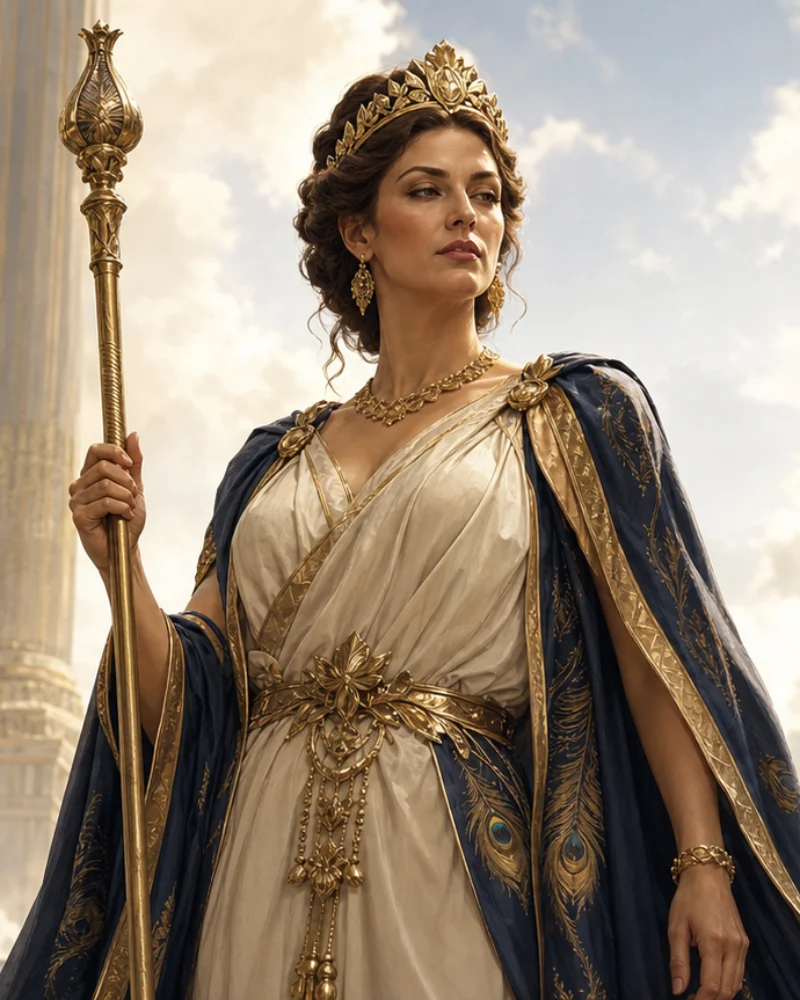
Hera is commonly shown as a majestic, veiled queen wearing a crown or diadem and holding a scepter. The peacock became her best-known animal in later art, while the cow and cuckoo also belonged to her symbolic tradition. The pomegranate could evoke marriage, fertility, and royal abundance.
Legacy
The Romans identified Hera with Juno, who protected marriage and the Roman state. Hera’s legacy remains complex: she is a divine queen, a guardian of lawful partnership, and a figure whose myths expose the unequal costs of power, marriage, and public honor.