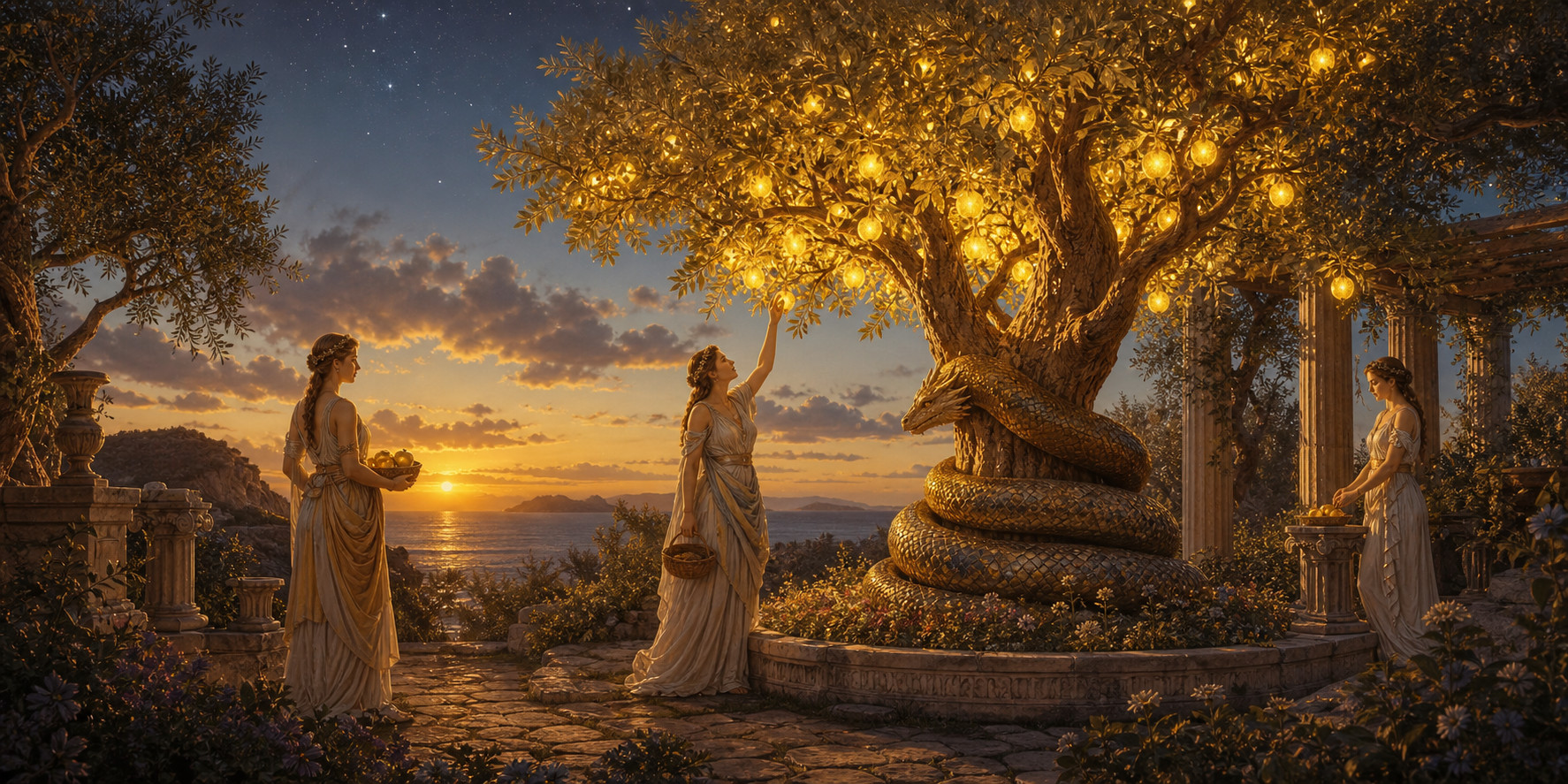
The remote orchard where evening nymphs and a deathless serpent protect Hera's golden fruit.
- Atlas
- Golden Apples
- Heracles
- Hesperides
- Ladon
- Ocean
- Origin
- Divine Occupation
- Major Myths
- Cult / Tradition
- Legacy
The Garden of the Hesperides is the remote divine orchard guarded by the Hesperides and the serpent Ladon. Ancient sources place it beyond Ocean, in the far west, Libya, or other distant regions, and Heracles reaches it through either Atlas's help or a direct encounter.
The Garden of the Hesperides is less a point on an ordinary map than a guarded edge of the mythic world. Beyond familiar roads and often beyond Ocean, a tree bears golden fruit under the care of the Hesperides and a deathless serpent. Heracles reaches this boundary for the labor of the apples, but ancient sources disagree about the route, the garden’s exact direction, and whether the hero enters it himself or asks Atlas to retrieve the prize.
A Garden beyond the Familiar World
Hesiod places the Hesperides beyond famous Ocean and toward the quarter of night. The language gives the garden a cosmological position rather than a surveyed address. It belongs where day approaches darkness, where divine geography begins after the routes of ordinary travelers have run out.
Later authors move or specify the setting in different ways: far west, Libya, the lands of Atlas, islands in Ocean, or a northern Hyperborean region. These locations should not be forced into one itinerary. Their shared function is remoteness. The garden is a destination found only after guidance, ordeal, or passage beyond the known world.
The Hesperides
The garden takes its familiar name from the Hesperides, nymphs connected with evening and the west. Hesiod makes them daughters of Night, while later genealogies connect them with Atlas and other parents. Their number and individual names vary, including Aegle, Erytheia, Hesperia, and Arethusa in one mythographic list.
They are guardians, singers, and inhabitants of a sacred landscape rather than interchangeable decorations around a tree. Some images emphasize their calm relation with the serpent; others focus on Heracles and the fruit. The nymphs personify the garden’s threshold between beauty, distance, and restricted access.
The Tree and Its Dragon
The golden apples grow on a tree guarded by an immortal serpent, commonly called Ladon in later tradition. Hesiod describes a terrible serpent watching the all-golden fruit in the hidden places of earth. Apollodorus gives the guardian a hundred heads and many voices, linking it to Typhon and Echidna.
The dragon does not merely threaten intruders. Its coils define ownership and limit approach. A treasure at the world’s edge still requires custody. The Hesperides tend the place while the serpent makes the prohibition physical, joining cultivated garden and monstrous boundary in one image.
Hera’s Guarded Possession
Apollodorus says Earth presented the apples to Zeus after his marriage with Hera, and the fruit remained under Hera’s protection. Other traditions phrase the gift and ownership differently, but the wedding connection became influential. It makes the garden a storehouse of divine marriage and guarded value rather than a field open to heroic harvest.
The garden therefore creates a tension within Heracles’s labor. Eurystheus orders him to bring back an object that belongs inside a divine arrangement. Success cannot mean ordinary possession. The fruit can be carried away temporarily, displayed as proof, and ultimately returned to its sacred place.
The Long Search of Heracles
Heracles does not begin the labor knowing where the Hesperides live. Apollodorus sends him through a long chain of encounters before he learns the route from the shape-changing sea god Nereus. The search expands the labor far beyond one theft from one tree.
The journey includes challenges whose geography is deliberately vast and sometimes inconsistent by modern standards. Myth measures the distance through peoples, rivers, monsters, and divine informants. Reaching the garden means acquiring knowledge of the world’s edges, not simply walking west for a fixed number of days.
Atlas Enters the Labor
In the best-known Atlas version, Heracles takes the celestial burden while Atlas goes for the apples. Atlas can cross the final threshold because of his connection with the Hesperides and the western boundary. The exchange turns the labor into a negotiation between two figures capable of bearing impossible weight.
When Atlas returns, he proposes carrying the fruit onward while Heracles remains beneath the heavens. Heracles agrees only long enough to ask Atlas to take back the burden while he adjusts his support. Once Atlas resumes his place, the hero departs with the apples. Strength succeeds through speech and timing as much as endurance.
Heracles and Ladon in Other Traditions
Other accounts and images bring Heracles directly to the tree and make him confront the serpent. The hero may kill Ladon with an arrow and take the fruit himself. Ancient art can show the nymphs assisting, watching, or standing beside a serpent that is not always represented as actively attacking.
These versions do not need to be harmonized with the Atlas exchange. They answer the same question in different ways: how can a mortal hero obtain a divine fruit from a guarded edge? One tradition uses delegated access and a burden trick; another uses direct confrontation with the guardian.
A Place That Moves in Reception
Later geography repeatedly tried to place the Hesperidean garden in recognizable lands. Western islands, Atlantic coasts, North Africa, and other distant regions could all attract the name. Such identifications reveal the changing horizon of the people telling the story rather than a single lost archaeological site.
Art and literature also transform the garden into paradise, orchard, sunset realm, or emblem of inaccessible abundance. Project Mythos keeps these receptions connected while distinguishing them from the early cosmological language. The garden’s power comes partly from never becoming completely ordinary ground.
Where the Story Leads
Follow Atlas to the burden of the heavens, the Golden Apples to Hera’s guarded gift, and Heracles to the labor imposed by Eurystheus. Ladon and the Hesperides remain important future entries because guardian and gardeners explain different kinds of custody within the same place.
Ocean and the far west lead toward ancient ideas of the world’s limits. Gaia, Hera, Zeus, and the divine marriage tradition explain why the fruit matters before Heracles arrives. The garden connects cosmology, treasure, geography, and heroic negotiation in one remote landscape.
Trivia
- Ancient sources place the Hesperides in several different remote regions.
- The garden is guarded by both the Hesperides and an immortal serpent commonly called Ladon.
- Some traditions send Atlas for the apples, while others bring Heracles directly to the tree.