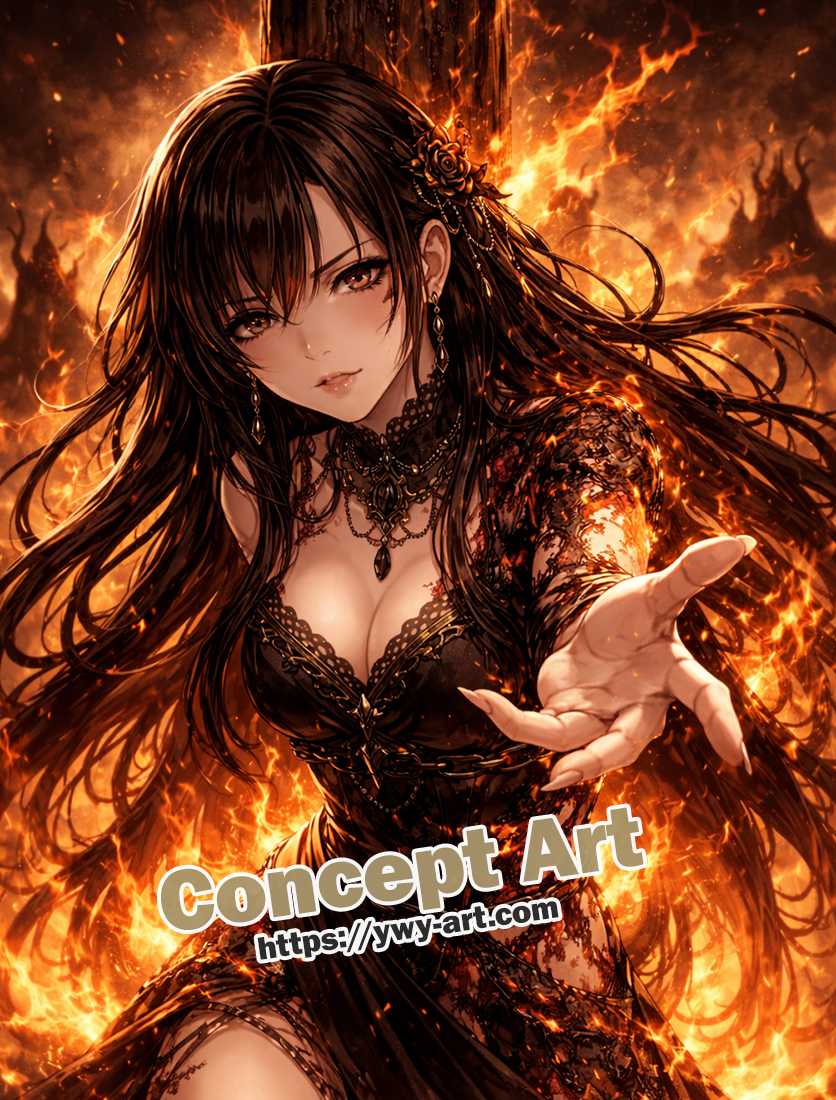
- Flame of Rebirth – Gullveig
- Basic Profile
- Overview
- Characteristics
- Symbolism and Meaning
- Quick Creative Reference
- Compare with Similar Deities
- The Woman Who Could Not Be Burned Away
- The Meaning of Flame of Rebirth
- The Scene Depicted in This Artwork
- Symbolism and Visual Elements
- Coloring Variations
- Coloring Tips
- Japanese Summary
- グルヴェイグという存在
- 再生の炎の意味
- このイラストの表現意図
- 塗りのポイント
- Explore Our Coloring Book Series
Flame of Rebirth – Gullveig
Gullveig is one of the most enigmatic and disturbing figures in Norse mythology — a woman who was burned again and again, yet could not be destroyed.
Basic Profile
| Name | Gullveig |
|---|---|
| Mythology | Norse |
| Gender | Female |
| Region | Scandinavia / Germanic North |
| Era | Medieval literary record based on older oral tradition |
| Domain | Magic, Gold, Desire, Destruction, Rebirth |
| Symbol | Fire, Spear, Gold, Sorcery |
| Culture / Religion | Old Norse religion |
| Main Role | A deathless figure whose repeated burning becomes a catalyst for divine conflict |
| Associated Deity | Sometimes interpreted in relation to Heiðr and seiðr magic |
| Common Depiction | A woman in flames who endures destruction without disappearing |
| Alignment | Chaotic / Transformative / Enduring |
| Creative Reference Use | Dark ritual, immortal witch, fire symbolism, destructive beauty, mythic rebirth |
Overview
Gullveig appears only briefly in the surviving Old Norse sources, yet that brief appearance is one of the most powerful in all of Norse myth. In Völuspá, she is taken by the gods, pierced by spears, and burned three times in the hall of Hárr — and still she lives. The text does not treat this as a miracle in a comforting sense. Instead, it presents Gullveig as a deeply unsettling presence: a being whom divine violence fails to erase.
This is one reason Gullveig has fascinated readers, scholars, and artists alike. Her role in myth is not fully explained, which gives her a rare symbolic intensity. She stands at the meeting point of punishment and persistence, destruction and revelation. The more the gods attempt to annihilate her, the clearer it becomes that she belongs to a power they cannot completely master.
Many interpretations connect Gullveig with wealth, desire, and destabilizing influence, in part because her name is often linked to gold. In the verses that follow, the figure of Heiðr appears as a wandering practitioner of seiðr, a powerful and often troubling form of Norse magic. Because of this sequence, Gullveig is frequently read as being closely related to Heiðr, or even as the same figure in another form, though that identification remains interpretive rather than absolutely certain.
Her story is also important on a larger mythological level. The episode involving Gullveig is commonly understood as one of the sparks that lead to the first war between the Æsir and the Vanir. In that sense, she is not merely a victim within the myth. She is part of the fracture line itself — the figure through whom hidden instability becomes visible.
Characteristics
- She is burned repeatedly but does not disappear.
- She is associated with a disruptive, transformative presence in the divine world.
- She is often read in connection with gold, desire, and corruption.
- She stands close to the tradition of seiðr, a powerful magical practice in Norse culture.
- Her treatment by the gods is tied to the mythic origins of larger conflict.
- She represents endurance through transformation rather than simple recovery.
Symbolism and Meaning
Gullveig symbolizes the kind of force that punishment cannot purify. Fire is usually imagined as an agent of cleansing, judgment, or final destruction. In her case, fire fails in all three roles. It does not erase her. It reveals her. That reversal gives Gullveig a uniquely dark symbolic power.
She can also be read as a figure of dangerous return. Her rebirth is not soft, healing, or sentimental. It is severe. Something is burned away, but something more essential remains. This makes her a compelling mythic image for survival beyond ruin, especially in stories where beauty, desire, knowledge, and danger are inseparable.
Because of her association with seiðr, Gullveig also carries the symbolism of boundary-crossing power. Norse magic in this tradition is not merely decorative mysticism; it is linked to fate, trance, transformation, and the unsettling reshaping of reality. Gullveig therefore belongs not only to the imagery of fire, but also to the older fear of forces that cannot be governed once they have entered the world.
Quick Creative Reference
| Best For | Dark fantasy illustration, immortal witch archetypes, ritual fire scenes, mythology-based coloring art |
|---|---|
| Visual Keywords | Flame, Ash, Gold, Spear, Sorcery, Bound Figure, Ritual Fire, Rebirth, Endurance |
| Mood | Severe, Alluring, Relentless, Mythic, Dangerous, Unbroken |
| Useful Themes | Rebirth through destruction, divine punishment, forbidden magic, instability of order, survival beyond annihilation |
Compare with Similar Deities
| Name | Mythology | Main Domains | Overall Image |
|---|---|---|---|
| Gullveig | Norse | Magic, Fire, Rebirth, Conflict | A deathless mythic woman whose burning reveals unstoppable transformation |
| Sekhmet | Egyptian | War, Destruction, Healing | A lioness goddess of solar wrath and divine punishment |
| Phoenix | Mythic Motif | Fire, Renewal | A being reborn from ashes in a cyclical pattern of destruction and return |
The Woman Who Could Not Be Burned Away
What makes Gullveig memorable is not simply that she survives, but that the gods themselves fail to end her. In myth, divine punishment is usually final. When a figure is struck down by the powers of the cosmos, that moment confirms the hierarchy of the world. Gullveig interrupts that logic.
She is pierced. She is burned. She is subjected to repeated destruction. And yet the myth refuses to give the gods the final word. This is what makes her presence so unnerving. She is not triumphant in the ordinary heroic sense. She does not conquer through force of arms. Instead, she exposes a limit within the authority of those who try to destroy her.
That alone gives her a darker and more sophisticated mythic force than a simple “reborn heroine” archetype. Gullveig is not reassuring. She is disruptive. Her continued existence implies that certain powers, once present, cannot simply be cast out or purified.
The Meaning of Flame of Rebirth
The title Flame of Rebirth is meant in the hardest possible sense. This is not rebirth as comfort, healing, or redemption. It is rebirth as proof that destruction has failed. The fire in Gullveig’s myth is both punishment and revelation: it is meant to end her, but instead it discloses what she truly is.
That is why flame is the correct visual language for her. Fire is unstable, devouring, and transformative. It destroys old form, but it also marks transition. In Gullveig’s case, the flame does not symbolize a clean beginning after a tragic end. It symbolizes continuity inside the act of destruction itself.
This distinction matters. Gullveig does not merely “come back.” She persists through the very process that should have erased her. Her rebirth is therefore not a reset. It is the revelation of a nature that cannot be reduced to ash.
The Scene Depicted in This Artwork
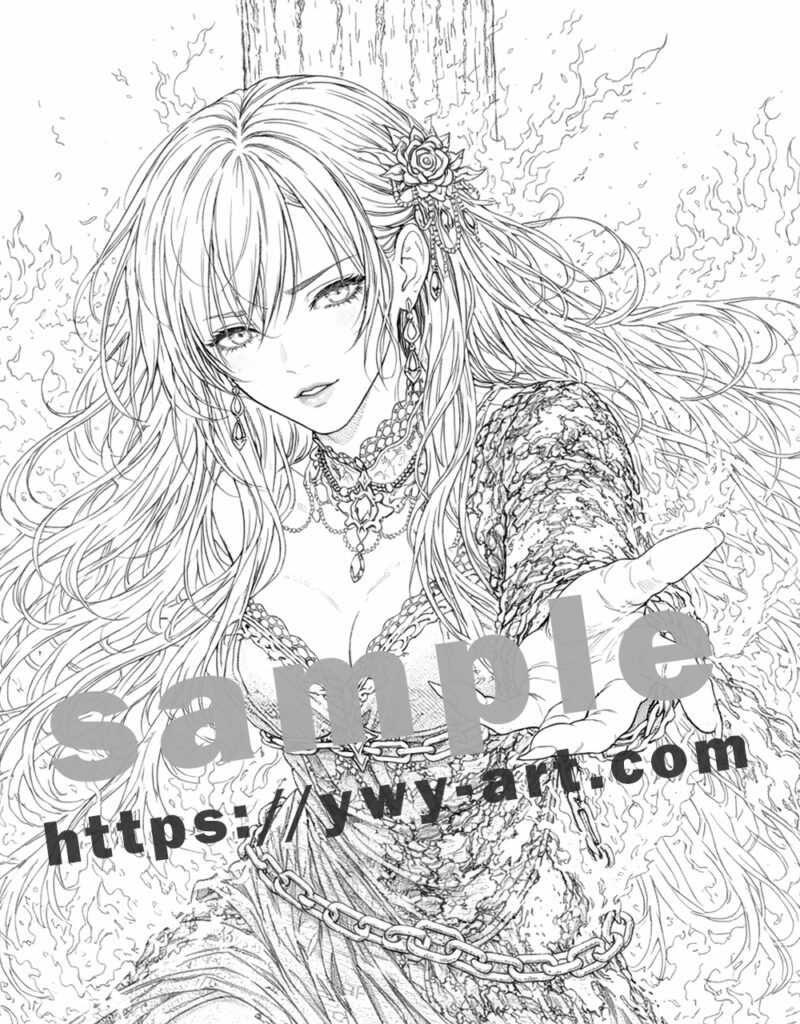
This illustration captures Gullveig not after the ordeal, but in the middle of it. She is bound to the post, surrounded by fire, and caught in the exact threshold between annihilation and return. That middle state is crucial, because it allows the image to hold both suffering and endurance at once.
One side of her body is visibly overtaken by flame, while the other remains comparatively intact. This split is not only visual drama; it is the central idea of the myth made visible. Gullveig is being destroyed and continuing to exist at the same time.
Her outstretched hand is also important. It does not read as a plea for rescue. Instead, it suggests persistence, reach, and continuation. There is strain in the image, but not surrender. The expression retains a controlled severity with a slight dangerous allure, reinforcing the idea that what is emerging from the fire is not weakness purified into innocence, but a harder and more formidable form of being.
Symbolism and Visual Elements
The post and restraints place the scene in the language of ritual punishment. This is not random violence. It feels formal, deliberate, almost sacrificial. That atmosphere suits Gullveig well, because in myth she is not simply attacked; she is made the object of repeated judgment.
The flames climbing across her body represent more than physical destruction. They act as a dividing line between what can be damaged and what cannot. The burned and unburned halves of the figure visualize the paradox at the core of her myth: loss and endurance occupying the same body.
Her hair flowing into flame extends this idea further. Rather than keeping the fire external, the image allows it to merge with her identity. The force meant to erase her becomes inseparable from her final form. This is where the image moves beyond illustration and into symbolism.
Coloring Variations
- Royal Ember: Gold, crimson, and radiant orange for a heightened, mythic rebirth atmosphere.
- Dark Ritual: Black, burgundy, ash gray, and muted copper to emphasize sorcery, punishment, and severity.
- Ashen Trance: Pale skin, smoky violet, dull ember-red, and low-saturation flame tones for a colder, more eerie result.
Coloring Tips
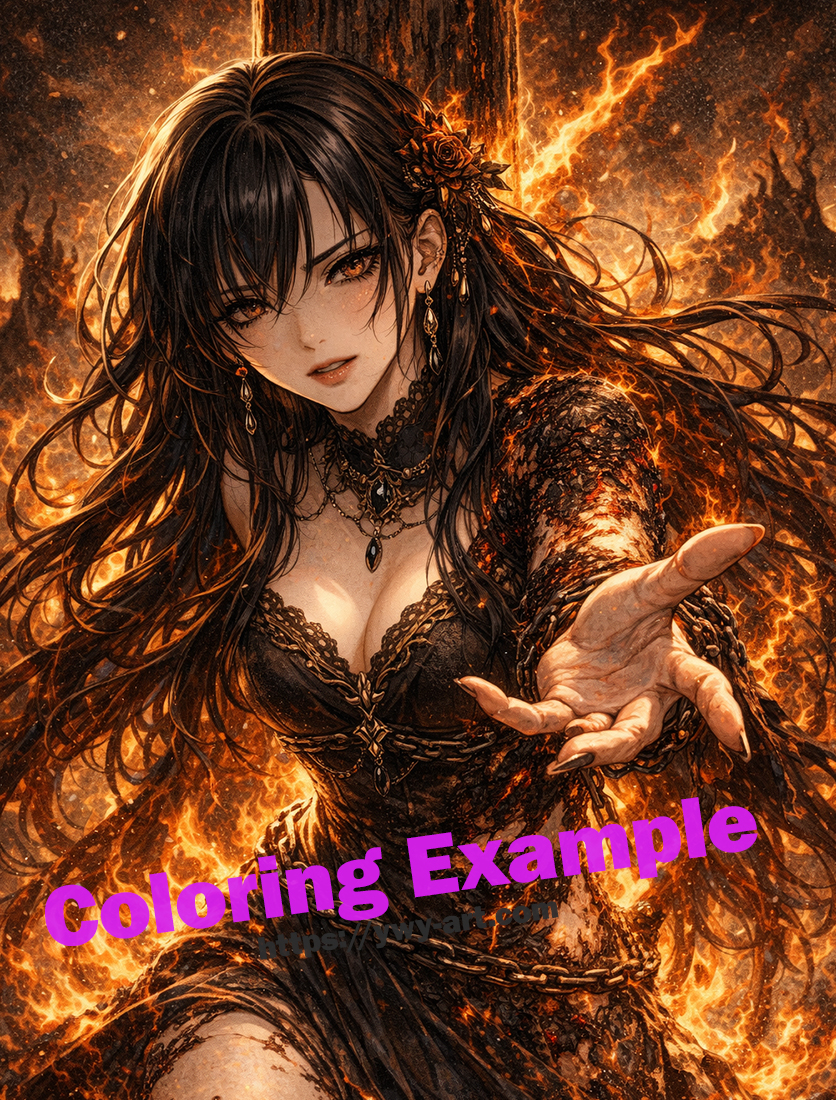
For a stronger finish, separate the flames into multiple layers rather than coloring them as a single mass. Deep reds and dark oranges can anchor the outer heat, while yellows and pale highlights can define the hottest inner sections.
The burned side should not be filled with flat black. It works better with textured layering: dark brown, charcoal gray, and ember-red accents can create the feeling of cracking heat and scorched depth without losing detail.
The unburned side should remain smoother and cleaner in tone. That contrast is essential to the image. Hair can also transition gradually from dark natural shades into fiery reds and oranges at the tips, reinforcing the theme of transformation without breaking the flow of the composition.
Japanese Summary
グルヴェイグは、北欧神話の中でも特に不穏で象徴性の強い存在です。神々に槍で貫かれ、何度も焼かれながら、それでも消えることなく生き続ける存在として描かれます。その出来事は神々の秩序にひびを入れ、アース神族とヴァン神族の争いへつながる発端のひとつとして読まれてきました。
また彼女は、運命や変容に関わる魔術「セイズ」と結びつけて解釈されることが多く、Heiðr との関係もたびたび論じられます。断定は避けるべき部分がある一方で、グルヴェイグが「破壊によって本質を暴かれる存在」として非常に強い神話的魅力を持つことは確かです。
グルヴェイグという存在
グルヴェイグの特徴は、何度焼かれても終わらないことにあります。ここで重要なのは、単に不死身であるというだけではありません。彼女を焼いたのは神々であり、本来ならその処罰は絶対であるはずでした。ところが神々の暴力は彼女を消し去ることができません。
この点によって、グルヴェイグは神話の中で非常に異質な立場を持ちます。彼女は戦って勝つ英雄ではなく、消されないことによって秩序の限界を露呈させる存在です。だからこそ彼女は、単なる悲劇の被害者ではなく、世界の均衡を揺るがす契機そのものとして読まれます。
さらに、その後に続く Heiðr とセイズの描写を重ねることで、グルヴェイグは「危険な知」「欲望を刺激する力」「境界を越える魔術」といったイメージとも強く結びついていきます。短い登場でありながら、彼女が強い印象を残すのはこのためです。
再生の炎の意味
本作の「再生」は、やさしい回復や救済ではありません。焼かれ、失われ、それでもなお残り続けるという、きわめて苛烈なかたちの再生です。火は本来、浄化や処罰や終焉を象徴するものですが、グルヴェイグにとってはむしろ本質を可視化する装置になっています。
つまり彼女の再生とは、死から戻ることではなく、「破壊されても終わらない存在であること」が明らかになる過程です。火を経ることで別のものに変わるのではなく、火によって消えない核が露わになる。この点に、グルヴェイグというモチーフの強さがあります。
だからこそ炎は背景ではなく主題です。炎は彼女を包み込みながら、同時に彼女の輪郭を浮かび上がらせます。終わりを与えるはずのものが、存在の証明に変わる。この逆転こそが、グルヴェイグ神話の核心です。
このイラストの表現意図
このイラストでは、グルヴェイグを「焼かれた後」ではなく、「焼かれている最中」の姿として描いています。この途中状態にすることで、破壊と再生の両方を一枚の中に同時に成立させています。柱に拘束され、炎に包まれながらも、視線と存在感は崩れていません。
身体の片側を焼損し、もう片側を保つ構図は、神話の本質を視覚化したものです。失われていく部分と残り続ける部分が同じ身体に共存することで、「壊れながら在り続ける」という矛盾をそのまま見せています。
また、前へ差し出した手は救いを求める身振りではなく、「まだ終わらない」という意思の表現です。表情にわずかな妖艶さを残しつつ、苦痛に屈しない硬さを持たせたのは、グルヴェイグを単なる受難の存在ではなく、炎の中でなお強度を増していく存在として見せるためです。
塗りのポイント
炎は赤・橙・黄だけで単純に塗り分けるより、外側を重く、内側を明るくする意識で重ねると熱量が出ます。焦げた部分は真っ黒で潰さず、こげ茶、灰、赤黒い色を使って質感をつくると奥行きが出ます。
無傷の側は比較的なめらかな肌や布の色で整えると、焼けた側との対比がはっきりし、作品のテーマが伝わりやすくなります。髪も毛先に向かって炎へ移行するように色を変えると、再生と変容の印象を自然に強めることができます。
Explore Our Coloring Book Series
Discover more mythological goddesses and dark fantasy illustrations from the series.
Step into the world of mythology..
Available on Amazon Dark Ritual Goddesses of Mythology Coloring Book Open in a new tab







コメント