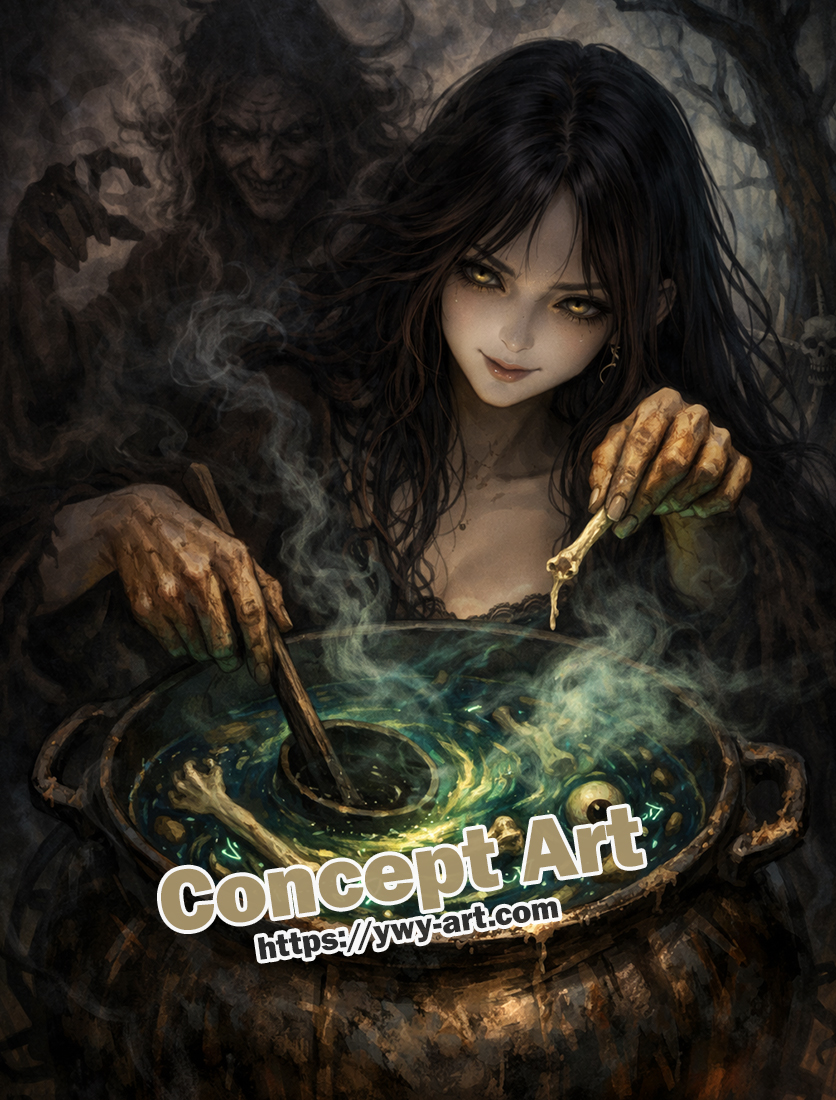
Baba Yaga is a legendary witch of Slavic folklore associated with fate, danger, wisdom, and transformation, standing at the boundary between destruction and guidance.
- Basic Profile
- Overview
- Characteristics
- Symbolism and Meaning
- Quick Creative Reference
- Compare with Similar Deities
- The Witch Who Stands Beyond Good and Evil
- The Meaning of Cauldron of Curses
- The Scene Depicted in This Artwork
- Symbolism and Visual Elements
- Coloring Variations
- Coloring Tips
- Japanese Summary
- バーバ・ヤーガという存在
- Cauldron of Curses の意味
- このイラストの表現意図
- 塗りのポイント
- Explore Our Coloring Book Series
Basic Profile
| Name | Baba Yaga |
|---|---|
| Mythology | Slavic folklore |
| Gender | Female |
| Region | Eastern Europe |
| Era | Ancient / Folkloric tradition |
| Domain | Witchcraft, Fate, Trials, Death, Transformation |
| Symbol | Cauldron, Forest, Bones, Mortar and Pestle, Hut on Chicken Legs |
| Culture / Religion | Slavic folk tradition |
| Main Role | Guardian of forbidden knowledge, tester of the worthy, embodiment of dangerous transformation |
| Associated Figure | Forest spirits, ancestral forces, liminal beings |
| Common Depiction | An ancient witch dwelling deep in the forest, sometimes appearing with both terrifying and strangely composed beauty |
| Alignment | Ambiguous / Transformative |
| Creative Reference Use | Dark fantasy, ritual magic, witch archetypes, duality of beauty and decay, trial-and-transformation themes |
Overview
Baba Yaga is one of the most iconic and unsettling figures in Slavic folklore. She is not a simple villain, nor a comforting guide, but a presence that exists beyond ordinary moral categories. She is associated with the deep forest, forbidden knowledge, dangerous wisdom, and the kind of transformation that is never gentle.
Her value as a mythology reference comes from that instability. Baba Yaga can threaten, judge, devour, warn, or empower depending on who stands before her. This makes her especially compelling for visual storytelling, where contradiction, tension, and atmosphere are more powerful than a single fixed role.
Characteristics
- Lives at the threshold between guidance and destruction
- Associated with the forest, witchcraft, and trials of character
- Often connected to bones, fire, ritual tools, and uncanny domestic objects
- Can appear as a terrifying crone, a composed ritualist, or a figure of unsettling ambiguity
- Represents transformation gained through danger, fear, and confrontation with the unknown
Symbolism and Meaning
Baba Yaga symbolizes the part of myth where wisdom is inseparable from risk. Her world is not safe, and her power is not nurturing in a simple sense. The forest around her represents the unknown, while her hut, tools, and rituals suggest that power is hidden behind tests, fear, and uncertainty.
At the same time, she is not merely destructive. Baba Yaga is compelling because she stands at the point where terror becomes revelation and danger becomes transformation. She does not simply harm. She reveals what someone truly is when all comfort has been stripped away.
Quick Creative Reference
| Best For | Witch character design, dark fantasy settings, ritual scenes, folklore-inspired horror, transformation symbolism |
|---|---|
| Visual Keywords | Cauldron, forest, green flame, bones, smoke, shadow, ritual symbols, eerie beauty, ancient magic |
| Mood | Haunting, secretive, tense, ritualistic, uncanny, transformative |
| Useful Themes | Forbidden knowledge, judgment, metamorphosis, beauty and decay, fear as a gateway, the cost of power |
Compare with Similar Deities
| Name | Mythology | Main Domains | Overall Image |
|---|---|---|---|
| Baba Yaga | Slavic folklore | Witchcraft, Trials, Fate, Transformation | Ambiguous forest witch who tests, judges, and transforms |
| Circe | Greek | Magic, Transformation, Enchantment | Sorceress of seductive power and supernatural change |
| Hecate | Greek | Magic, Crossroads, Night, Spirits | Mystic guardian of liminal spaces and occult knowledge |
The Witch Who Stands Beyond Good and Evil
Baba Yaga is one of the most enduring figures in Slavic folklore because she cannot be reduced to a single role. She is feared as a devourer, remembered as a keeper of dangerous wisdom, and respected as a force that tests those who dare to seek what lies beyond ordinary life.
Unlike a conventional villain, she does not destroy for chaos alone. Her presence functions more like a trial. Those who approach her with arrogance, foolishness, or selfish desire are often broken by the encounter. Those who endure fear and prove their worth may leave with knowledge, tools, or a transformed understanding of themselves.
The Meaning of Cauldron of Curses
The phrase “Cauldron of Curses” suggests more than simple malice. A cauldron is a vessel of change, where separate elements are broken down and remade into something new. In the world of Baba Yaga, that process is never comforting. It belongs to the realm of ordeal, mystery, and dangerous knowledge.
Curses in this sense are not only punishments. They also represent consequences, hidden truths, and forces that cannot be controlled once awakened. The title therefore points to a ritual space where fate is altered, identities are stripped down, and transformation comes with a cost.
The Scene Depicted in This Artwork
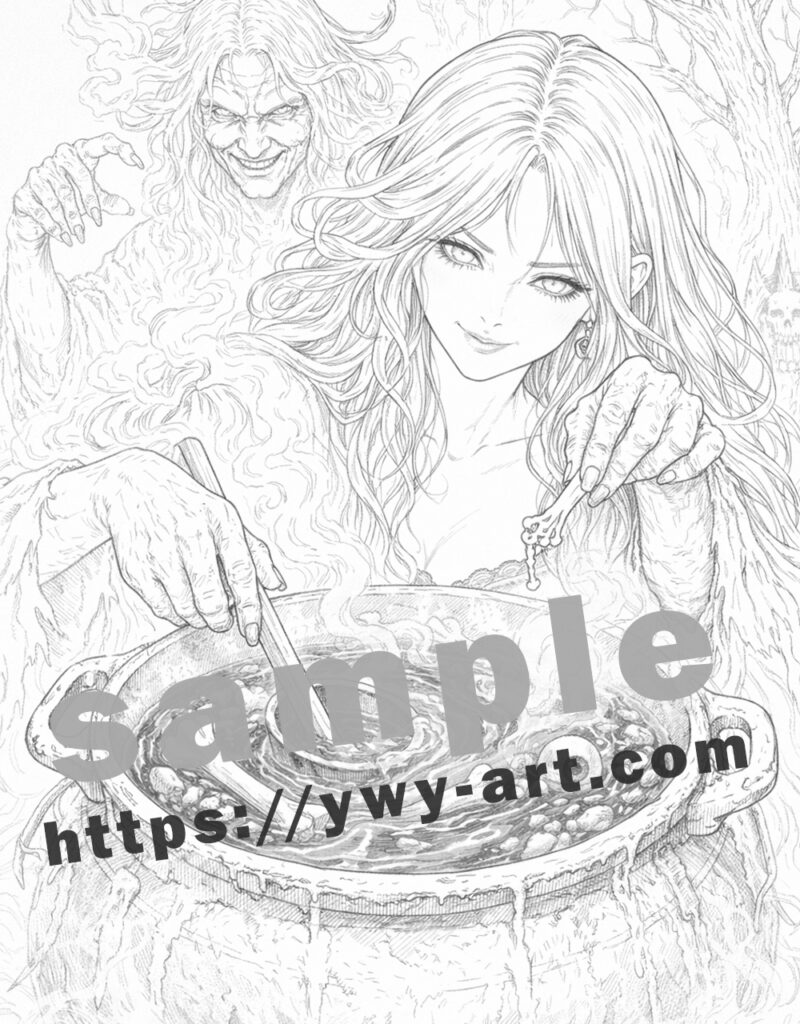
This illustration captures Baba Yaga at a moment of quiet concentration. She stands before a boiling cauldron, not in a frenzy, but with the controlled certainty of someone who understands exactly what power she is handling. That restraint is what makes the scene more unsettling. Nothing is exaggerated, yet everything suggests that something irreversible is already underway.
The glowing liquid is filled with bones, eyes, and ritual forms, implying that this is no ordinary potion. It feels less like a spell being cast and more like a fate being prepared. Behind her, a dark shadow rises like another self, hinting that the ritual may be revealing her true nature rather than merely serving her will.
Symbolism and Visual Elements
The cauldron functions as the central symbol of transformation. It is the place where life and death, beauty and horror, knowledge and punishment are mixed together. Its glow acts as both illumination and warning, revealing just enough to make the unseen feel more threatening.
The bones and eyes suggest memory, mortality, and the price of forbidden knowledge. The shadow behind Baba Yaga reinforces her duality, presenting her as both a visible ritualist and an older, deeper force that cannot be fully contained in human form. The stillness of her pose contrasts with the instability of the magic, creating a powerful sense of contained danger.
Coloring Variations
- Forest Ritual Style: Use deep greens, moss tones, muted browns, and dim yellow light for an ancient woodland atmosphere.
- Cursefire Style: Use toxic greens, dark teal, black, and sharp pale highlights to emphasize forbidden magic and supernatural danger.
- Decay and Bone Style: Use ash gray, bone ivory, dull bronze, and smoky olive to create an aged, eerie, death-touched mood.
Coloring Tips
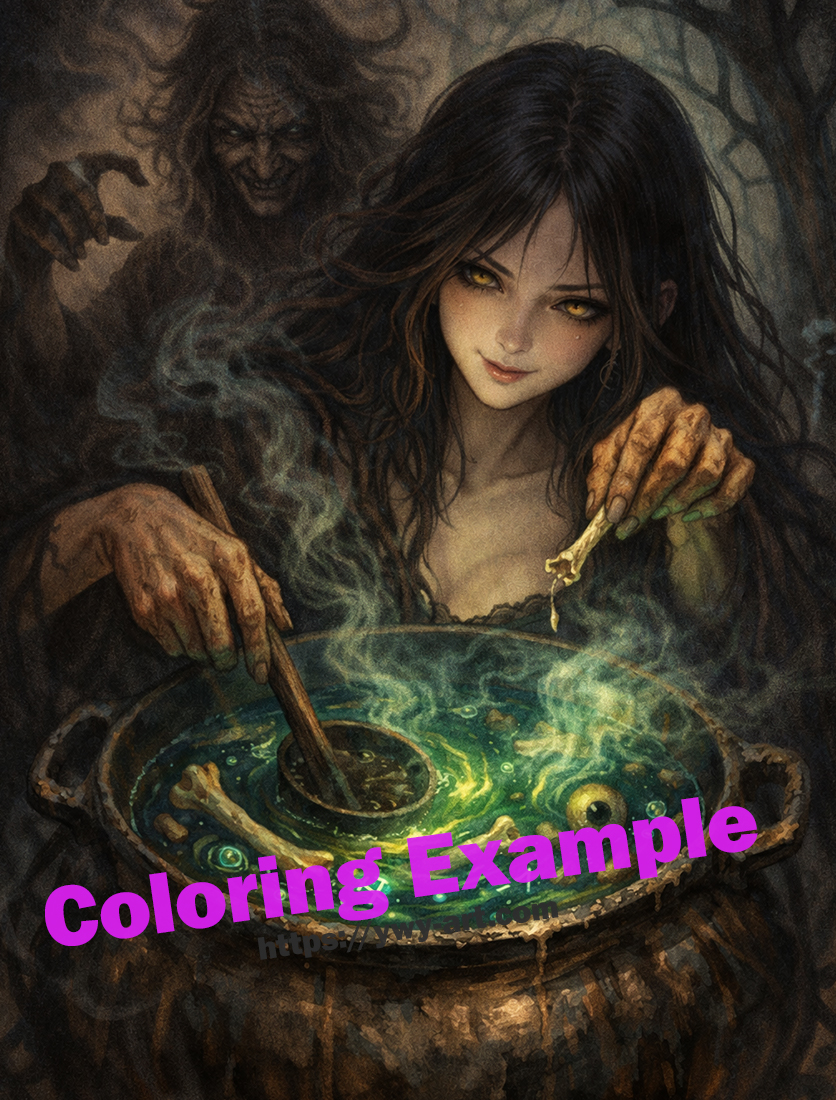
Start by treating the cauldron as the primary light source. Layer greens, yellow-greens, and subtle blue shadows inside the liquid so the glow feels magical rather than flat. A gradual transition from bright center to darker outer edges will make the potion appear alive and unstable.
Keep the surrounding forest and clothing more restrained in saturation. This helps the cauldron’s light dominate the composition and naturally guides the viewer’s eye toward the ritual. Bones, symbols, and small details should be colored carefully so they enrich the image without becoming visually noisy.
If you want to emphasize Baba Yaga’s duality, use slight temperature shifts in the skin, hair, or shadowed areas. Warm and cool contrast can subtly suggest beauty and decay existing together, which suits the mythic ambiguity of the character.
Japanese Summary
バーバ・ヤーガはスラヴ民話に登場する、恐ろしくも魅力的な魔女です。森の奥に住み、禁じられた知識、試練、変容、そして人の本質を見抜く力と結びついた存在として語られてきました。
彼女は単純な悪役ではなく、訪れる者を試し、場合によっては破滅させ、場合によっては力や知恵を与える曖昧な存在です。この危うさと多面性こそが、創作モチーフとしての大きな魅力になっています。
バーバ・ヤーガという存在
バーバ・ヤーガは、善悪のどちらかにきれいに分類できる存在ではありません。人を喰らう恐ろしい魔女として語られる一方で、試練を乗り越えた者には知恵や道具を与える存在としても描かれます。そのため彼女は、単なる脅威ではなく、訪れる者の本質を暴き出す“試し”そのもののような存在です。
彼女が住む深い森や異様な住まいは、現実の外側にある領域を象徴しています。そこへ足を踏み入れることは、安心できる日常を離れ、恐怖や未知と向き合うことを意味します。バーバ・ヤーガは、その境界で待つ存在です。
Cauldron of Curses の意味
「Cauldron of Curses」という題名は、単なる呪いの道具を指しているのではありません。大釜は何かを煮込み、混ぜ、別のものへ変える器であり、神話や魔術においては変容そのものの象徴として扱われることが多いです。
ここでいう“curses”は、悪意だけでなく、逃れられない結果、暴かれる本質、そして手を出した者が支払う代償まで含んだ響きを持っています。つまりこの題名は、恐ろしさと同時に、避けられない変化の場を示しています。
このイラストの表現意図
本作では、激しく暴れる瞬間ではなく、儀式が静かに進行している瞬間を描いています。バーバ・ヤーガは感情を爆発させるのではなく、すでに結果を理解したうえで大釜を扱っているように見えます。この落ち着きが、かえって不気味さと緊張感を強めています。
大釜の中に浮かぶ骨や眼球、背後に立ち上がる影は、単なる演出ではなく、彼女の力が生死や運命にまで及ぶことを示しています。また、美女のような静けさと、背後にある異形の気配を同時に見せることで、美しさと老い、理性と狂気、現実と異界がひとつの画面に重なる構成になっています。
塗りのポイント
主役になるのは大釜の光です。緑をベースに、黄緑や青みのある影色を少しずつ重ねると、毒々しさと発光感を両立しやすくなります。真ん中だけ明るくして周囲を暗く落とすと、儀式の不穏さが自然に出ます。
背景や衣装は彩度を抑え、森の湿った空気感や古びた雰囲気を意識するとまとまりやすいです。骨や紋様などの細部は雑に塗ると密度が落ちるため、明暗差をつけながら丁寧に塗り分けると完成度が上がります。
バーバ・ヤーガの二面性を強めたい場合は、肌や髪、影の一部にわずかな色温度差を入れるのが有効です。暖色と寒色を小さくぶつけることで、若さと老い、美しさと不気味さが同時に感じられる画面に仕上げやすくなります。
Explore Our Coloring Book Series
Discover the full collection.
Explore more goddesses and bring them to life with your colors.
Step into the world of mythology..
Available on Amazon Dark Ritual Goddesses of Mythology Coloring Book Open in a new tab
コメント