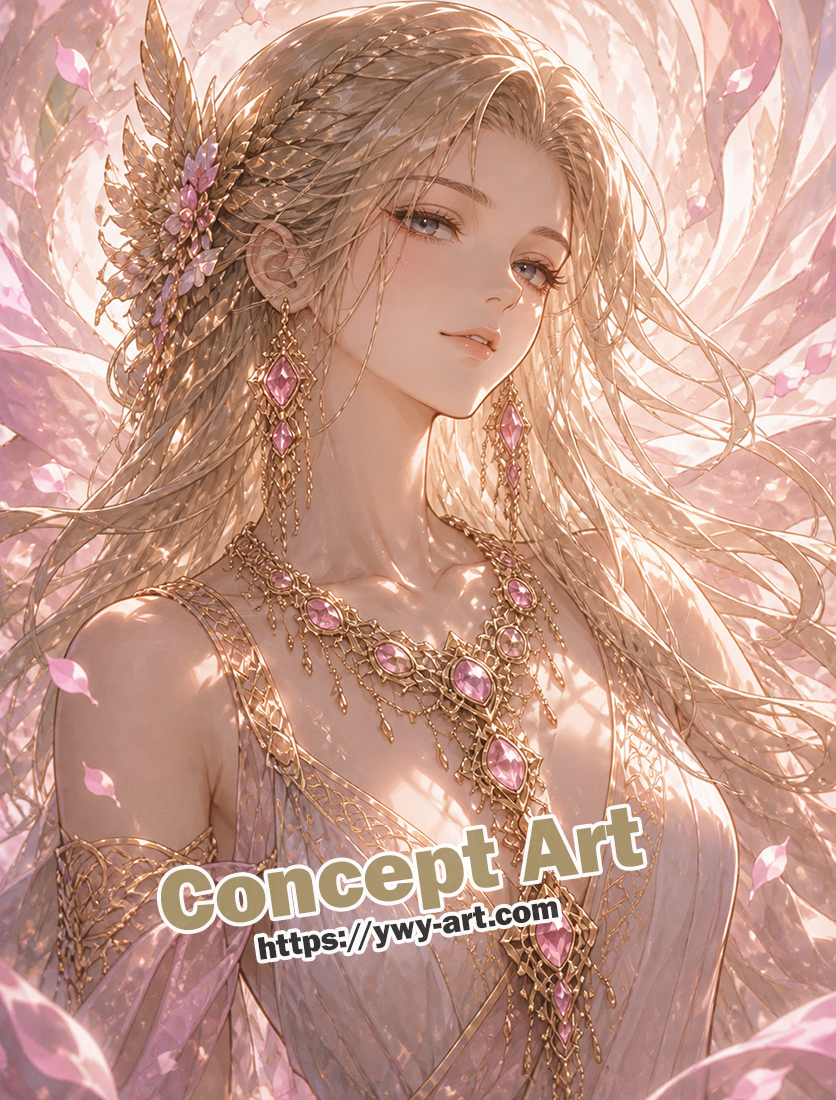
Freyja Brísingamen Necklace
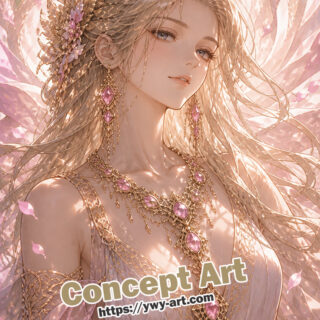
Freyja is often introduced as a goddess of love and beauty, but that description is far too small for her. She is desire, magic, wealth, battle, grief, and the fierce right to choose what she wants. In this illustration, Brísingamen becomes the central artifact, glowing across her chest with pink gems and delicate goldwork. It looks soft and romantic at first, but honestly, there is a very strong will behind it. Freyja’s beauty is not passive. It has power, price, and intention.
Basic Profile
| Name | Freyja |
|---|---|
| Mythology | Norse Mythology |
| Gender | Female |
| Region | Norse mythic world, especially Asgard, Vanaheimr, Folkvangr, and places connected with magic and desire |
| Era | Viking Age mythic tradition and earlier Germanic belief |
| Domain | Love, beauty, desire, fertility, seidr magic, wealth, battle, death, and chosen warriors |
| Symbol | Brísingamen, falcon cloak, cats, boar, amber, gold, tears, necklace, flowers |
| Culture / Religion | Norse mythology and pre-Christian Germanic religion |
| Main Role | Vanir goddess of love, magic, beauty, wealth, and battle-death |
| Associated Deity | Njord, Freyr, Odin, Loki, Thor, Ódr, the Brísings, the Valkyries |
| Common Depiction | A radiant goddess wearing precious jewelry, often associated with gold, cats, falcon feathers, or sensual power |
| Alignment | Beautiful, passionate, magical, independent, dangerous, generous, and emotionally powerful |
Overview
Freyja is one of the most important goddesses in Norse mythology. She belongs to the Vanir, a group of gods strongly connected with fertility, prosperity, magic, and natural abundance. After the war between the Aesir and the Vanir, Freyja becomes part of the divine world around Odin, but she keeps a distinct presence. She is not simply an ornament in the halls of the gods. She is a force.
Her identity is wide and layered. Freyja is a goddess of love, but that love is not always gentle or domestic. It can be passionate, risky, costly, and full of longing. She is a goddess of beauty, but her beauty is not only for being admired. It affects the world. It causes desire, conflict, bargaining, and movement.
Freyja is also strongly connected with magic, especially seidr, a form of Norse magic linked with fate, trance, prophecy, and transformation. In some traditions, she teaches this magic to Odin. That detail is important because it shows Freyja as a holder of dangerous knowledge, not only a figure of romance or fertility.
She also has a battle-related side. Freyja receives half of the slain warriors in her hall, Sessrúmnir, in the field of Folkvangr, while Odin receives the other half in Valhalla. This makes her a goddess of death as well as desire. The same figure who wears the beautiful necklace also stands near the fallen. That contrast gives her mythology a deep, sharp edge.
The Artifact: Brísingamen Necklace
Brísingamen is Freyja’s most famous treasure. It is often described as a magnificent necklace or collar of extraordinary beauty, made by dwarves known as the Brísings. The exact details vary across sources and later retellings, but the necklace remains strongly tied to Freyja’s beauty, desire, value, and divine authority.
A necklace is different from a weapon. It rests close to the body, near the throat, chest, and heart. That makes Brísingamen feel intimate. It is not carried at a distance like a spear. It is worn. It becomes part of Freyja’s presence, changing the way others see her and perhaps the way she chooses to reveal herself.
The necklace can also be read as a symbol of chosen value. Freyja does not receive Brísingamen casually. In later stories, she desires it intensely and pays a serious price for it. Whether the story is read as sensual, magical, political, or symbolic, the key point remains: this artifact is not merely decoration. It is something she wants enough to claim.
In this artwork, Brísingamen is imagined with pink gemstones and intricate goldwork, glowing against pale fabric and soft light. That choice gives the artifact a romantic surface, but the structure is elaborate and commanding. It feels less like simple jewelry and more like a divine statement: beauty can be armor, power, and spell at the same time.
Mythological Background
Freyja’s relationship with Brísingamen is most famously told in later Norse tradition, especially in stories where Loki discovers how she obtained the necklace. The tale is often morally charged, and different versions can feel shaped by later attitudes toward female desire. Still, the myth preserves something important: Freyja’s desire is active. She sees the treasure, wants it, and acts.
Loki is also involved in a story where he steals Brísingamen, and Heimdall fights him to recover it. This connects the necklace to conflict, secrecy, and divine rivalry. A treasure this powerful does not simply sit in the background. It attracts theft, exposure, and struggle.
Freyja is also known for her tears of gold. When she searches for her missing husband Ódr, she weeps, and her tears become precious. This connects her beauty and wealth with grief. Gold is not only luxury in her mythology. It can be the visible form of longing.
Another major symbol of Freyja is her falcon cloak, which allows its wearer to fly in bird form. Loki borrows it in several stories. This cloak shows Freyja’s connection to transformation and magical mobility. When placed beside Brísingamen, it helps define her as a goddess of powerful objects: treasures that change presence, movement, identity, and influence.
Freyja’s association with cats and the boar Hildisvíni also adds richness to her image. Cats suggest sensuality, independence, mystery, and domestic magic. The boar connects her to fertility, battle, and protective force. Freyja is not one-note. She moves between softness and danger very naturally.
Symbolism and Meaning
Brísingamen represents beauty as active power. It is not beauty waiting to be approved by someone else. It is beauty chosen, worn, and used. That matters for Freyja because her mythology often presents desire as something powerful enough to change events.
The necklace also symbolizes value and cost. Precious things are rarely neutral in myth. They attract attention. They create bargains. They reveal what a person or god is willing to do. Brísingamen asks a direct question: what is beauty worth, and who gets to decide that price?
The placement of the necklace near the heart gives it an emotional layer. Freyja’s myths include passion, longing, grief, and pride. Brísingamen can be read as a shining object that gathers all of those feelings into one visible form. It is desire made gold.
The pink jewels in the artwork emphasize love and sensuality, while the gold structure suggests divine wealth and status. This combination works beautifully for Freyja. She is tender in some stories, fierce in others, and never fully harmless. The necklace holds that duality.
The soft flower-like background strengthens the theme of fertility and beauty, but the artifact keeps the image from becoming only gentle. Brísingamen has edges, chains, and weight. That is important. Freyja’s beauty may glow, but it is not weightless.
Coloring Notes
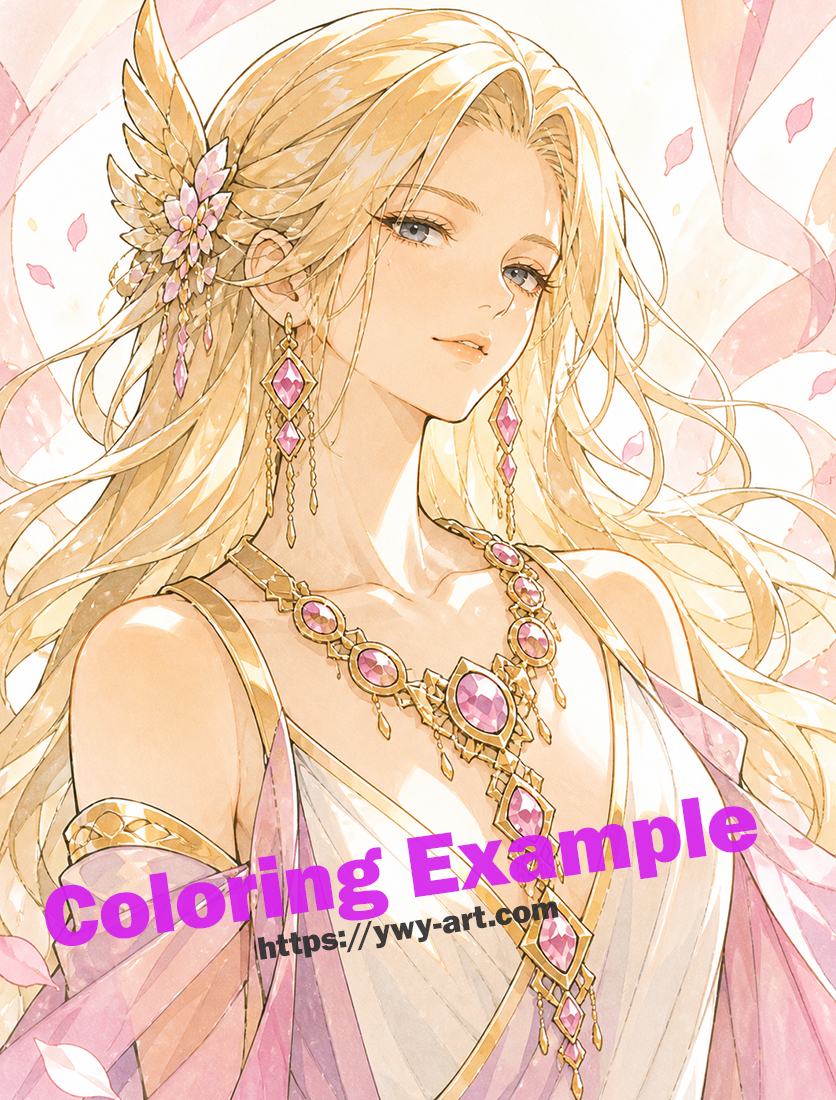
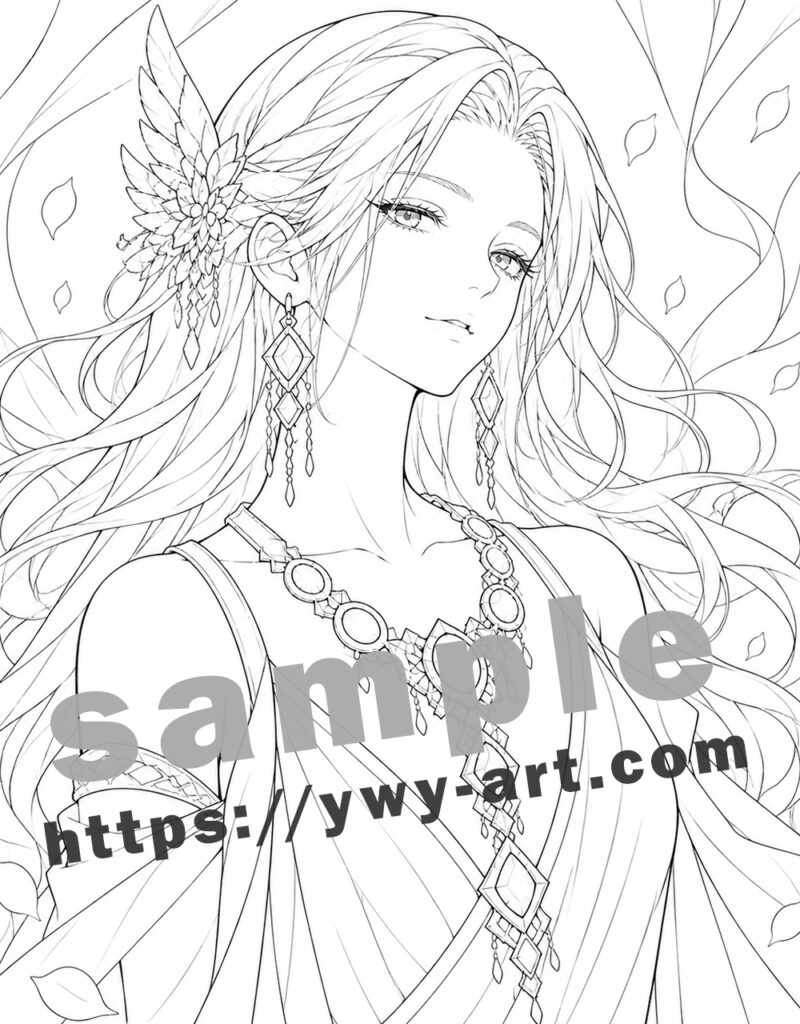
This page works beautifully with a warm romantic palette. Soft pink, rose, pale gold, ivory, warm cream, light brown, and pearl tones can create a radiant Freyja atmosphere. Brísingamen should remain the main focus, so the gemstones and gold chains need clear highlights.
For the necklace, antique gold or bright warm gold will work well. The central stones can be colored in rose pink, ruby pink, soft magenta, or pale garnet. If you want the gems to feel luminous, leave small white highlights in each stone and deepen the lower edges with a darker pink.
Freyja’s clothing can stay light: ivory, blush white, pale peach, or soft cream. This will help the necklace stand out. Too much strong color in the fabric may compete with the jewelry, so subtle shading is better here.
Her hair can be colored in golden blonde, honey brown, ash blonde, or soft light brown. Warm highlights will match the pink-gold mood. If the hair becomes too yellow, adding muted beige or light brown shadows can keep it natural.
The background petals and light effects can use very soft pinks and peach tones. They should support the romantic atmosphere without overpowering the artifact. The strongest contrast should stay around the necklace, earrings, and Freyja’s face.
Quick Creative Reference
| Element | Creative Direction |
|---|---|
| Best For | Norse goddess themes, divine beauty, love and desire symbolism, magical jewelry, elegant fantasy portraits |
| Visual Keywords | Freyja, Brísingamen, necklace, pink gemstones, gold chains, flowers, desire, divine beauty |
| Mood | Radiant, sensual, soft, powerful, magical, emotionally rich |
| Recommended Colors | Rose pink, pale gold, ivory, warm cream, soft peach, pearl white, honey brown |
| Main Focus | Brísingamen as a symbol of beauty, desire, value, magic, and Freyja’s independent power |
| Coloring Tip | Keep the gemstones saturated and the clothing softer so Brísingamen remains the visual and emotional center. |
Compare with Similar Deities
| Name | Mythology | Main Domains | Overall Image |
|---|---|---|---|
| Freyja | Norse | Love, beauty, desire, magic, wealth, battle-death | A radiant and independent goddess whose beauty is inseparable from magic, longing, and power |
| Frigg | Norse | Marriage, motherhood, fate, household authority | A queenly goddess with a quieter and more domestic form of divine authority |
| Aphrodite | Greek | Love, beauty, desire, attraction, sexuality | A goddess of irresistible beauty and desire, more focused on attraction and erotic power than battle or magic |
| Ishtar | Mesopotamian | Love, war, sexuality, kingship, power | A fierce goddess of love and war whose intensity makes her closer to Freyja’s dangerous beauty than a purely gentle love deity |
Closing
Freyja Brísingamen Necklace is a strong artifact piece because it treats beauty as something powerful, chosen, and costly. The necklace is not just jewelry. It is desire turned into gold, grief turned into treasure, and magic worn close to the heart. Freyja may appear soft in the glow of pink petals and light, but Brísingamen reminds us that her beauty has weight, and her choices can shake the world around her.
Step into the world of mythology..
Available on Amazon Mythology Artifacts Series: Symbols of Power Coloring Book Open in a new tab


コメント