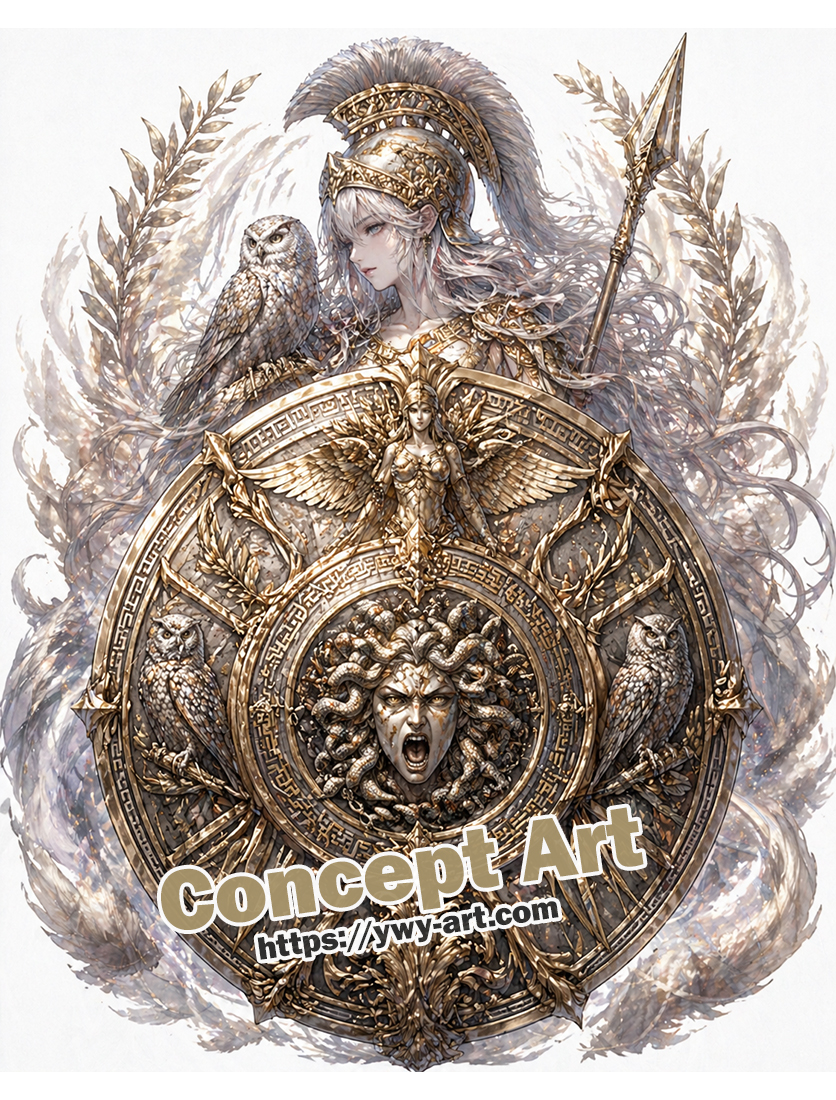
Athena Aegis Shield
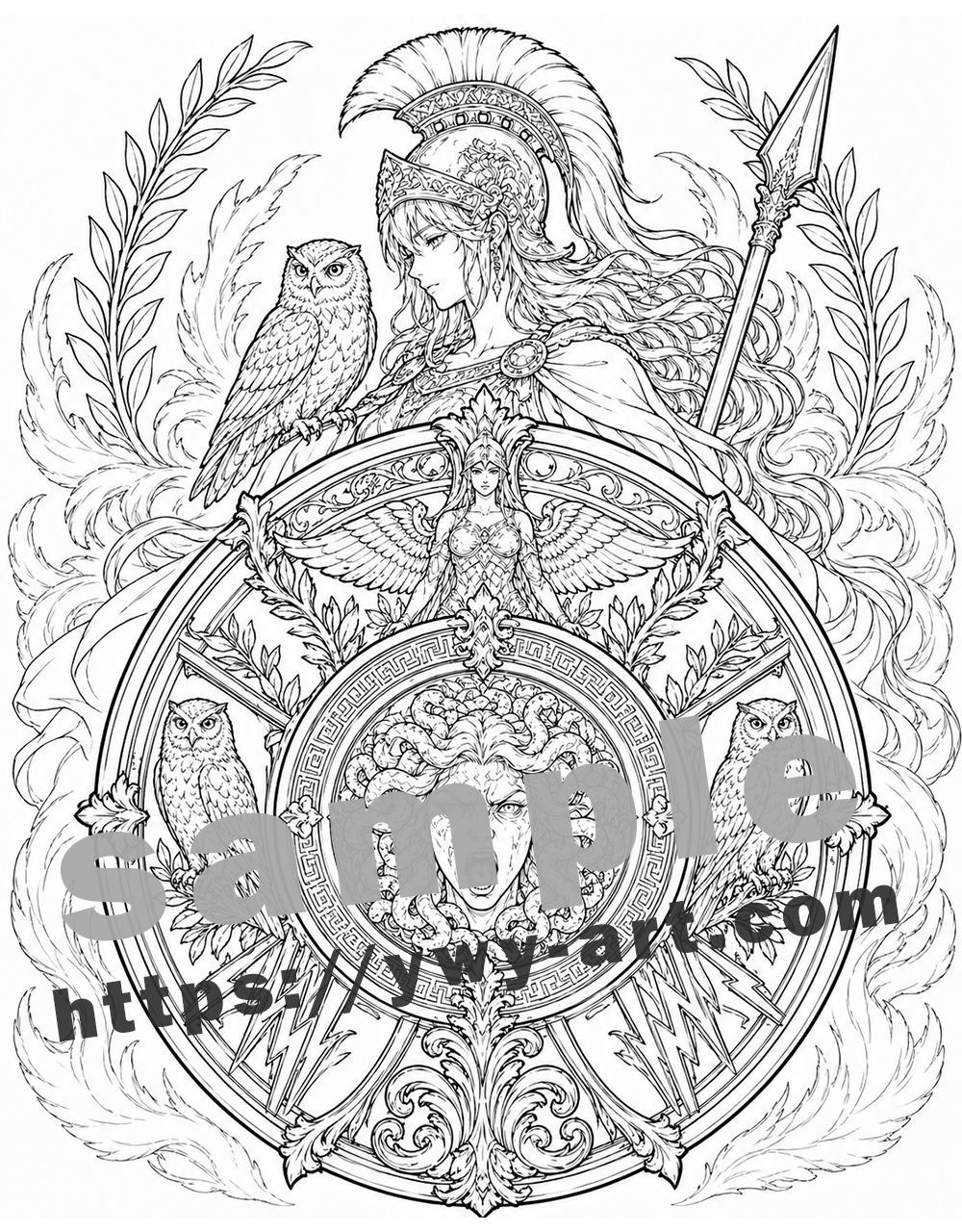
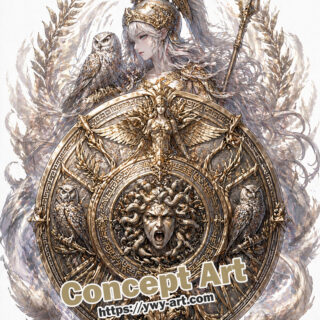
Athena is not the kind of goddess who wins by force alone. She stands for strategy, discipline, clear judgment, and the kind of courage that does not rush forward blindly. In this illustration, the Aegis Shield becomes the main focus, surrounded by owls, laurel branches, a spear, and the terrifying face of Medusa at its center. It feels elegant, but also sharp. Honestly, this one has a very satisfying kind of authority — not loud, not chaotic, but almost impossible to ignore.
Basic Profile
| Name | Athena |
|---|---|
| Mythology | Greek Mythology |
| Gender | Female |
| Region | Ancient Greece, especially Athens |
| Era | Ancient Greek mythic age |
| Domain | Wisdom, strategy, warfare, crafts, protection, cities |
| Symbol | Owl, olive tree, spear, helmet, shield, Gorgoneion |
| Culture / Religion | Ancient Greek religion |
| Main Role | Goddess of wisdom and strategic warfare, protector of heroes and cities |
| Associated Deity | Zeus, Nike, Hephaestus, Poseidon, Medusa, Perseus |
| Common Depiction | A calm armored goddess carrying a spear and shield, often accompanied by an owl |
| Alignment | Wise, disciplined, protective, tactical, noble, and commanding |
Overview
Athena is one of the most important Olympian deities in Greek mythology. She is the daughter of Zeus and is famously said to have been born from his head, already armed and fully grown. That image tells us a lot about her. Athena is not simply a warrior goddess. She represents intelligence in action — thought becoming armor, strategy becoming victory, and wisdom becoming protection.
Unlike Ares, who is often connected with the bloodier and more violent side of war, Athena represents controlled warfare. She is the goddess of planning, defense, formations, clever tactics, and the ability to win without wasting strength. That difference matters. Athena’s power is not about losing control in battle. It is about seeing the whole field clearly and making the right move at the right time.
Her connection to Athens also gives her a civic and cultural role. She is not only a battlefield figure. She protects the city, supports craftspeople, and symbolizes ordered civilization. In the famous contest between Athena and Poseidon, both gods offer a gift to the city. Poseidon strikes the earth and produces a spring or sign of sea power, while Athena offers the olive tree. Athena’s gift is chosen because it brings food, oil, wood, trade, and long-term prosperity. It is a quieter gift, but a smarter one.
This is why the Aegis Shield fits her so well. It is defensive, but not passive. It does not merely block an attack. It declares control. In this artwork, the shield feels almost like a sacred map of Athena’s identity: wisdom through the owls, victory through the golden details, protection through the circular form, and terror through the Medusa head at the center.
The Artifact: Aegis Shield
The Aegis is one of the most powerful protective symbols in Greek myth. Depending on the source and artistic tradition, it can be described as a shield, a cloak, or a divine protective object associated with Zeus and Athena. In many visual depictions, Athena bears the Aegis with the head of Medusa, also called the Gorgoneion, placed at its center.
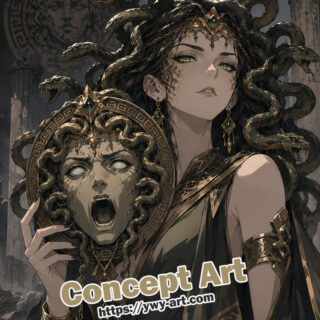
That detail is important. Medusa’s head is not just decoration. In myth, Medusa’s gaze could turn people to stone, and after Perseus defeated her, her head became a powerful apotropaic symbol — a symbol meant to ward off evil. Athena’s use of the Gorgoneion turns fear itself into protection. That is such a strong idea. The monster is no longer only a threat. Under Athena’s authority, it becomes a guardian.
The circular structure of the shield also matters visually. Circles can suggest wholeness, defense, order, and control. Here, the Aegis Shield is not shown as a simple flat object. It feels ceremonial, layered, and almost architectural. The golden rings, sharp points, and central Medusa face make it feel like an artifact that belongs in both a temple and a battlefield.
The owls around the shield reinforce Athena’s connection to wisdom. In Greek culture, the owl became closely linked with Athena and with the city of Athens itself. It is a small creature, but symbolically it carries alertness, perception, night vision, and the ability to see what others miss. That makes it a perfect companion to a goddess of strategy.
Mythological Background
Athena appears throughout Greek myth as a guide, protector, and strategist. She helps heroes, but she rarely does the work for them completely. Instead, she gives direction, courage, tools, or a crucial piece of insight. That is one of the reasons she feels so different from many other gods. Athena’s help often comes through intelligence.
In the myth of Perseus, Athena plays a key role in the defeat of Medusa. Perseus cannot look directly at Medusa without being turned to stone, so he uses a reflective shield to see her safely. Athena is often connected to this shield and later bears the Gorgoneion as part of her own divine equipment. The story gives the Aegis a deep symbolic layer: victory does not come from staring danger in the face recklessly, but from using wisdom to survive what brute courage cannot handle.
Athena also assists Odysseus, one of the cleverest heroes in Greek myth. His strength matters, but his mind matters more. Athena supports him because his character fits her domain: endurance, planning, disguise, timing, and strategic patience. This side of Athena is very useful when thinking about the Aegis Shield. It protects, yes, but it also represents the mind that knows when to advance, when to wait, and when to turn an enemy’s force against them.
In the Trojan War tradition, Athena stands firmly on the Greek side and often influences the flow of battle. But again, her presence is not just about violence. She is the divine force behind coordination, tactical advantage, and focused action. When Athena appears in armor, it is not random decoration. It is wisdom prepared for conflict.
Symbolism and Meaning
The Aegis Shield can be read as a symbol of intelligent protection. It does not hide from danger. It faces danger, understands it, and transforms it into strength. The Medusa head at the center captures this idea perfectly. The most frightening element becomes the most protective one.
That is what makes this artifact especially interesting. It is not a soft symbol of safety. It is not gentle shelter. It is protection with teeth. Athena’s shield says that wisdom is not always quiet and peaceful. Sometimes wisdom has to stand in front of chaos and say, “No further.”
The owl imagery adds another layer. Owls suggest perception and calm observation. They see in the dark, and that matters symbolically. Athena’s wisdom is not limited to obvious answers. It reaches into confusion, uncertainty, and danger. The owl does not panic when the light is low. It adapts.
The gold decoration gives the shield a noble and sacred feeling, while the spear in the background reminds us that Athena is still a warrior. She is not wisdom separated from action. She is wisdom armed. That combination is the heart of the image.
Coloring Notes
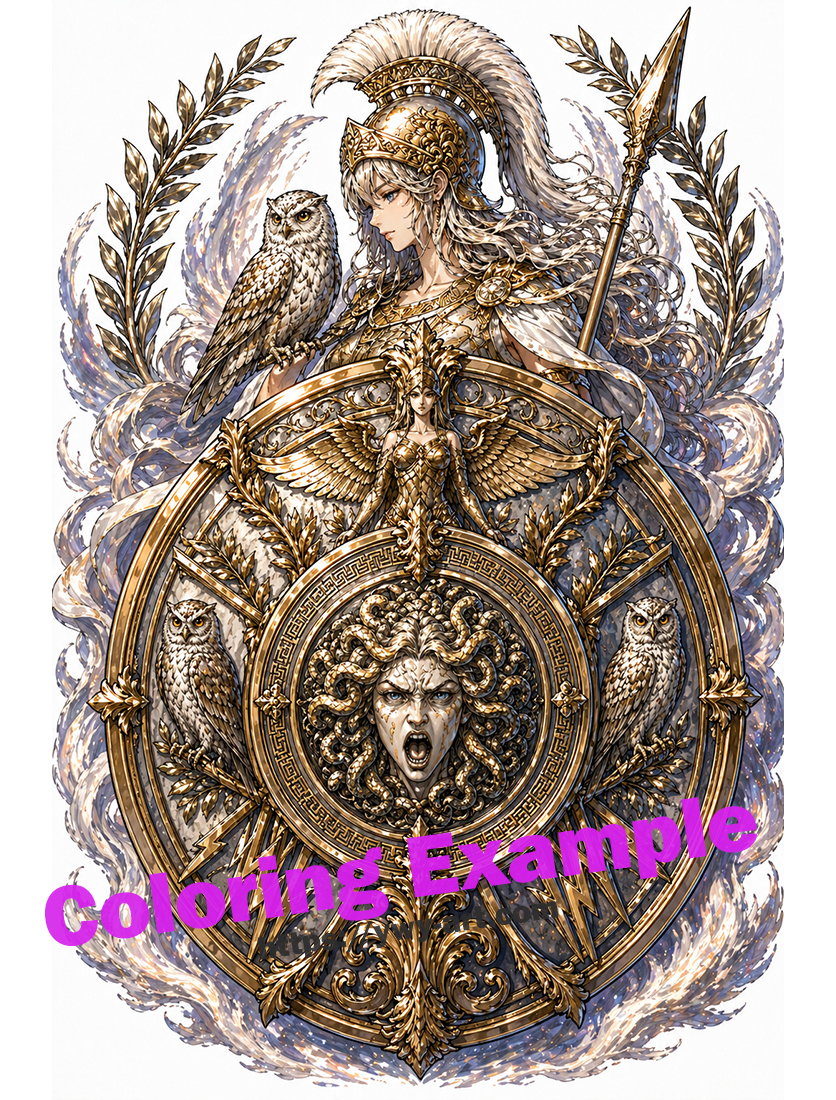
This page works beautifully with a refined, ancient palette. Gold, ivory, bronze, pale gray, soft brown, and muted olive tones can bring out Athena’s classical atmosphere. The shield should remain the visual center, so it may help to give the outer rings a clear metallic direction while keeping the background softer.
For the Medusa head, you can choose either a cold stone-like palette or a more dramatic monster-like palette. Pale gray and muted green will make it feel ancient and sculptural. Darker shadows around the eyes and mouth can make the expression stronger without making the whole shield too heavy.
The owls are a good place to add quiet variation. They do not all need the same color. Some can lean warm beige, some gray-brown, and some slightly cooler. Small changes in the feathers will keep the composition lively while still feeling unified.
Athena herself can be colored more softly than the shield. Pale skin tones, silver-white hair, and restrained gold armor can help her feel divine and calm. If everything becomes equally bright, the image may lose its hierarchy. Let the shield speak first, then allow Athena and the owls to support it.
The background leaves and smoky shapes can stay light and airy. They are useful for atmosphere, but they should not overpower the artifact. Leaving some open white areas can actually help the gold and dark shield details stand out more clearly.
Quick Creative Reference
| Element | Creative Direction |
|---|---|
| Best For | Mythological wisdom, divine protection, strategic warfare, classical Greek atmosphere |
| Visual Keywords | Aegis, shield, Medusa, owl, spear, gold armor, wisdom, defense |
| Mood | Elegant, intelligent, protective, sacred, disciplined |
| Recommended Colors | Antique gold, bronze, ivory, pale gray, olive, muted brown, soft white |
| Main Focus | The Aegis Shield as a symbol of wisdom turned into protection |
| Coloring Tip | Keep the strongest contrast around the Medusa face and shield rings so the artifact stays visually powerful. |
Compare with Similar Deities
| Name | Mythology | Main Domains | Overall Image |
|---|---|---|---|
| Athena | Greek | Wisdom, strategy, warfare, crafts, protection | A calm and disciplined goddess who turns intelligence into action and protection |
| Minerva | Roman | Wisdom, arts, strategy, crafts | The Roman counterpart of Athena, often associated with learning, craft, and noble intelligence |
| Ares | Greek | War, violence, bloodshed, battle frenzy | A more aggressive war god representing the brutal and chaotic side of conflict |
| Nike | Greek | Victory, triumph, success in battle and competition | A winged goddess of victory, often connected to the outcome Athena’s strategy helps achieve |
Closing
Athena Aegis Shield is a strong artifact piece because it does not treat defense as weakness. The shield is protective, but it is also frightening, beautiful, and intelligent. Medusa’s face, the owls, the spear, and the gold structure all work together to show Athena’s true strength: she does not just fight. She understands the battlefield before the battle begins.
Step into the world of mythology..
Available on Amazon Mythology Artifacts Series: Symbols of Power Coloring Book Open in a new tab







コメント