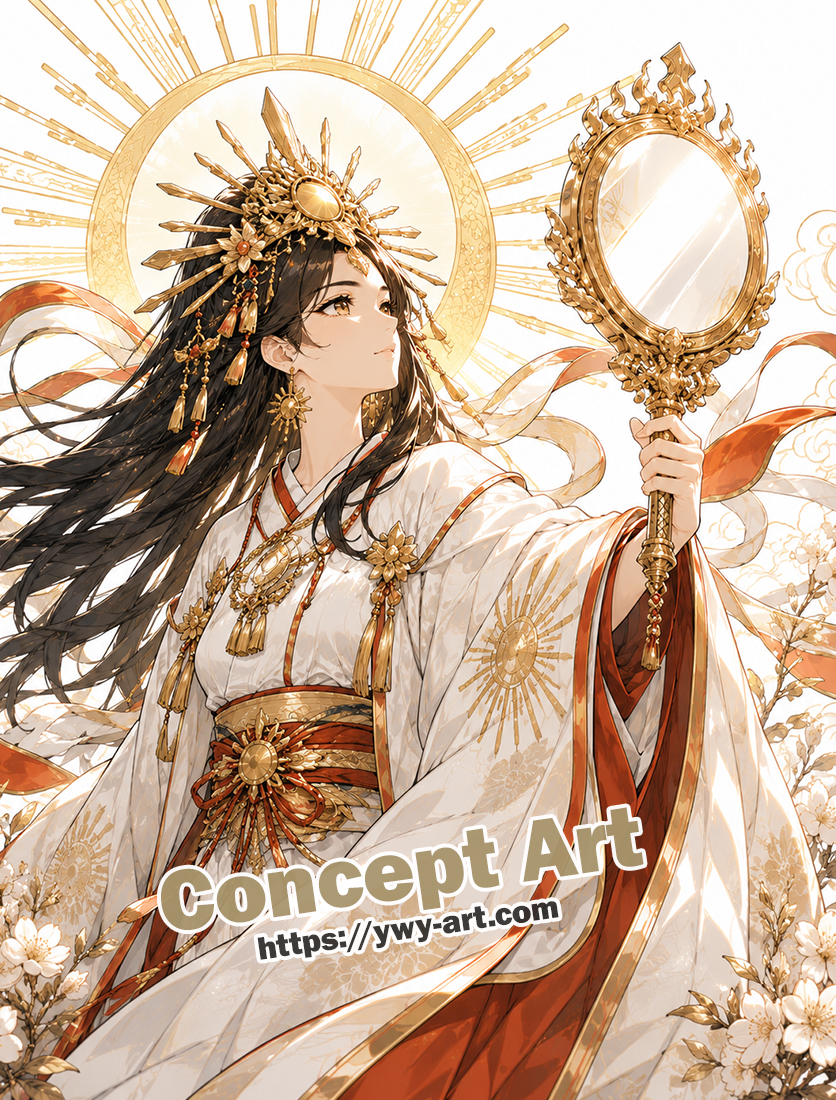
Amaterasu Sacred Mirror
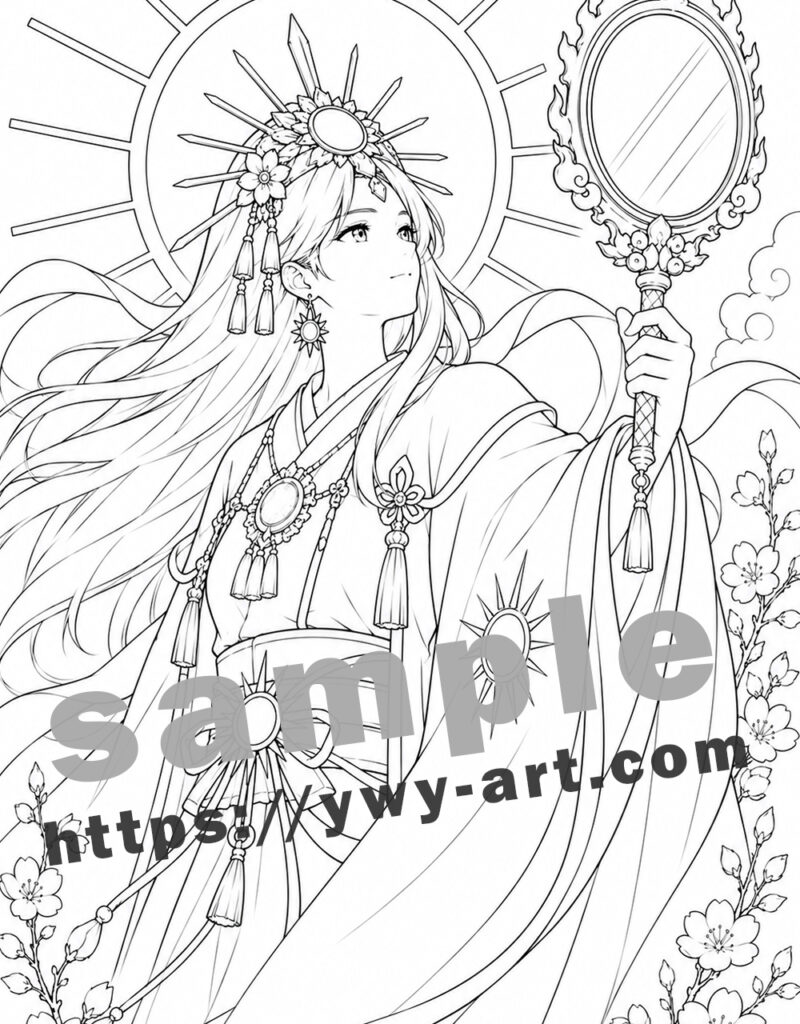
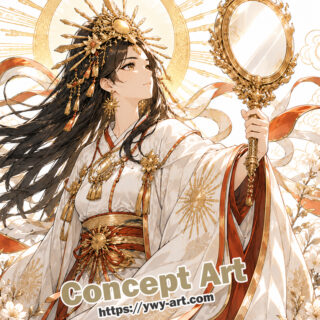
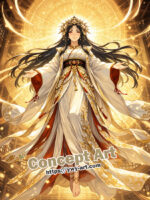
Amaterasu is not just a bright sun goddess. She is the light that returns after the world has fallen into darkness, the sacred radiance of order, and one of the most important divine figures in Japanese mythology. In this illustration, the Sacred Mirror becomes the central artifact, lifted toward the light like an object that can call the sun back into the world. It feels graceful and pure, but honestly, there is something very emotional underneath it. The mirror is beautiful, yes, but its real power is that it reveals what darkness tries to hide.
Basic Profile
| Name | Amaterasu |
|---|---|
| Mythology | Japanese Mythology / Shinto Tradition |
| Gender | Female |
| Region | Japan, especially Takamagahara, Ise, and sacred traditions connected with imperial ancestry |
| Era | Ancient Japanese mythic tradition recorded in texts such as the Kojiki and Nihon Shoki |
| Domain | Sun, light, order, purity, agriculture, sacred kingship, divine ancestry |
| Symbol | Mirror, sun disk, rays of light, white cloth, sacred jewel, rice fields, torii-like sacred space |
| Culture / Religion | Shinto and Japanese mythological tradition |
| Main Role | Sun goddess and central ancestral deity of the Japanese imperial line |
| Associated Deity | Susanoo, Tsukuyomi, Izanagi, Ame-no-Uzume, Ninigi-no-Mikoto |
| Common Depiction | A radiant goddess associated with sunlight, sacred robes, mirrors, jewels, and divine purity |
| Alignment | Radiant, dignified, life-giving, orderly, sacred, pure, and quietly commanding |
Overview
Amaterasu is one of the most important deities in Japanese mythology. She is the goddess of the sun and the ruler of Takamagahara, the heavenly realm of the kami. Her light is not only physical sunlight. It represents order, purity, renewal, agricultural life, and sacred legitimacy.
In many mythologies, the sun is imagined as masculine, but Amaterasu is a powerful female solar deity. That alone gives her a distinct presence. She is not a warrior sun god who charges forward with flame. Her power is more refined, more ceremonial, and deeply tied to harmony. When her light disappears, the world does not simply become dark. The proper order of existence breaks down.
Her most famous myth is the story of the Heavenly Rock Cave. After the violent and chaotic actions of her brother Susanoo, Amaterasu withdraws into a cave, hiding her light from the world. Without her, heaven and earth fall into darkness. The other gods must find a way to lure her out, not by force, but through ritual, laughter, performance, and a mirror.
That is why the Sacred Mirror is such a powerful artifact for her. It is not merely a reflective object. It becomes the tool that brings light back. In this artwork, the mirror is held high, surrounded by rays, flowers, white robes, and golden ornamentation. The whole scene feels like a sacred moment of return, as if the world is breathing again after darkness.
The Artifact: Sacred Mirror
The Sacred Mirror is inspired by Yata no Kagami, one of the Three Sacred Treasures of Japan. These treasures are traditionally associated with imperial legitimacy and divine descent: the mirror, the sword, and the jewel. Among them, the mirror is especially connected with Amaterasu.
In the cave myth, the gods hang a mirror outside the cave to draw Amaterasu’s attention. When she opens the cave slightly and sees the reflection, she is drawn out, and her light returns to the world. Symbolically, this is extremely rich. The mirror does not defeat darkness by attacking it. It reveals light to itself.
A mirror can represent truth, self-knowledge, purity, and divine presence. It reflects what stands before it, but in sacred tradition, that reflection can become more than an image. It can be a reminder of hidden identity. For Amaterasu, the mirror becomes the object that shows the radiance she has withdrawn from the world.
In this illustration, the mirror is ornate and solar, with flame-like golden edges and a bright circular face. That design makes it feel like a handheld sun. It is not just catching light. It appears to gather, hold, and return it. The artifact becomes both mirror and solar disk, reflection and source.
Mythological Background
Amaterasu is born from the purification of Izanagi after he returns from the underworld-like realm of Yomi. When Izanagi washes his left eye, Amaterasu is born. From his right eye comes Tsukuyomi, the moon deity, and from his nose comes Susanoo, the storm god. This birth already places Amaterasu in a sacred structure of light, purification, and cosmic order.
The conflict with Susanoo is one of the key episodes in her mythology. Susanoo’s disruptive behavior reaches a point where Amaterasu retreats into the Heavenly Rock Cave. This withdrawal causes the world to lose the sun. The gods gather outside and create a ritual plan. Ame-no-Uzume performs a wild dance, the gods laugh, and the mirror is placed so that Amaterasu becomes curious.
When Amaterasu emerges, light returns. This story can be read in many ways: as a myth of eclipse, seasonal renewal, ritual performance, social restoration, or the victory of sacred order over chaos. It is also emotionally powerful because the goddess is not forced back by violence. She is drawn out through reflection, sound, and communal action.
Amaterasu is also central to the myth of Ninigi-no-Mikoto, her grandson, who descends from heaven to earth carrying the sacred treasures. This descent connects Amaterasu to the foundation of sacred rulership and the imperial line. The mirror therefore carries not only mythic meaning, but political and ritual significance.
The Ise Grand Shrine is strongly associated with Amaterasu, and her presence there is one of the most important centers of Shinto worship. The sacred mirror connected to her is not treated as a simple artwork or myth prop. It belongs to a living tradition of reverence, purity, and continuity.
Symbolism and Meaning
The Sacred Mirror represents truth through reflection. It does not create a false image. It reveals what is already there. In Amaterasu’s myth, the mirror helps restore the goddess to the world by showing her own radiance. That makes it a symbol of recognition, not just brightness.
The mirror also symbolizes purity. In Shinto thought, purification is deeply important, and a clean reflective surface can suggest a heart or spirit free from pollution. A mirror shows clearly only when it is not clouded. That gives the artifact a moral and spiritual meaning.
The golden sun rays behind Amaterasu strengthen the idea of divine return. The image does not feel like aggressive sunlight. It feels ceremonial, almost like the opening of a sacred space. The mirror becomes the object that focuses that light and gives it form.
The white robes and floral details add softness, but they do not weaken the scene. They make the power feel refined rather than violent. Amaterasu’s authority is not the same as Sekhmet’s burning wrath or Ra’s sovereign glare. Her power is restoration, clarity, and the return of balance.
The act of holding the mirror outward is also important. It suggests offering, revelation, and blessing. The mirror is not hidden against the body. It is presented to the world. That gesture makes the artifact feel active, as if light is being shared rather than possessed.
Coloring Notes
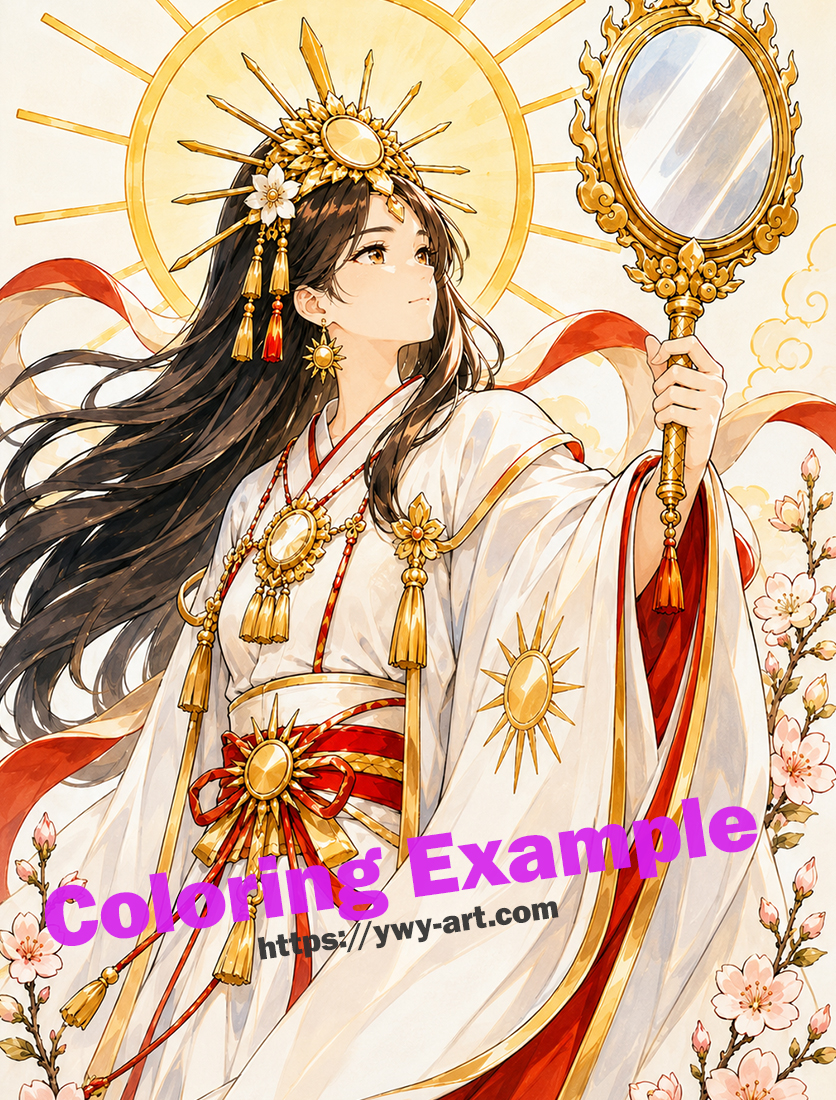
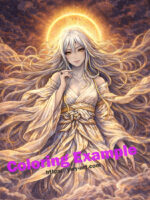
This page works beautifully with a radiant Japanese ceremonial palette. White, ivory, warm gold, soft red, pale peach, black, and gentle floral pinks can create a sacred Amaterasu atmosphere. The Sacred Mirror should remain the brightest focus, so the gold frame and reflective center need clear highlights.
For the mirror, antique gold or bright solar gold will work well. The outer flame-like shapes can use deeper orange-gold shadows, while the inner reflective surface can stay pale cream, soft silver, or warm white. A few diagonal highlights will help it read as a mirror rather than a flat disk.
Amaterasu’s clothing can stay mostly white and ivory, with red and gold accents. This combination gives a strong shrine-like feeling. The red ribbons or lining can be colored with vermilion or warm crimson, but they should not overpower the mirror.
Her hair can be deep black or dark brown with warm highlights. Against the bright robe and gold accessories, dark hair will create a strong visual anchor. The sun ornament behind her head can be colored with pale gold and soft yellow so it glows without competing too strongly with the mirror.
The floral background can remain soft: pale pink, cream, light beige, and muted gold. Leaving some areas bright and open will help the whole page feel luminous. The key is to make the scene glow while keeping the mirror and Amaterasu’s face as the clearest points of attention.
Quick Creative Reference
| Element | Creative Direction |
|---|---|
| Best For | Japanese mythology, sun goddess themes, sacred mirror symbolism, light restoration, divine purity |
| Visual Keywords | Amaterasu, Sacred Mirror, sun rays, white robes, vermilion ribbon, flowers, divine reflection |
| Mood | Radiant, pure, ceremonial, elegant, restorative, sacred |
| Recommended Colors | White, ivory, warm gold, vermilion, soft pink, pale peach, black, light cream |
| Main Focus | The mirror as a symbol of divine reflection, purity, solar return, and sacred legitimacy |
| Coloring Tip | Keep the mirror surface pale and reflective, then use stronger gold around the frame so the artifact feels like it is gathering sunlight. |
Compare with Similar Deities
| Name | Mythology | Main Domains | Overall Image |
|---|---|---|---|
| Amaterasu | Japanese | Sun, light, order, purity, sacred kingship | A radiant sun goddess whose light restores order and whose mirror symbolizes divine presence and legitimacy |
| Ra | Egyptian | Sun, creation, kingship, cosmic order | A supreme solar god whose light sustains the world and protects order from chaos |
| Helios | Greek | Sun, daylight, witness, solar journey | A direct personification of the sun who travels across the sky and sees all from above |
| Sól | Norse | Sun, celestial movement, daily solar cycle | A sun goddess who drives the sun across the sky, pursued by cosmic forces |
Closing
Amaterasu Sacred Mirror is a strong artifact piece because it turns reflection into restoration. The mirror does not simply shine. It reveals the hidden sun, draws light back from darkness, and carries the sacred authority of a goddess whose presence keeps the world in balance. Amaterasu’s power feels graceful here, but not fragile. She holds the mirror toward the sky, and the whole scene seems to open with light.
Step into the world of mythology..
Available on Amazon Mythology Artifacts Series: Symbols of Power Coloring Book Open in a new tab








コメント