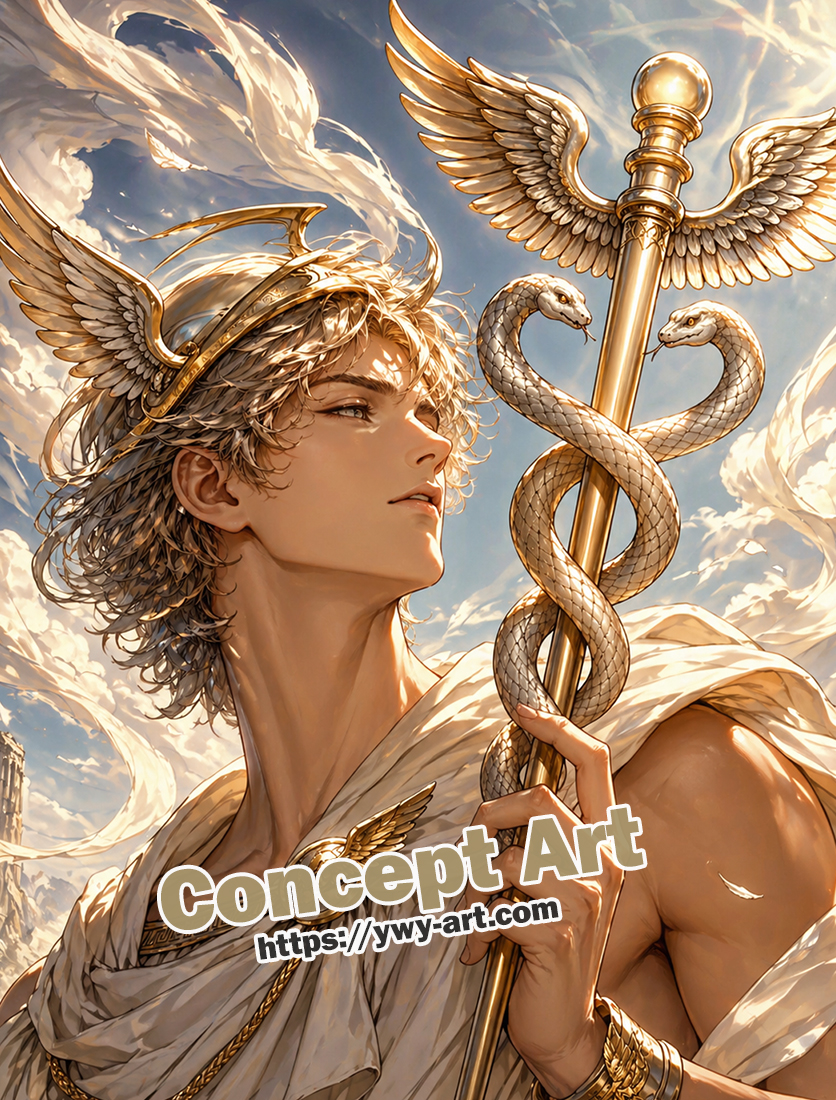
Hermes Caduceus Staff
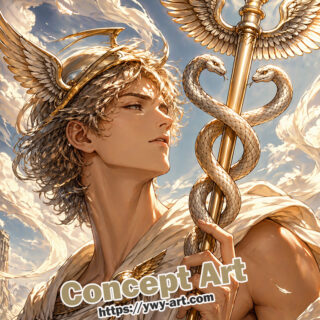
Hermes is not the kind of god who stays in one place. He moves between roads, markets, borders, messages, dreams, and even the world of the dead. In this illustration, the Caduceus Staff becomes the center of that restless energy, held close beneath a bright open sky. The twin serpents, golden staff, and winged ornament all feel light, but there is still a strange seriousness to it. Honestly, I really like that balance. Hermes looks graceful here, but the artifact he holds carries far more than simple speed.
Basic Profile
| Name | Hermes |
|---|---|
| Mythology | Greek Mythology |
| Gender | Male |
| Region | Ancient Greece, especially roads, borders, marketplaces, and sacred crossing points |
| Era | Ancient Greek mythic age |
| Domain | Travel, messages, trade, boundaries, thieves, luck, language, transitions, souls of the dead |
| Symbol | Caduceus, winged sandals, winged helmet, tortoise, ram, traveler’s cloak |
| Culture / Religion | Ancient Greek religion |
| Main Role | Messenger of the gods and guide between different worlds |
| Associated Deity | Zeus, Maia, Apollo, Hades, Persephone, Dionysus, Pan |
| Common Depiction | A youthful, quick-moving god with winged sandals, a winged hat, and the Caduceus Staff |
| Alignment | Quick, clever, charming, unpredictable, helpful, tricky, and deeply connected to movement |
Overview
Hermes is one of the most versatile gods in Greek mythology. He is usually known as the messenger of the gods, but that description only covers part of him. Hermes is also connected with travelers, merchants, thieves, speech, cleverness, luck, athletic movement, and safe passage. He belongs to the spaces between things, which makes him very different from gods who rule one fixed realm.
That “in-between” quality is the key to understanding Hermes. He crosses borders that others cannot cross easily. He moves from Olympus to the human world, from the human world to the underworld, and from one situation to another before anyone has time to stop him. He is not just fast. He is flexible. He understands timing, language, opportunity, and escape.
Hermes can be helpful, but he is not completely tame. He is clever from the moment he is born. In one famous myth, he steals Apollo’s cattle while still an infant, hides the evidence, and then negotiates his way out of trouble by giving Apollo the lyre. That story is funny, but it also tells us something important. Hermes does not win through brute force. He wins through invention, charm, and quick thinking.
In this artwork, the Caduceus Staff captures that personality very well. The staff is vertical and balanced, but the serpents twist around it with living motion. The wings suggest speed and divine movement. The golden surface gives it sacred authority. It looks elegant, almost peaceful, yet it also feels like an object that could open a road between worlds.
The Artifact: Caduceus Staff
The Caduceus is the most famous staff associated with Hermes. It is usually shown as a winged staff with two serpents coiled around it. In Greek mythology, it represents Hermes’ role as messenger, guide, negotiator, and divine traveler. It is not simply a walking stick. It is a symbol of passage, communication, and movement between realms.
The two serpents are especially important visually. Serpents often carry layered meanings: wisdom, danger, renewal, hidden knowledge, and transformation. Because they shed their skin, they can suggest change and rebirth. Around Hermes’ staff, they feel less like monsters and more like controlled forces. Their movement is alive, but the staff keeps them in balance.
The wings at the top of the staff connect directly to Hermes’ speed. He is often shown with winged sandals or a winged cap, and those wings show that he does not move like ordinary beings. He slips through distance. He arrives before expected. He carries messages that can change the course of a myth in a single moment.
The Caduceus is sometimes confused with the Rod of Asclepius, which is the healing symbol with one serpent and no wings. That distinction matters. Hermes’ Caduceus is not primarily a medical symbol in its Greek mythological context. It belongs more to communication, negotiation, travel, exchange, and the safe crossing of boundaries. In this piece, that makes the artifact feel like a golden key to movement itself.
Mythological Background
Hermes’ story begins with speed and mischief. Born to Zeus and Maia, he is already active almost immediately after birth. In the myth of Apollo’s cattle, Hermes steals the herd, hides his tracks, and creates the first lyre from a tortoise shell. When Apollo discovers the theft, Hermes turns the situation into an exchange. Apollo receives the lyre, and Hermes gains recognition among the gods. It is one of the clearest examples of his style: trouble, invention, negotiation, and a surprisingly smooth landing.
Hermes also serves as a psychopomp, a guide of souls. This role is darker and more serious than his playful trickster image. After death, souls need guidance to reach the underworld, and Hermes can lead them there. That means he is not only a god of travelers on roads. He is also a guide for the final journey. This gives the Caduceus a deeper tone. It can be read as a staff that leads not only the living, but also the dead.
He appears throughout Greek myth whenever movement or transition is needed. He helps Perseus on the quest against Medusa, aids Odysseus during his long journey, and carries messages between gods and mortals. He is often the one who can enter a tense situation and shift it. Not always by force. Often by words, timing, or a clever tool handed to the right person.
Hermes also has a strong connection to commerce and exchange. Markets are places of movement: goods, money, promises, lies, jokes, and negotiations all pass from one person to another. Hermes rules that kind of energy. He is the god of deals, quick speech, and the luck that appears when someone takes the right chance at the right moment.
Symbolism and Meaning
The Caduceus Staff represents communication as power. That may sound quieter than a thunderbolt or a war helmet, but it can be just as important. A message can start a war, end a conflict, save a hero, or change someone’s fate. Hermes understands that movement of information is a kind of divine force.
The two serpents can also be read as opposing energies held in balance. Life and death, truth and trickery, travel and return, danger and protection — Hermes moves between all of them. He does not erase contradiction. He travels through it. That is what makes him so fascinating.
The golden staff suggests authority, but not the heavy authority of a throne. Hermes’ authority is lighter, faster, and more adaptable. He does not need to rule a kingdom to influence everything. He only needs access to the road, the message, and the moment where one choice becomes another.
In this image, the bright sky and open clouds make the staff feel connected to flight and divine passage. The serpents add mystery, while the wings keep the whole artifact from feeling too heavy. The result is an object that feels graceful, clever, and slightly dangerous — exactly right for Hermes.
Coloring Notes
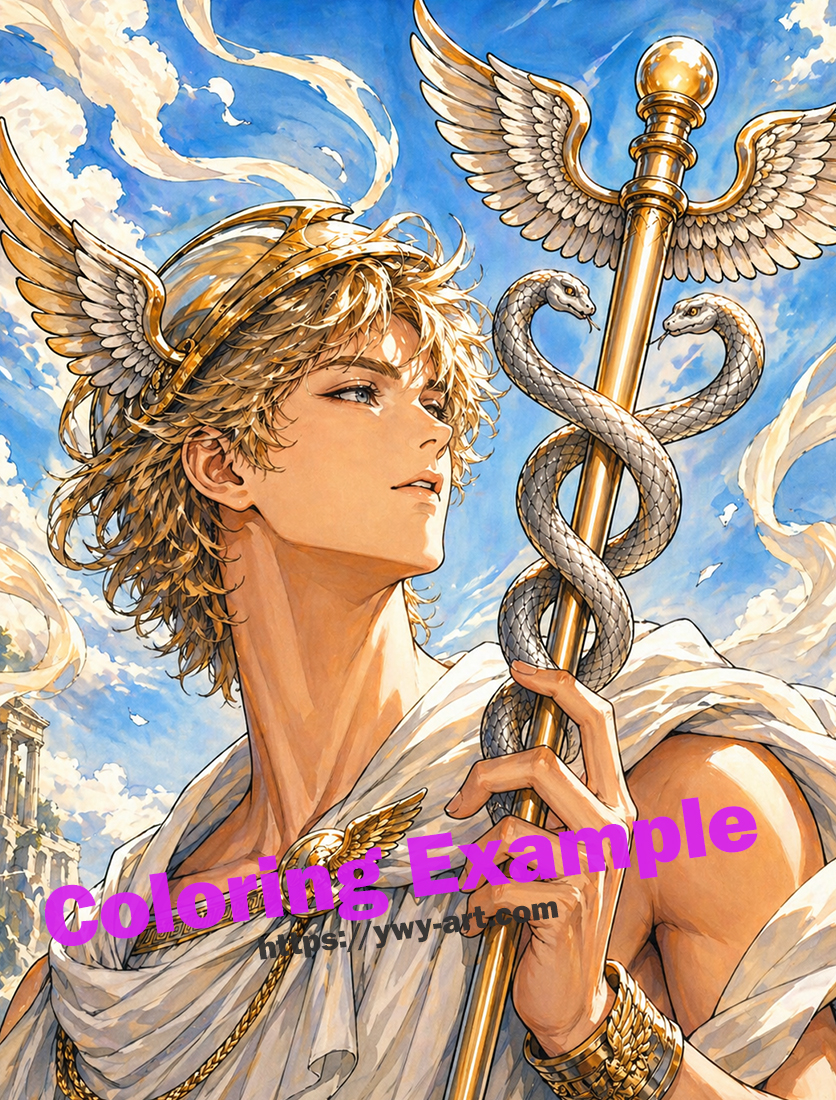
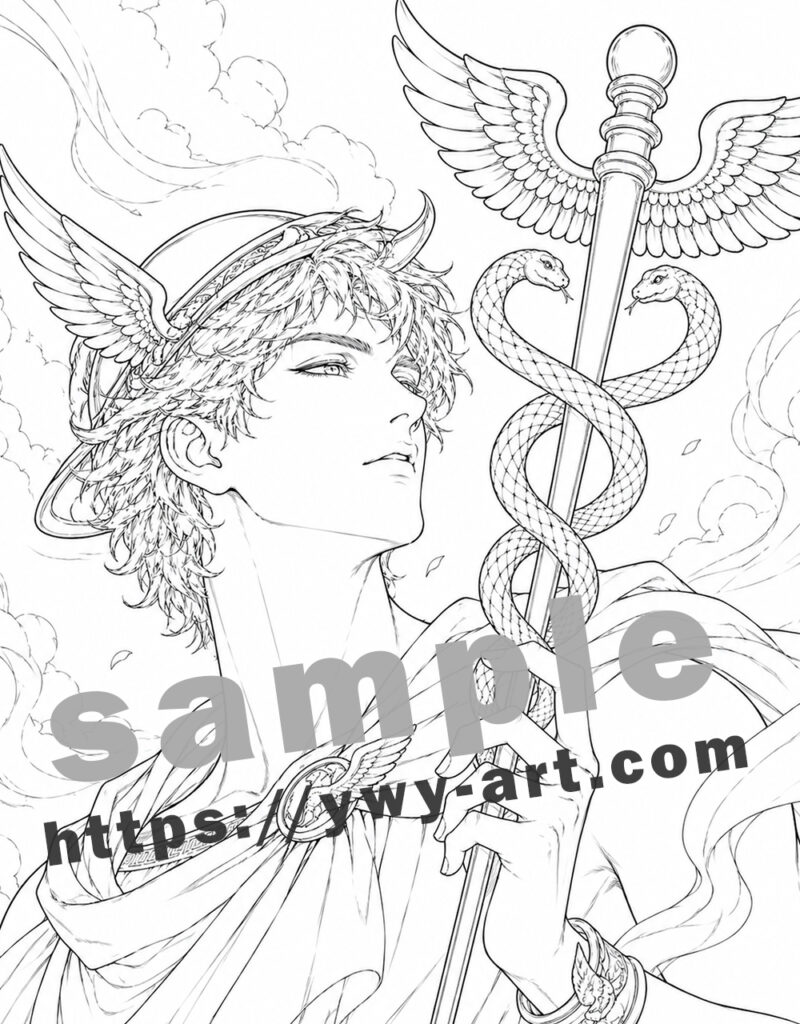
This page works very well with a bright and airy palette. Gold, ivory, pale blue, warm cream, soft brown, and light gray can create a clean mythological atmosphere. The Caduceus should remain the main focus, so it helps to give the staff a warm metallic shine and keep the surrounding sky slightly softer.
For the serpents, white, pale gold, cream, or soft gray can work beautifully. Adding gentle shadow under the scales will help them stand out without making them too dark. Since the serpents wrap around the staff, clear contrast between the snakes and the gold shaft is important.
Hermes’ clothing can stay light and wind-like. White fabric with warm shadows will support the sky setting. Small gold accents on the helmet, jewelry, and accessories can visually connect him to the staff. If everything becomes equally gold, the artifact may lose priority, so a little restraint will help.
The winged helmet is a good secondary focus. It can be colored with the same gold family as the Caduceus, but slightly softer or darker. This keeps Hermes visually unified while still allowing the staff to shine most strongly.
The background sky can be layered with pale blue, blue-gray, and soft cream. Leaving some cloud areas almost white will make the image feel bright and open. The key is to let the page breathe. Hermes is a god of movement, so heavy coloring everywhere may reduce the sense of speed and air.
Quick Creative Reference
| Element | Creative Direction |
|---|---|
| Best For | Messenger mythology, travel themes, divine communication, sky and movement imagery |
| Visual Keywords | Caduceus, Hermes, winged staff, twin serpents, sky, speed, passage |
| Mood | Bright, clever, swift, graceful, airy, slightly mysterious |
| Recommended Colors | Gold, ivory, pale blue, cream, soft gray, warm brown, white |
| Main Focus | The Caduceus as a symbol of movement, messages, balance, and crossing between worlds |
| Coloring Tip | Keep the staff and serpents clearly separated with contrast so the coiled shape stays readable. |
Compare with Similar Deities
| Name | Mythology | Main Domains | Overall Image |
|---|---|---|---|
| Hermes | Greek | Messages, travel, trade, boundaries, luck, souls | A swift and clever messenger god who moves between worlds with charm and speed |
| Mercury | Roman | Commerce, messages, travel, profit, negotiation | The Roman counterpart of Hermes, strongly connected to trade and quick exchange |
| Iris | Greek | Divine messages, rainbow, communication | A messenger goddess who connects gods and mortals through the rainbow |
| Anubis | Egyptian | Embalming, graves, judgment, guidance of souls | A guardian and guide of the dead, more solemn and funerary than Hermes |
Closing
Hermes Caduceus Staff is a strong artifact piece because it shows that divine power is not always about destruction. Sometimes power is speed, timing, language, and knowing which road to take before anyone else sees it. The Caduceus carries all of that in one elegant shape: wings for movement, serpents for mystery, and a golden staff for passage between worlds. It feels light at first glance, but the more you look, the more mythological weight it gains.
Step into the world of mythology..
Available on Amazon Mythology Artifacts Series: Symbols of Power Coloring Book Open in a new tab



コメント