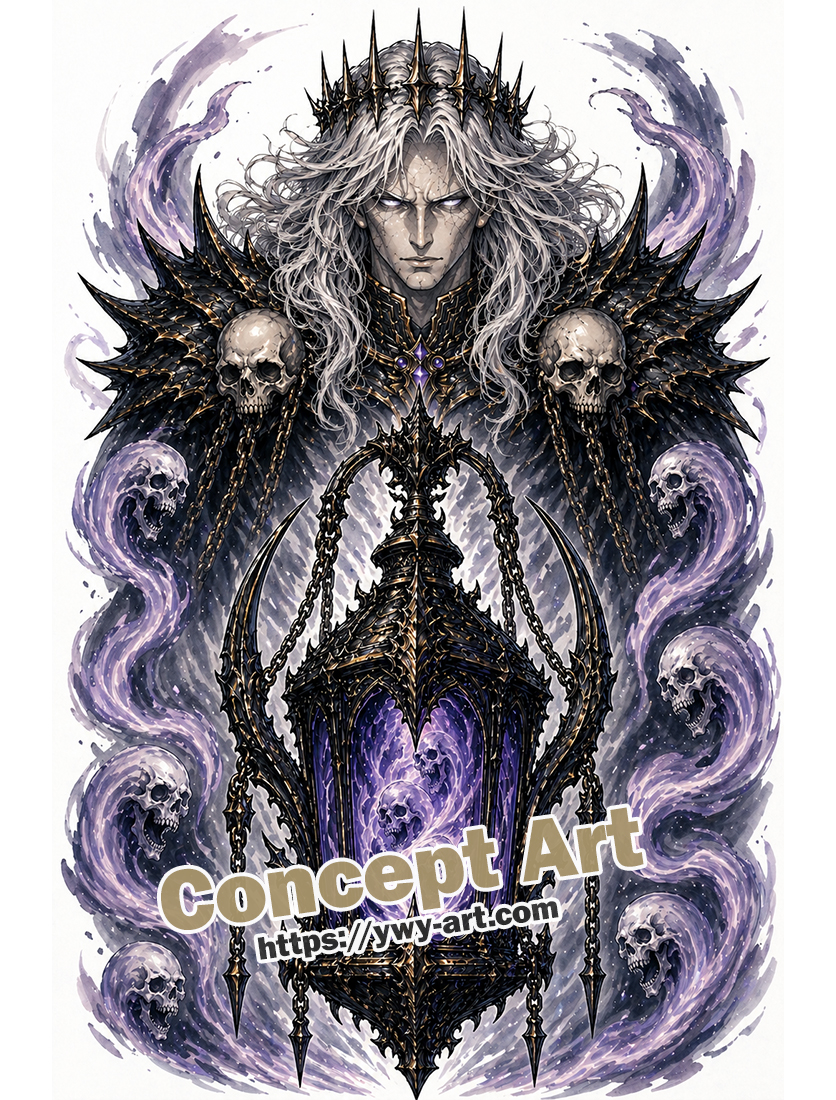
Hades Soul Lantern
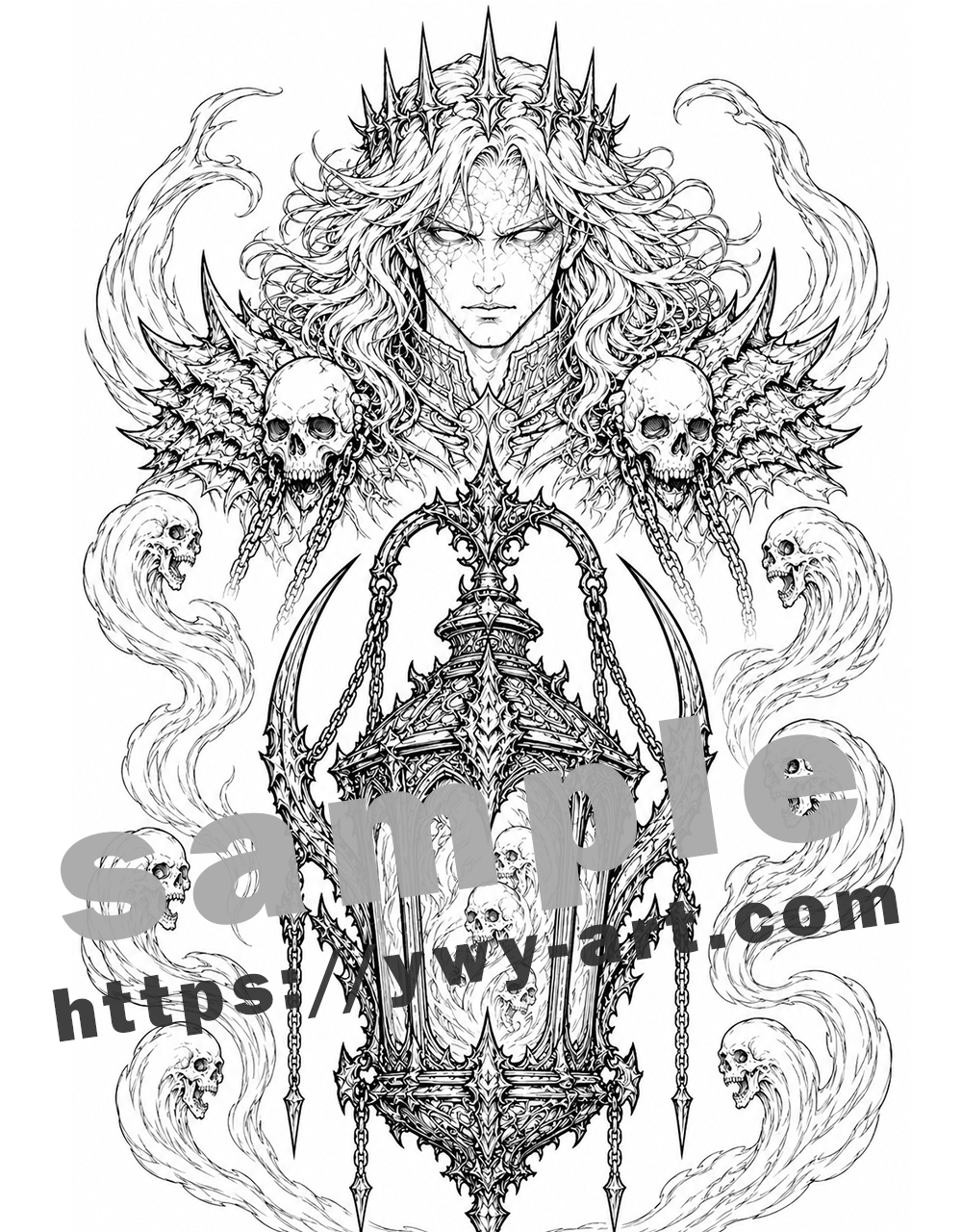
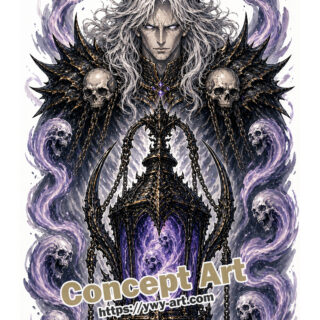
Hades is often imagined as a dark king sitting far below the world, silent and unreachable. But in this illustration, his power feels a little different. The Soul Lantern becomes the center of the scene, holding drifting skulls and pale violet spirits inside a black, thorn-like frame. It is beautiful, but honestly, it is also a bit unsettling. Not in a cheap horror way. More like the feeling of standing near a door you are not supposed to open.
Basic Profile
| Name | Hades |
|---|---|
| Mythology | Greek Mythology |
| Gender | Male |
| Region | Ancient Greece and the Greek underworld tradition |
| Era | Ancient Greek mythic age |
| Domain | Underworld, the dead, hidden wealth, burial, unseen power |
| Symbol | Helm of Darkness, keys, scepter, Cerberus, pomegranate, underworld throne |
| Culture / Religion | Ancient Greek religion |
| Main Role | Ruler of the underworld and keeper of the realm of the dead |
| Associated Deity | Persephone, Demeter, Zeus, Poseidon, Hermes, Charon, Thanatos |
| Common Depiction | A stern king of the dead, often shown with dark robes, a crown, scepter, or Cerberus nearby |
| Alignment | Grim, lawful, reserved, powerful, and deeply connected to inevitability |
Overview
Hades is one of the three great brothers who divided the cosmos after the fall of the Titans. Zeus took the sky, Poseidon took the sea, and Hades received the underworld. That realm was not simply “hell” in the later sense. In Greek myth, the underworld was the place where almost all souls eventually traveled. Heroes, kings, ordinary people, the loved and the forgotten — all roads led downward in the end.
Because of that, Hades is not just a villain figure. He is severe, yes. He is frightening, absolutely. But he is also a ruler with order, boundaries, and responsibility. His kingdom must be kept. The dead must remain where they belong. The living cannot simply enter and take what they want. This makes Hades feel less like a monster and more like the final guardian of a law nobody can escape.
That is why the Soul Lantern works so well as an artifact for him. A lantern usually means guidance. It brings light into darkness. But in Hades’ hands, that light is not warm and comforting in the usual way. It is the glow of souls, memory, grief, and judgment. It suggests that even in the deepest shadow, something is still being watched.
The image places the lantern in front of Hades like a sacred prison, or maybe a ritual vessel. The skulls and violet mist swirl around it, while chains hang from the dark frame. Hades himself looks calm, almost emotionless. That contrast is important. The spirits are moving, the smoke is alive, the skulls are crying out — but the god above them does not need to react. He already owns the silence beneath all of it.
The Artifact: Soul Lantern
The Soul Lantern is not a standard ancient Greek object in the same way that Poseidon’s trident or Zeus’s thunderbolt is. Instead, it is a creative artifact built from underworld symbolism. It brings together several ideas connected to Hades: the souls of the dead, the hidden realm, black metal, chains, ghostly light, and the sense of a boundary between life and death.
A lantern is a strong choice because it naturally suggests passage. People use lanterns when they walk through darkness. In myth, the journey to the underworld is also a passage: across rivers, past guardians, into a place where normal sunlight no longer reaches. So this artifact can be read as a guide for the dead, a container for wandering souls, or even a royal instrument that allows Hades to see every restless spirit in his domain.
The chains around the lantern add another layer. They make the artifact feel restrictive, not gentle. These are not free-floating lights. They are held, weighed down, and bound to the authority of the underworld. That fits Hades very well. His power is not wild like Poseidon’s waves or explosive like Zeus’s lightning. It is enclosed, absolute, and almost impossible to argue with.
The skulls inside and around the lantern make the piece more visually intense, but they also serve a symbolic role. Skulls are not only signs of death. They are reminders of equality. Wealth, beauty, fame, strength — all of it ends in the same place. That may sound bleak, but myth often uses this kind of imagery to make us look directly at what people usually avoid.
Mythological Background
Hades appears in many myths, but he is not as constantly active as Zeus or Athena. His stillness is part of his identity. He rules from below, and his presence is felt most strongly when someone crosses the boundary between life and death. Heroes such as Heracles, Orpheus, and Theseus all enter or approach the underworld in different stories, and each time, the realm feels dangerous because it is not meant for the living.
One of the most famous myths connected to Hades is the story of Persephone. Hades takes Persephone to the underworld, and her mother Demeter’s grief causes the earth to become barren. Eventually, Persephone spends part of the year below with Hades and part of the year above with Demeter, creating a mythic explanation for the cycle of seasons. This story gives Hades a more complicated image. He is feared, but he is also part of a cosmic rhythm: descent, absence, return, and renewal.
Another important underworld idea is the journey of souls. Hermes often guides the dead to the underworld, Charon ferries them across the river, and judges decide their fate. Hades rules over this entire structure. He is not usually shown chasing souls himself. He does not need to. His kingdom is the final destination, and the system already bends toward him.
That makes the Soul Lantern feel like an artifact of observation and containment. It could be imagined as a lamp that burns with the light of souls who have not yet found rest. Or perhaps it is a royal lantern used to reveal hidden memories of the dead. Either way, it fits the cold dignity of Hades much better than a simple weapon would.
Symbolism and Meaning
The Soul Lantern represents the idea that death is not only an ending, but also a crossing. The dead do not simply vanish in Greek myth. They move into another order of existence. Their voices may grow faint, their bodies may be gone, but something remains. The lantern gives that “something” a visible form.
The purple smoke and pale skulls suggest spirits caught between fear and memory. Purple is especially useful here because it can feel royal, magical, and mournful at the same time. It is not as harsh as pure red, and not as calm as blue. It sits in a strange middle place, which makes it perfect for an underworld scene.
Hades’ expression also matters. He does not look angry. He looks controlled. That is what makes the scene hit harder. A screaming villain would be easier to understand, but Hades is more frightening because he feels certain. The lantern glows below him, the souls twist around it, and he simply watches. There is a quiet pressure in that, and I think that is where the piece gets most of its power.
The artifact can also be read as a symbol of memory. Every soul carries a story. Every skull once had a voice, a name, a life, a fear, a desire. The Soul Lantern gathers those lost fragments into one visible flame. It turns death into a kind of archive, dark and sacred, but not empty.
Coloring Notes
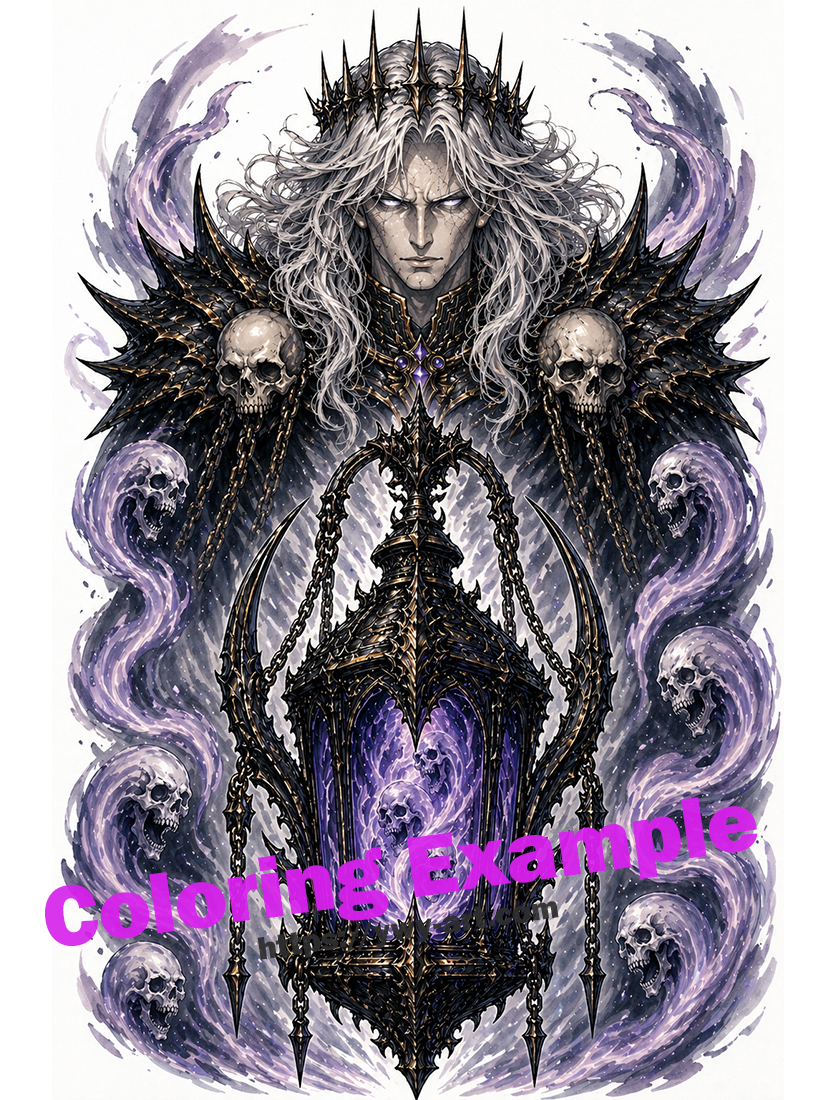
This piece works well with a limited but dramatic palette. Black, gray, violet, bone white, and a touch of cold gold can create a strong underworld mood. The lantern should probably stay the visual center, so it helps to give the inner glow more saturation than the surrounding armor and smoke.
For the skulls, avoid making every one exactly the same. Some can be warmer bone tones, while others can lean pale gray or lavender. That small variation keeps the spirits from looking flat. The smoke can be layered gently with violet, blue-gray, or muted purple. Leaving some white space inside the mist will also help it feel like vapor instead of a solid object.
Hades himself can be colored with colder tones to separate him from the glowing lantern. His hair may work beautifully in silver, white, or very pale gray. The armor can stay dark, but adding small bronze or muted gold accents along the edges will make the design feel ancient rather than simply black.
The main trick is contrast control. If everything becomes equally dark, the lantern may disappear. Keep the deepest blacks around the armor and frame, then let the soul light become softer and brighter. That balance will make the artifact feel like it is actually shining from inside the underworld.
Quick Creative Reference
| Element | Creative Direction |
|---|---|
| Best For | Dark fantasy, underworld scenes, ghostly artifacts, mythic death symbolism |
| Visual Keywords | Lantern, souls, skulls, chains, violet mist, underworld king |
| Mood | Silent, grim, sacred, haunted, royal |
| Recommended Colors | Black, bone white, violet, pale lavender, cold gray, antique gold |
| Main Focus | The lantern as a vessel of souls and underworld authority |
| Coloring Tip | Keep the lantern glow brighter than the surrounding armor so the artifact remains the emotional center of the page. |
Compare with Similar Deities
| Name | Mythology | Main Domains | Overall Image |
|---|---|---|---|
| Hades | Greek | Underworld, the dead, hidden wealth, final order | A stern and lawful ruler of the dead, feared more for his inevitability than for cruelty |
| Thanatos | Greek | Death, peaceful passing, mortality | A personification of death itself, often quieter and more direct than Hades |
| Anubis | Egyptian | Embalming, graves, judgment of the dead | A guardian and guide of souls, strongly connected to funerary rites and the weighing of the heart |
| Hel | Norse | Realm of the dead, underworld, those who die outside battle | A cold and mysterious ruler of the dead, associated with a shadowy realm beneath the world |
Closing
Hades Soul Lantern is not just a dark fantasy image with skulls. It has a stronger idea behind it: death as a realm, memory as a light, and Hades as the one who keeps all of it from breaking loose. The lantern makes the underworld visible for a moment, but it does not make it safe. That is the best part. It invites you to look closer, while quietly warning you not to step too far in.
I Tried Coloring This Artifact Page
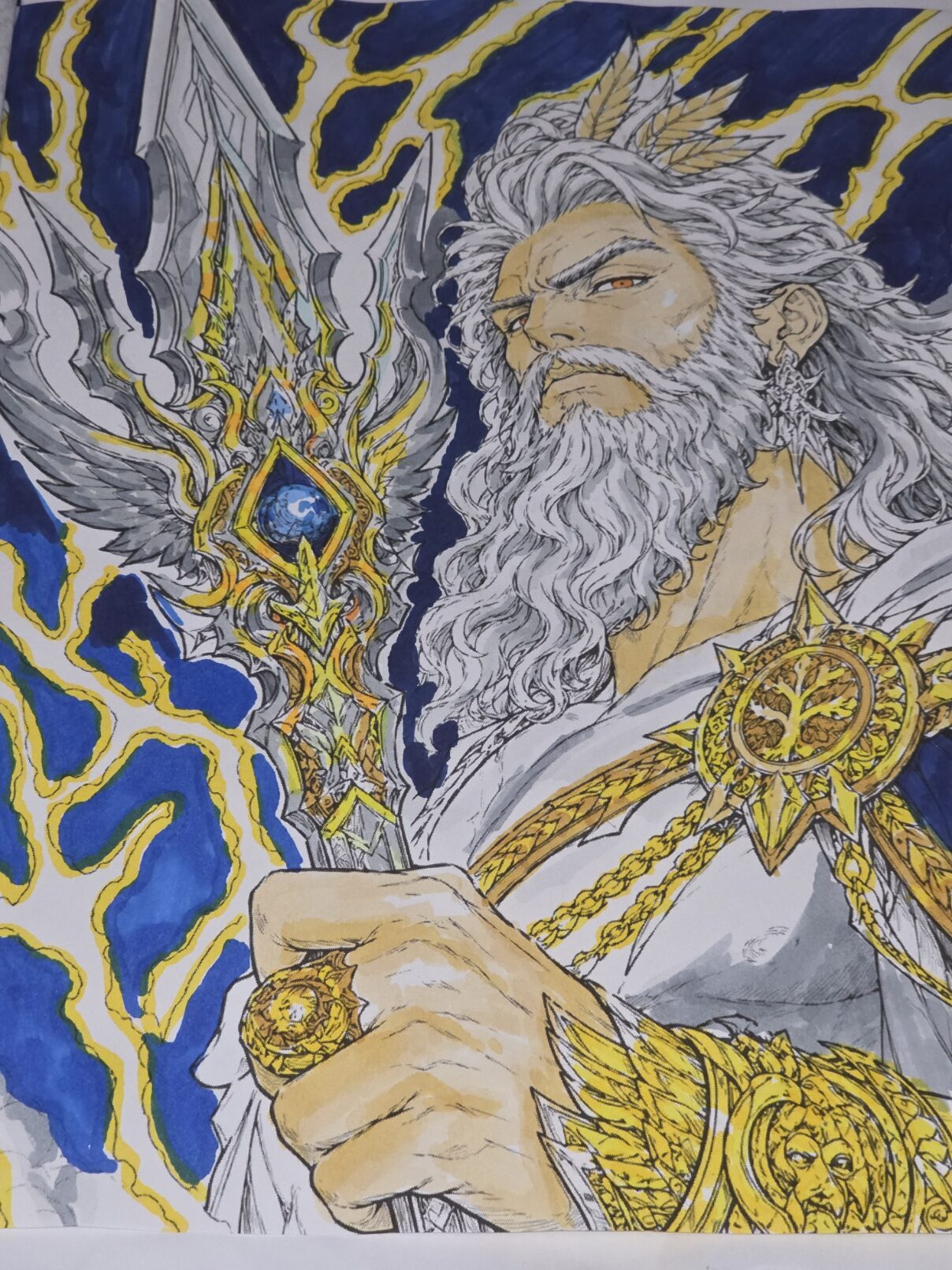
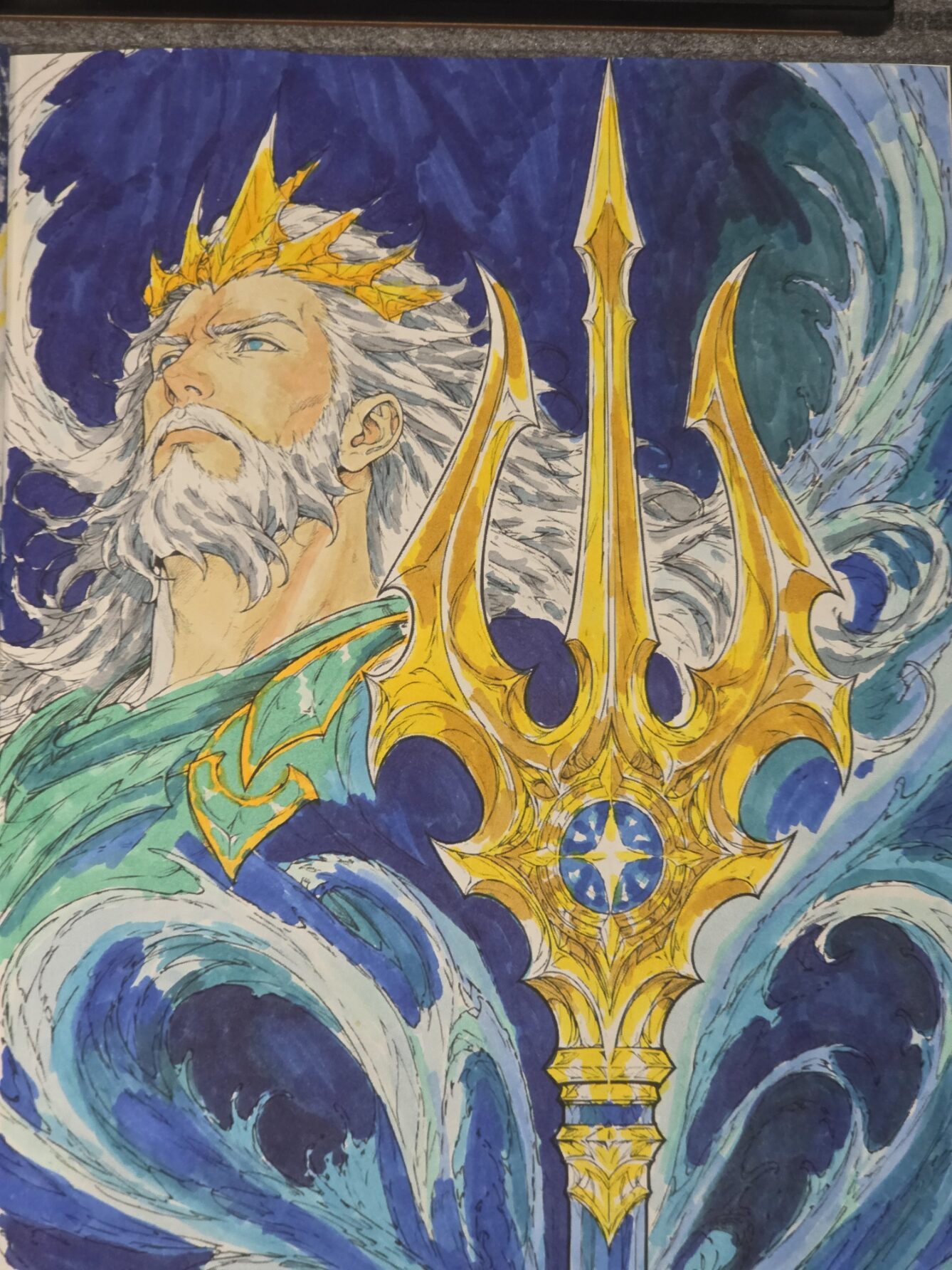
This page was colored by a beginner colorist, carefully using the sample coloring as a guide.
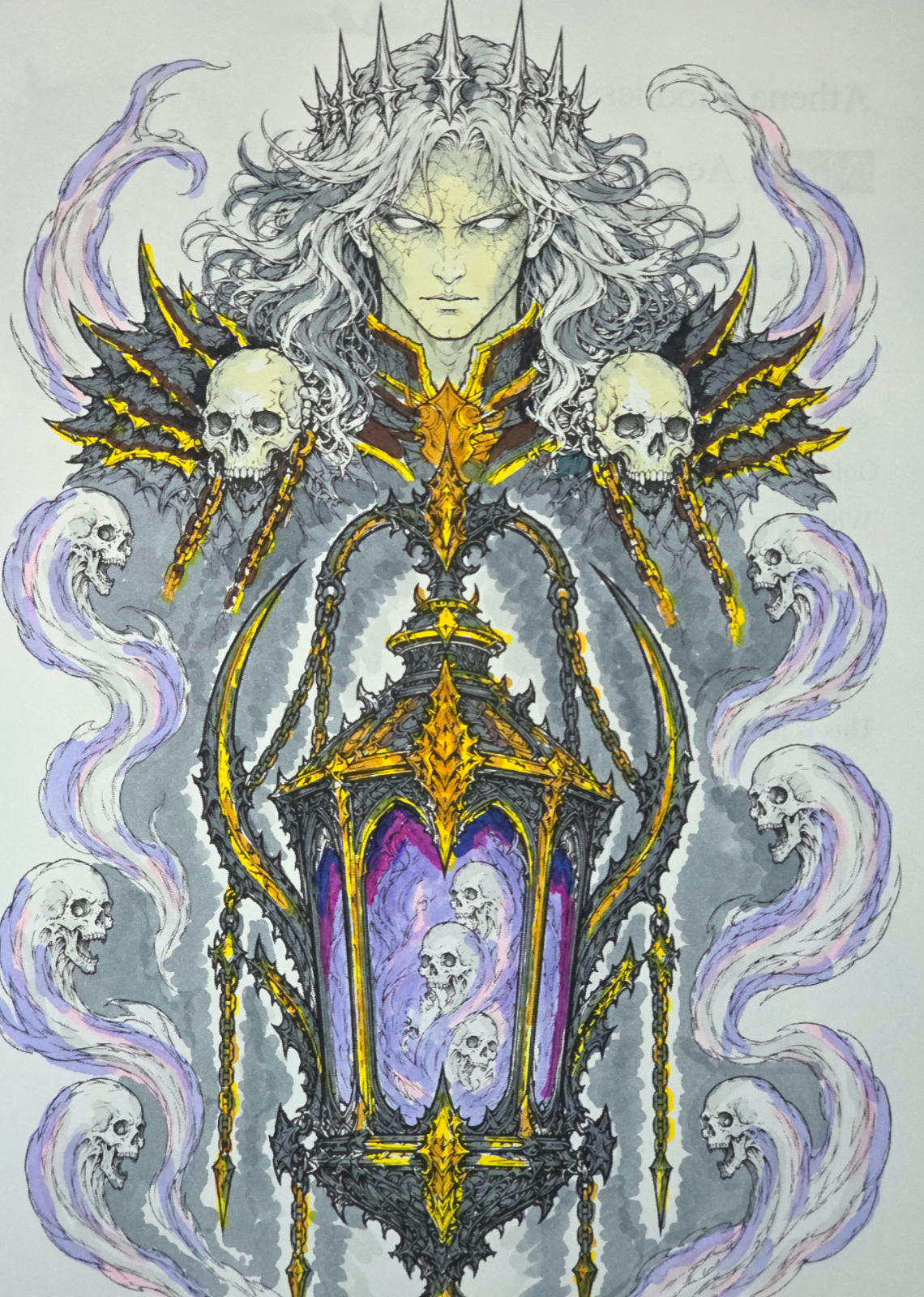
I really enjoyed coloring the lantern decorations and the shadows in the hair.
Since it is difficult to create smooth gradients with alcohol markers, I would like to try again using a wider range of marker colors.
Step into the world of mythology..
Available on Amazon Mythology Artifacts Series: Symbols of Power Coloring Book Open in a new tab

コメント