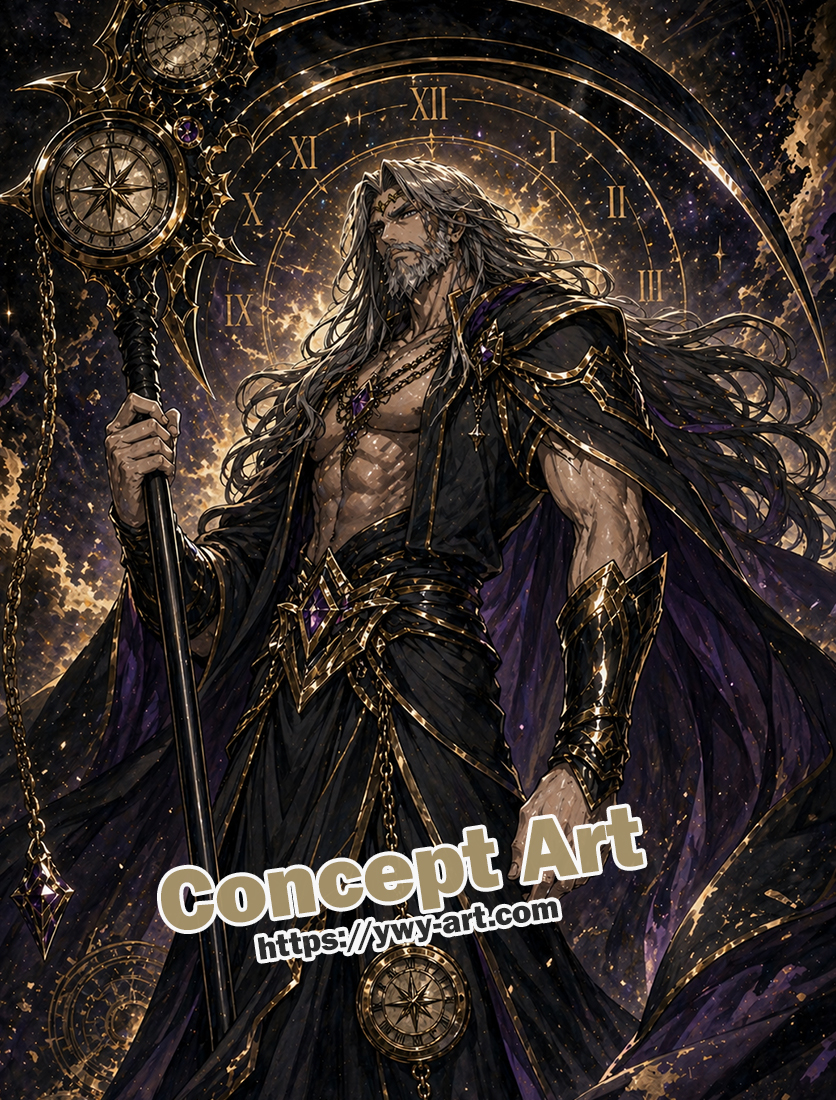
Cronus Titan Scythe
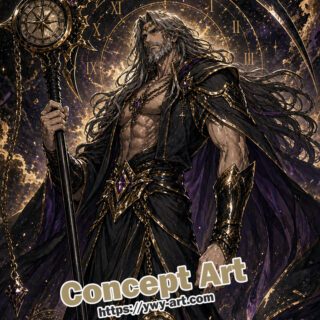
Cronus is not just an old Titan holding a blade. He is the fear of being overthrown, the violence of succession, and the heavy shadow that stands between one age and the next. In this illustration, the Titan Scythe becomes the central artifact, rising beside him like a weapon made for cutting history itself. Clocks, chains, dark gold, and cosmic fragments surround the scene, giving the whole piece a strange pressure. Honestly, this one feels massive in a very grim way. Cronus does not look like a simple villain here. He looks like an era that refuses to end.
Basic Profile
| Name | Cronus |
|---|---|
| Mythology | Greek Mythology |
| Gender | Male |
| Region | Primordial and Titan-era Greek cosmos |
| Era | Age of the Titans, before the full Olympian order |
| Domain | Titan kingship, succession, harvest symbolism, time-like imagery, generational conflict |
| Symbol | Scythe, sickle, chain, clock, harvest blade, dark crown, cosmic ring |
| Culture / Religion | Ancient Greek myth and Titanomachy tradition |
| Main Role | King of the Titans and father of the Olympian gods |
| Associated Deity | Uranus, Gaia, Rhea, Zeus, Hades, Poseidon, Hera, Demeter, Hestia |
| Common Depiction | A severe Titan ruler holding a sickle or scythe, often linked with time, harvest, or the fall of an older age |
| Alignment | Ancient, tyrannical, fearful, powerful, tragic, and bound to the cycle of overthrow |
Overview
Cronus stands at one of the most violent turning points in Greek mythology. He is the son of Uranus, the sky, and Gaia, the earth. Before the Olympians rule the cosmos, the Titans hold power, and Cronus becomes their king. But his rise to power is not peaceful. It begins with a blade.
According to the myth, Uranus imprisons some of his children within Gaia, causing her great suffering. Gaia creates a sickle and asks her children to act against him. Cronus is the one who accepts. He uses the blade to castrate Uranus, separating sky from earth and ending his father’s rule. That moment is brutal, but symbolically huge. The universe changes shape because one generation cuts down the one before it.
After taking power, Cronus becomes king of the Titans. But he carries the same fear that created his rule. A prophecy warns him that one of his own children will overthrow him, just as he overthrew Uranus. Instead of breaking the cycle, Cronus tries to control it. He swallows his children as they are born, hiding the future inside himself.
That is what makes Cronus so tragic and frightening. He knows how power can be taken because he took it himself. His fear is not imaginary. It is based on his own history. In this artwork, the Titan Scythe captures that perfectly. It is not only a weapon. It is the memory of the first cut and the threat of the next one.
The Artifact: Titan Scythe
The Titan Scythe is a creative artifact based on the sickle or curved blade associated with Cronus in Greek myth. Traditionally, this blade is the weapon he uses against Uranus. It is sometimes described as a sickle rather than a full scythe, but visually, the larger scythe form gives the artifact a more monumental feeling. It becomes less like a farming tool and more like a cosmic executioner’s blade.
A scythe carries several meanings at once. It is a harvest tool, used to cut grain when the season is complete. But because harvest is also a kind of ending, the scythe easily becomes a symbol of death, time, and inevitable cutting. For Cronus, that symbolism fits extremely well. He cuts down his father’s age, then tries to prevent his own age from being cut down.
The clocks and Roman numerals in this illustration add another layer. Strictly speaking, Cronus and Chronos are not always the same figure in Greek tradition. Cronus is the Titan king, while Chronos can represent time as a more abstract primordial force. But later interpretation often blends their imagery, and the association with time has become visually powerful. Here, the scythe feels like a blade that measures eras, not minutes.
The chains also matter. They suggest imprisonment, consequence, and the inability to escape the cycle. Cronus swallows his children to bind the future, but the future still returns. The Titan Scythe may cut, but it cannot stop what comes after the cut.
Mythological Background
Cronus’ story begins with rebellion against Uranus. Gaia suffers because Uranus hides their children away, and she creates the weapon that will end his domination. Cronus acts where the others hesitate. This makes him both liberator and aggressor. He frees one trapped generation, but he also establishes a pattern of violence that later turns against him.
After Cronus becomes ruler, he marries his sister Rhea. Their children include Hestia, Demeter, Hera, Hades, Poseidon, and Zeus. When each child is born, Cronus swallows them to prevent the prophecy of his overthrow. Rhea finally deceives him by giving him a stone wrapped like a baby instead of Zeus. Zeus is hidden and raised away from Cronus.
When Zeus grows up, he forces Cronus to release the swallowed children. The Olympians then rise against the Titans in the Titanomachy, a great war between the older divine generation and the new order of gods. Cronus, who once overthrew his father, now faces the same fate from his son. The cycle is complete, and that is what makes the myth feel so sharp.
Cronus is sometimes linked with a Golden Age, especially in later traditions where his reign is remembered as an age of abundance before decline. That creates an interesting contradiction. He can be imagined as a tyrant who devours his children, but also as a ruler of an older, more mysterious age. Greek myth often allows that kind of tension. A figure can be monstrous and majestic at the same time.
Symbolism and Meaning
The Titan Scythe represents succession through violence. It is the blade that separates one world from another. Uranus’ rule ends because Cronus cuts it. Cronus’ rule later ends because Zeus rises against him. The artifact therefore carries the terrible truth that power gained through fear often creates more fear.
The scythe also symbolizes harvest. That gives the image a colder, more inevitable feeling. A harvest does not happen because the grain is evil. It happens because the season has reached its limit. Cronus’ blade suggests that every age, no matter how powerful, eventually becomes ready to be cut.
The clock imagery deepens this idea. Even if Cronus is not simply “the god of time” in the strictest sense, the visual connection works because his myth is about generations. Fathers, children, prophecy, aging rule, and replacement all belong to time. His story is not about a single battle only. It is about the terrifying movement from one age into another.
The chains across the composition suggest that Cronus is trapped by the very system he tries to control. He binds others, but he is also bound by prophecy. He consumes the future, but cannot digest it. That is a strong mythological image: trying to stop change by force only makes the return of change more violent.
Coloring Notes
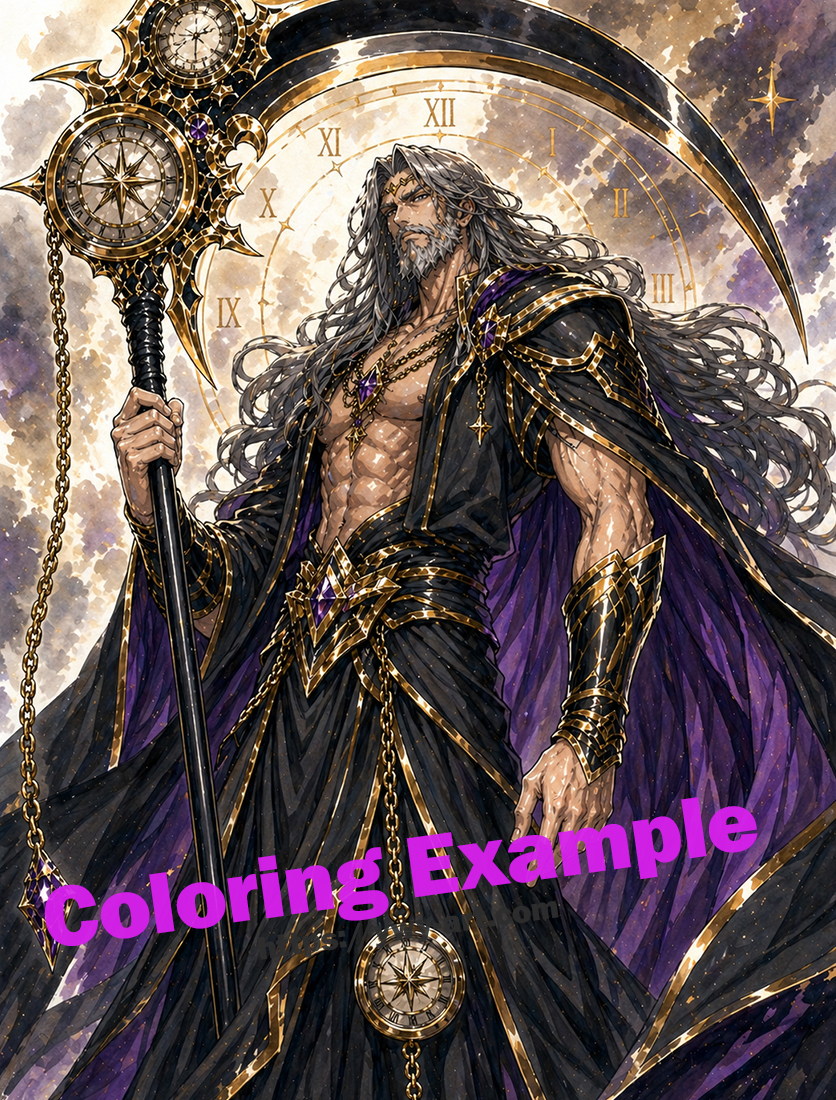
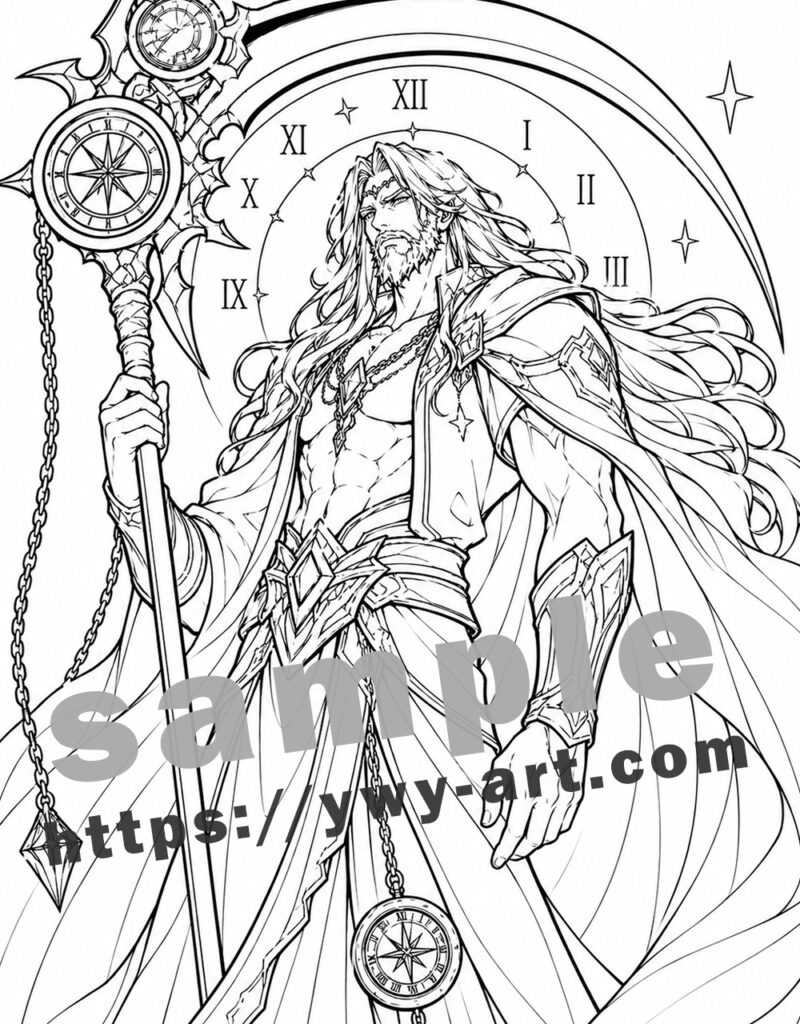
This page works well with a dark cosmic palette. Black, charcoal, antique gold, deep purple, bronze, gray-brown, and muted silver can create a heavy Titan-era atmosphere. The scythe should remain the strongest artifact focus, so the blade needs clear highlights against the dark background.
For the Titan Scythe, dark metal with gold or bronze edges will make it feel ancient and dangerous. The curved blade can use silver-gray highlights near the cutting edge, while the inner parts can stay darker. This will help the shape read clearly without turning the whole weapon too bright.
Cronus’ clothing can use black, deep violet, and smoky brown shadows. Small gold details on the armor and belt will connect him to the cosmic clock elements behind him. Since the image already has many dark areas, keeping selected highlights sharp will be more effective than trying to brighten everything.
The clocks and circular background symbols can be colored in aged gold, bronze, or dull brass. They should feel old, almost buried in cosmic dust. A few brighter points around the Roman numerals can help the time motif stay visible, but they should not overpower the scythe.
Purple gemstones and accents can add a strong mythic tone. Deep violet works especially well with Cronus because it feels royal, cosmic, and slightly ominous. The background can stay dark with scattered gold dust or star-like marks, giving the whole piece the feeling of an ancient age breaking apart.
Quick Creative Reference
| Element | Creative Direction |
|---|---|
| Best For | Titan mythology, dark cosmic scenes, succession themes, time and fate symbolism |
| Visual Keywords | Cronus, Titan Scythe, clocks, chains, Roman numerals, cosmic darkness, old king |
| Mood | Ancient, grim, heavy, tragic, tyrannical, inevitable |
| Recommended Colors | Black, charcoal, antique gold, bronze, deep purple, muted silver, smoky brown |
| Main Focus | The scythe as a symbol of succession, cutting, harvest, and the fall of old divine power |
| Coloring Tip | Keep the scythe edge and clock rings highlighted, while leaving the cloak and background darker to preserve the heavy Titan atmosphere. |
Compare with Similar Deities
| Name | Mythology | Main Domains | Overall Image |
|---|---|---|---|
| Cronus | Greek | Titan kingship, succession, harvest blade, generational conflict | A grim Titan king whose scythe marks the violent cutting of one age from another |
| Chronos | Greek / Orphic tradition | Time, cosmic generation, primordial order | A more abstract figure of time itself, often visually blended with Cronus in later symbolism |
| Uranus | Greek | Sky, primordial fatherhood, first cosmic rule | The ancient sky father overthrown by Cronus, representing the older order before the Titans |
| Zeus | Greek | Sky, thunder, kingship, Olympian order | The son who defeats Cronus and establishes the rule of the Olympian gods |
Closing
Cronus Titan Scythe is a strong artifact piece because it turns one weapon into the symbol of an entire cosmic cycle. The scythe cuts Uranus from power, haunts Cronus’ reign, and points forward to the rise of Zeus. It is harvest, time, fear, and succession all in one dark curve. Cronus may stand like a mighty king, but the blade beside him reminds us that every ruler eventually faces the edge of the next age.
Step into the world of mythology..
Available on Amazon Mythology Artifacts Series: Symbols of Power Coloring Book Open in a new tab
コメント