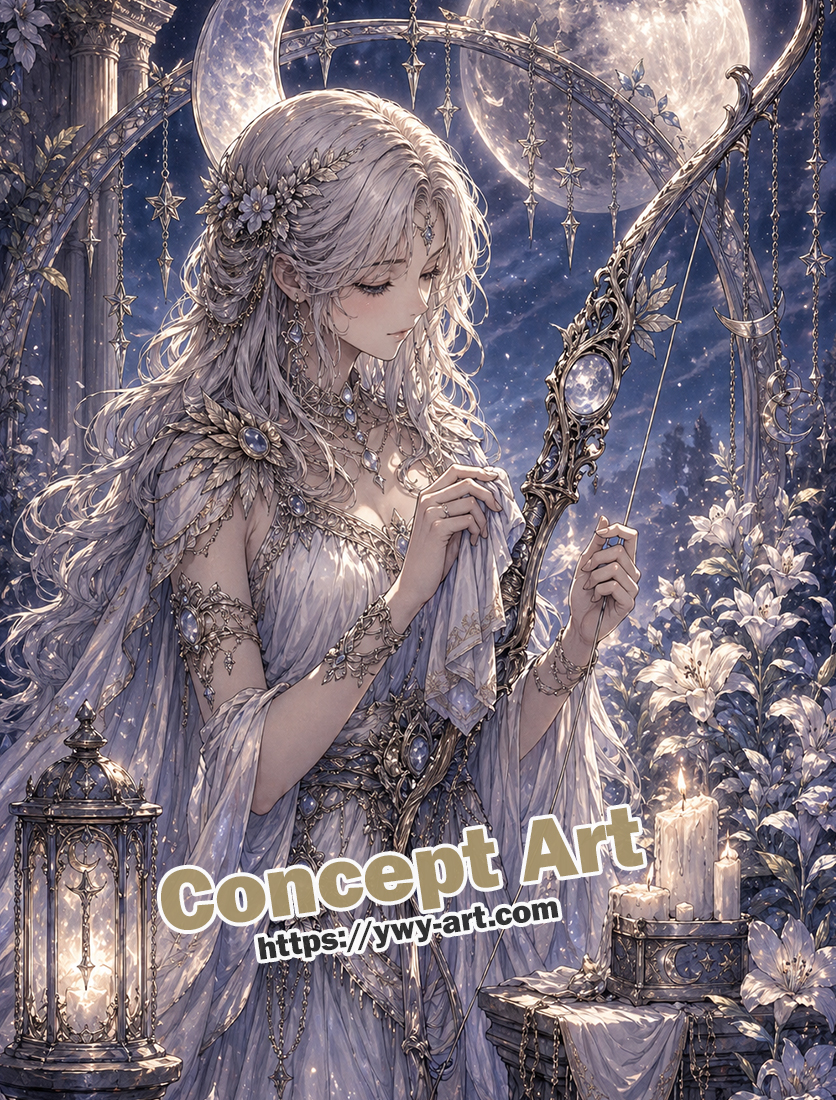
Artemis Lunar Bow
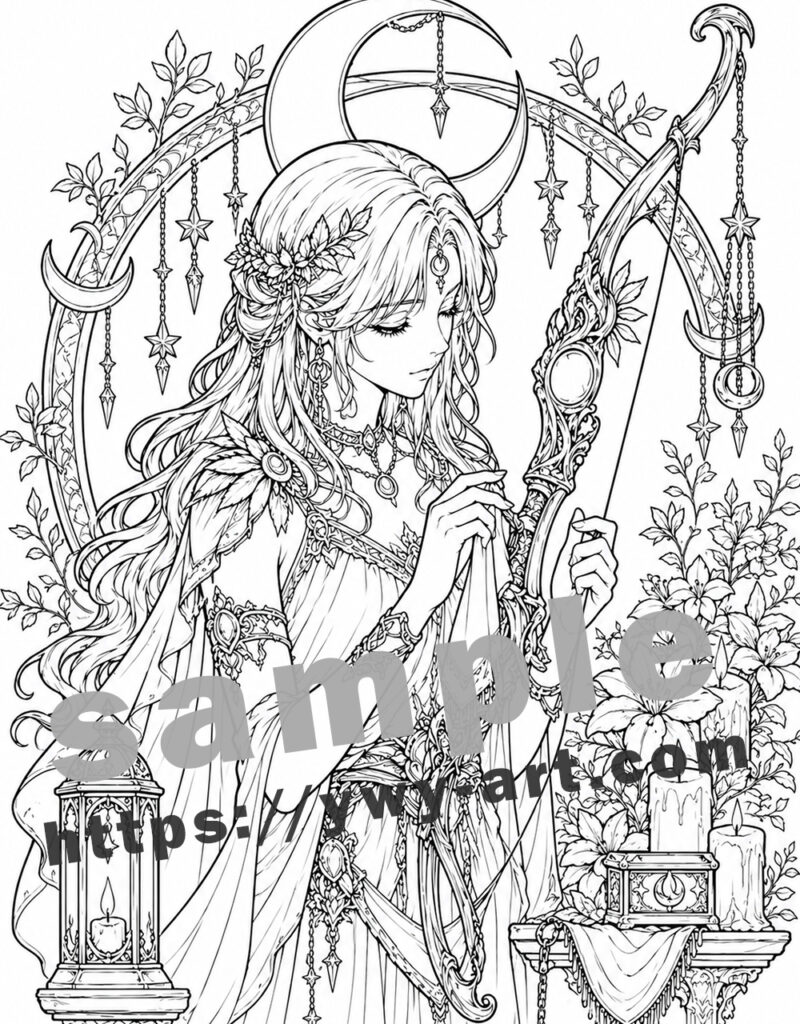
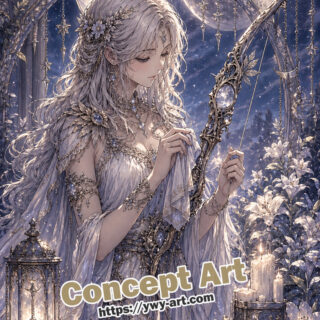
Artemis is often described as a goddess of the hunt, but that simple label does not really capture her whole presence. She is the wild forest, the silent moon, the sudden arrow, and the calm space where no one is allowed to disturb her. In this illustration, the Lunar Bow becomes the central artifact, held in a quiet moonlit garden filled with stars, lilies, candles, and hanging crescent ornaments. It feels soft at first, but there is a sharpness underneath. Honestly, I love that tension. This is not a noisy battle scene. It is the moment before the arrow is released.
Basic Profile
| Name | Artemis |
|---|---|
| Mythology | Greek Mythology |
| Gender | Female |
| Region | Ancient Greece, especially wilderness, mountains, forests, and sacred groves |
| Era | Ancient Greek mythic age |
| Domain | Hunting, wilderness, the moon, chastity, childbirth, young women, wild animals |
| Symbol | Bow, arrow, crescent moon, deer, hound, cypress, silver light |
| Culture / Religion | Ancient Greek religion |
| Main Role | Goddess of the hunt and protector of wild spaces |
| Associated Deity | Apollo, Leto, Zeus, Selene, Hecate, Orion, Actaeon |
| Common Depiction | A youthful goddess carrying a bow, often accompanied by animals or shown under the moon |
| Alignment | Independent, precise, untamed, protective, distant, and quietly dangerous |
Overview
Artemis is one of the most distinctive goddesses in Greek mythology. She is the twin sister of Apollo and the daughter of Zeus and Leto. While Apollo is often connected with sunlight, music, prophecy, and reason, Artemis moves through moonlight, forests, mountains, and the edges of human society. She belongs to places that are beautiful but not fully safe.
Her identity is built around independence. Artemis does not fit neatly into the usual roles expected of women in many ancient stories. She refuses marriage, guards her freedom, and protects her own sacred space. That makes her feel very modern in some ways, even though her myths are ancient. She is not waiting to be chosen or rescued. She chooses her own path, and anyone who violates her boundaries faces the consequences.
The bow is the clearest symbol of that personality. It is elegant, controlled, and deadly from a distance. Unlike a sword or spear, a bow requires patience, focus, breathing, and timing. It is not just a weapon of attack. It is a weapon of awareness. The archer must see before others notice, prepare before others move, and release only when the moment is right.
In this artwork, the Lunar Bow is surrounded by moon symbols and delicate ornaments, but it never feels weak. The curved shape echoes the crescent moon, while the long line of the string suggests tension held in silence. Artemis herself looks calm and inward, almost as if she is listening to the night before making her next move.
The Artifact: Lunar Bow
The Lunar Bow is a creative artifact based on Artemis’ traditional weapon and her later association with the moon. In ancient Greek religion, Artemis was primarily a goddess of the hunt and wild nature, but over time she became strongly connected with lunar imagery. This connection grew especially through her relationship with other moon goddesses such as Selene and Hecate.
A lunar bow is a perfect visual symbol for Artemis because the bow and crescent moon already share a similar shape. Both are curved, both imply tension, and both belong naturally to the night. The crescent moon can look peaceful, but it also resembles a blade. That double meaning fits Artemis very well. She is graceful, but not harmless.
The bow in this illustration feels less like a simple hunting tool and more like a sacred instrument. The gemstone near the center, the ornate metalwork, and the moonlit setting make it feel as if the bow gathers light from the night sky. It does not need flames or thunder to feel powerful. Its strength comes from stillness, aim, and restraint.
This is also why the artifact works well for a coloring page. The Lunar Bow can carry many visual layers: silver metal, moonstone-like gems, pale blue highlights, dark inner shadows, and small points of reflected starlight. It can be colored as a holy object, a weapon, or something between the two.
Mythological Background
Artemis appears in many myths where boundaries are tested. One of the most famous is the story of Actaeon, a hunter who accidentally sees Artemis bathing. In many versions, Artemis turns him into a stag, and his own hunting dogs tear him apart. It is a harsh story, but it reveals something important about her mythic role. Artemis protects sacred privacy. The wild places under her care are not open for careless intrusion.
She is also connected to Orion, the great hunter. The details vary depending on the version, but Orion’s story often circles around hunting, companionship, pride, and death. Sometimes Artemis cares for him. Sometimes he becomes a threat. Sometimes Apollo is involved in his downfall. These variations show how Artemis’ world is filled with tension between closeness and distance. Even affection does not erase danger around her.
Another important part of Artemis’ identity is her protection of young women and children. This may feel surprising when placed beside her fiercer hunting myths, but it makes sense when we look more closely. Artemis guards transitions: childhood to adulthood, safety to danger, civilization to wilderness, life to death. She stands at thresholds, especially those where vulnerability and power meet.
Her relationship with Apollo also deepens her symbolic role. Apollo’s arrows can bring plague or sudden death, and Artemis’ arrows can also strike swiftly. Together, the twins represent divine precision. Their power is not messy. It arrives from a distance, clean and unavoidable.
Symbolism and Meaning
The Lunar Bow represents focused independence. It is not a weapon for chaotic violence. It is a symbol of choosing a target, holding steady, and refusing to be pulled off course. That makes it a strong image for Artemis, because her myths are full of moments where she preserves her own path against pressure from others.
The moon behind her adds another layer. Moonlight changes how the world looks. It softens some things and sharpens others. Under the moon, familiar places can become strange, quiet, and slightly dangerous. Artemis belongs to that kind of space. She is not a bright daylight goddess who explains everything clearly. She is more like a presence you feel when the forest goes silent.
The lilies and candles in the composition bring a ritual atmosphere to the scene. They make the image feel less like a hunt in motion and more like a sacred preparation. Artemis is not simply carrying the bow. She seems to be tending to it, honoring it, or preparing it under moonlight. That gives the artifact a spiritual weight.
The hanging stars and crescent ornaments reinforce the idea that this bow is connected to the sky. It is not only aimed across a forest. It is aligned with celestial rhythm, night, and the quiet cycles of nature. The bow becomes a bridge between the hunter on earth and the moon above.
Coloring Notes
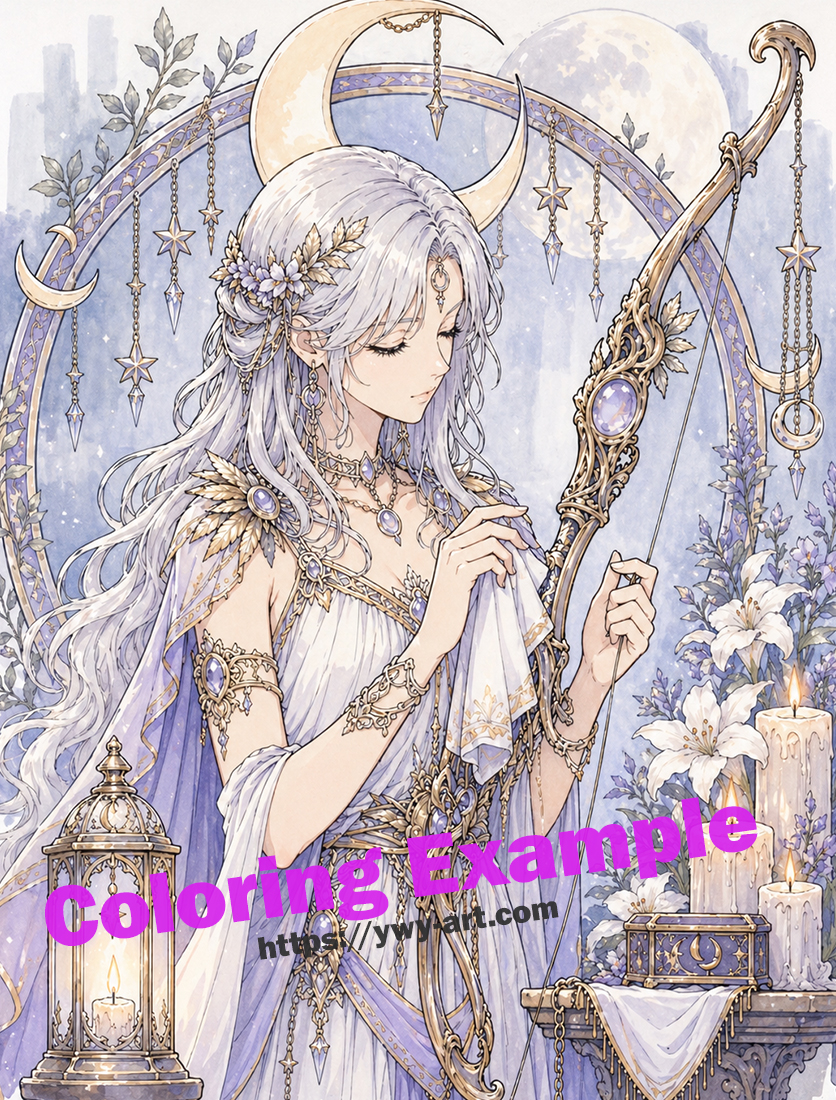
This page works beautifully with soft night colors. Silver, pale blue, lavender, cool gray, pearl white, and deep navy can create a calm moonlit atmosphere. The important thing is not to make everything equally bright. Let the moon and the bow carry the strongest glow, while the background stays slightly quieter.
For Artemis’ clothing, white and pale violet tones can make her feel connected to moonlight. Small metallic accents in silver or muted gold can bring out the ornamental details without making the whole image too heavy. Her hair can be colored in silver, ash blonde, pale lavender-gray, or even very light blue-gray if you want a more fantasy-like result.
The Lunar Bow should probably receive the clearest contrast. A dark metal base with silver highlights can make it feel ancient and powerful. The central gemstone can be colored like moonstone, pale amethyst, or soft blue crystal. If the gem is brighter than the surrounding metal, the eye will naturally move toward the artifact.
The flowers and candles are good places to add gentle warmth. A small amount of cream, pale yellow, or soft ivory can keep the scene from becoming too cold. Just a little is enough. If the candlelight becomes too strong, it may fight against the moonlight, so keeping it subtle will preserve the night atmosphere.
The background sky can be layered with dark blue, blue-gray, and violet. Leaving small white points for stars will help the image breathe. The moon itself does not need too much shading; a few soft gray shadows can be enough to make it feel round without losing its glow.
Quick Creative Reference
| Element | Creative Direction |
|---|---|
| Best For | Moonlit fantasy, divine archery, sacred huntress themes, quiet mythological atmosphere |
| Visual Keywords | Lunar bow, moon, stars, Artemis, lilies, silver light, sacred night |
| Mood | Quiet, elegant, distant, mysterious, focused, slightly dangerous |
| Recommended Colors | Silver, pearl white, pale blue, lavender, cool gray, deep navy, soft ivory |
| Main Focus | The bow as a symbol of Artemis’ independence, precision, and moonlit authority |
| Coloring Tip | Keep the brightest highlights on the moon, gemstone, and bow edges so the artifact remains the visual center. |
Compare with Similar Deities
| Name | Mythology | Main Domains | Overall Image |
|---|---|---|---|
| Artemis | Greek | Hunting, wilderness, moon, protection, young women | A free and precise goddess of the wild, carrying both beauty and danger under moonlight |
| Diana | Roman | Hunting, moon, forests, childbirth | The Roman counterpart of Artemis, often shown as a moonlit huntress and protector of wild spaces |
| Selene | Greek | Moon, night sky, lunar cycles | A more direct personification of the moon, often imagined as a radiant celestial goddess |
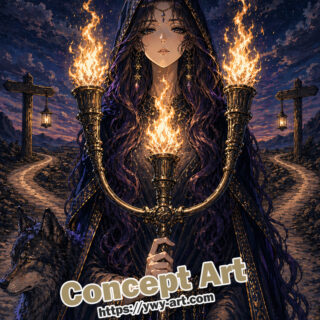
| Hecate | Greek | Magic, crossroads, night, spirits, liminal spaces | A darker night goddess associated with thresholds, witchcraft, torches, and hidden paths |
Closing
Artemis Lunar Bow is a quiet but powerful artifact piece. It does not rely on battle, flames, or dramatic violence to feel strong. Instead, it builds its impact through moonlight, silence, and the tension of a bowstring held at rest. The result is a scene that feels gentle for a moment, then suddenly sharp when you look closer. That is very Artemis: beautiful, distant, and never fully safe.
Step into the world of mythology..
Available on Amazon Mythology Artifacts Series: Symbols of Power Coloring Book Open in a new tab
コメント