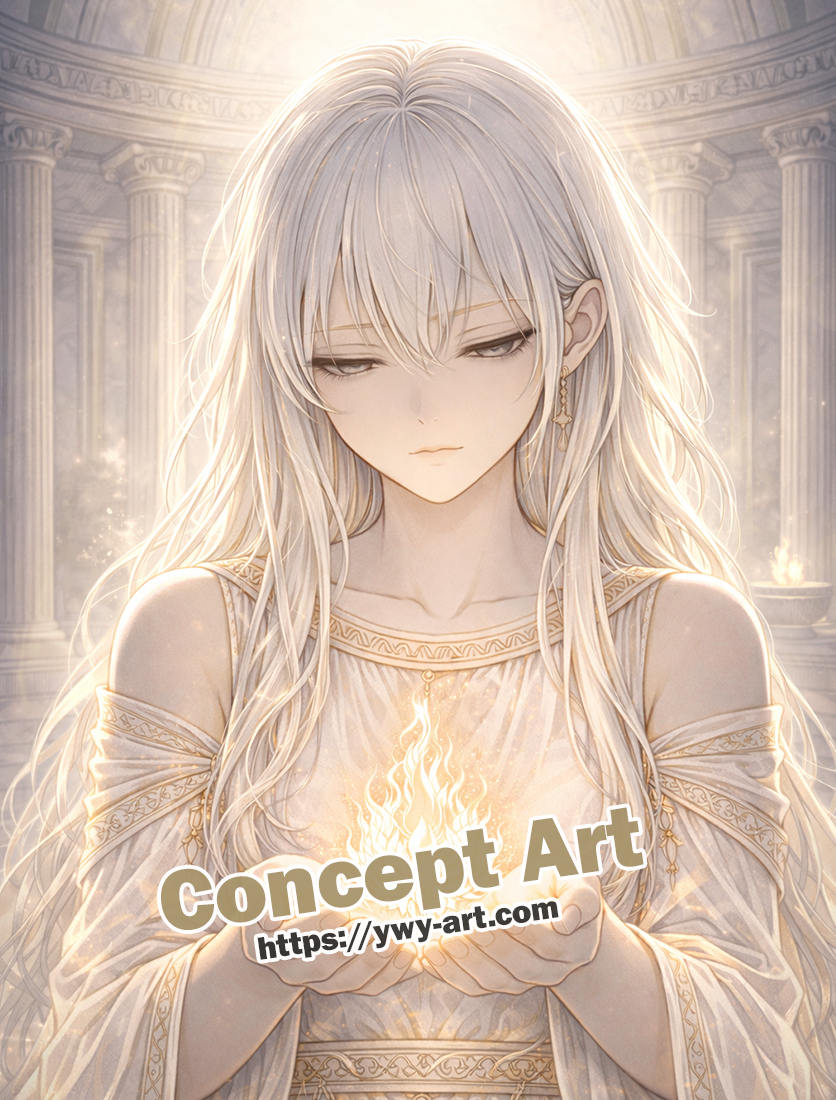
Hestia — Flame of Order / Summoning
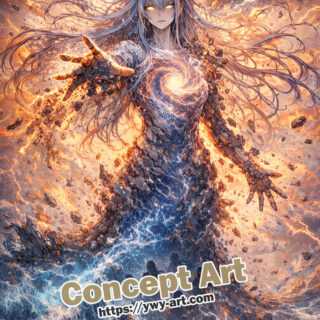
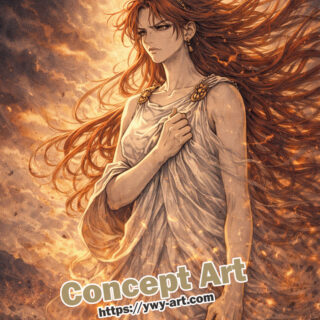
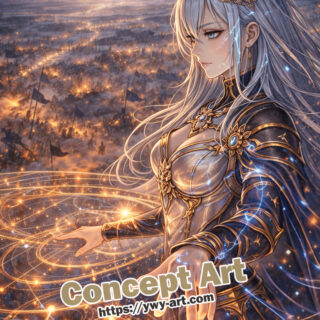
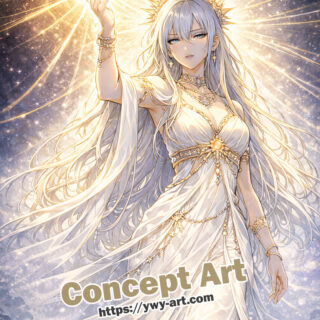
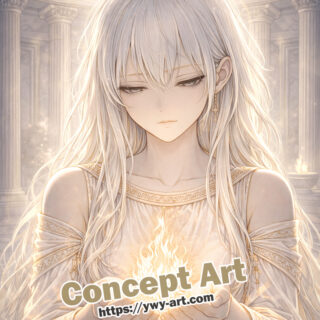
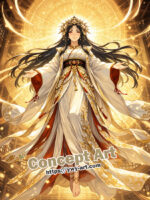
Before conflict, before division, there must be something that holds the world together. Hestia exists at that point of origin. She does not command armies or reshape the heavens, yet without her, no structure can endure. In this scene, she stands not as a warrior, but as the silent center from which order begins.
Basic Profile
| Name | Hestia |
|---|---|
| Mythology | Greek Mythology |
| Gender | Female |
| Region | Ancient Greece |
| Era | Archaic to Classical Greek Mythic Tradition |
| Domain | Hearth, Home, Sacred Flame, Order |
| Symbol | Flame, hearth, fire, sanctuary |
| Culture / Religion | Ancient Greek Religion |
| Main Role | High Priestess of the First Flame |
| Rank | Olympian Twelve |
| Position in Titanomachy | Foundation of Order before Division |
| Associated Deity | Zeus, Poseidon, Demeter, the Olympian family |
| Common Depiction | A calm and composed goddess tending or embodying a sacred flame |
| Alignment | Neutral Order / Sacred Balance |
| Creative Reference | A still and unwavering presence that defines stability before the world begins to fracture |
Overview
Hestia is one of the most fundamental yet often understated figures in Greek mythology. As the goddess of the hearth, she represents the center of both the home and the sacred space. Unlike other Olympians who dominate through action or conflict, Hestia maintains stability through presence. Every ritual begins with her, and every structure of order depends on her quiet continuity.
Within a Titanomachy interpretation, Hestia becomes especially important as the last embodiment of unified balance before division occurs. She is not part of the conflict itself, but she defines what is being lost. Her flame represents a world that still holds together, a state that cannot survive once opposing forces begin to separate.
Characteristics
- Embodies stability, continuity, and sacred order rather than action or conflict.
- Represents the spiritual and physical center of space through the hearth.
- Maintains calm, emotionless composure that reinforces her role as a constant presence.
- Functions as a symbolic anchor in narratives involving change or disruption.
- Works best in compositions emphasizing stillness, symmetry, and controlled light.
Symbolism and Meaning
Hestia symbolizes the idea that all systems require a center. Her flame is not destructive, but sustaining. It does not spread uncontrollably, but remains contained, deliberate, and essential. In mythological storytelling, this makes her the embodiment of order before fragmentation, a state in which everything still belongs to a single structure.
In the context of the Titanomachy, her meaning becomes even more powerful. She represents the last moment in which opposing forces have not yet fully separated. Once the world divides into Titans and Olympians, the kind of unity she represents can no longer exist in the same way. Her presence therefore carries a quiet tension, suggesting that stability is about to be lost.
Quick Creative Reference
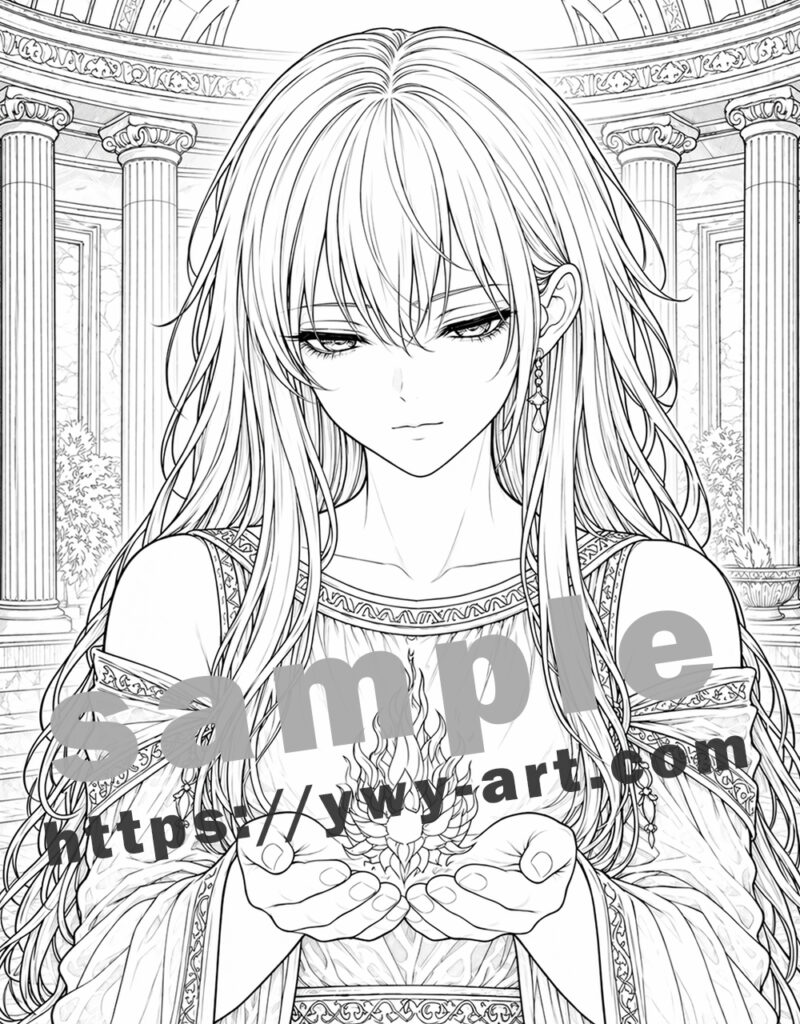
| Best For | Calm central compositions, symbolic origin scenes, pre-conflict stillness |
|---|---|
| Visual Keywords | still flame, symmetry, quiet light, centered figure, sacred fire, minimal motion |
| Mood | Serene, controlled, sacred, unwavering |
| Useful Themes | order before chaos, sacred center, stability, origin of structure |
Compare with Similar Deities
| Name | Mythology | Main Domains | Overall Image |
|---|---|---|---|
| Vesta | Roman Mythology | Hearth, sacred fire | Very similar in role, often more explicitly tied to ritual and civic duty |
| Demeter | Greek Mythology | Agriculture, fertility | More active and emotional, connected to seasonal change rather than stillness |
| Athena | Greek Mythology | Wisdom, strategy | Represents structured intellect and action rather than quiet foundational order |
The Flame Before Division
Hestia’s role in a Titanomachy-based narrative is not to act, but to define the baseline state of the world. Her flame represents a condition in which everything still belongs to a unified structure. When placed at the beginning of a sequence, she establishes what balance looks like before it begins to fracture.
This makes her visually powerful despite minimal movement. A still figure, a contained flame, and a centered composition can communicate more than dramatic motion when used correctly. The viewer understands that something stable exists, and that this stability will not last.
The Meaning of “Flame of Order”
The phrase “Flame of Order” reflects controlled energy. Unlike destructive fire, Hestia’s flame is contained and purposeful. It provides warmth, continuity, and identity. It is the kind of fire that sustains life rather than ending it, and this distinction is essential to her character.
In a broader narrative, this controlled flame becomes a contrast point. When conflict begins and uncontrolled forces emerge, the absence of this stability becomes more apparent. Hestia therefore strengthens the impact of later scenes by establishing a clear sense of what has been lost.
Visual Direction for This Illustration
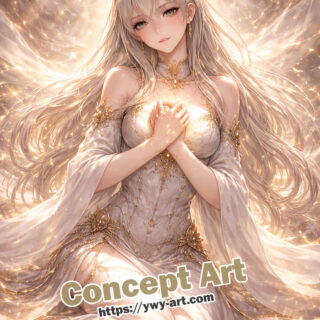
A strong composition places Hestia in a centered, symmetrical pose with a calm, upright posture. The flame should be small but intense, acting as the focal point without overwhelming the scene. Surrounding elements should be minimal to reinforce the sense of control and order.
Facial expression should remain neutral and composed. Avoid exaggerated emotion, as her strength comes from consistency rather than reaction. The lighting should be soft and stable, emphasizing the contained nature of the flame and the stillness of the environment.
Why Hestia Matters in This Series
Hestia defines the starting point of the entire Titanomachy arc. Without her, the concept of “before” loses clarity. She provides a reference for balance, allowing every subsequent change to be understood as a departure from something stable and complete.
Her inclusion ensures that the series is not only about conflict, but about transformation. By showing what the world was before it divided, she gives meaning to everything that follows.
Coloring Variations
- Sacred Flame: Use warm orange, gold, and soft red tones with gentle glow effects.
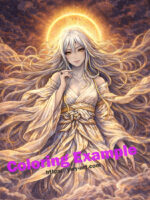
- White Flame: Focus on pale yellow, white, and light gray for a more divine and abstract feel.
Add subtle pink and soft purple tones to create a transitional atmosphere.
Coloring Tips
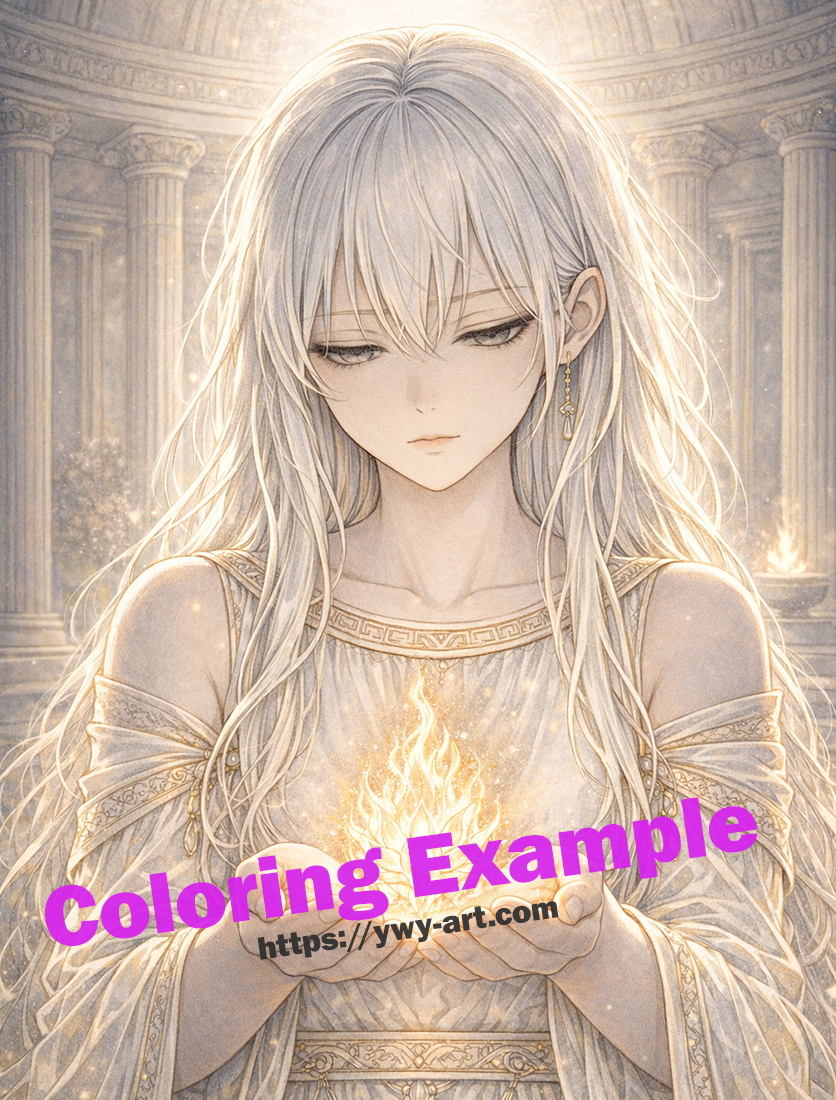
Keep the flame controlled rather than exaggerated. Avoid making it too large or chaotic, as its meaning comes from containment. Use gradients and soft transitions to express warmth without losing structure.
The surrounding area should remain relatively simple. Too many details can weaken the sense of focus and stability. Let the flame act as the central point and guide the rest of the composition.
Skin tones and clothing can be kept neutral or warm to harmonize with the fire. Avoid overly strong contrast outside the flame area so that the viewer’s attention remains centered.
Japanese Summary
ヘスティアは、戦いの前に存在する「秩序そのもの」を象徴する神である。炉と聖なる炎を司る彼女は、争いや変化を引き起こす存在ではなく、世界が安定している状態を保つ中心として機能する。そのためティタノマキアにおいては、戦いの当事者ではなく、分裂が起こる前の基準として描かれることが重要になる。
この作品では、彼女は静かに立ち、制御された炎を保ち続けている。その姿は動きが少ないが、逆にそれが安定の象徴となり、これから世界が大きく変わることへの対比として機能する。ヘスティアの存在によって、後に訪れる混乱や衝突の意味がより強く感じられるようになる。
秩序の中心としての役割
ヘスティアは、戦いを動かすのではなく、戦いが起こる前の状態を定義する存在である。すべてが一つにまとまっていた世界の中心にあり、その均衡が崩れることで初めて対立が生まれる。そのため、彼女は静かでありながら、物語全体の出発点として非常に重要な位置にいる。
このように描くことで、単なる戦闘の連続ではなく、世界がどのように変化していくのかという流れを自然に見せることができる。ヘスティアはその最初の基準として機能する。
表現と塗りの見どころ
構図では中央配置を意識し、炎を中心に据えることで安定感を強調するとよい。周囲の要素はあえて抑えめにし、余白や静けさを活かすことで、秩序の象徴としての強さが際立つ。
塗りでは炎を主役として扱い、周囲は控えめな色でまとめるとバランスが取りやすい。暖色系をベースにしつつも、グラデーションを丁寧に使うことで神聖さと落ち着きを同時に表現できる。
塗りのポイント
炎は単色で塗るのではなく、中心を明るく外側を少し濃くすることで立体感を出すとよい。過度に派手にせず、あくまで制御された光として見せることが重要である。
背景や衣装は炎よりも控えめな色でまとめることで、視線を自然に中央へ誘導できる。全体として「動かない強さ」を意識すると、この作品の魅力が引き出しやすい。
Explore Our Coloring Book Series
Discover more dark mythology and divine feminine designs in our growing coloring book collection.
Explore character features, symbolism, and coloring ideas inspired by gods, goddesses, Titans, and primordial beings from around the world.
Step into the world of mythology..
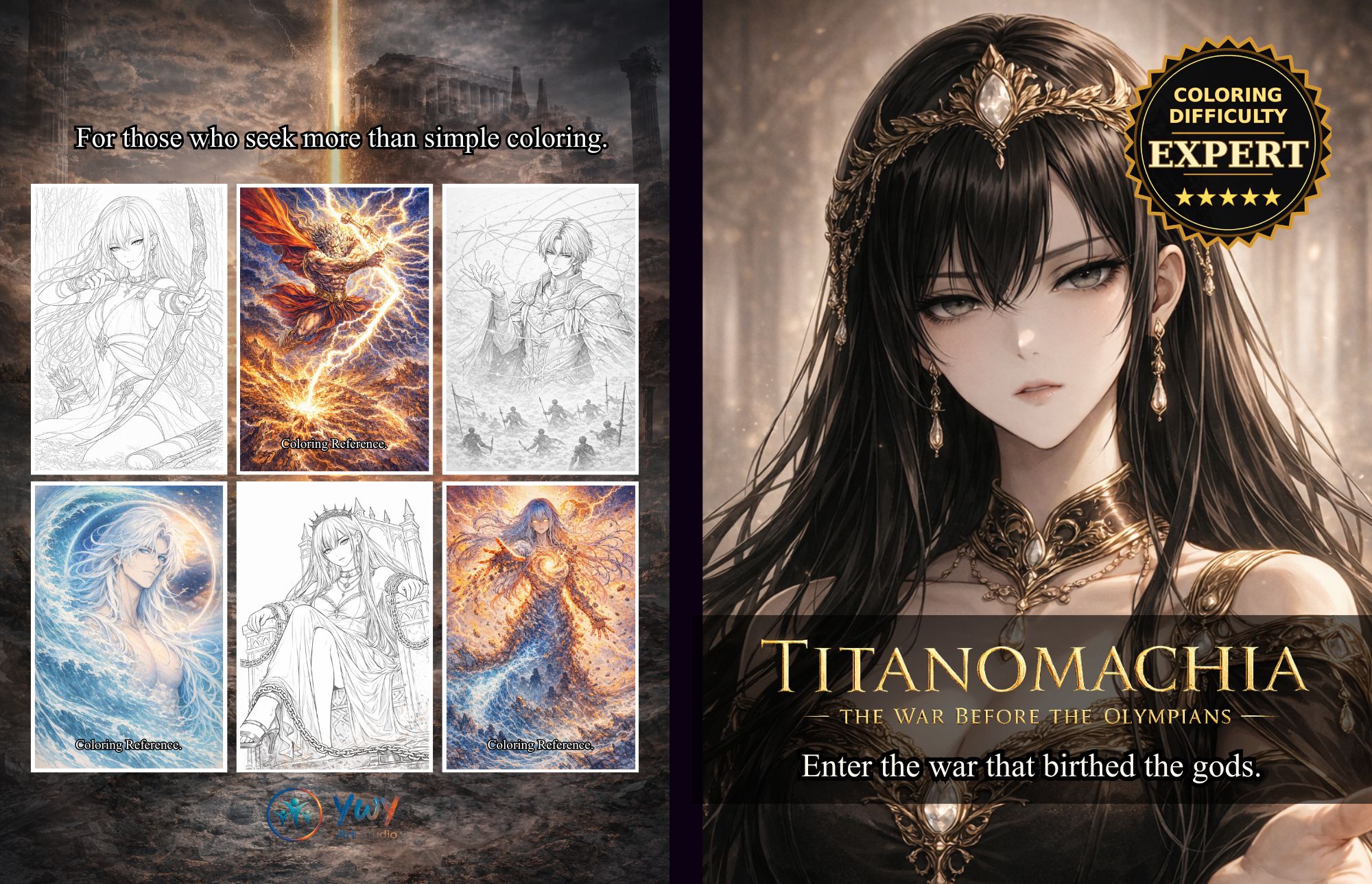
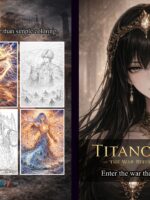
Available on Amazon Titanomachia: The War Before the Olympians Open in a new tab















コメント