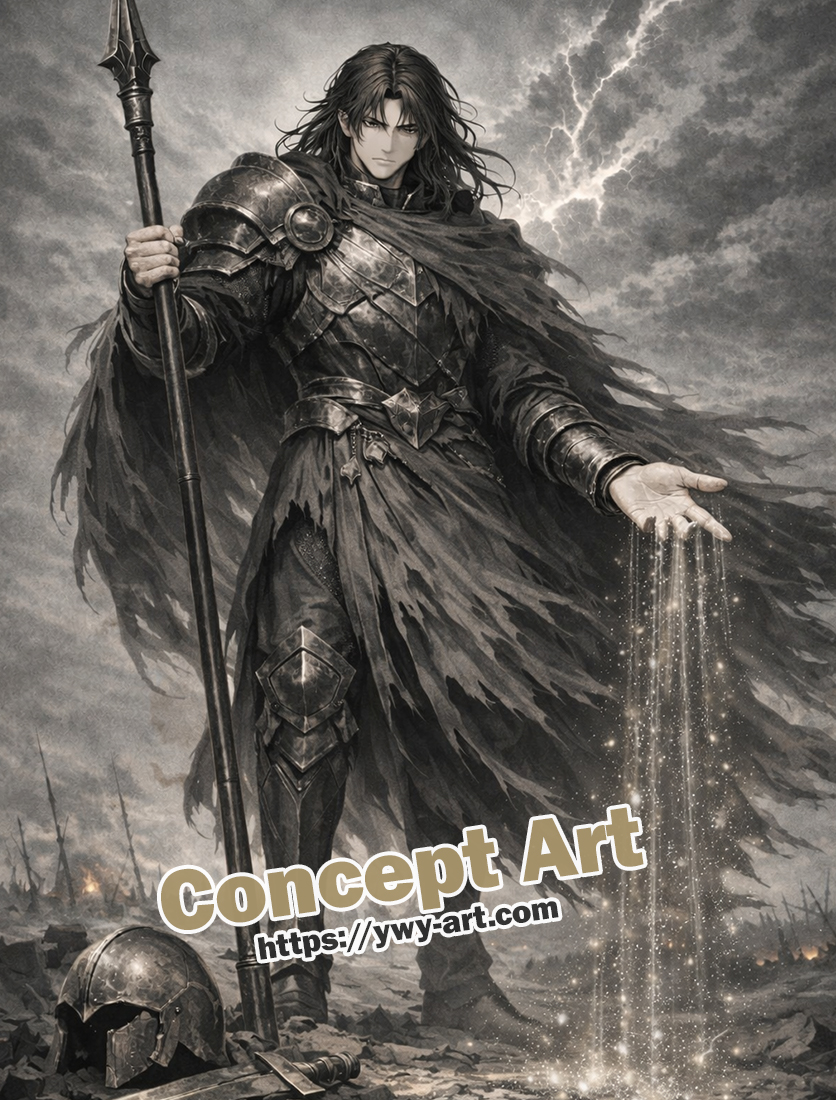
Iapetus — The Arbiter of Mortal Fate
Before the clash of gods, before thunder splits the sky, there is a quieter force that determines how the story will end. Iapetus does not rush into battle, nor does he command armies with fire or rage. Instead, he stands at the threshold where destiny settles into certainty. In the world of the Titans, he represents the unavoidable truth that all things, no matter how powerful, are bound by limits. And in the shadow of the Titanomachy, that truth becomes heavier than any weapon.
Basic Profile
| Name | Iapetus |
|---|---|
| Mythology | Greek Mythology |
| Gender | Male |
| Region | Ancient Greece |
| Era | Mythological Age (Pre-Olympian) |
| Domain | Mortal life, limitation, and fate |
| Symbol | Spear, falling sand, fractured earth |
| Culture / Religion | Ancient Greek Religion |
| Main Role | Titan representing the limits of existence and human mortality |
| Rank | First-generation Titan |
| Position in Titanomachy | Titan faction (opposing the Olympians) |
| Associated Deity | Cronus, Atlas, Prometheus, Epimetheus |
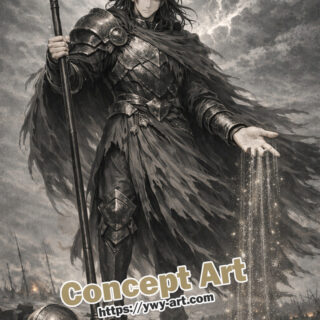
| Common Depiction | Stoic armored figure releasing fate upon the earth |
| Alignment | Neutral / Inevitability |
| Creative Reference | Embodiment of consequence rather than action |
Overview
Iapetus is one of the lesser-discussed Titans, yet his conceptual role is among the most profound. While other gods dominate through visible power, he governs something quieter but far more universal: the inevitability of limits. In myth, he is often remembered as the father of Prometheus and Atlas, figures deeply tied to suffering, endurance, and consequence. Through them, his influence extends into both human fate and divine punishment.
In the context of the Titanomachy, Iapetus is not depicted as a frontline warrior, but that absence is precisely what defines him. This scene captures the moment before the war fully erupts, when outcomes are already beginning to take shape beneath the surface. As he releases grains of fate onto the earth, the image suggests that the war is not merely a conflict of strength, but a chain of consequences already set into motion. While others prepare for battle, Iapetus acknowledges what that battle will inevitably cost.
Characteristics
- A quiet and immovable presence rather than an aggressive force
- Embodies inevitability rather than direct intervention
- Associated with generational consequence through his descendants
- Detached from emotional expression, yet deeply tied to outcomes
- Represents the boundary between power and limitation
Symbolism and Meaning
Iapetus symbolizes the inescapable nature of consequence. In contrast to gods who act, he represents what follows action. The falling sand in this depiction is not merely visual decoration, but a metaphor for time, erosion, and the quiet certainty that all things move toward an end. It suggests that fate is not always imposed violently—it can also descend gently, yet irreversibly.
Within the Titanomachy narrative, his presence reinforces the idea that the war was never simply about victory. It was about transition, loss, and the inevitable reshaping of order. By placing Iapetus in this pre-battle moment, the scene emphasizes that the outcome of the war begins long before the first strike is made.
Quick Creative Reference
| Best For | Scenes emphasizing inevitability and quiet tension |
|---|---|
| Visual Keywords | Falling sand, calm gaze, fractured land, silent authority |
| Mood | Somber, inevitable, controlled |
| Useful Themes | Fate, consequence, transition, pre-war tension |
Compare with Similar Deities
| Name | Mythology | Main Domains | Overall Image |
|---|---|---|---|
| Cronus | Greek | Time, rule, authority | Dominant ruler driven by fear of overthrow |
| Atlas | Greek | Endurance, burden | Bearer of the heavens, symbol of punishment |
| Prometheus | Greek | Knowledge, rebellion | Defiant figure who suffers for humanity |
The Role of Silence Before War
War is often remembered for its chaos, but its true weight is carried in the moments before it begins. Iapetus embodies that silence. He does not raise his weapon because his role is not to change the course of events, but to acknowledge their inevitability. In this way, he becomes a presence that defines the emotional tone of the Titanomachy rather than its physical outcome.
This perspective allows the viewer to see the war differently—not as a spectacle of destruction, but as a culmination of forces that have long been building. Iapetus stands at that threshold, marking the transition from tension to irreversible conflict.
The Meaning of Mortal Fate
The concept of “mortal fate” extends beyond human life. It reflects the idea that even gods are subject to limits, consequences, and eventual decline. Iapetus represents this boundary. His existence reminds us that power does not eliminate fate—it merely delays or reshapes it.
In the Titanomachy, this idea becomes central. The fall of the Titans is not just a defeat, but a necessary shift in cosmic order. Iapetus, in this context, is less a participant and more a witness to inevitability itself.
Visual Interpretation in This Artwork
The act of releasing sand-like particles is a deliberate visual metaphor. It suggests that fate is something that disperses, settles, and accumulates over time. Unlike lightning or fire, it carries no immediate violence, yet its effect is absolute.
The broken weapons and cracked earth further reinforce this interpretation. They are not signs of ongoing battle, but remnants of what is to come. The scene captures the exact moment where the future begins to take form.
Coloring Variations
- Ancient Bronze: Use muted metallic tones to emphasize age and timeless authority.
- Stormborn Grey: Focus on cool greys and subtle blues to highlight tension and atmosphere.
- Fading Light: Apply soft gradients to the falling sand to express the passage of fate.
Coloring Tips
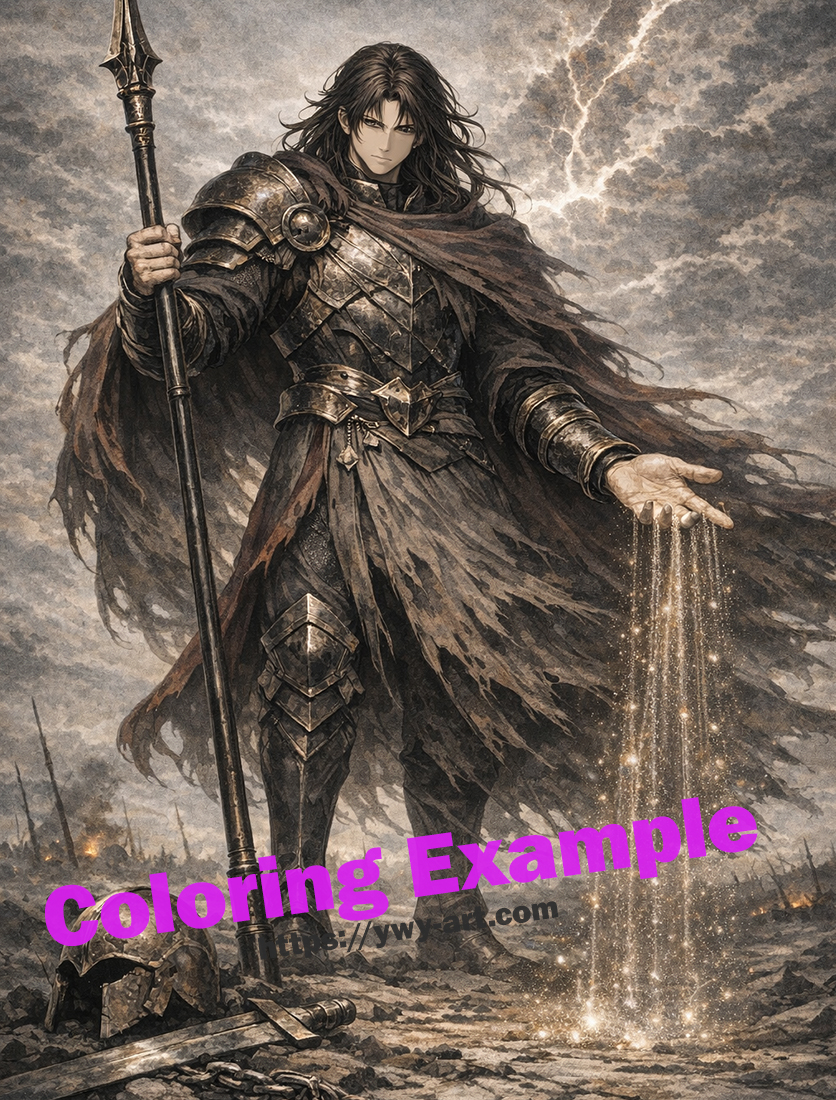
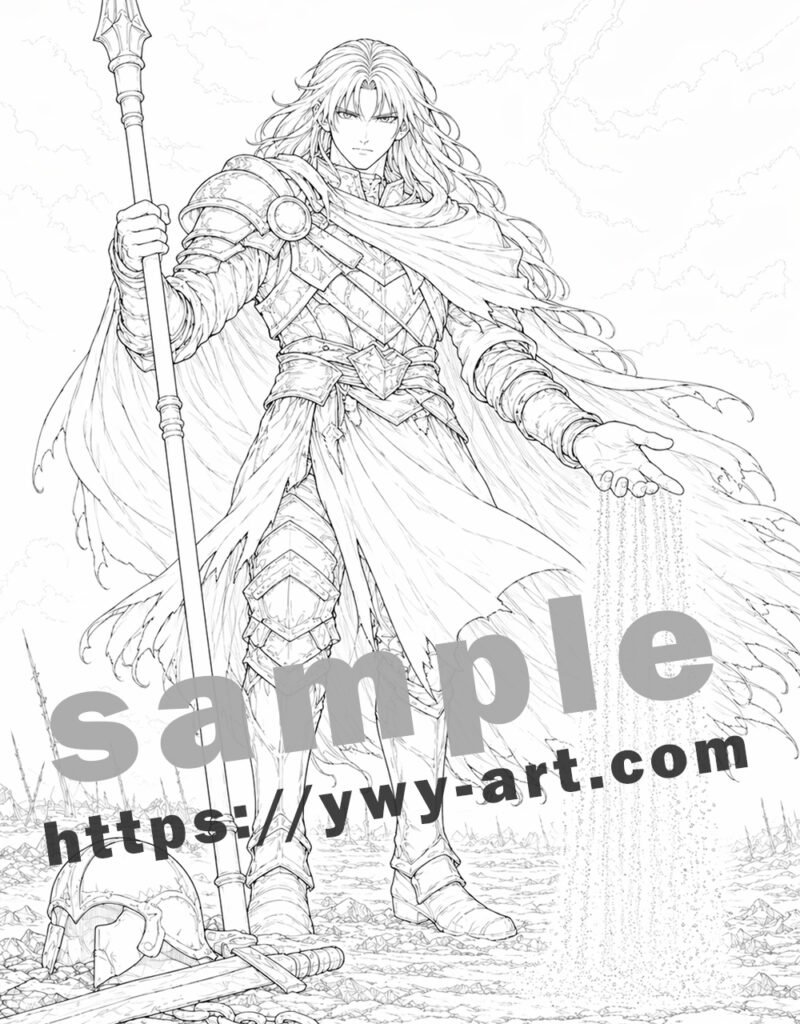
Start by defining the character separately from the background. Keeping the figure slightly darker will naturally draw attention to the central subject.
Use the light grey guides in the sky and ground to create depth without overwhelming the main figure. These guides are meant to support, not dominate.
The falling particles can be treated with variation in pressure, allowing for a gradient effect that enhances the sense of motion and inevitability.
Japanese Summary
イアペトスはティタン神族の一柱であり、人間の限界や運命そのものを象徴する存在として描かれることが多い神です。力で支配する神ではなく、結果として訪れる「避けられない結末」を体現する点に特徴があります。
このシーンはティタノマキア開戦前の一瞬を切り取ったもので、戦いそのものではなく、その先にある結果をすでに見据えている存在としてイアペトスを描いています。
戦いの前にあるもの
戦争というと激しい戦闘を想像しがちですが、その本質は戦いが始まる前の静けさにあります。この作品では、その静寂の中で既に運命が動き始めていることを表現しています。
イアペトスはその象徴であり、戦わずして戦争の結果を示唆する存在として機能しています。
運命というテーマ
手からこぼれ落ちる粒子は、時間や運命の流れを象徴しています。それは激しい力ではなく、静かに、しかし確実に積み重なっていくものです。
この演出によって、ティタノマキアが単なる戦争ではなく、必然的な流れの中で起きた出来事であることが強調されています。
塗りのポイント
人物はやや濃いトーンでまとめ、背景とのコントラストを意識すると主役が引き立ちます。
空や地面のガイドを活かしつつ、塗りすぎないことで奥行きと静けさを表現できます。
Explore Our Coloring Book Series
Step into the world of myth, where each figure carries a story beyond the lines.
Discover more characters and bring their legends to life through color.
Step into the world of mythology..
Available on Amazon Titanomachia: The War Before the Olympians Open in a new tab



コメント