
Tethys — Flow of Life
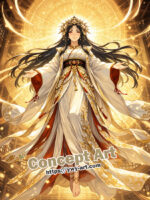
Tethys appears at the threshold between stillness and change. Before the Titanomachy fully takes shape, she is already in motion, not through violence, but through the silent spread of life-giving water. In this scene, she does not merely witness the coming division of the world. She prepares the conditions in which that division can exist at all.
Basic Profile
| Name | Tethys |
|---|---|
| Mythology | Greek Mythology |
| Gender | Female |
| Region | Ancient Greece |
| Era | Archaic Greek Mythic Tradition |
| Domain | Fresh Water, Nourishment, Fertility, Life Flow |
| Symbol | Rivers, springs, flowing water, moisture, life-bearing streams |
| Culture / Religion | Ancient Greek Religion |
| Main Role | Primordial Matron of the Waters |
| Associated Deity | Oceanus, the river gods, oceanids, and the wider Titan lineage |
| Common Depiction | A serene and majestic water mother, often associated with rivers, springs, and the sustaining flow of life |
| Alignment | Neutral Primordial / Life-Origin Force |
| Creative Reference | Titan Major; a silent initiator who does not choose a side, but creates the environmental and symbolic conditions from which all sides emerge |
Overview
Tethys is one of the great Titanesses of Greek mythology, a figure tied not to violent conquest, but to the sustaining power of water itself. As the consort of Oceanus and mother of countless river and water deities, she represents an ancient layer of the cosmos in which life was not yet divided into opposing camps, but nourished through continuous flow. Her domain is not merely water as an element, but water as a condition of existence: the force that softens land, feeds growth, and makes creation possible.
Within a Titanomachy-themed interpretation, Tethys becomes especially compelling because she stands at the edge of transformation. She is not a warrior in the direct sense, yet her influence is foundational. Before armies gather and divine names harden into rival factions, it is her water that prepares the world to shift. That makes her ideal for a pre-war scene focused on subtle change, tension beneath calmness, and the first signs that balance is beginning to break.
Characteristics
- Embodies water as a life-generating and world-shaping force rather than as a weapon.
- Functions as a maternal Titan presence connected to nourishment, continuity, and origin.
- Feels calm and emotionally restrained, yet cosmically powerful.
- Works well in scenes that suggest change through environment rather than direct action.
- Can symbolize the beginning of conflict by showing the world becoming fluid and unstable.
Symbolism and Meaning
Tethys symbolizes life before division. Her waters are not only nourishing, but transformative. They blur fixed boundaries, soften what seems stable, and allow new forms to emerge. In myth-inspired visual storytelling, this makes her a powerful symbol of transition. She does not destroy the old order with brute force. Instead, she makes change inevitable by altering the state of the world itself.
That symbolism is especially valuable in a Titanomachy series because it prevents the storyline from becoming a sequence of only combat-oriented deities. Tethys introduces a quieter form of power. Her presence suggests that great wars do not begin only with thunder or command. Sometimes they begin when the foundations of the world start to move, and when life itself begins flowing in a new direction.
Quick Creative Reference

| Best For | Pre-war transition scenes, primordial water imagery, calm but powerful feminine divinity, environmental symbolism |
|---|---|
| Visual Keywords | still water, flowing hand gesture, silver-white hair, ripples, river source, soft current, seedlings, reflective surface, silent awakening |
| Mood | Serene, restrained, sacred, inevitable, quietly transformative |
| Useful Themes | origin of life, tension before conflict, cosmic motherhood, elemental transition, silent initiation |
Compare with Similar Deities
| Name | Mythology | Main Domains | Overall Image |
|---|---|---|---|
| Oceanus | Greek Mythology | Encircling world-river, cosmic waters | Vast, ancient, environmental, more cosmic and territorial than maternal |
| Theia | Greek Mythology | Radiance, brilliance, divine sight | Luminous and majestic, focused on light and splendor rather than life-flow |
| Amphitrite | Greek Mythology | Sea, queenship of the ocean | Marine and regal, more associated with sea dominion than primordial nourishment |
Tethys in the World Before War
In a Titanomachy narrative, Tethys is most effective when treated not as a fighter, but as a catalyst. She does not raise a weapon, and she does not call others to battle. Instead, she changes the atmosphere of the world itself. The scene becomes stronger when her water is shown as something that spreads outward with intention, quietly altering land, air, and life before open conflict begins.
This gives her a vital narrative function. A series built only on confrontation can quickly become visually repetitive. Tethys breaks that rhythm by introducing movement through environment. The viewer sees that something has begun, even if no war cry has yet been heard. In that sense, she is not passive at all. She is the first sign that the age of stillness is ending.
The Meaning of “Flow of Life”
The phrase “Flow of Life” should not be understood as a gentle decorative title. It suggests something more fundamental: the movement by which the world becomes active, fertile, and unstable all at once. Water creates life, but it also erodes certainty. A river nourishes, yet it redraws the land through which it passes. Tethys carries this dual meaning beautifully.
That makes her especially suited to a scene in which beauty and unease coexist. Her gesture can feel soft, but the implications should feel immense. The life she brings is not harmless decoration. It is the beginning of change, and change in mythic worlds always carries consequence. Through her, the viewer should sense that what is blooming now may later become the ground of conflict.
Visual Direction for This Illustration
For a strong composition, Tethys should be placed in calm, shallow water with a controlled, elegant posture. The water flowing from her hand should feel deliberate, as though it continues under its own law rather than by effort. Her hair can merge visually with the movement of water, reinforcing the idea that she is not standing in nature, but extending herself through it. Small plants or new growth near the waterline can suggest life beginning without making the image overly busy.
Facial expression is critical. She should not appear cheerful, frightened, or romanticized. A neutral and faintly distant expression works best, because it preserves her Titan dignity and keeps the focus on presence rather than personality. This restraint also makes the scene more useful within a larger sequence, allowing later, more aggressive deities to escalate the emotional intensity naturally.
Why Tethys Matters in a Titanomachy Series
Tethys adds structural depth to the series. She reminds the viewer that the Titanomachy is not only a war of personalities, but a transformation of the cosmos. By including her, the series gains an origin point rooted in life, fluidity, and inevitability rather than immediate violence. This broadens the emotional and symbolic range of the collection.
She also helps define the Titans as more than merely “the side before the Olympians.” Through Tethys, the Titans can be seen as forces of the world itself: ancient, foundational, and larger than individual ambition. That perspective enriches the entire project and gives the viewer a clearer sense of what is truly at stake when divine order begins to fracture.
Coloring Variations
- Pale River Dawn: Use soft silver, pale blue, muted lavender, and faint green accents to emphasize purity, stillness, and new life.
- Moonlit Water: Push the scene toward cool grays, icy blue, and white highlights for a sacred and distant nocturnal mood.
- Before the Storm: Add subdued blue-violet shadows, darker water tones, and restrained green growth to suggest beauty carrying hidden tension.
Coloring Tips

Tethys works best when the water is kept lighter than expected. Instead of filling every water surface with strong blue, preserve open space and use soft tonal transitions to create transparency. This gives the illustration more elegance and prevents the scene from becoming visually heavy.
Hair and water can be treated as related but not identical elements. The hair may take on silvery or pearl-like tones, while the water remains clearer and more reflective. This separation helps maintain readability while still reinforcing the conceptual link between the goddess and her element.
If plants or small signs of life are included, they should act as accents rather than the main focus. A few carefully placed green or pale earth tones can be very effective. The emotional center of the piece should remain the quiet movement of water and the sense that the world is changing beneath a calm surface.
Japanese Summary
テテュスは、戦いを直接引き起こす神ではないが、世界が戦いへ向かうための条件を静かに作り出す存在として非常に重要である。水と生命の源を司るティターンとして、彼女は大地を潤し、境界を曖昧にし、世界そのものを流動的な状態へ変えていく。そのため、ティタノマキアを描くシリーズの中では、衝突そのものよりも「変化が始まる瞬間」を象徴する役割を担う。
この作品におけるテテュスは、静かな水辺に立ちながら、手から流れる水によって生命と変化を同時に生み出している。彼女はどちらの陣営にも明確に属しているようには見えないが、実際にはすべての陣営が生まれる土台を作っている存在である。だからこそ、この場面は穏やかでありながら、後に訪れる大きな対立の予兆として機能する。
戦いの前に世界を動かす存在
ティタノマキアの物語において、テテュスは戦士ではなく起点として捉えると強い。武器を掲げることも、誰かに命じることもないが、彼女の水は世界の空気そのものを変えていく。地面を緩め、生命を芽吹かせ、固定されていたはずの世界を少しずつ揺らがせることで、戦いが始まる前から時代の転換を示している。
この見せ方によって、シリーズ全体にリズムが生まれる。強い対立や暴力だけでなく、環境が変わること自体が戦いの始まりであると示せるからだ。テテュスは静かな存在だが、受け身ではない。むしろ誰よりも早く、世界を次の段階へ進めている存在として描くのが効果的である。
「Flow of Life」という題名の意味
「Flow of Life」は単に優しい水のイメージではない。生命が生まれ、広がり、世界のかたちを変えていく根源的な運動を示している。水は育む一方で、土地を削り、境界を作り替え、かつて安定していたものを別の形へ導いていく。その二面性こそが、テテュスの魅力であり、この作品の核でもある。
そのため、この場面では美しさと不穏さが同時に存在している必要がある。柔らかな仕草や穏やかな表情だけでは弱く、彼女の行為が世界全体に影響する規模のものであると伝わることが重要になる。生命の始まりは祝福であると同時に、変化の始まりでもあり、変化はやがて争いへつながっていく。
表現と塗りの見どころ
構図としては、静かな浅瀬に立ち、手から自然に水が流れ落ちる姿が非常に相性が良い。髪と水の流れを視覚的に連動させることで、彼女自身が自然の一部というより、自然を延長した存在であることが伝わる。足元や水辺に小さな芽吹きを入れると、生命の始まりというテーマが視覚的に補強される。
塗りでは、水を重く塗り込みすぎないことが重要になる。明るい余白や白のハイライトを活かしながら、薄い青や灰色で透明感を作ると、テテュスらしい静けさが出しやすい。髪は銀白や淡い水色、影には青紫系を使うと幻想性が増し、生命を運ぶ冷たく神聖な水の雰囲気が整いやすい。
塗りのポイント
水面は一律に青く塗るよりも、塗らない部分を残しながら反射と影で見せる方が美しく仕上がる。透明感が出るだけでなく、画面全体が軽く保たれるため、人物の存在感も際立ちやすい。
髪と水は近い色でまとめつつも、完全に同色にはしない方が見やすい。髪は銀や白を主体に、水はもう少し透明感を優先して塗ると、神格と自然現象の両方が整理されて見える。植物を入れる場合は差し色程度に留め、主役はあくまでテテュスと流れる水に置くのがよい。
Explore Our Coloring Book Series
Discover more dark mythology and divine feminine designs in our growing coloring book collection.
Explore character features, symbolism, and coloring ideas inspired by gods, goddesses, and mythic beings from around the world.
Step into the world of mythology..
Available on Amazon Titanomachia: The War Before the Olympians Open in a new tab






























コメント