
- Guiding the Departed – Nephthys
- Basic Profile
- Overview
- Characteristics
- Symbolism and Meaning
- Quick Creative Reference
- Compare with Similar Deities
- The Goddess Who Guides the Departed
- The Meaning of Guiding the Departed
- The Scene Depicted in This Artwork
- Symbolism and Visual Elements
- Coloring Tips
- ネフティスという存在
- 魂を導くという意味
- このイラストの表現意図
- 塗りのポイント
- Conclusion
- Explore Our Coloring Book Series
Guiding the Departed – Nephthys
Step into the quiet presence of Nephthys, the Egyptian goddess who watches over the dead and gently guides souls beyond the veil. This artwork captures a solemn and beautiful moment of transition, where fear gives way to stillness, and the unknown becomes something sacred.
Basic Profile
| Name | Nephthys |
|---|---|
| Mythology | Egyptian |
| Gender | Female |
| Domain | Death, Mourning, Protection, Transition |
| Symbols | House hieroglyph, wings, funerary rites, sacred protection |
| Role | Guardian of the dead and guide of souls |
| Theme in This Artwork | Quiet guidance, sacred passage, gentle transition into the afterlife |
Overview
Nephthys is one of the most solemn and protective goddesses in ancient Egyptian mythology. She is associated with mourning, funerary rituals, and the liminal space between life and death. Unlike gods who dominate through force or judgment, Nephthys represents quiet guidance. Her role is not to punish the dead, but to accompany them as they pass from one world into the next.
She is often remembered as a guardian who stands close to grief, transition, and sacred ritual. This makes her a uniquely gentle but powerful figure among mythological deities connected to death.
Characteristics
- A quiet and protective presence rather than a force of destruction
- Associated with mourning, funerary rites, and spiritual passage
- Embodies the boundary between the visible world and the afterlife
- Offers guidance, protection, and acceptance during transition
Symbolism and Meaning
Nephthys symbolizes the sacred threshold between worlds. She is not the end itself, but the presence that remains beside the soul as it continues forward. In mythological imagery, she represents protection during vulnerable moments, especially those involving death, separation, and transformation.
Her meaning is deeply connected to stillness. Where other divine figures may appear in fire, battle, or judgment, Nephthys appears in quiet space. She reminds us that not all power is loud. Some of the most profound roles in mythology belong to those who stand silently at the edge of what cannot be seen.
Quick Creative Reference
- Core Mood: Quiet, sacred, solemn, protective
- Visual Tone: Soft light, pale hair, calm expression, drifting spirits
- Color Direction: White, pale blue, silver gray, ivory, muted gold
- Best Coloring Approach: Smooth gradients, soft highlights, restrained contrast
- Key Emotional Impression: Peaceful transition rather than fear
Compare with Similar Deities
Nephthys shares thematic ground with several underworld and death-related goddesses across mythology, but her role remains distinct.
- Ereshkigal rules the underworld with gravity and authority, while Nephthys functions more as a quiet guide than a ruler.
- Hel embodies death through cold inevitability and division, while Nephthys carries a softer, more ritual-centered presence.
- Persephone is tied to seasonal descent and return, whereas Nephthys is more deeply linked to mourning and funerary passage.
Among these figures, Nephthys stands out as a goddess of accompaniment. She does not dominate the dead. She watches over them.
The Goddess Who Guides the Departed
Nephthys holds a special place in Egyptian mythology because her power is expressed through care rather than spectacle. She is not defined by rage, conquest, or command. Instead, she is associated with the sacred responsibility of standing beside those who have left the world of the living.
This role makes her one of the most emotionally resonant figures in myth. She belongs to the moment when grief and mystery meet. She is neither the cause of death nor the judge of it. She is the one who remains present, ensuring that the soul does not pass alone.
The Meaning of Guiding the Departed
The phrase “Guiding the Departed” refers to a transitional moment rather than an ending. It suggests movement from one state into another, shaped not by violence but by calm acceptance. That concept lies at the heart of Nephthys.
In this interpretation, death is not presented as horror. It is portrayed as passage. The scene centers on the fragile and sacred interval between worlds, and Nephthys becomes the figure who gives that interval meaning. Her guidance transforms uncertainty into direction.
The Scene Depicted in This Artwork
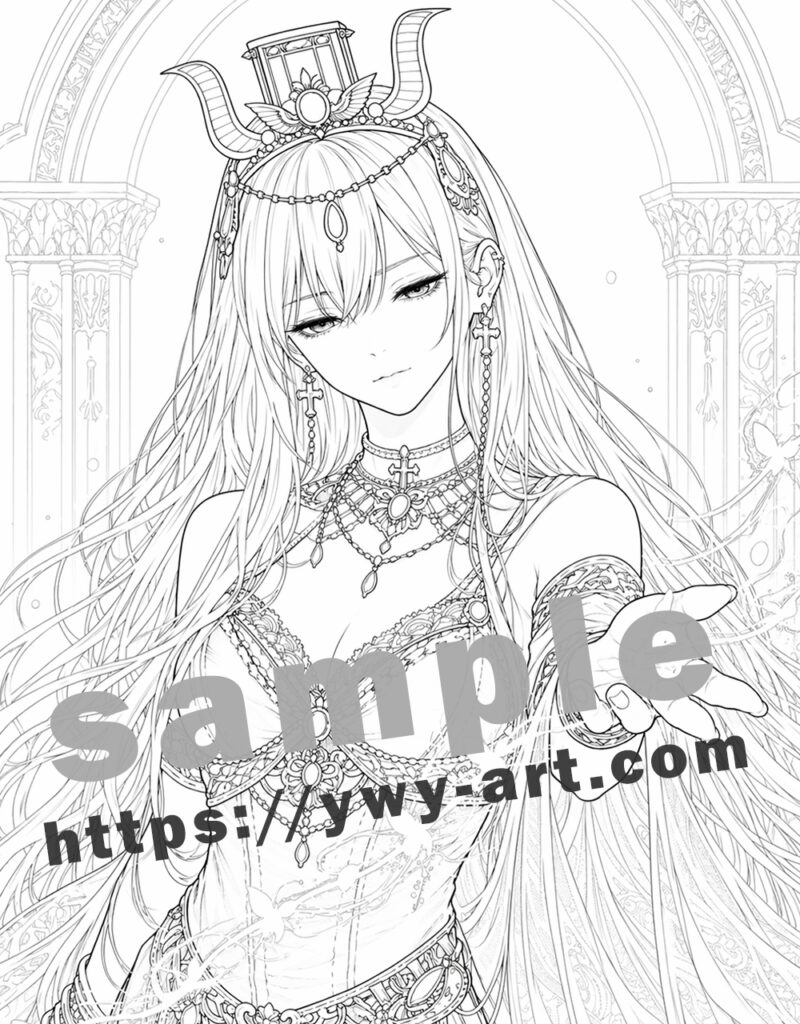
This illustration presents Nephthys in a serene and solemn moment of spiritual guidance. Her gaze is slightly lowered, creating a feeling of inward calm rather than command. One hand extends gently forward, becoming the symbolic center of the image.
Around her hand drift luminous spirit-like forms, suggesting souls moving peacefully onward. These lights are delicate rather than frightening, reinforcing the idea that this is not a scene of terror, but of sacred transition.
Behind her, the architectural setting evokes a ceremonial threshold. It feels less like a literal place and more like a symbolic space between worlds. Together, these elements create an image that is quiet, graceful, and deeply reflective.
Symbolism and Visual Elements
The extended hand symbolizes guidance. It does not command or restrain. It invites movement forward.
The glowing forms near her hand represent souls in passage. Their lightness and softness suggest continuation rather than disappearance.
Her pale flowing hair adds to the ethereal feeling of the composition, while the quiet background architecture reinforces the sacred atmosphere of a boundary space. Her calm expression is crucial to the overall meaning of the artwork. It turns the image away from fear and toward acceptance.
Coloring Tips

Use soft and restrained color layering to preserve the peaceful atmosphere of the piece.
For the hair, begin with white space and gradually add pale gray, cool silver, light blue, or a touch of lavender. Keeping the hair light will help maintain the ethereal quality that defines Nephthys in this artwork.
For the skin, use warm beige with a very soft touch of pink to create a natural but gentle complexion. Avoid harsh shadows, since the expression depends on calm subtlety.
The clothing works well in muted tones such as light gray, blue-gray, soft ivory, or faded silver. For jewelry and ornaments, gold or antique champagne tones can add sacred elegance without overpowering the scene.
For the drifting spirits, leave some areas white and apply pale yellow or soft gold lightly around the edges. This creates a glowing effect while preserving the delicate stillness of the image.
ネフティスという存在
ネフティスは古代エジプト神話において、死者を守り、魂の旅立ちを見守る女神です。破壊や裁きの力で前面に出る存在ではなく、喪や儀式、そして死後の移行に寄り添う静かな守護者として知られています。
目立つ派手さはありませんが、その役割はとても重要です。生者の世界を離れた魂が次の領域へ向かうとき、ネフティスはそのそばに立ち、恐怖ではなく保護と導きの気配を与えます。
魂を導くという意味
「Guiding the Departed」という題名が示しているのは、死そのものではなく、死後の移行の瞬間です。そこには激しさや裁きの迫力はありません。あるのは、ひとつの世界を離れ、次の場所へ進んでいく静かな流れです。
ネフティスは、その流れを乱すことなく、そっと支える存在として描かれています。この作品では、死を恐怖ではなく、神聖な通過点として見せていることが大きな特徴です。
このイラストの表現意図
本作では、ネフティスが魂を導く一瞬を、穏やかな緊張感の中で表現しています。少し伏せた視線と差し出された手によって、彼女が支配するのではなく、静かに道を示していることが伝わります。
手元を漂う光は、行き先を見つけつつある魂の象徴です。恐ろしく不穏な存在としてではなく、繊細で柔らかな光として描くことで、この場面が神聖で静かなものであることを強調しています。
背景にある建築的な要素は、現実の場所というより、現世と来世のあいだにある儀式的な空間を示しています。そのため全体として、静けさの中に意味が宿る構図になっています。
塗りのポイント
髪は白を活かしながら、薄いグレー、淡い青、薄紫などを重ねると、透明感と静けさを表現しやすくなります。濃くしすぎず、やわらかく何層かに分けて色を乗せるのが効果的です。
肌はベージュをベースに、ごく控えめなピンクを加えることで自然な血色感が出せます。表情が繊細な作品なので、影やチークは強くしすぎない方が全体の雰囲気を保ちやすくなります。
衣装は薄いグレーや青みのあるグレー、アイボリー系と相性が良く、装飾には金や淡いシャンパンゴールドを使うと神聖さが引き立ちます。魂の光は白を残しながら、周囲にごく薄い黄色や金色を入れると自然な発光感を出せます。
Conclusion
Guiding the Departed presents Nephthys not as a figure of fear, but as a sacred companion at the threshold between worlds. Through a calm expression, an outstretched hand, and drifting spirit-light, this artwork captures the beauty of quiet passage and divine protection.
It is an image of transition, stillness, and grace — a reminder that even in mythology’s darkest spaces, there are figures who guide rather than destroy.
Explore Our Coloring Book Series
Discover more dark goddesses, legendary women, and mythological figures through our growing coloring book collection. Each artwork explores a different divine presence, from wrath and judgment to mystery, magic, and sacred transformation.
Step into the world of mythology..
Available on Amazon Dark Ritual Goddesses of Mythology Coloring Book Open in a new tab



コメント