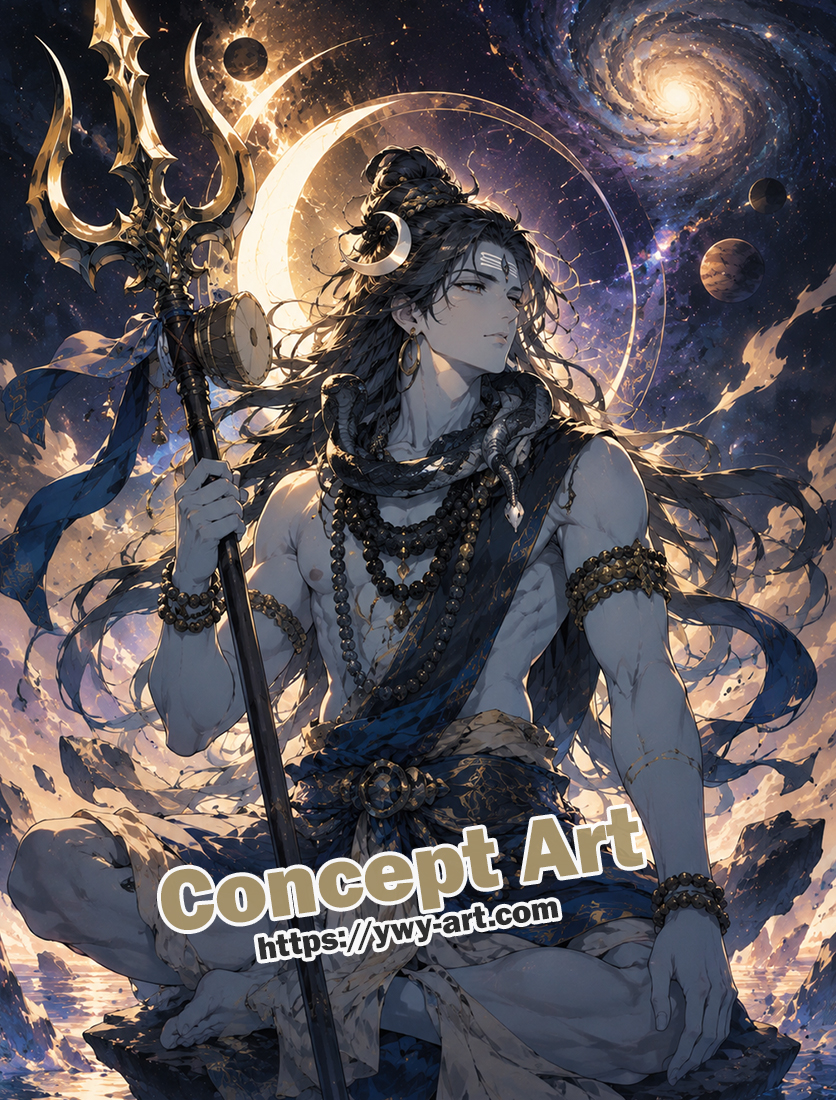
Shiva Cosmic Trident
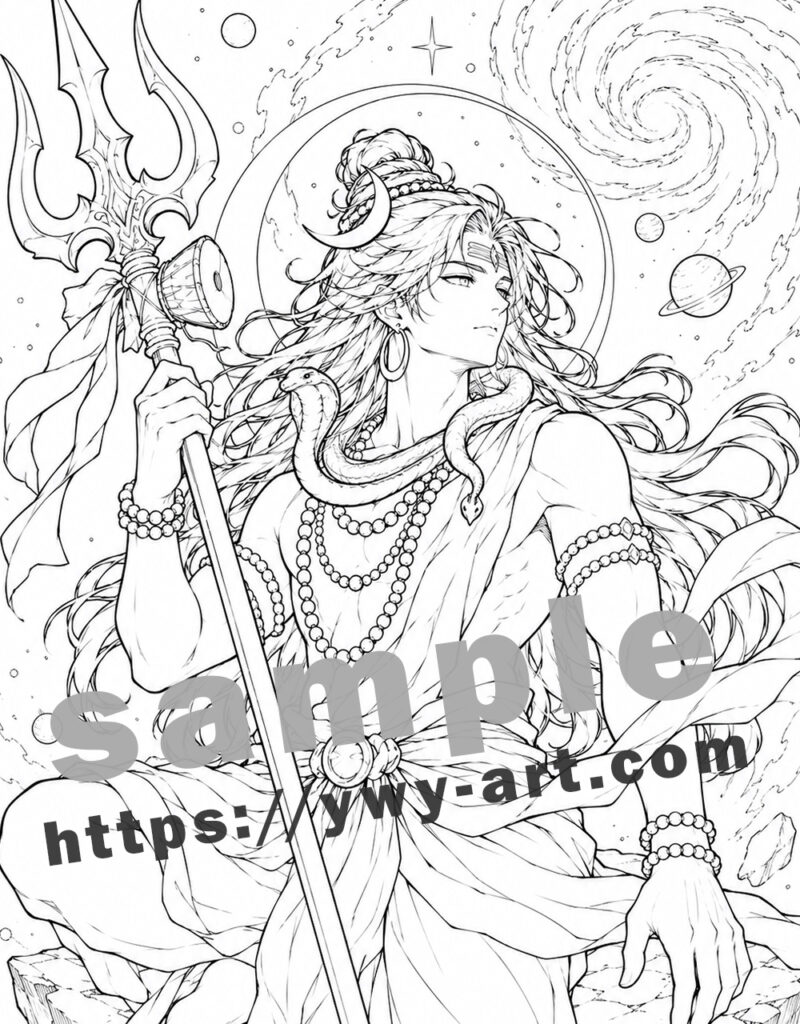
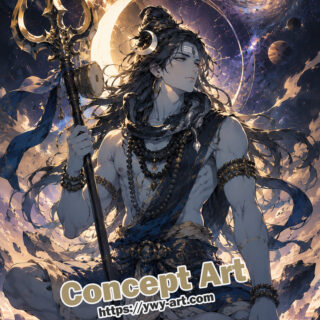
Shiva sits in this artwork with the kind of calm that feels almost heavier than movement. The cosmic trident rises beside him, sharp and silent, while the universe opens behind his figure like a field of stars, cycles, and ancient fire. This is not just a god holding a weapon. It feels like a moment where destruction, meditation, and rebirth all meet in one place.
This illustration is part of the Mythology Artifacts Series, a coloring book collection focused on divine weapons, sacred relics, and legendary symbols of power. Here, the central artifact is Shiva’s cosmic trident, inspired by the trishula, one of the most recognizable and meaningful symbols connected to Shiva in Hindu tradition.
Basic Profile
| Name | Shiva |
|---|---|
| Mythology | Hindu Mythology |
| Gender | Male |
| Region | India and South Asia |
| Domain | Destruction, renewal, meditation, asceticism, cosmic transformation |
| Artifact | Cosmic Trident |
| Associated Symbol | Trishula, crescent moon, third eye, serpent, damaru drum, sacred ash |
| Main Role | The divine force of dissolution and transformation within the cosmic cycle |
| Common Depiction | A powerful ascetic god with matted hair, a crescent moon, a third eye, serpent ornaments, and a trident |
| Overall Image | Calm, severe, cosmic, meditative, and overwhelmingly sacred |
Overview
Shiva is one of the most important deities in Hindu mythology and worship. He is often described as the destroyer within the great cosmic cycle, alongside Brahma the creator and Vishnu the preserver. But the word “destroyer” does not fully explain him. Shiva is not simply a god who breaks things apart. He destroys what has reached its end, what has become false, exhausted, or unable to continue.
That is why Shiva’s power can feel strangely peaceful, even when it is terrifying. His destruction is connected to renewal. Old forms dissolve so new ones can appear. Illusion burns away so truth can be seen. The world ends, not as a meaningless collapse, but as part of a larger rhythm.
In this artwork, Shiva is not shown in a battle pose. He is seated, composed, and surrounded by cosmic space. I honestly love that choice. It makes the scene feel stronger, because Shiva does not need to prove his power through action. His stillness already says enough.
The Artifact: Cosmic Trident
The cosmic trident in this piece is based on Shiva’s trishula. On the surface, it is a divine weapon. It can strike, pierce, and destroy. But symbolically, it reaches much deeper than ordinary battle imagery.
The three points of the trident are often connected with different triads: creation, preservation, and destruction; past, present, and future; body, mind, and spirit; or the three qualities of nature known as gunas. Because of that, the trident feels less like a simple weapon and more like a tool that holds the structure of existence itself.
In this illustration, the trident stands almost like a cosmic axis. It connects Shiva’s calm seated presence with the vast sky and celestial movement behind him. The artifact is not just placed beside the god as decoration. It becomes the visual center of the whole idea: the universe has order, and Shiva holds the power to end one cycle so another can begin.
Mythological Background
Shiva appears in many forms across Hindu tradition. He is the great yogi, the lord of meditation, the destroyer of demons, the husband of Parvati, the father of Ganesha and Kartikeya, and the cosmic dancer known as Nataraja. Each form reveals a different side of him.
As Nataraja, Shiva dances the rhythm of creation and destruction. The dance is not random. It represents the pulse of the universe itself: appearing, moving, dissolving, and returning. That same feeling fits the trident beautifully. The weapon is not only about ending life. It is about cutting through illusion, breaking old patterns, and opening the way for transformation.
The crescent moon often shown in Shiva’s hair adds another important layer. The moon grows, fades, disappears, and returns again. It naturally suggests time, cycles, and change. When placed on Shiva, the moon shows that he is not simply trapped inside time. He stands beyond it, watching its rise and fall.
The serpent associated with Shiva can also be read as a symbol of danger, death, energy, and mastery over fear. Around Shiva, the serpent does not make him look threatened. It makes him look untouchable. Even forces that frighten humans become calm when they rest near him.
Symbolism and Meaning
The strongest theme of this artwork is controlled transformation. Shiva’s face and posture are calm, but the surrounding universe suggests enormous force. That contrast is what gives the piece its weight.
The trident represents authority over change. It can be read as a weapon, but also as a spiritual instrument that pierces illusion, ego, and attachment. The three points make the artifact feel balanced rather than chaotic. This is not destruction for the sake of destruction. It is destruction with purpose.
The cosmic background expands the meaning beyond one mythological scene. Shiva is not standing in a small battlefield. He is placed inside a universal setting. Stars, planets, and celestial light make the image feel like a meditation on time itself.
That is the emotional center of the piece for me: Shiva does not look angry. He looks certain. And that certainty is more frightening than rage.
Coloring Notes
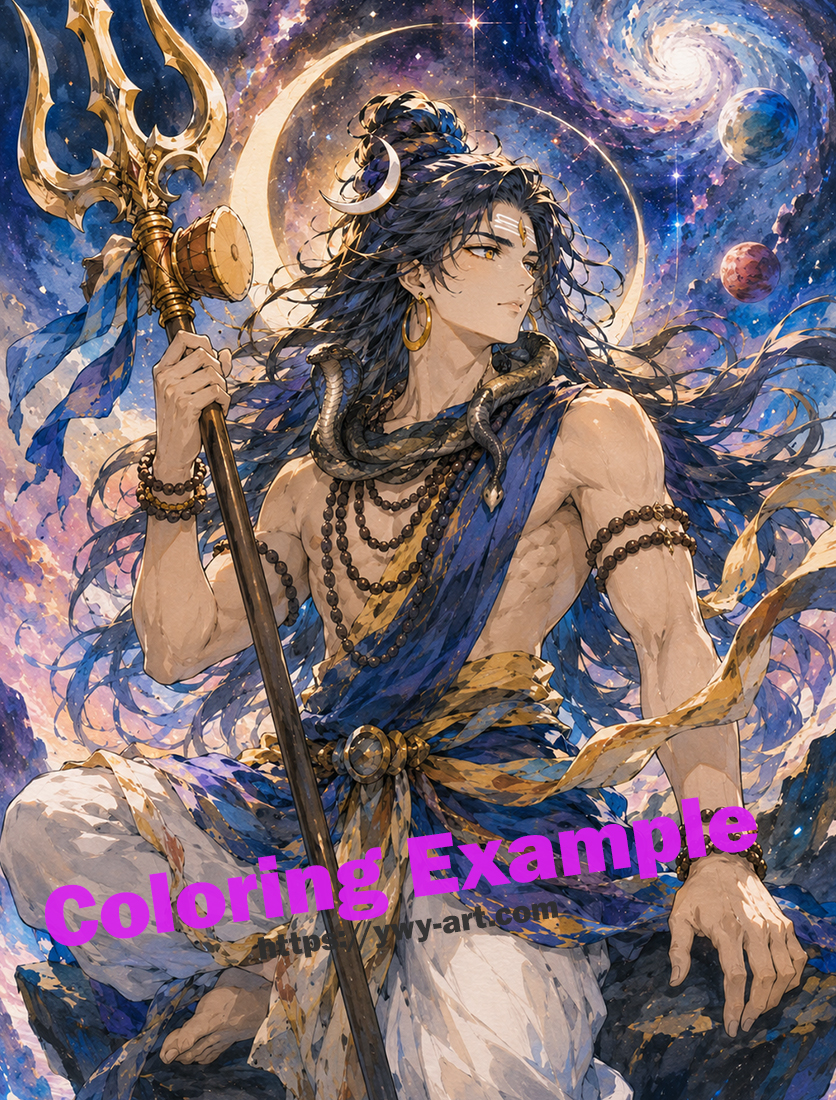
This page works well with a strong contrast between cool divine tones and warm sacred highlights. Shiva’s skin can be colored in pale blue, ash blue, gray-blue, or a soft moonlit tone. These colors help connect him to meditation, night, and cosmic stillness.
The trident should probably receive the clearest visual emphasis. Gold, bronze, white-gold, or warm yellow highlights can make it feel like a sacred artifact rather than ordinary metal. If the tips of the trident are treated as a small light source, the whole composition becomes more dramatic.
For the background, deep navy, violet, black, indigo, and controlled touches of yellow or orange can create a strong cosmic atmosphere. It is better not to make every star and planet equally bright. A few focused glowing areas will make the space feel larger and more powerful.
The crescent moon can stay simple and bright. Silver, pale yellow, or soft white would work well. Since the moon is a symbolic detail, it should be easy to recognize even if the surrounding sky becomes colorful.
The beads, ornaments, and hair details can be colored more quietly. Dark brown, muted gold, bronze, and deep blue-gray can add weight without making the whole image too busy. Shiva’s cloth can use indigo, navy, muted purple, or deep blue to keep the figure connected to the night sky.
Quick Creative Reference
| Element | Creative Direction |
|---|---|
| Shiva’s Skin | Use pale blue, ash blue, or gray-blue for a calm divine atmosphere. |
| Cosmic Trident | Gold, bronze, or white-gold can make the artifact feel sacred and central. |
| Crescent Moon | Keep it bright and clean so it clearly represents time and cycles. |
| Cosmic Background | Deep navy, violet, black, and small warm highlights create a vast universe effect. |
| Ornaments | Muted metallic tones work well without stealing attention from the trident. |
| Overall Mood | Calm, cosmic, severe, meditative, and sacred. |
Compare with Similar Deities
| Name | Mythology | Main Domains | Overall Image |
|---|---|---|---|
| Shiva | Hindu Mythology | Destruction, renewal, meditation, cosmic transformation | A calm but overwhelming god who ends old cycles and opens the way to rebirth. |
| Kali | Hindu Mythology | Time, death, fierce protection, destruction of evil | A terrifying and protective goddess who destroys illusion and ego with raw divine force. |
| Zeus | Greek Mythology | Sky, thunder, kingship, divine authority | A ruler-god whose weapon represents command, judgment, and heavenly power. |
| Odin | Norse Mythology | Wisdom, war, magic, prophecy, sacrifice | A wandering god of knowledge and fate, willing to sacrifice for deeper power. |
Coloring Variations
- Moonlit Shiva: Pale blue skin, silver moonlight, dark indigo cloth, and a cool cosmic background.
- Golden Trident Focus: A darker background with the trident glowing in gold, bronze, and warm yellow.
- Cosmic Fire Version: Add orange, red, and yellow around the halo or galaxy to suggest destruction and renewal.
- Meditative Night Version: Use muted blues, soft grays, and quiet star colors for a calmer spiritual mood.
Closing
Shiva Cosmic Trident is a coloring page about more than divine strength. It is about the sacred moment when an ending becomes part of a larger beginning. The trident is sharp, but its meaning is not only violent. It carries time, balance, discipline, and transformation.
For colorists, this piece offers a beautiful mix of cool divine tones, deep space colors, metallic highlights, and symbolic details. The best approach may be to let the image breathe: keep Shiva calm, make the trident powerful, and allow the universe behind him to feel vast but not overcrowded.
In the end, this artwork shows Shiva as a god who does not need to shout. He simply sits at the center of the cosmic cycle, holding the trident that reminds us every ending has a place in the rhythm of creation.
Step into the world of mythology..
Available on Amazon Mythology Artifacts Series: Symbols of Power Coloring Book Open in a new tab

コメント