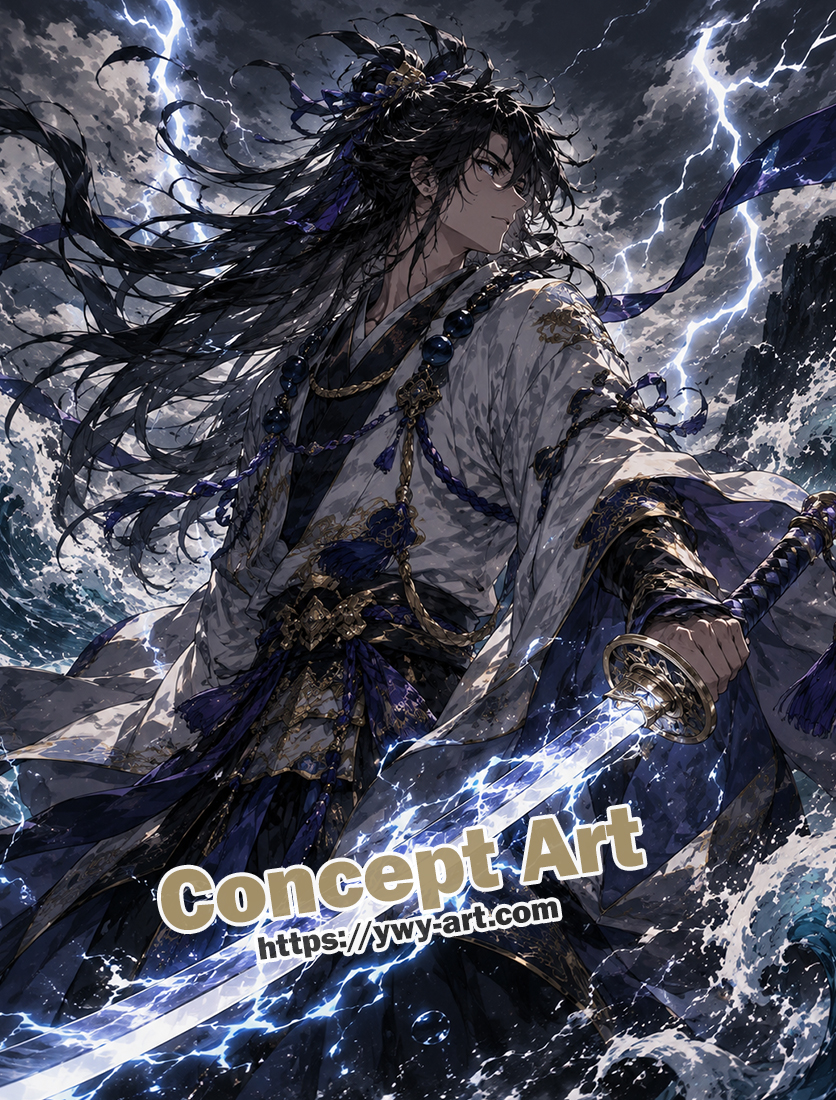
Susanoo Storm Sword
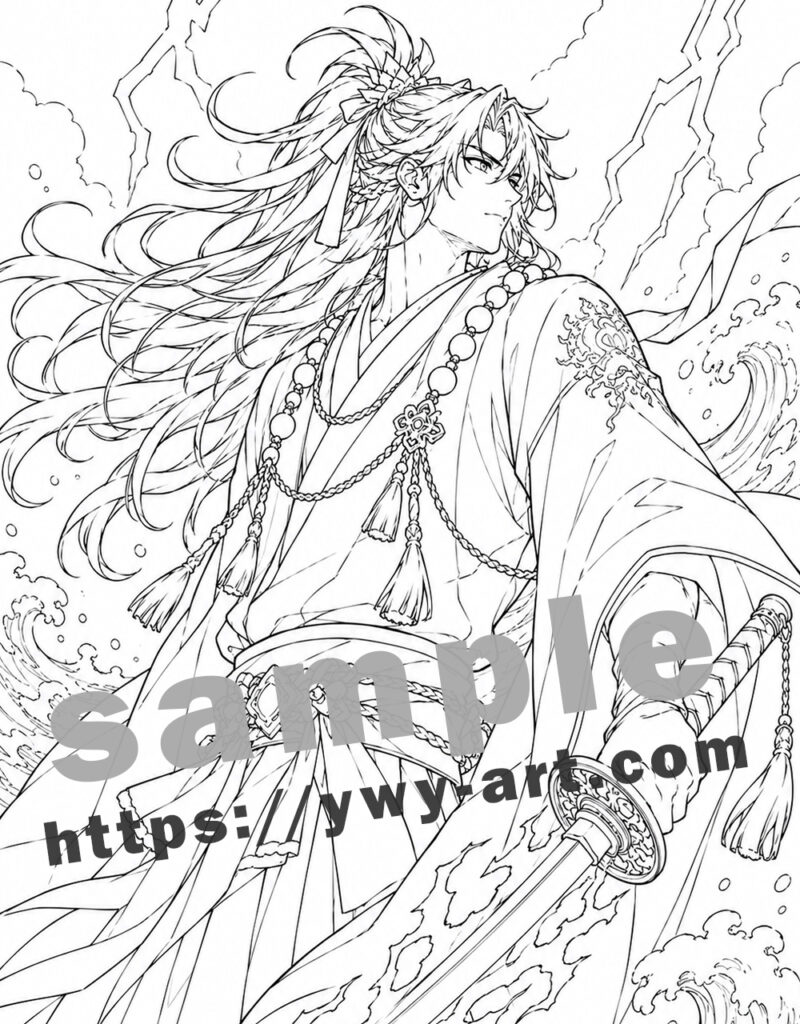
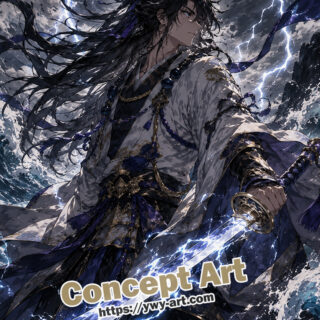
Susanoo is not a calm god of gentle rain. He is storm, sea, rage, exile, and the wild force that can either destroy a world or save it at the last moment. In this illustration, the Storm Sword becomes the central artifact, cutting through waves and lightning while the sky breaks open behind him. It feels violent, but not empty. Honestly, this one has a fierce kind of beauty that really works. Susanoo’s power is chaotic, but the sword gives that chaos a direction.
Basic Profile
| Name | Susanoo |
|---|---|
| Mythology | Japanese Mythology / Shinto Tradition |
| Gender | Male |
| Region | Japan, especially Takamagahara, Izumo, stormy seas, and mythic landscapes tied to chaos and heroic transformation |
| Era | Ancient Japanese mythic tradition recorded in texts such as the Kojiki and Nihon Shoki |
| Domain | Storms, sea, wind, chaos, violence, purification, heroic monster-slaying, transformation |
| Symbol | Sword, storm clouds, waves, lightning, serpent, wind, sea, sacred blade |
| Culture / Religion | Shinto and Japanese mythological tradition |
| Main Role | Storm god whose destructive nature later turns toward heroic protection |
| Associated Deity | Amaterasu, Tsukuyomi, Izanagi, Kushinada-hime, Yamata no Orochi, Ōkuninushi |
| Common Depiction | A fierce and untamed deity connected with storms, the sea, swords, serpents, and dramatic divine conflict |
| Alignment | Wild, destructive, emotional, heroic, unpredictable, cleansing, and deeply tied to violent transformation |
Overview
Susanoo is one of the most dramatic gods in Japanese mythology. He is born from Izanagi during purification, alongside Amaterasu, the sun goddess, and Tsukuyomi, the moon deity. From the beginning, Susanoo carries a different energy. Amaterasu is light and order. Tsukuyomi is moonlit separation. Susanoo is storm.
His behavior in the heavenly realm is famously disruptive. He causes chaos, violates sacred spaces, and brings terrible disorder to Amaterasu’s world. His actions eventually lead to Amaterasu hiding inside the Heavenly Rock Cave, plunging heaven and earth into darkness. This makes Susanoo one of the forces behind one of the most important crises in Japanese myth.
But Susanoo is not only destructive. After his exile from heaven, his story shifts. He descends to earth and encounters the terrible serpent Yamata no Orochi, an eight-headed and eight-tailed monster that has been devouring the daughters of an elderly couple. Susanoo defeats the serpent and rescues Kushinada-hime. This transformation is important. The storm god who once caused disaster becomes the one who ends it.
In this artwork, the Storm Sword captures that duality. It is surrounded by waves, lightning, and dark clouds, but it is not lost inside the chaos. The blade cuts forward with purpose. Susanoo’s energy is wild, yet the sword turns it into action. That is the heart of the image.
The Artifact: Storm Sword
The Storm Sword is a creative artifact built from Susanoo’s storm nature and his connection to sacred blades. The most famous sword in his myth is not exactly the one he first uses in battle, but the sword he discovers inside the body of Yamata no Orochi: Kusanagi-no-Tsurugi, the Grass-Cutting Sword.
After Susanoo kills the serpent, he finds the divine sword within one of its tails and later presents it to Amaterasu. This sword becomes one of the Three Sacred Treasures of Japan, along with the mirror and the jewel. That makes Susanoo’s monster-slaying myth deeply connected to sacred kingship and divine legitimacy.
The Storm Sword in this illustration can be read as the blade of Susanoo’s own storm force: lightning, sea, and wind gathered into a cutting edge. It is not only a weapon for combat. It is a symbol of chaos being shaped into heroic action. The storm does not disappear. It becomes the blade.
The blue-white lightning around the sword gives the artifact a sharp supernatural feeling. It suggests that the blade is not merely steel. It carries the pressure of storm clouds, the force of waves, and the sudden brightness of lightning. This makes the sword feel both divine and dangerous.
Mythological Background
Susanoo’s birth follows Izanagi’s return from Yomi, the land of the dead. After escaping that polluted realm, Izanagi purifies himself, and from that purification several major deities are born. Amaterasu comes from his left eye, Tsukuyomi from his right eye, and Susanoo from his nose. This origin ties Susanoo to purification, but also to the turbulent residue of a terrifying underworld journey.
His conflict with Amaterasu is one of the most famous parts of his mythology. Susanoo’s violent actions in Takamagahara cause great disorder. In response, Amaterasu hides in the Heavenly Rock Cave, and the world loses sunlight. The gods must work together to lure her out, using ritual, laughter, performance, and the sacred mirror. Susanoo is then expelled, marking his fall from heaven.
After his exile, the story changes direction. Susanoo arrives in Izumo and meets an old couple whose daughters have been devoured by Yamata no Orochi. Only one daughter, Kushinada-hime, remains. Susanoo agrees to defeat the serpent, prepares strong sake, and tricks the monster into drinking. When Orochi becomes helpless, Susanoo cuts it apart.
Inside the serpent’s tail, he discovers the divine sword later known as Kusanagi. This is a crucial mythic moment. A sacred treasure is found within a monster. Order is recovered from chaos. A destructive god becomes the source of a royal artifact. That is exactly the kind of contradiction that makes Susanoo so powerful as a subject.
Susanoo’s later lineage also connects him to important earthly deities, including Ōkuninushi in some traditions. This places him not only in the heavenly drama of Amaterasu, but also in the mythic landscape of Izumo, earthly rule, and the formation of Japan’s divine geography.
Symbolism and Meaning
The Storm Sword represents controlled violence. That may sound contradictory, but it fits Susanoo perfectly. A storm is dangerous because it has force without human control. A sword is dangerous because it gives force a line, an edge, and a target. The artifact combines both ideas.
The waves around the blade suggest Susanoo’s connection to the sea and storm. Water can nourish, but in storm form it becomes overwhelming. The sword cutting through the water shows the god’s ability to move through chaos without being swallowed by it.
The lightning adds the idea of sudden revelation. Lightning appears for a moment and changes everything. It exposes the sky, splits the dark, and strikes before anyone can prepare. Susanoo’s heroic turn works in a similar way. He is not a slow, stable god of order. He is a violent force that suddenly becomes necessary.
The dark clothing and wind-torn composition make the image feel unstable, which is right for him. Susanoo should not feel polished in the same way as Amaterasu. His beauty is rougher, sharper, and more dangerous. The storm around him is part of his identity, not just scenery.
The sword can also be read as transformation through conflict. Susanoo’s path moves from heavenly disruption to earthly heroism. He does not become gentle. He becomes useful. The blade is the moment where destructive energy is redirected into protection.
Coloring Notes
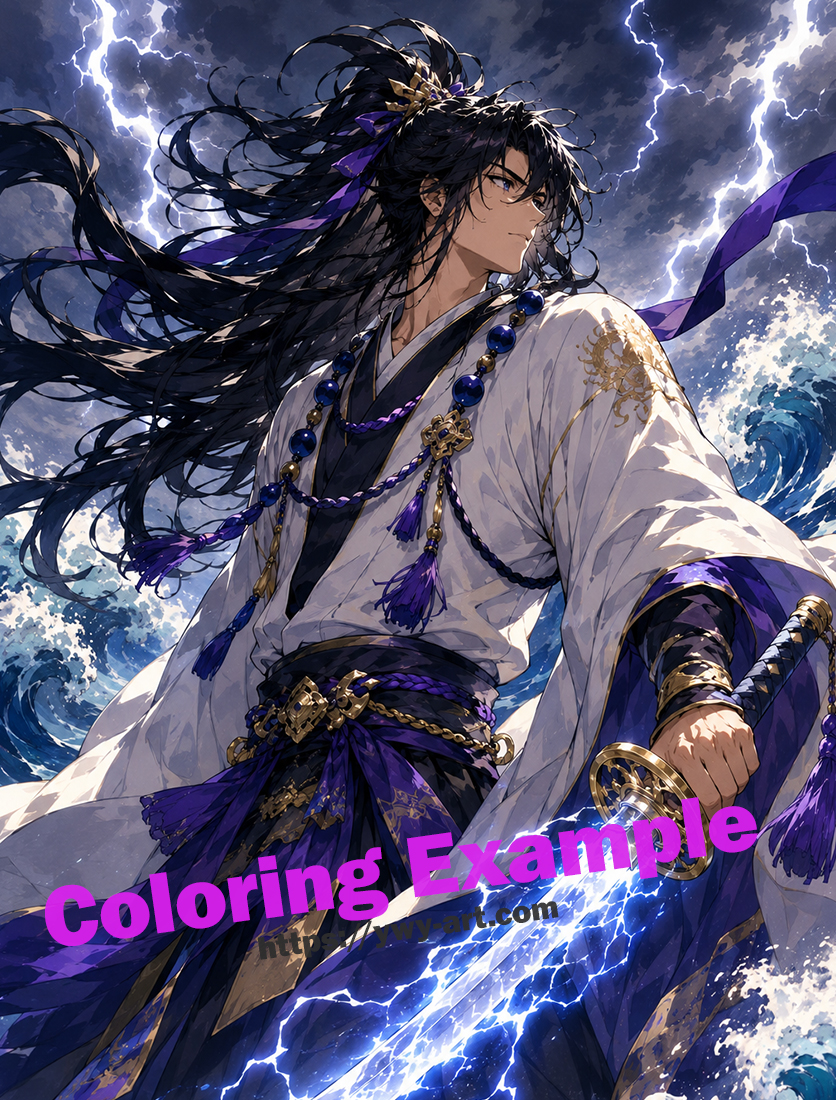
This page works well with a storm-heavy palette. Deep navy, charcoal, blue-gray, white lightning, muted gold, black, and sea blue can create a powerful Susanoo atmosphere. The Storm Sword should be the brightest and sharpest focus, so the blade and lightning effects need clean contrast.
For the sword, use cool silver or pale steel with bright white highlights along the edge. Blue-white lightning can wrap around the blade, with darker blue shadows nearby to make the glow stand out. The cutting edge should feel almost electric.
Susanoo’s clothing can use white, dark blue, black, and muted gold. The white robe will catch lightning beautifully, while darker inner layers can keep the scene intense. Purple-blue accents can add a more supernatural storm feeling.
The waves should not be colored as one flat blue. Try layering dark teal, deep blue, gray-blue, and white foam. Leaving some white areas around the wave crests will make the water feel violent and readable. The sea should support the blade, not compete with it.
The sky can be dark charcoal, storm gray, and navy, with bright lightning cracks. Use the strongest brightness near the sword and the main bolts in the sky. If every cloud becomes equally dark, the image may flatten, so a few pale storm highlights will help create depth.
Quick Creative Reference
| Element | Creative Direction |
|---|---|
| Best For | Japanese storm mythology, heroic monster-slaying themes, sea and lightning scenes, sacred sword imagery |
| Visual Keywords | Susanoo, Storm Sword, lightning blade, waves, storm clouds, Yamata no Orochi, Kusanagi |
| Mood | Fierce, stormy, heroic, chaotic, sharp, transformative |
| Recommended Colors | Deep navy, charcoal, storm gray, silver, blue-white, sea blue, muted gold, black |
| Main Focus | The sword as a symbol of storm power redirected into heroic action and sacred transformation |
| Coloring Tip | Keep the blade and lightning as the brightest points, then use darker waves and clouds to make the Storm Sword cut visually through the scene. |
Compare with Similar Deities
| Name | Mythology | Main Domains | Overall Image |
|---|---|---|---|
| Susanoo | Japanese | Storms, sea, chaos, exile, monster-slaying, sacred sword | A wild storm god whose destructive nature becomes heroic through the defeat of Yamata no Orochi |
| Thor | Norse | Thunder, storms, strength, protection, giants | A direct and protective storm god who uses Mjölnir to defend gods and humans from destructive forces |
| Poseidon | Greek | Sea, storms, earthquakes, horses | A powerful sea god whose storms express divine anger and command over the ocean |
| Indra | Vedic / Hindu | Storms, thunder, rain, battle, serpent-slaying | A heroic storm god who defeats the serpent Vritra and releases the life-giving waters |
Closing
Susanoo Storm Sword is a strong artifact piece because it turns chaos into a blade. The storm does not vanish; it gathers along the edge, flashes through the lightning, and breaks through the waves. Susanoo is dangerous, emotional, and difficult to contain, but that is exactly why his heroic turn matters. When his wild force finds a target, the storm becomes protection.
Step into the world of mythology..
Available on Amazon Mythology Artifacts Series: Symbols of Power Coloring Book Open in a new tab


コメント