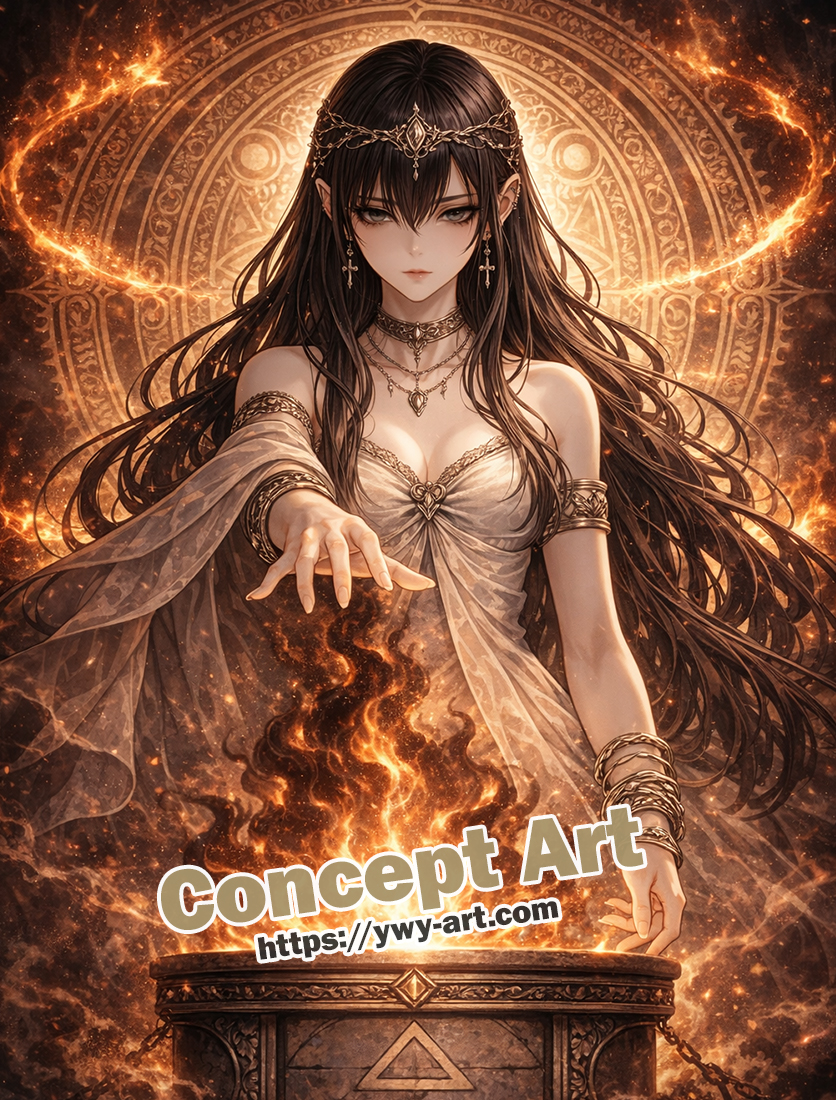
Rite of Vengeance – Alecto
Alecto stands in silence, her presence heavy with something that cannot be escaped. She does not move with anger, nor does she raise her voice. The moment she appears, everything has already been decided. What remains is not judgment, but inevitability.
Basic Profile
| Name | Alecto |
|---|---|
| Mythology | Greek Mythology |
| Gender | Female |
| Region | Ancient Greece |
| Era | Archaic to Classical Greek period |
| Domain | Vengeance, Retribution, Endless Punishment |
| Symbol | Flame, Serpents, Whip, Blood Oath |
| Culture / Religion | Ancient Greek Religion |
| Main Role | Relentless enforcer of moral and familial vengeance |
| Associated Deity | Erinyes (Furies), Hades, Nyx |
| Common Depiction | Cold, emotionless woman with serpents or dark aura, often surrounded by flames or shadows |
| Alignment | Neutral (inevitable justice rather than morality) |
| Creative Reference | Embodiment of unavoidable consequence and psychological torment |
Overview
Alecto is one of the Erinyes, the ancient spirits of vengeance who pursue those guilty of grave sins. Unlike gods who judge or forgive, Alecto exists solely to ensure that wrongdoing is never erased. She does not decide who is guilty. She acts when guilt already exists.
Her role is not to punish through violence alone, but to impose a state from which there is no escape. Memory becomes the weapon, and guilt becomes the prison. Once Alecto appears, the cycle has already begun, and it does not end easily.
Characteristics
- Embodies relentless and unending vengeance rather than immediate punishment
- Emotionless presence that reflects inevitability instead of anger
- Targets sins tied to blood, betrayal, and moral violation
- Uses psychological torment as much as physical consequence
- Represents a force that cannot be escaped or negotiated with
Symbolism and Meaning
Alecto symbolizes the idea that actions cannot be erased. In many interpretations, she is less a character and more a principle: that consequences follow naturally and cannot be avoided through denial or time.
The flames often associated with her are not destructive in a chaotic sense. They reveal, illuminate, and bind. They expose what was hidden and transform it into something permanent. Through this, Alecto represents the moment when truth becomes unavoidable.
Quick Creative Reference
| Best For | Dark ritual scenes, psychological themes, controlled power compositions |
|---|---|
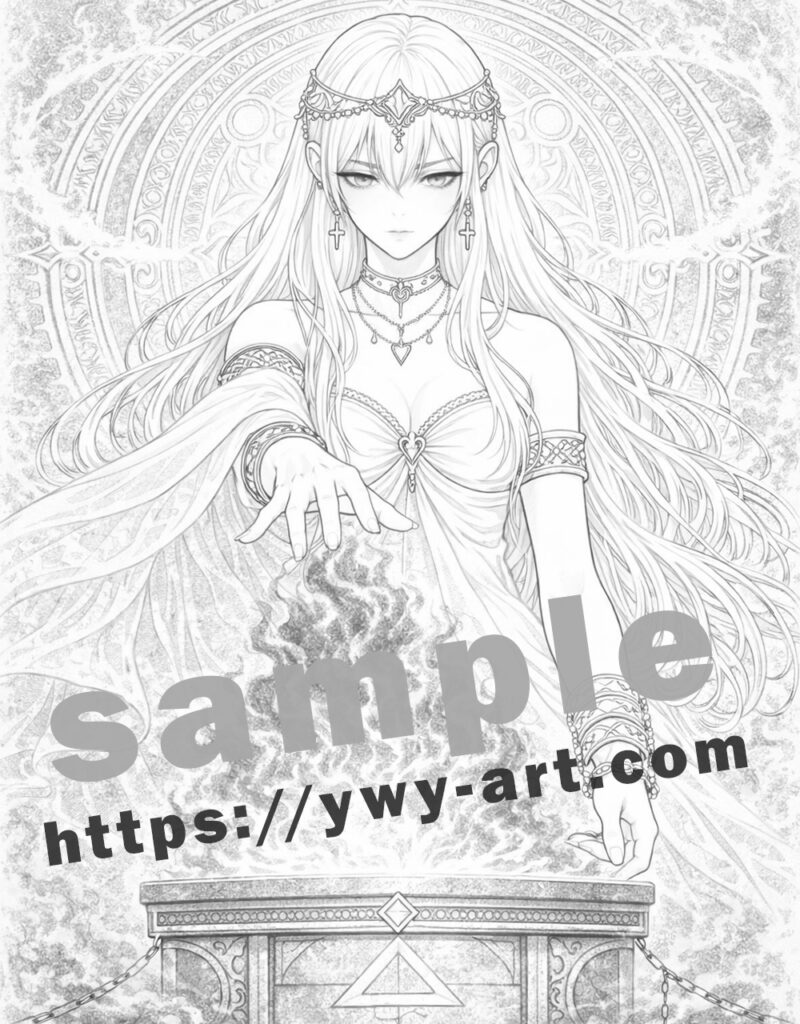
| Visual Keywords | cold gaze, ritual flame, circular sigil, still posture, flowing hair |
| Mood | Silent, oppressive, inevitable |
| Useful Themes | vengeance, memory, consequence, inevitability, moral weight |
Compare with Similar Deities
| Name | Mythology | Main Domains | Overall Image |
|---|---|---|---|
| Nemesis | Greek | Justice, Balance | Measured and corrective force of justice |
| Kali | Hindu | Destruction, Transformation | Violent yet divine force of renewal |
| Hecate | Greek | Magic, Crossroads | Mysterious guide between worlds |
The Nature of Vengeance
Alecto does not act in anger. This is what separates her from many other figures of destruction. Her presence is quiet, controlled, and absolute. Vengeance, in her form, is not emotional—it is the completion of a process.
This makes her far more unsettling. There is no moment of mercy, no hesitation, and no possibility of appeal. What has been done has already taken shape, and she simply brings it forward.
The Ritual of Binding
The ritual associated with Alecto is not one of summoning power, but of revealing truth. The flame serves as a medium where past actions become visible and undeniable.
Once the truth is revealed, it binds itself to the individual. This is not a temporary punishment, but a state of being. The person becomes inseparable from their own actions.
Why She Does Not Move
In many depictions, Alecto stands still, almost statuesque. This is not a lack of action, but a reflection of certainty. Movement implies change, but her role begins after change is no longer possible.
Everything has already been set into motion. Her stillness represents the point of no return.
The Fear of Inevitability
What makes Alecto truly frightening is not violence, but inevitability. There is no escape, no forgiveness, and no end to what she represents.
She embodies the idea that some consequences do not fade. They persist, returning again and again, until they are fully acknowledged.
Coloring Variations
- Cold Judgment: Use desaturated tones and pale skin with minimal warmth to emphasize emotional distance.
- Infernal Ritual: Focus on strong reds, oranges, and glowing highlights to enhance the flame as a central element.
- Shadow Dominance: Use deep blacks and muted tones with subtle highlights for a darker, oppressive atmosphere.
Coloring Tips

Keep the overall palette controlled rather than overly vibrant. Alecto’s presence is defined by restraint, so limiting color intensity helps maintain her atmosphere.
The flame can be used as a focal point by layering warm tones gradually, allowing it to glow without overpowering the composition.
Hair and clothing can benefit from subtle gradients rather than strong contrast, preserving the calm yet dominant visual balance.
Japanese Summary
アレクトーはギリシャ神話に登場する復讐の存在であり、罪を裁くのではなく、罪を忘れさせない役割を持つ存在として描かれます。彼女は怒りではなく、すでに確定した結果としての「報い」を象徴しています。
今回の儀式は、罪と結果を結びつける瞬間を表しています。炎は破壊ではなく、記憶や行為を可視化する媒体であり、逃れられない状態を作り出します。
アレクトーの本質
アレクトーは判断を下す存在ではなく、すでに存在する罪を追い続ける存在です。そのため彼女の行動には迷いや感情がなく、常に一定の静けさが保たれています。
この静けさこそが恐怖の本質であり、逃げ場のない状況を強く印象づけます。
儀式の意味
この儀式は力を得るためのものではなく、すでに行われた行為を明確にし、それを対象に固定するためのものです。
一度結びついた結果は消えることがなく、時間が経っても影響を与え続けます。
なぜ動かないのか
アレクトーがほとんど動かないのは、すべてがすでに決定している状態を表しています。動きがないことで、逆に絶対的な力を感じさせます。
これは感情ではなく「確定した現象」としての復讐を表現しています。
塗りのポイント
髪や衣装は落ち着いた色でまとめ、炎とのコントラストを意識するとバランスが取りやすくなります。
炎は黄色から赤へのグラデーションで段階的に塗ることで、自然な発光表現が可能になります。
Explore Our Coloring Book Series
Discover more powerful mythological figures brought to life through detailed line art.
Explore the full series and find your next dark goddess to color.
Step into the world of mythology..
Available on Amazon Dark Ritual Goddesses of Mythology Coloring Book Open in a new tab











コメント