Apollo Solar Lyre
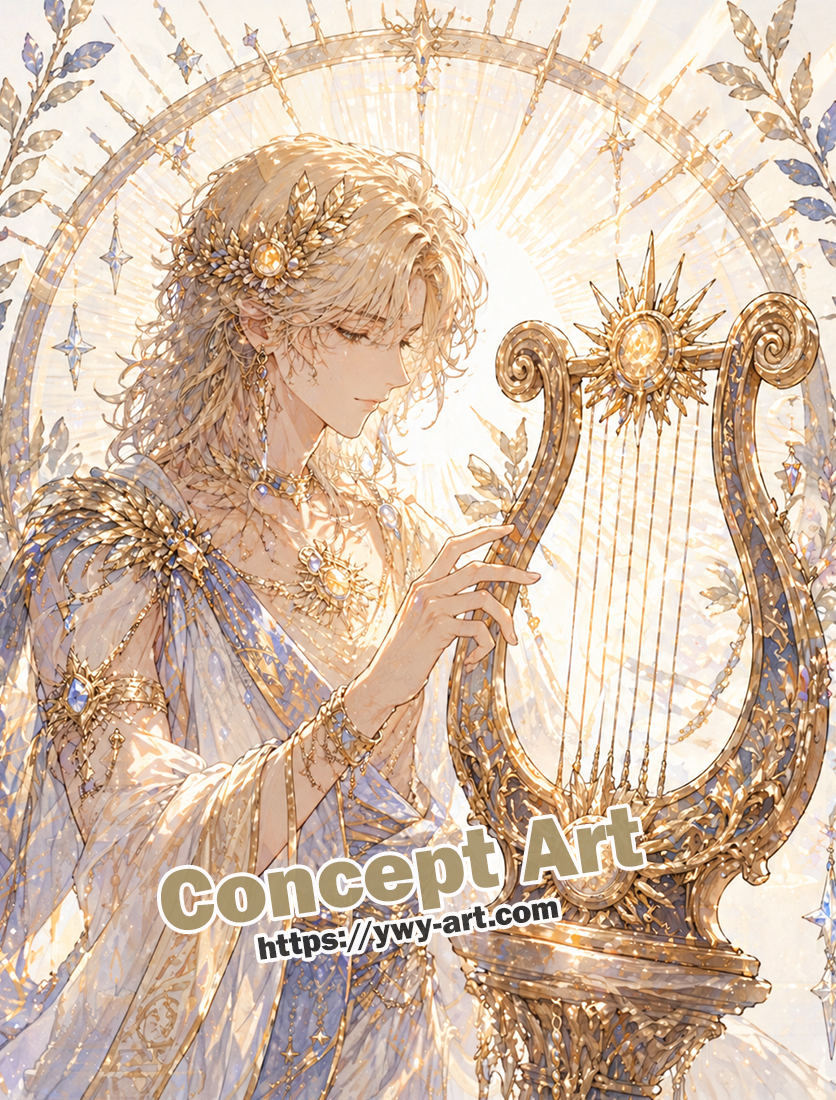
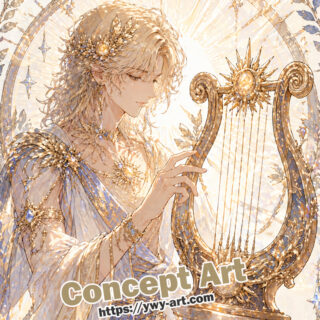
Apollo is one of those gods who can look calm, graceful, and almost untouchable, but his power is not small at all. He is connected with music, prophecy, healing, poetry, archery, and later, the light of the sun. In this illustration, the Solar Lyre becomes the main artifact, glowing with warm golden light while Apollo gently reaches toward its strings. It feels peaceful, but not weak. Honestly, this one has a beautiful kind of brightness — the kind that makes the whole scene feel sacred without needing to shout.
Basic Profile
| Name | Apollo |
|---|---|
| Mythology | Greek Mythology |
| Gender | Male |
| Region | Ancient Greece, especially Delphi, Delos, and sacred sites connected with prophecy and music |
| Era | Ancient Greek mythic age |
| Domain | Music, prophecy, healing, archery, poetry, purification, sunlight, order |
| Symbol | Lyre, laurel wreath, bow, arrow, sun, raven, swan |
| Culture / Religion | Ancient Greek religion |
| Main Role | God of music, prophecy, healing, and divine harmony |
| Associated Deity | Artemis, Zeus, Leto, Hermes, Daphne, Asclepius, the Muses |
| Common Depiction | A youthful and radiant god holding a lyre, bow, or laurel, often surrounded by light |
| Alignment | Radiant, disciplined, artistic, prophetic, healing, and sometimes dangerously precise |
Overview
Apollo is one of the most complex gods in Greek mythology. At first glance, he may seem like a god of beauty and music, but his role goes much deeper than that. Apollo is connected with harmony, truth, purification, and the ability to bring order into chaos. He can heal, but he can also send plague. He can inspire poetry, but he can also strike with deadly arrows. That balance makes him much more interesting than a simple “bright sun god.”
He is the twin brother of Artemis, and their contrast is important. Artemis moves through moonlit forests and wild spaces, while Apollo is often linked with clarity, prophecy, and structured beauty. Artemis’ bow feels like silence before the hunt. Apollo’s lyre feels like sound becoming order. They are different, but both are precise.
Apollo’s connection to prophecy is especially important. His oracle at Delphi was one of the most famous religious centers of the ancient Greek world. People came to Delphi to seek divine guidance, but Apollo’s truth was not always simple or easy to understand. Prophecy could be bright, but also dangerous. A message from Apollo might guide a king, confuse a hero, or reveal a fate that could not be escaped.
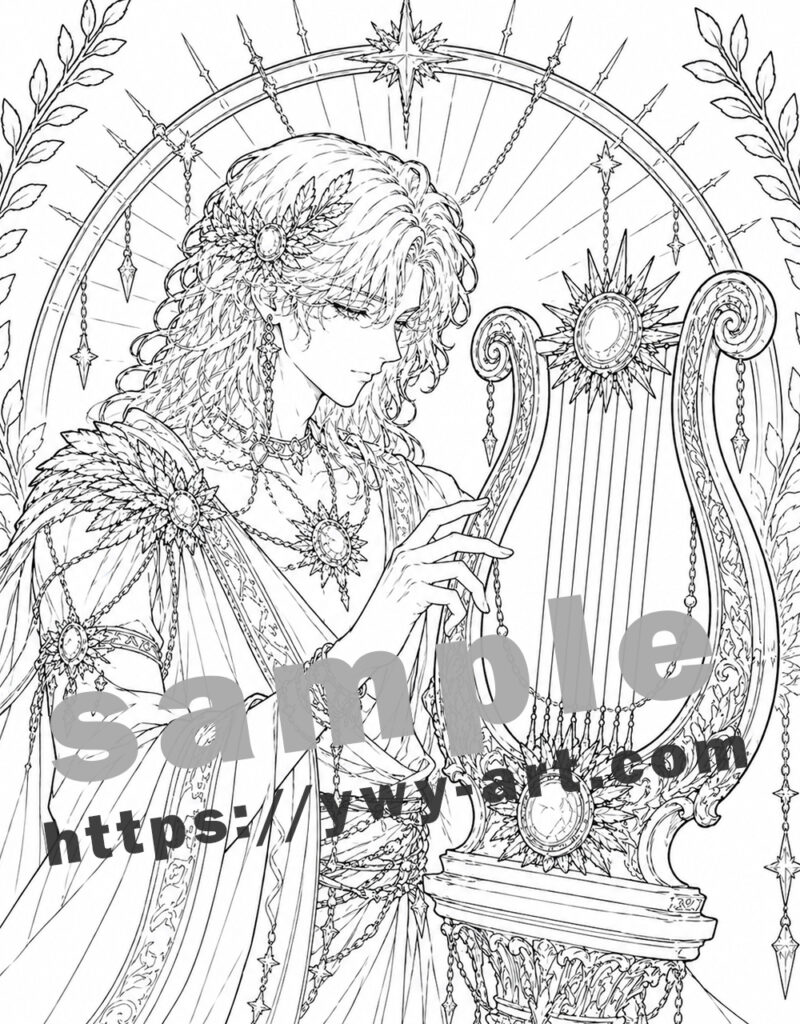
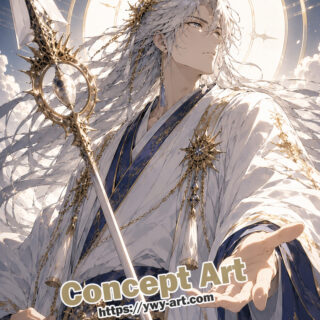
In this artwork, the Solar Lyre captures Apollo’s more radiant and musical side. The instrument glows like a sacred object, surrounded by laurel leaves, stars, and golden light. Apollo does not appear to be forcing power into the scene. He is touching the strings gently, as if light itself can be played like music.
The Artifact: Solar Lyre
The lyre is one of Apollo’s most recognizable symbols. In myth, the instrument is strongly connected to music, poetry, harmony, and the refined arts. It also links Apollo to the Muses, who inspire song, memory, dance, poetry, and knowledge. When Apollo holds the lyre, he is not simply a musician. He becomes the divine source of ordered beauty.
The Solar Lyre in this illustration is a creative artifact based on Apollo’s traditional lyre and his later association with solar light. In earlier Greek tradition, Helios was the direct personification of the sun, while Apollo’s solar identity grew stronger over time. Even so, the combination feels very natural visually. Apollo’s clarity, radiance, prophecy, and healing all blend well with sunlight.
A solar lyre suggests that music is not only sound, but light arranged into rhythm. That is a beautiful idea for Apollo. His power does not always need to explode like thunder or crash like the sea. It can enter the world through proportion, melody, brightness, and balance. The lyre becomes a tool that turns divine order into something humans can feel.
The sun-like ornament at the top of the instrument gives the lyre a sacred center. It looks less like decoration and more like the heart of the artifact. The strings beneath it feel like rays of light stretched into music. This makes the Solar Lyre both an instrument and a symbol of illumination.
Mythological Background
Apollo’s lyre is closely connected to Hermes. According to myth, Hermes invented the lyre using a tortoise shell and later gave it to Apollo after stealing his cattle. Instead of remaining enemies, the two gods reach an exchange: Apollo receives the lyre, and Hermes gains a place among the Olympian gods as a clever messenger and guide. It is a surprisingly charming story, and it shows how music can transform conflict into agreement.
Apollo also appears in myths where music becomes a contest of divine authority. In the story of Marsyas, the satyr challenges Apollo to a musical competition and loses terribly. The ending is brutal, and it reminds us that Apollo’s beauty has a severe side. His art is sacred, but it is not casual. To challenge divine harmony without understanding its weight can bring punishment.
Another important figure connected to Apollo is Orpheus, the legendary musician whose song could move animals, trees, and even the rulers of the underworld. Orpheus is not Apollo himself, but his music belongs to the same mythic world of sacred sound. Through figures like Orpheus, Greek myth presents music as something far more powerful than entertainment. It can persuade, mourn, enchant, and reach places ordinary speech cannot.
Apollo’s laurel is also essential to his identity. In the myth of Daphne, Apollo pursues the nymph Daphne, who is transformed into a laurel tree. Apollo then adopts the laurel as his sacred plant. This myth gives Apollo’s beauty and desire a more complicated feeling. The laurel is not only a symbol of victory. It also carries memory, loss, longing, and transformation.
Symbolism and Meaning
The Solar Lyre represents harmony as power. That is the key idea. In many myths, power is shown through weapons, monsters, storms, or physical strength. Apollo’s lyre shows another kind of force: the ability to arrange the world into meaning. Music gives shape to emotion. Light reveals what was hidden. Prophecy gives pattern to events that seem random.
The sun imagery makes the artifact feel even more direct. Sunlight exposes, warms, heals, and sometimes burns. Apollo is similar. His truth can comfort, but it can also be harsh. His music can soothe, but his arrows can kill. The Solar Lyre captures that duality in a gentler visual form: beauty with discipline behind it.
The laurel leaves around the composition suggest victory, art, and sacred recognition. They also soften the brightness of the scene, keeping it from becoming only dazzling gold. Laurel belongs to poets, prophets, and champions. Around Apollo’s lyre, it feels like a crown given to music itself.
There is also something very human about this artifact. A trident can command the sea, and a thunderbolt can tear the sky open, but a lyre asks someone to listen. That makes Apollo’s power feel intimate. The sound may be divine, but it reaches the heart through rhythm and feeling.
Coloring Notes
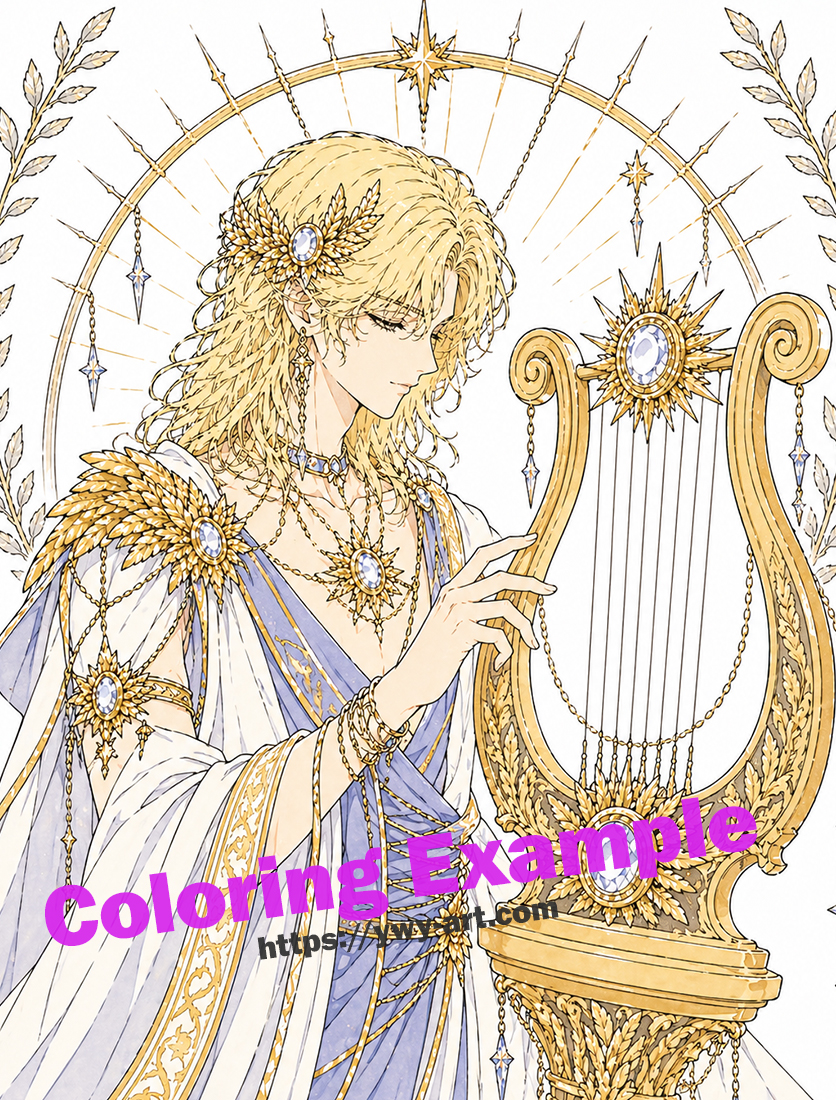
This page works beautifully with warm sunlight colors. Soft gold, cream, pale yellow, ivory, light blue, and gentle lavender can create a bright and elegant atmosphere. The Solar Lyre should stay as the main focus, so it helps to give the instrument the clearest metallic shine and the strongest warm highlights.
For Apollo’s clothing, pale blue and white can balance the gold. If the entire page becomes yellow, the image may lose depth, so cooler shadows are useful. A little lavender-gray or blue-gray in the folds of the fabric can make the golden light feel brighter by contrast.
The lyre itself can be colored with antique gold, polished bronze, or warm ivory details. The sun ornament at the top should probably receive the brightest glow. The strings can stay light, but adding subtle shadow behind them will make them easier to see.
Apollo’s hair can be colored in gold, pale blond, soft white-blond, or even a light honey tone. If you want a more divine look, leaving some highlights nearly white will make the hair feel touched by sunlight. The face and hands should stay gentle, because the emotional center of the scene is not aggression. It is concentration.
The background leaves and hanging ornaments can stay softer than the lyre. Pale olive, muted gold, and gray-blue accents will help create depth without pulling attention away from the artifact. The key is to let the page glow, but still keep enough contrast for the lyre to stand clearly.
Quick Creative Reference
| Element | Creative Direction |
|---|---|
| Best For | Radiant mythology, divine music, prophecy themes, sacred light imagery |
| Visual Keywords | Solar lyre, Apollo, sunlight, laurel, music, prophecy, golden harmony |
| Mood | Bright, graceful, sacred, calm, refined, quietly powerful |
| Recommended Colors | Gold, ivory, pale yellow, soft blue, cream, lavender-gray, warm bronze |
| Main Focus | The lyre as a symbol of divine harmony, music, and solar radiance |
| Coloring Tip | Use warm highlights on the lyre and cooler shadows in the clothing to keep the golden light from becoming flat. |
Compare with Similar Deities
| Name | Mythology | Main Domains | Overall Image |
|---|---|---|---|
| Apollo | Greek | Music, prophecy, healing, archery, sunlight, poetry | A radiant god of harmony, truth, beauty, and precise divine power |
| Helios | Greek | Sun, solar chariot, daylight | A direct personification of the sun, often imagined driving the solar chariot across the sky |
| Orpheus | Greek | Music, poetry, sacred song, underworld journey | A legendary musician whose song could move nature, gods, and even the dead |
| Bragi | Norse | Poetry, eloquence, song | A Norse god of poetry and spoken art, more focused on language and inspiration than solar radiance |
Closing
Apollo Solar Lyre is a gentle-looking piece, but it carries a strong mythological core. The lyre is not just an instrument placed beside a beautiful god. It is Apollo’s idea of power: light shaped into music, order carried through sound, and truth made almost beautiful enough to trust. The whole scene feels warm, sacred, and calm — but underneath that calm, there is still the precision of a god who never misses his note.
Step into the world of mythology..
Available on Amazon Mythology Artifacts Series: Symbols of Power Coloring Book Open in a new tab
コメント