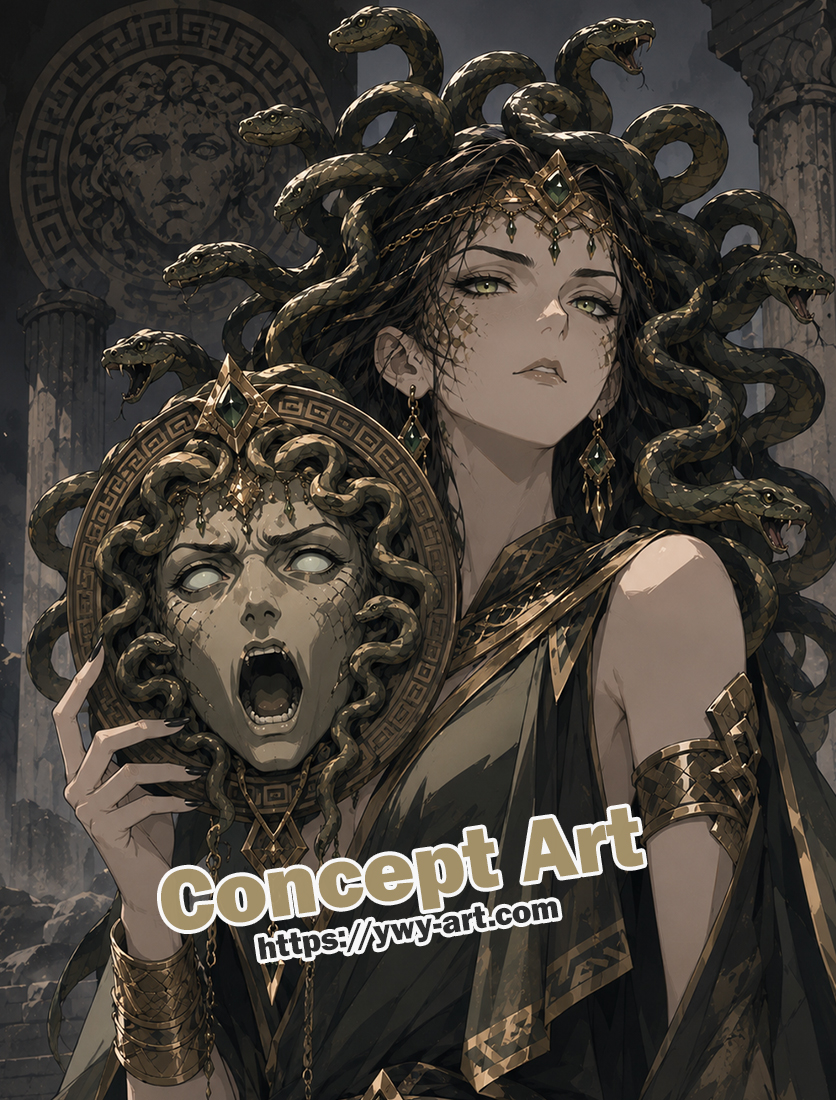
Medusa Petrifying Gorgon Mask
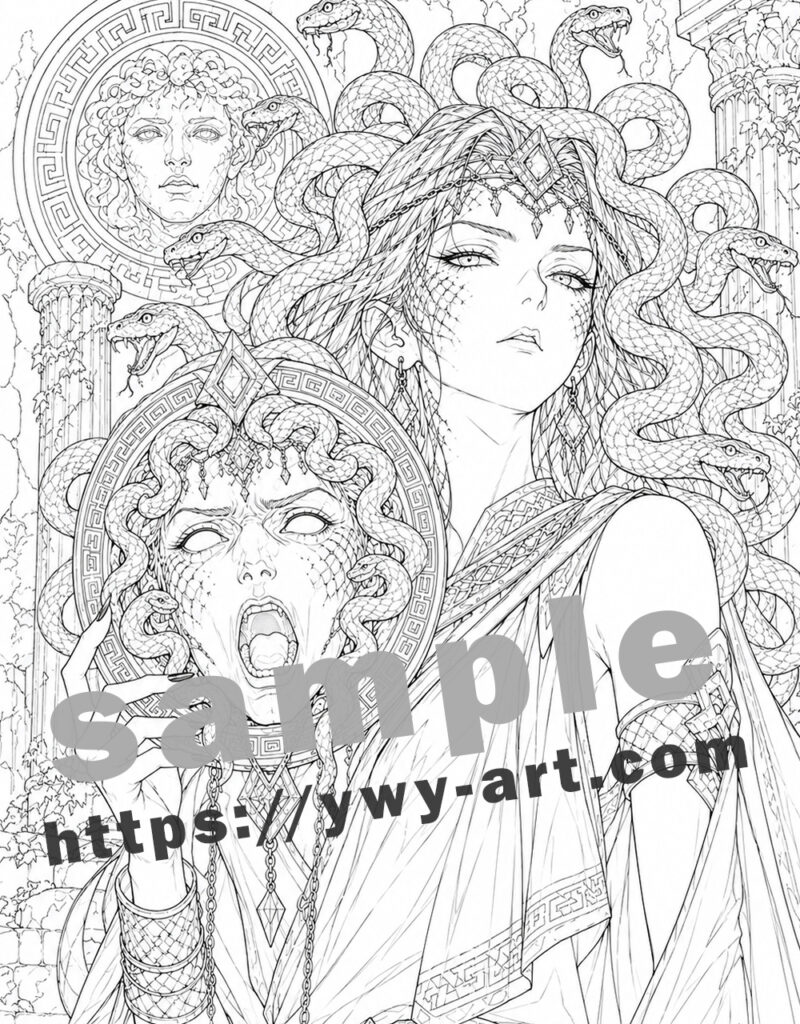
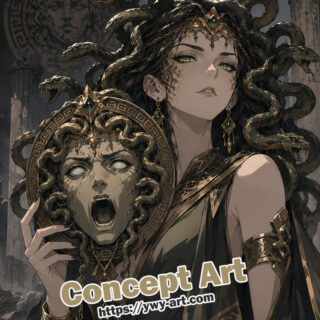
Medusa appears in this artwork with a gaze that feels dangerous before she even moves. Snakes coil around her head, ancient stone ruins fade into the background, and the mask in her hand carries a frozen scream of terror. This is not just a portrait of a monster. It feels more like a scene about fear, beauty, punishment, and the terrible power of being seen.
This piece belongs to the Mythology Artifacts Series, a coloring book collection focused on divine weapons, sacred relics, and symbolic objects from world mythology. Here, the central artifact is the Petrifying Gorgon Mask, inspired by Medusa’s famous power to turn those who looked at her into stone. The mask becomes more than an object. It is a captured curse, a warning, and a symbol of gaze itself.
Basic Profile
| Name | Medusa |
|---|---|
| Mythology | Greek mythology |
| Gender | Female figure / Gorgon |
| Region | Ancient Greece and the wider Mediterranean world |
| Domain | Petrification, fear, monstrous beauty, protection, punishment, and transformation |
| Artifact | Petrifying Gorgon Mask |
| Associated Symbol | Serpents, stone, staring eyes, severed head, curse, protective emblem |
| Main Role | A Gorgon whose gaze could turn living beings into stone |
| Common Depiction | A woman with snakes for hair, a deadly gaze, and a terrifying face used as a protective symbol |
| Overall Image | Beautiful, tragic, terrifying, cursed, and strangely protective |
Overview
Medusa is one of the most famous figures in Greek mythology, and she is also one of the most complicated. Many people remember her simply as a monster with snakes for hair, but her story has always carried more weight than that. She is frightening, yes, but she is also tragic. She stands somewhere between victim, monster, weapon, and symbol.
In the best-known version of the myth, Medusa was one of the Gorgons. Unlike her immortal sisters, she was mortal. Her gaze had the power to turn anyone who looked directly at her into stone. That one detail made her one of the most feared beings in Greek myth, because the danger was not in a sword or claw. It was in the act of seeing.
That is what makes this artwork so strong. Medusa is not shown only as a screaming horror figure. She looks composed, almost regal, while holding a mask that carries the more monstrous expression. I really like that separation. It lets the image show two sides of Medusa at once: the woman who carries the curse, and the terrifying face the world remembers.
The Artifact: Petrifying Gorgon Mask
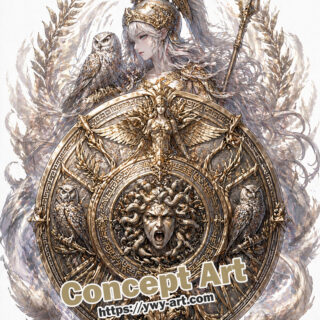
The Petrifying Gorgon Mask is the central artifact of this illustration. It is inspired by the famous image of Medusa’s head, which became a powerful protective symbol in Greek art. The face of the Gorgon, often called a gorgoneion, was used on shields, armor, buildings, and sacred objects to frighten away evil.
That gives the mask an interesting double meaning. On one side, it represents horror. It carries the open mouth, staring eyes, serpent forms, and petrifying force associated with Medusa. On the other side, it also represents protection. The same terrifying image that could destroy an enemy could also guard a doorway, a warrior, or a sacred space.
In this artwork, Medusa holds the mask close to her body, almost like she is presenting the curse itself. The mask looks like a frozen scream, while Medusa’s own face remains calm and unreadable. That contrast makes the artifact feel even stronger. It is not just a mask. It is the visible form of fear separated from the person who bears it.
Mythological Background
Medusa’s most famous story is connected to the hero Perseus. Sent to bring back her head, Perseus avoided looking directly at her by using a reflective shield. With the help of divine gifts, he was able to behead Medusa while she slept. Afterward, her head retained its petrifying power and became a weapon.
That detail is important. Medusa’s power did not end with her death. Her gaze remained active, even when separated from her body. Later myths describe Perseus using the head to defeat enemies, and eventually it became connected with Athena’s shield or aegis. The Gorgon image then became a sign of divine terror and protection.
There are different versions of Medusa’s origin. In some traditions, she is simply born monstrous as one of the Gorgons. In later versions, especially the version told by Ovid, Medusa was once beautiful and was transformed into a Gorgon after events involving Poseidon and Athena’s temple. That version gives her story a much more tragic feeling.
Because of that, modern readers often see Medusa as more than a monster. She can represent punishment, violated boundaries, rage, protection, and the way a feared image can be turned into power. Her myth is uncomfortable, and honestly, that is part of why it still feels alive.
Symbolism and Meaning
The strongest theme in this artwork is the power of the gaze. Medusa’s danger is not only physical. She changes the viewer. Anyone who looks at her directly risks becoming stone. That makes her myth unusually psychological. Fear, desire, curiosity, and violence all meet in one act: looking.
The mask represents the face that others project onto Medusa. It is monstrous, loud, and terrifying. Medusa herself, however, appears controlled and almost distant. This creates a strong emotional tension. Is the monster the woman, the curse, the gaze, or the fear of those who look at her?
The snakes around her head add another layer of meaning. Serpents can represent danger, death, transformation, healing, and ancient earth power. On Medusa, they make beauty unstable. Hair, usually a symbol of femininity and attraction, becomes alive, venomous, and impossible to control.
The stone background also matters. Broken ruins, gray pillars, and carved faces remind us of petrification. The world around Medusa feels half alive and half frozen. It is a place where beauty can harden into fear, and fear can become an eternal monument.
Coloring Notes
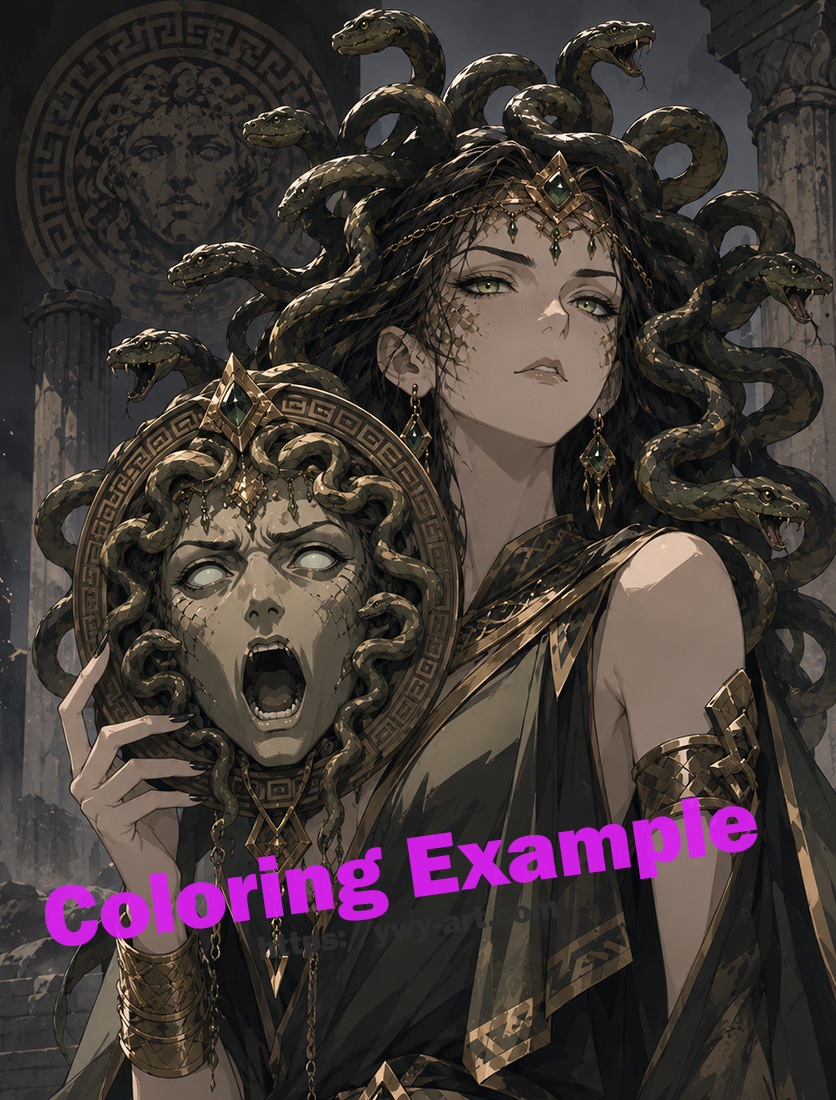
This page works beautifully with muted stone colors, dark green, antique gold, black, and pale skin tones. Medusa should feel ancient and dangerous, but not overly bright. A restrained palette will help the mask and snakes stand out.
For the snakes, dark olive, deep green, gray-green, or black-green can create a strong Gorgon atmosphere. Small highlights in yellow-green or muted gold can make the scales readable without making them look too decorative. Since there are many snakes, repeating a limited set of colors will keep the design unified.
The mask can be colored like old stone, bronze, or cursed marble. A gray-green stone effect would connect it to petrification, while antique gold or bronze could make it feel like a ritual artifact. The open mouth and eyes can be kept darker to preserve the frightening expression.
Medusa’s clothing can stay in black, dark olive, charcoal, muted bronze, or deep green. These colors fit the ruin-like setting and keep the focus on her face, the mask, and the serpents. If you want a more dramatic look, small emerald accents on jewelry can create a sharp but elegant contrast.
The background should probably stay quieter than the figure. Stone gray, faded beige, smoke gray, and muted shadow tones will work well for the ruins. If the background becomes too colorful, the central figure may lose her severe, cursed presence.
Quick Creative Reference
| Element | Creative Direction |
|---|---|
| Snakes | Use dark olive, gray-green, black-green, and small yellow-green highlights for depth. |
| Gorgon Mask | Stone gray, cursed marble, antique bronze, or gray-green tones can work well. |
| Medusa’s Skin | Pale warm tones or slightly cool marble-like skin can strengthen the cursed mood. |
| Jewelry | Antique gold, bronze, and emerald accents add elegance without softening the danger. |
| Background | Muted stone gray, smoke, faded beige, and shadow tones keep the ruins atmospheric. |
| Overall Mood | Tragic, dangerous, ancient, elegant, cursed, and quietly terrifying. |
Compare with Similar Figures
| Name | Mythology | Main Domains | Overall Image |
|---|---|---|---|
| Medusa | Greek mythology | Petrification, fear, curse, transformation, protection | A tragic Gorgon whose gaze turns life into stone and whose image becomes a protective emblem. |
| Athena | Greek mythology | Wisdom, strategy, protection, warfare, crafts | A disciplined goddess whose shield sometimes carries the terrifying power of the Gorgon image. |
| Perseus | Greek mythology | Heroism, monster-slaying, divine aid, courage | A hero who defeats Medusa by avoiding her gaze and using reflection instead of direct confrontation. |
| Kali | Hindu mythology | Time, death, destruction, fierce protection | A terrifying divine figure whose frightening appearance also carries protective and transformative meaning. |
Coloring Variations
- Cursed Marble Version: Use pale skin, gray-green snakes, stone-colored ruins, and a marble-like Gorgon mask.
- Antique Bronze Version: Color the mask and ornaments with bronze, dark gold, emerald, and black-green accents.
- Dark Gorgon Version: Use charcoal clothing, black-green snakes, pale skin, and muted gray ruins for a severe mood.
- Mythic Ruin Version: Add dusty beige, cracked stone gray, faded olive, and small gold highlights for an ancient temple feeling.
Closing
Medusa Petrifying Gorgon Mask is a coloring page about fear, beauty, punishment, and the strange power of an image that refuses to disappear. The mask is not just a prop. It is the visual form of Medusa’s curse, separated from her face but still full of danger.
For colorists, this piece offers a strong mix of serpents, stone textures, antique jewelry, dark fabric, and cursed atmosphere. The key is to keep the palette controlled. Dark greens, muted golds, pale skin, and stone grays will help the artwork feel unified and powerful.
In the end, this artwork shows Medusa as more than a monster. She is tragic, frightening, beautiful, and unforgettable. The Petrifying Gorgon Mask reminds us that some myths do not simply ask us to look. They ask what happens when we cannot look away.
Step into the world of mythology..
Available on Amazon Mythology Artifacts Series: Symbols of Power Coloring Book Open in a new tab
コメント