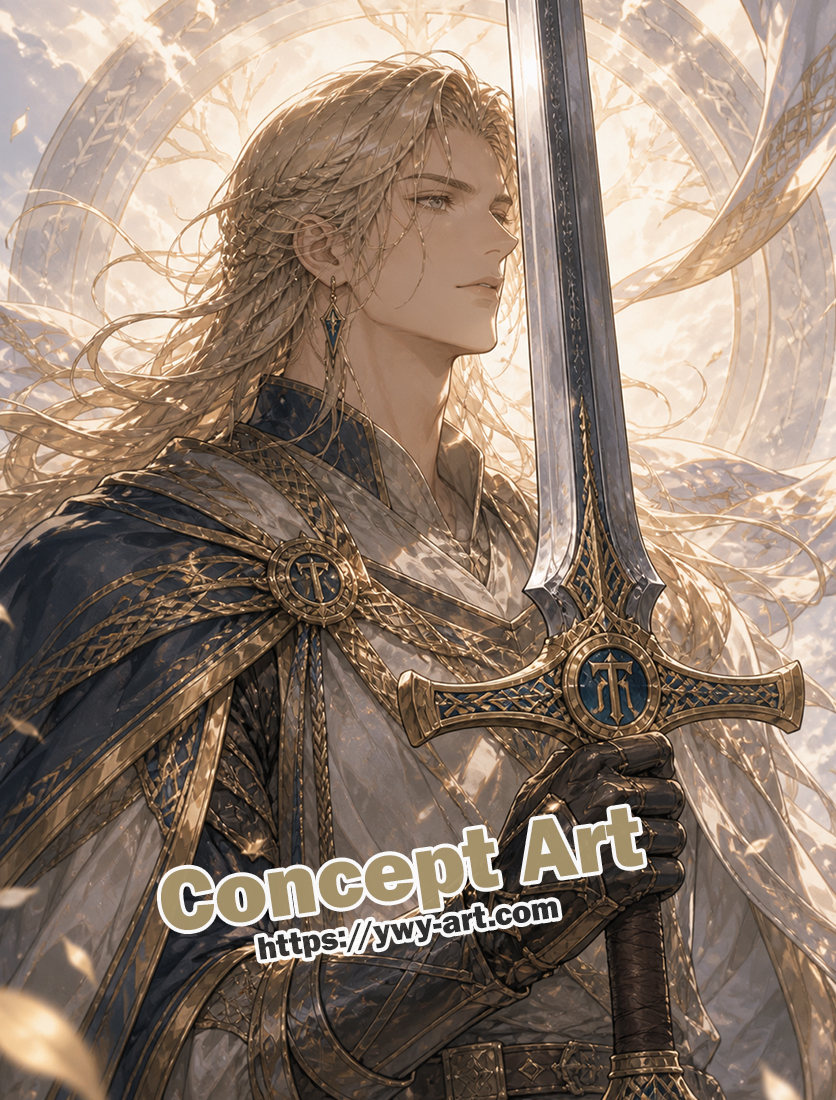
Tyr Oath Blade
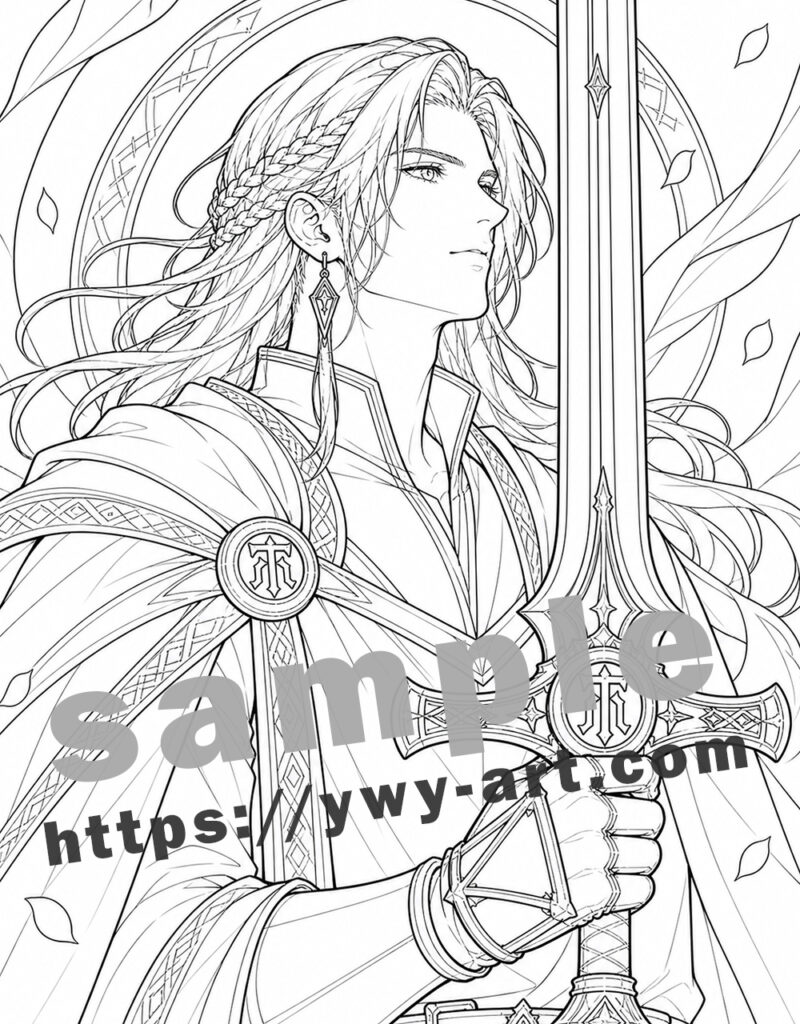
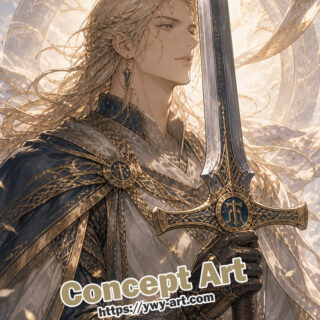
Tyr is not the loudest god in Norse mythology, but his story cuts very deep. He is connected with war, law, courage, and the painful cost of keeping order when everyone knows something must be sacrificed. In this illustration, the Oath Blade becomes the central artifact, held upright like a line between truth and betrayal. It feels calm, but honestly, there is something incredibly heavy behind that calm. Tyr’s power is not about showing off. It is about standing there when the price has to be paid.
Basic Profile
| Name | Tyr |
|---|---|
| Mythology | Norse Mythology |
| Gender | Male |
| Region | Norse and Germanic mythic world, especially Asgard, battlefields, legal assemblies, and sacred oaths |
| Era | Viking Age mythic tradition and earlier Germanic belief |
| Domain | War, law, justice, oaths, courage, sacrifice, heroic duty |
| Symbol | Sword, oath blade, severed hand, wolf, scales, legal assembly, binding rope |
| Culture / Religion | Norse mythology and pre-Christian Germanic religion |
| Main Role | God associated with law, war, sacred oaths, and courageous sacrifice |
| Associated Deity | Odin, Thor, Fenrir, Loki, the Aesir, Heimdall |
| Common Depiction | A solemn warrior god, often remembered for losing his hand while binding Fenrir |
| Alignment | Brave, lawful, severe, honorable, restrained, sacrificial, and morally difficult |
Overview
Tyr is one of the older and more serious figures in Norse mythology. He is often described as a god of war, but his kind of war is not the wild storm-force of Thor or the strategic, magical kingship of Odin. Tyr’s power feels closer to duty, oath, and the courage to act when the outcome is already painful.
In many modern retellings, Tyr is mostly remembered through one major myth: the binding of Fenrir. That story is enough to define him, though. Fenrir, the monstrous wolf and child of Loki, grows so powerful that the gods fear what he will become. They decide he must be bound. The problem is that Fenrir is not foolish. He suspects trickery.
To convince Fenrir to accept the magical binding Gleipnir, the gods make it look like a test of strength. Fenrir agrees only if one of them places a hand in his mouth as a pledge of good faith. Tyr is the one who does it. When Fenrir realizes he has been deceived and cannot break free, he bites off Tyr’s hand.
That moment gives Tyr a very different kind of strength. He does not win by overpowering the wolf. He wins by accepting the cost of a broken trust that still protects the world. It is not clean heroism. It is painful, morally complicated, and unforgettable.
The Artifact: Oath Blade
The Oath Blade is a creative artifact built from Tyr’s connection to law, war, and sacred promises. A sword is a natural symbol for a warrior god, but for Tyr it should not feel like a simple weapon of aggression. It is a blade tied to judgment, duty, and the seriousness of words once spoken.
An oath is not just a promise in mythic thinking. It is a binding force. To swear an oath is to place your honor, fate, and identity under pressure. Breaking it can damage more than reputation. It can shake the moral structure that holds a society together. For a god like Tyr, an oath is almost a weapon and a chain at the same time.
The Oath Blade can therefore be read as a sword that cuts through falsehood, but also as a reminder that truth can wound the person who carries it. Tyr’s myth with Fenrir shows this clearly. He keeps the larger order safe, but he does so through an act that costs him his hand and stains the gods with deception.
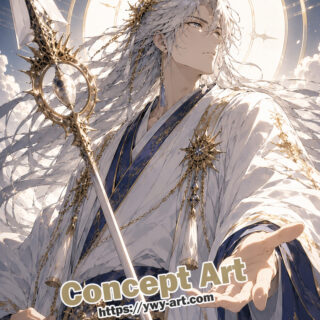
In this artwork, the blade is held upright, close to the face, giving it a ceremonial feeling. It is not being swung in battle. It is being presented. That makes the sword feel like an object of vow, judgment, and solemn decision. The light behind it gives the artifact an almost sacred weight.
Mythological Background
Tyr’s exact place in Norse mythology is complex. In earlier Germanic tradition, he may have held a more central role than he does in later surviving Norse texts. His name is related to older Indo-European sky or god terms, and the weekday Tuesday comes from his name. That hints at an older importance beneath the smaller number of stories we still have.
By the time of the main Norse sources, Odin and Thor dominate many narratives, while Tyr appears less often. But when he does appear, his role is sharp and memorable. He is not a comic figure, not a trickster, and not a god of luxury. He carries the atmosphere of law and consequence.
The binding of Fenrir is his defining myth. The gods know that Fenrir is destined to bring disaster at Ragnarök, where he will eventually break free and devour Odin. Their attempt to bind him is understandable, but the method is deceptive. Tyr’s hand in the wolf’s mouth becomes the physical pledge that makes the deception possible.
This is why Tyr’s sacrifice is so powerful. He does not simply lose his hand in battle. He loses it because he becomes the guarantor of an oath that the gods will not truly honor. That makes the myth darker than a simple bravery story. Tyr’s courage exists inside a morally damaged situation.
At Ragnarök, Tyr is said to fight the monstrous hound Garmr. In some accounts, they kill each other. This ending fits his character. Tyr’s path is not one of easy victory. It is the path of a god who faces dangerous beings directly, even when the outcome is fatal.
Symbolism and Meaning
The Oath Blade represents justice with a cost. That is the main idea. Many symbols of justice look clean from far away: swords, scales, laws, bright halls. Tyr reminds us that order is sometimes preserved through painful choices made by someone who cannot remain untouched.
The blade also symbolizes the cutting edge of truth. A promise sounds simple until it is tested. Tyr’s story shows that a vow is not only words. It becomes real when the body is placed at risk. His missing hand is proof that oaths are not abstract.
There is also a strong contrast between Tyr and Loki. Loki’s power often lies in slippery language, shifting identity, and clever escape. Tyr’s power lies in standing still. He places his hand where danger is obvious. He does not talk his way out of the price. That directness gives him a severe dignity.
The sword in the image can also be read as a vertical axis: heaven above, earth below, truth in the center. Tyr stands beside it like someone who has accepted judgment before giving it. That makes the artifact feel less like a fantasy sword and more like a sacred legal object.
The pale light and flowing ribbons around the figure soften the scene, but they do not remove the seriousness. Tyr is beautiful here, yes, but the beauty feels restrained. The focus stays on the blade, the hand, and the quiet expression of someone who understands consequence.
Coloring Notes
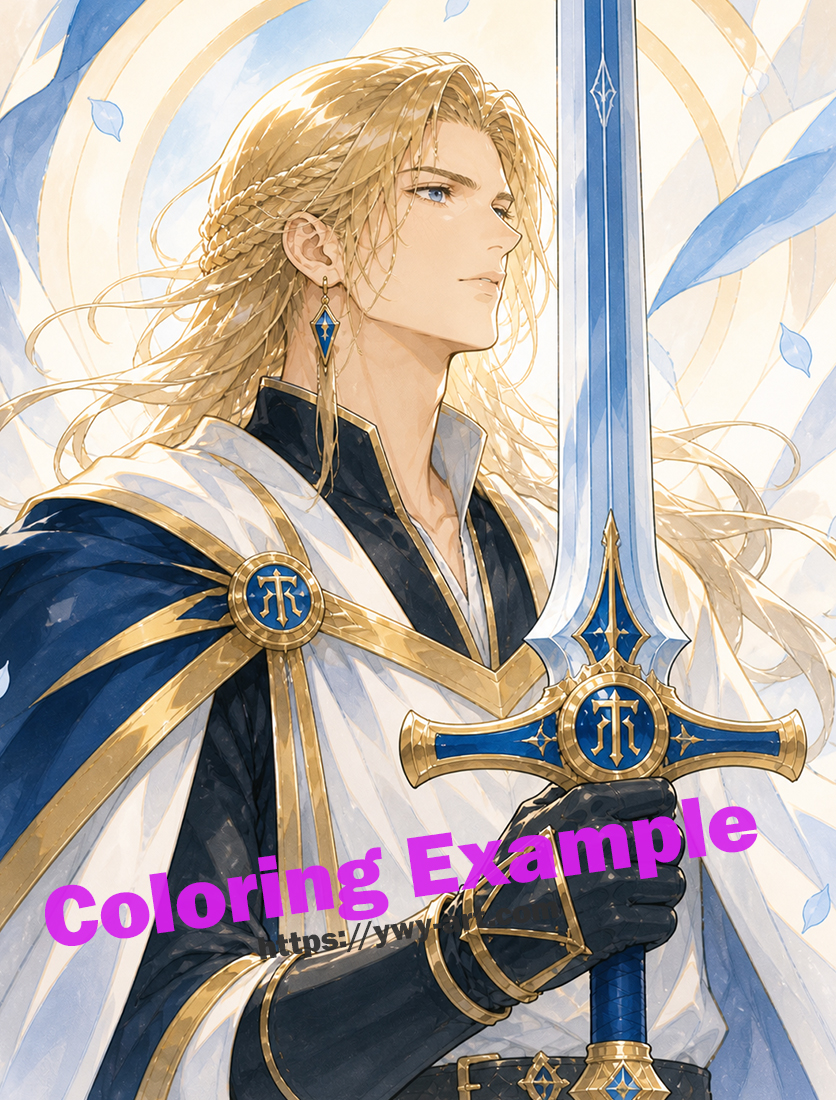
This page works well with a noble and restrained palette. Silver, steel gray, ivory, muted gold, pale blue, dark navy, and soft beige can create a solemn oath-bound atmosphere. The Oath Blade should remain the clearest focus, so the metal needs sharp highlights and darker edge shadows.
For the blade, cool silver or polished steel will work beautifully. Adding a thin line of pale blue or white along the edge can make it feel sacred and sharp. The central emblem near the guard can use deep blue, teal, or muted gold to give the sword a mythic identity.
Tyr’s clothing can stay in white, gray, dark blue, or charcoal. This restrained color range suits his lawful and serious character. Gold trim should be used carefully, as small accents rather than broad decoration, so the image does not become too luxurious.
The gloves and armor can be colored in black leather, dark steel, or deep brown. If you want to emphasize the oath theme, the hand holding the sword should remain readable and strong. The grip is important because it shows commitment, not just style.
The background can stay bright but controlled. Soft sunlight, pale clouds, and faint circular patterns will support the sacred feeling without competing with the blade. The key is clarity. Tyr’s artifact should feel like a line of truth cutting through a quiet sky.
Quick Creative Reference
| Element | Creative Direction |
|---|---|
| Best For | Norse oath symbolism, honorable warrior themes, justice, sacrifice, solemn heroic portraits |
| Visual Keywords | Tyr, Oath Blade, sword, vow, Fenrir, severed hand, law, sacrifice |
| Mood | Solemn, noble, restrained, painful, honorable, sacred |
| Recommended Colors | Silver, steel gray, ivory, muted gold, pale blue, dark navy, charcoal, soft beige |
| Main Focus | The blade as a symbol of sacred oaths, justice, sacrifice, and the cost of keeping order |
| Coloring Tip | Keep the sword edge bright and clean, while using softer tones around the figure to make the Oath Blade feel absolute. |
Compare with Similar Deities
| Name | Mythology | Main Domains | Overall Image |
|---|---|---|---|
| Tyr | Norse | War, law, oaths, courage, sacrifice, justice | A solemn god of duty whose courage is shown through sacrifice and the painful keeping of order |
| Odin | Norse | Wisdom, war, magic, kingship, sacrifice, prophecy | A complex ruler and seeker of knowledge whose sacrifices serve power, fate, and cosmic understanding |
| Thor | Norse | Thunder, strength, protection, storms, giants | A direct and protective storm god whose strength defends gods and humans through force |
| Themis | Greek | Divine order, law, justice, prophecy, balance | An ancient goddess of sacred law and cosmic order, more impartial and judicial than warrior-like |
Closing
Tyr Oath Blade is a strong artifact piece because it makes honor feel sharp, not easy. The sword is beautiful, but it carries the weight of promises, sacrifice, and the moment when someone must stand in for everyone else. Tyr’s myth reminds us that justice is not always clean and courage is not always rewarded. Sometimes the blade stays bright because someone else has already paid the price.
Step into the world of mythology..
Available on Amazon Mythology Artifacts Series: Symbols of Power Coloring Book Open in a new tab




コメント