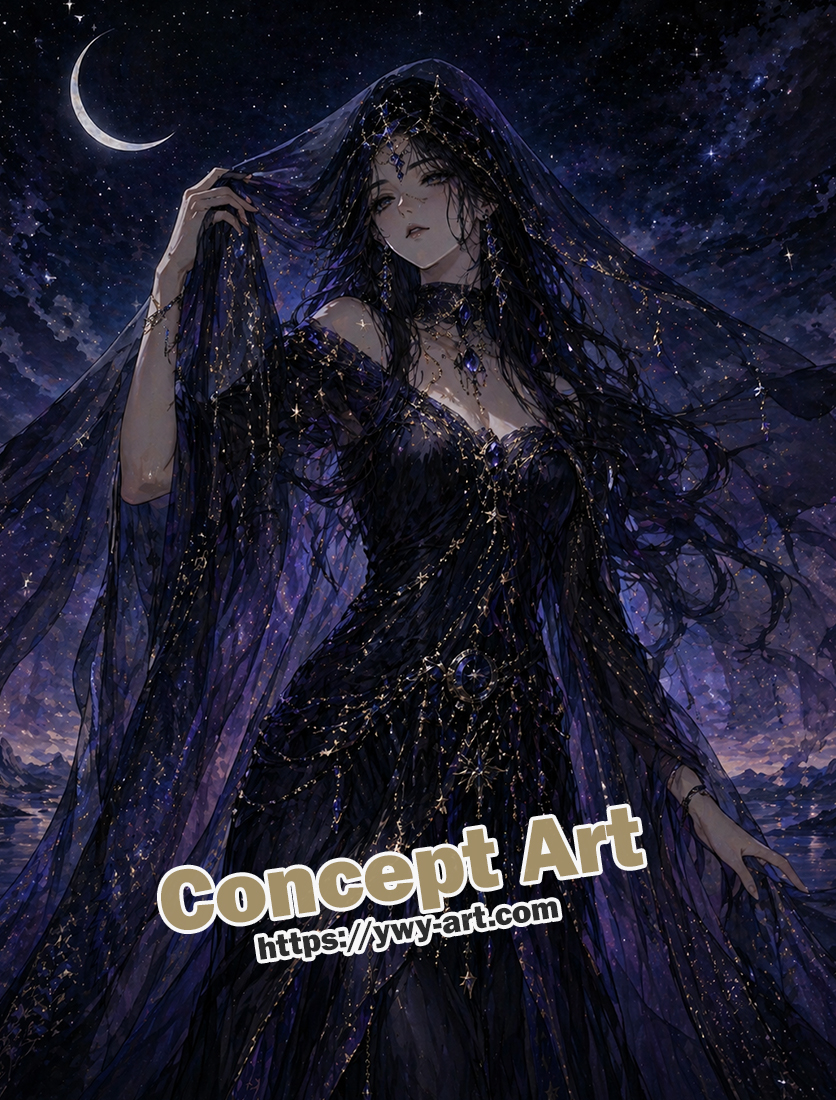
Nyx Night Veil
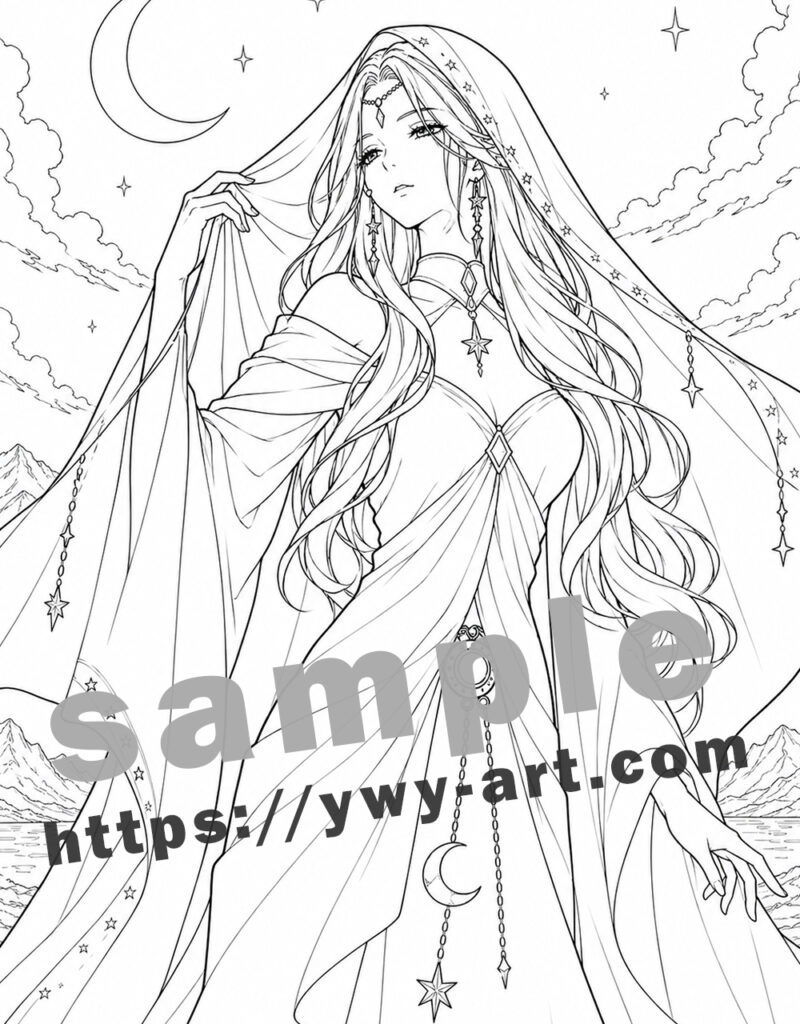
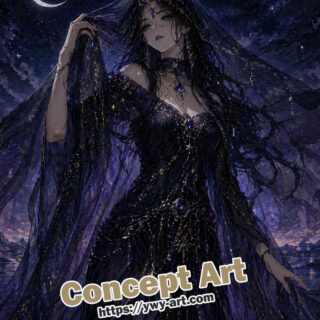
Nyx is not simply a goddess who appears after sunset. She is Night itself — ancient, vast, and older than the Olympian order. In this illustration, the Night Veil spreads around her like a living sky, filled with stars, crescent light, and deep violet darkness. It feels beautiful, but also strangely untouchable. Honestly, this one has a quiet cosmic fear to it, and I really like that. Nyx does not look like she is trying to rule the night. She is the night.
Basic Profile
| Name | Nyx |
|---|---|
| Mythology | Greek Mythology |
| Gender | Female |
| Region | Primordial Greek cosmos, especially the realm of night, darkness, and the unseen |
| Era | Primordial age before the full Olympian order |
| Domain | Night, darkness, mystery, sleep, death, fate, hidden cosmic forces |
| Symbol | Night veil, stars, crescent moon, dark wings, mist, shadow, celestial ornaments |
| Culture / Religion | Ancient Greek myth and cosmology |
| Main Role | Primordial goddess and personification of Night |
| Associated Deity | Chaos, Erebus, Hemera, Aether, Hypnos, Thanatos, Moros, the Moirai |
| Common Depiction | A dark, majestic female figure surrounded by night, stars, wings, mist, or a flowing veil |
| Alignment | Ancient, mysterious, cosmic, powerful, distant, protective, and quietly terrifying |
Overview
Nyx belongs to the earliest layer of Greek mythology. She is not one of the Olympians, and that is important. Before Zeus, Athena, Apollo, or Artemis take their familiar places, there are older powers: Chaos, Night, Darkness, Day, Air, Earth, and the deep structures of existence itself. Nyx is part of that ancient cosmic generation.
In Hesiod’s Theogony, Nyx is born from Chaos and becomes one of the primordial forces of the universe. She is not just a character with a personal story. She is a condition of reality. Night exists before human cities, before heroic quests, before most divine drama. It covers everything.
That makes Nyx very different from a goddess such as Artemis or Hecate. Artemis moves through the night. Hecate stands at crossroads under the moon. But Nyx is the darkness they move within. She is the background force that allows stars, dreams, fear, secrecy, sleep, and hidden things to exist.
In this artwork, the Night Veil captures that idea beautifully. The veil is not just clothing. It feels like a piece of the sky itself, draped over her body and spreading into the surrounding darkness. The stars across the fabric make the artifact feel cosmic, as if Nyx is wearing the universe in its quietest form.
The Artifact: Night Veil
The Night Veil is a creative artifact built from Nyx’s identity as the personification of night. A veil naturally suggests concealment, mystery, distance, and sacred separation. It covers, but it also reveals in a different way. Under a veil, things are not gone. They are hidden, softened, and made harder to grasp.
For Nyx, the veil becomes more than fabric. It is the boundary between daylight understanding and nocturnal mystery. When the veil falls, the world changes. Colors weaken. Shapes blur. Sound becomes sharper. Fear and imagination grow stronger. The Night Veil represents that transformation.
The stars embroidered or scattered across the veil add another layer. Night is not empty blackness. It contains constellations, navigation, myth, and distant light. That is what makes Nyx so powerful visually. Her darkness is not nothingness. It is a vast field where hidden lights appear.
The crescent moon beside her strengthens the feeling of sacred night, but it should not be confused with Nyx herself. The moon is a light within night. Nyx is the condition that holds it. This distinction gives the artifact a deeper mythological weight. The veil does not imitate the moon; it surrounds it.
Mythological Background
Nyx is one of the most respected and quietly feared beings in Greek cosmology. In some traditions, even Zeus shows caution toward her. That detail matters. Zeus is the king of the gods, but Nyx belongs to an older order. Her authority does not come from a throne on Olympus. It comes from being part of the structure of the cosmos itself.
Nyx is also the mother of many powerful and abstract figures. Depending on the tradition, her children include Hypnos, the god of sleep; Thanatos, the personification of death; Moros, doom; Nemesis, retribution; Eris, strife; the Keres, spirits of violent death; and sometimes the Moirai, the Fates. This family tree is intense. Night gives birth not only to rest, but also to death, destiny, conflict, and unavoidable consequence.
That is one reason Nyx feels so much larger than a simple dark goddess. She is the mother of forces people cannot negotiate with easily. Sleep comes every night. Death comes eventually. Fate turns quietly. Strife enters human life again and again. These are not monsters outside the world. They are part of the world’s rhythm, and Nyx stands behind them.
At the same time, night is not only frightening. It is also protective. Night allows rest. It hides the wounded. It gives lovers privacy, travelers stars, and dreamers a world beyond the waking one. Nyx holds both fear and refuge. That duality gives her a beautiful complexity.
Symbolism and Meaning
The Night Veil represents concealment as power. In daylight, things are exposed. Under night, they become layered. A person can hide, dream, remember, grieve, or transform. Nyx’s veil does not destroy the world. It changes how the world is experienced.
The dark fabric can also symbolize the unknown. Humans often fear what they cannot see, but the unknown is not only danger. It is also possibility. Stars appear only because the sky becomes dark enough to reveal them. That is one of the strongest symbolic ideas in this piece: darkness can reveal what brightness hides.
The star ornaments across her dress and veil suggest fate and distance. Stars are beautiful, but unreachable. They guide sailors and inspire myths, yet they remain far beyond human control. Nyx carries that same feeling. She is close enough to cover the world every evening, but too vast to be possessed.
Her expression is calm, distant, and almost unreadable. That suits Nyx perfectly. She does not need rage or dramatic movement. A primordial goddess does not have to prove herself. Her silence is the point. The night arrives whether anyone welcomes it or not.
Coloring Notes
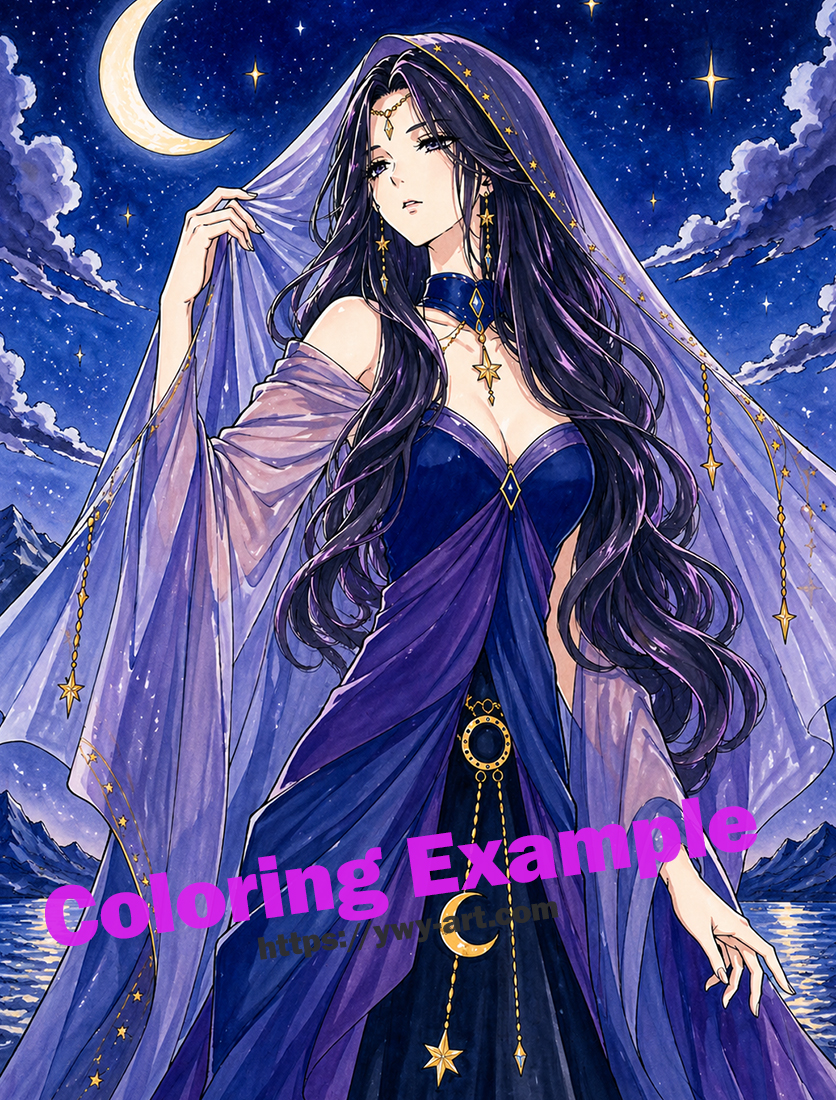
This page works best with a deep celestial palette. Black, indigo, violet, blue-purple, charcoal, silver, and pale moon white can create a strong night atmosphere. The veil should stay visually rich, so it helps to use layered dark colors rather than filling everything with flat black.
For the Night Veil, try building depth with dark navy, violet, and blue-gray. Small star details can be left white, silver, or pale gold. If the stars are too bright everywhere, the veil may become busy, so it may help to make only a few key stars shine strongly.
Nyx’s hair can blend with the night but should not completely disappear. Deep black with violet highlights, dark blue-black, or soft purple undertones can keep it readable. The areas near the face can be slightly lighter so her expression remains visible.
Her skin can stay pale and cool, almost moonlit. Soft gray-violet shadows will match the night setting better than warm orange shadows. The jewelry can use silver, dark gold, or blue gemstones to connect with the celestial theme.
The background sky should support the figure without overpowering her. Deep gradients from navy to black, with a few brighter stars and the crescent moon, will keep the scene quiet and cosmic. The key is restraint. Nyx is powerful because the darkness feels endless, not because every part of the page is equally bright.
Quick Creative Reference
| Element | Creative Direction |
|---|---|
| Best For | Primordial mythology, celestial darkness, night goddess themes, cosmic fantasy portraits |
| Visual Keywords | Nyx, night veil, stars, crescent moon, darkness, primordial goddess, cosmic fabric |
| Mood | Ancient, quiet, mysterious, vast, elegant, slightly terrifying |
| Recommended Colors | Black, indigo, deep violet, navy, charcoal, silver, pale moon white, blue-gray |
| Main Focus | The veil as a symbol of night, mystery, concealment, and cosmic depth |
| Coloring Tip | Layer several dark blues and violets in the veil instead of using flat black, then reserve the brightest highlights for selected stars and moonlit edges. |
Compare with Similar Deities
| Name | Mythology | Main Domains | Overall Image |
|---|---|---|---|
| Nyx | Greek | Night, darkness, primordial mystery, sleep, death, fate | A vast primordial goddess whose darkness holds stars, dreams, fear, and destiny |
| Erebus | Greek | Darkness, shadow, the deep gloom between worlds | A primordial darkness figure, more abstract and shadow-like than the star-filled presence of Nyx |
| Selene | Greek | Moon, night sky, lunar radiance | A luminous moon goddess who shines within night rather than embodying night itself |
| Nótt | Norse | Night, darkness, cosmic cycle | A Norse personification of night, often imagined as riding across the sky in the natural rhythm of time |
Closing
Nyx Night Veil is a strong artifact piece because it turns darkness into something sacred, not empty. The veil hides the world, but it also reveals stars, dreams, and the quiet forces people cannot fully name. Nyx does not need a weapon to feel powerful. She wears the night itself, and that is enough. The whole image feels calm on the surface, but underneath it is the weight of something older than the gods.
Step into the world of mythology..
Available on Amazon Mythology Artifacts Series: Symbols of Power Coloring Book Open in a new tab
コメント