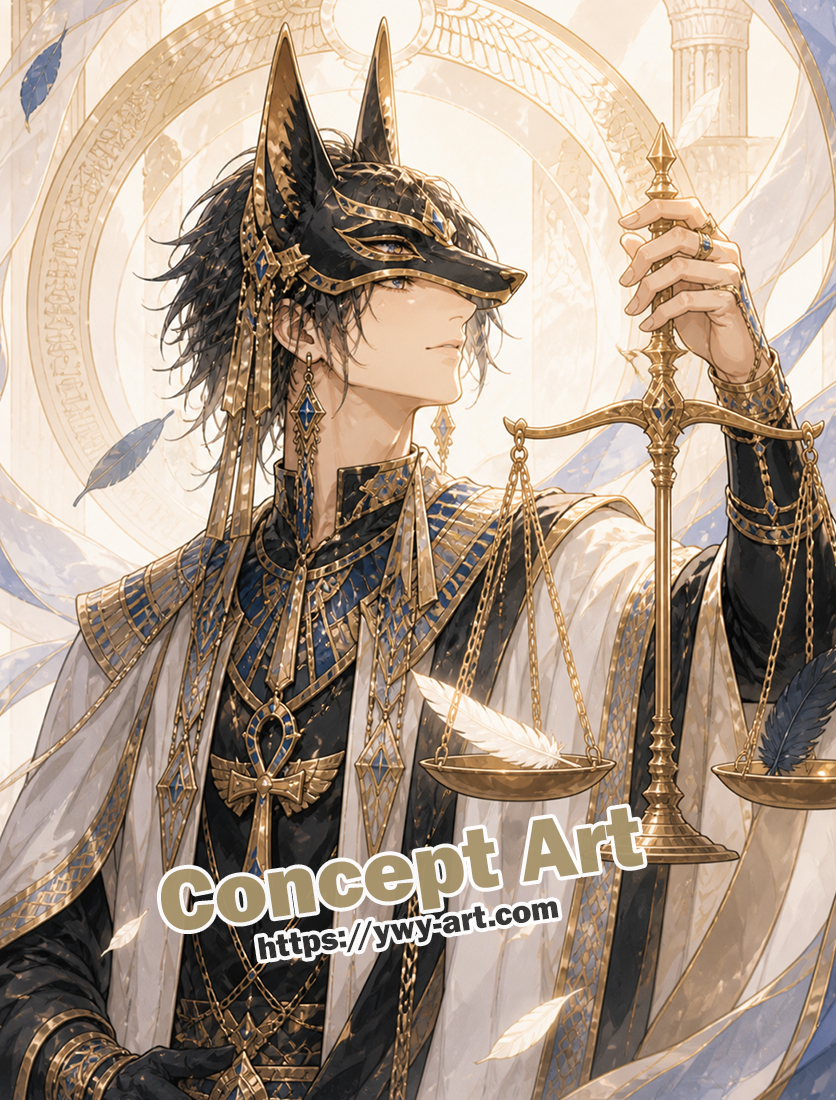
Anubis Weighing Feather
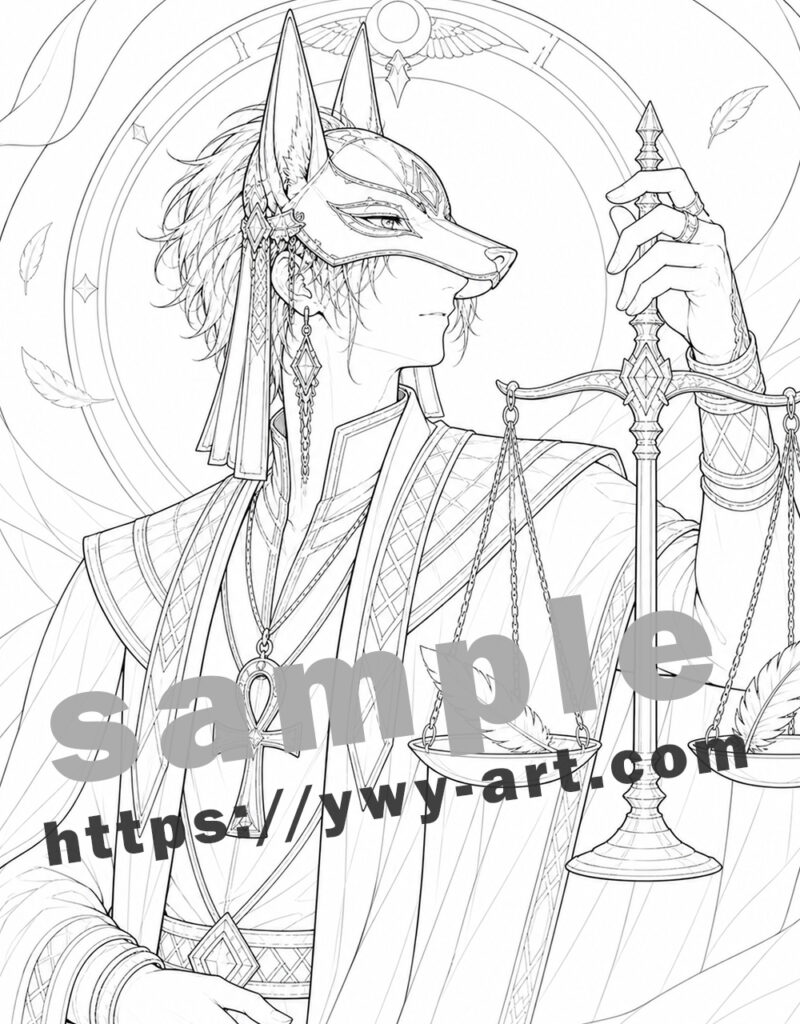
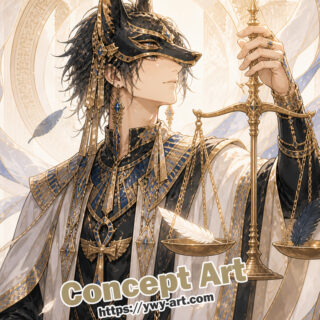
Anubis is not just a dark figure standing near tombs. He is the guide at the most serious doorway of all: the passage between life, death, and judgment. In this illustration, the Weighing Feather becomes the central artifact, balanced on the scales beside a dark feather and sacred Egyptian symbols. It feels calm, almost ceremonial, but honestly, there is a real chill underneath it. Anubis does not threaten the soul. He measures it, and that somehow feels even heavier.
Basic Profile
| Name | Anubis |
|---|---|
| Mythology | Egyptian Mythology |
| Gender | Male |
| Region | Ancient Egypt, especially tombs, necropolises, embalming places, and the Hall of Judgment |
| Era | Ancient Egyptian religious tradition, from early dynastic periods through later temple and funerary belief |
| Domain | Embalming, mummification, graves, funerary rites, protection of the dead, guidance of souls, judgment |
| Symbol | Jackal, scales, feather of Ma’at, ankh, embalming tools, black mask, tomb guardianship |
| Culture / Religion | Ancient Egyptian religion |
| Main Role | Guardian and guide of the dead, especially in embalming and the weighing of the heart |
| Associated Deity | Osiris, Ma’at, Thoth, Isis, Nephthys, Ammit, Horus |
| Common Depiction | A jackal-headed god or black jackal figure, often shown near mummies, tombs, or judgment scales |
| Alignment | Solemn, protective, precise, funerary, watchful, and deeply connected to sacred transition |
Overview
Anubis is one of the most recognizable gods of ancient Egypt. With his jackal head, dark coloring, and close connection to tombs, he immediately carries the atmosphere of death. But his role is not simply frightening. Anubis is a protector, a guide, and a sacred specialist of the dead. He does not only stand at the end of life. He helps the soul pass through what comes next.
In Egyptian belief, death was not treated as a simple disappearance. It was a dangerous transition that required ritual, preservation, protection, and truth. The body had to be prepared. The tomb had to be guarded. The soul had to face judgment. Anubis belongs to this entire process, especially the careful handling of the body and the weighing of the heart.
His connection to mummification is especially important. Anubis is often associated with embalming and the protection of the corpse, helping ensure that the dead person could continue into the afterlife properly. This gives him a practical sacred role. He is not only symbolic. He is tied to ritual work, preparation, and the idea that even death must be handled with skill.
In this artwork, the scales and feather bring Anubis into the moment of judgment. The composition feels bright and formal, almost like a sacred courtroom. The feather rests lightly, but its meaning is enormous. A whole life may be weighed against that delicate object.
The Artifact: Weighing Feather
The Weighing Feather is based on the feather of Ma’at, the Egyptian principle and goddess of truth, justice, balance, cosmic order, and rightness. In the famous judgment scene, the heart of the deceased is weighed against the feather of Ma’at. If the heart is balanced and not heavier than the feather, the soul may continue into the afterlife. If it fails, the result is terrifying.
This makes the feather one of the most powerful judgment symbols in world mythology. It is not heavy, sharp, or violent. It is almost impossibly light. That is the point. The soul is not measured against a weapon or a crown. It is measured against truth.
In many depictions, Anubis oversees the weighing, adjusting the scales or guiding the deceased through the process. Thoth may record the result, while Ammit waits nearby to devour the unworthy heart. Osiris may preside as lord of the dead. Each figure has a role, but Anubis is the one closest to the act of measurement.
The feather in this illustration becomes more than a small ritual object. It is the visible form of cosmic order. The scales, the staff-like structure, and the bright background all make the artifact feel ceremonial and exact. Nothing about this judgment feels random. That is what makes it powerful.
Mythological Background
Anubis has deep roots in Egyptian religion. In earlier periods, he was one of the most important gods of the dead, and later, as Osiris became more central to afterlife theology, Anubis remained essential as embalmer, guardian, and guide. His role shifted, but it did not disappear.
The jackal form is meaningful. Jackals were associated with desert edges and burial grounds, places where the living world met the realm of the dead. By giving this form to a god, Egyptian religion transforms a feared scavenger image into a divine guardian. Anubis does not desecrate the dead. He protects them from desecration.
In the Osiris myth, Anubis is often connected to the preparation of Osiris’ body after his death and dismemberment. This association makes Anubis a sacred embalmer, someone who helps restore the dead body into a form suitable for rebirth and afterlife. It also ties him to one of Egypt’s central religious hopes: that death can be ritually transformed into continuation.
The weighing of the heart appears most famously in funerary texts and tomb imagery. The heart was especially important because Egyptians saw it as the seat of thought, memory, emotion, and moral identity. The heart could testify for or against a person. That is such a strong idea. You do not merely bring your name into the afterlife. You bring the weight of what you have lived.
Ma’at is essential to this judgment. She is not only “truth” in a narrow sense. She represents the balanced order that keeps the universe from collapsing into chaos. To live in accordance with Ma’at is to live rightly within the cosmic pattern. The feather therefore measures not just personal innocence, but alignment with order itself.
Symbolism and Meaning
The Weighing Feather represents truth as a standard no one can bargain with. A feather looks fragile, but in this mythic setting it becomes absolute. Gold, power, status, and excuses do not matter. The heart is weighed, and the result speaks.
The scales symbolize balance, but Egyptian judgment is not cold bureaucracy. It is moral and cosmic. The question is not only “Did you break a rule?” It is closer to “Did your life disturb the balance of the world, or did you live in harmony with truth?” That gives the artifact a much deeper feeling.
Anubis’ mask-like jackal form adds solemnity to the scene. He is not emotional in a human way. He does not look angry or soft. He looks precise. That precision is important because judgment cannot depend on mood. It must be measured carefully.
The white feather and dark feather in the scales can create a strong visual contrast. One side may suggest purity, truth, and cosmic light. The other may suggest shadow, hidden actions, or the weight that follows the soul. The image does not need to explain the verdict directly. The balance itself creates the tension.
The ankh and Egyptian ornaments around Anubis also deepen the meaning. The ankh is often associated with life, which creates an interesting contrast beside judgment of the dead. In Egyptian thought, death and life are not completely separate. The afterlife is another form of continuation, but only if the passage is properly made.
Coloring Notes
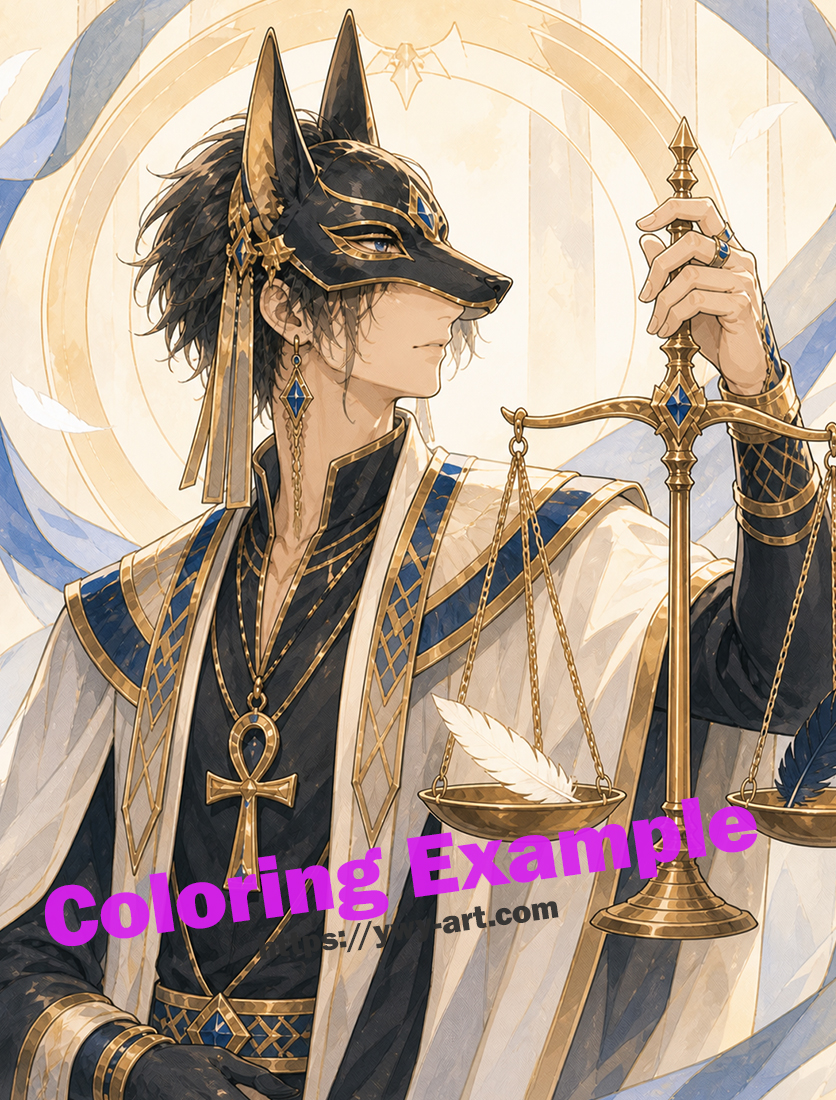
This page works beautifully with a refined Egyptian palette. Antique gold, ivory, lapis blue, black, warm sand, pearl white, and soft gray can create a sacred funerary atmosphere. The scales should remain the main focus, so the chains, bowls, and feather shapes need clean contrast.
For Anubis’ mask and clothing, black with blue undertones can work very well. Pure flat black may hide too much detail, so using dark navy, charcoal, or blue-black shadows will keep the form readable. Gold accents along the mask, collar, and jewelry will bring out the Egyptian design.
The feather of Ma’at can stay white, ivory, or pale gold. If you want it to feel sacred, leave the center bright and add soft gray or cream shadows along the edges. The darker feather on the opposite scale can use deep blue, charcoal, or black-gray so the contrast remains clear.
The scales can be colored in antique gold or polished bronze. Small highlights on the chain links will make the delicate structure easier to read. The central staff and crossbar should have enough contrast so the viewer immediately understands the weighing action.
Background cloth, halos, or temple-like patterns can stay light: cream, pale blue, sand, or soft gray. This keeps the scene ceremonial rather than too dark. The key is balance. Let Anubis feel solemn, let the gold feel sacred, and let the feather remain visually light but symbolically heavy.
Quick Creative Reference
| Element | Creative Direction |
|---|---|
| Best For | Egyptian afterlife themes, judgment scenes, sacred balance, funerary symbolism, moral mythology |
| Visual Keywords | Anubis, Weighing Feather, Ma’at, scales, heart judgment, jackal mask, afterlife |
| Mood | Solemn, sacred, precise, mysterious, ceremonial, quietly intense |
| Recommended Colors | Antique gold, ivory, lapis blue, black, warm sand, pearl white, charcoal gray |
| Main Focus | The feather and scales as symbols of truth, moral weight, and passage into the afterlife |
| Coloring Tip | Keep the feather light and the scale chains clearly highlighted so the judgment scene remains readable at first glance. |
Compare with Similar Deities
| Name | Mythology | Main Domains | Overall Image |
|---|---|---|---|
| Anubis | Egyptian | Embalming, graves, protection of the dead, judgment guidance | A solemn jackal-headed guide who protects the dead and oversees the weighing of the heart |
| Ma’at | Egyptian | Truth, cosmic order, justice, balance, rightness | The principle and goddess of truth whose feather becomes the standard of judgment |
| Osiris | Egyptian | Afterlife, resurrection, kingship, fertility, judgment of the dead | The lord of the dead who presides over the afterlife and the hope of rebirth |
| Hermes | Greek | Messages, travel, boundaries, guidance of souls | A messenger and psychopomp who guides souls, but with a lighter and more mobile character than Anubis |
Closing
Anubis Weighing Feather is a strong artifact piece because it makes judgment feel quiet instead of dramatic. There is no battlefield here, no roaring monster, no thunderbolt. Just a feather, a scale, and the weight of a life. That is what makes it powerful. Anubis stands at the threshold, not to frighten the soul, but to guide it toward the moment when truth becomes measurable.
Step into the world of mythology..
Available on Amazon Mythology Artifacts Series: Symbols of Power Coloring Book Open in a new tab




コメント