Demeter Harvest Sickle
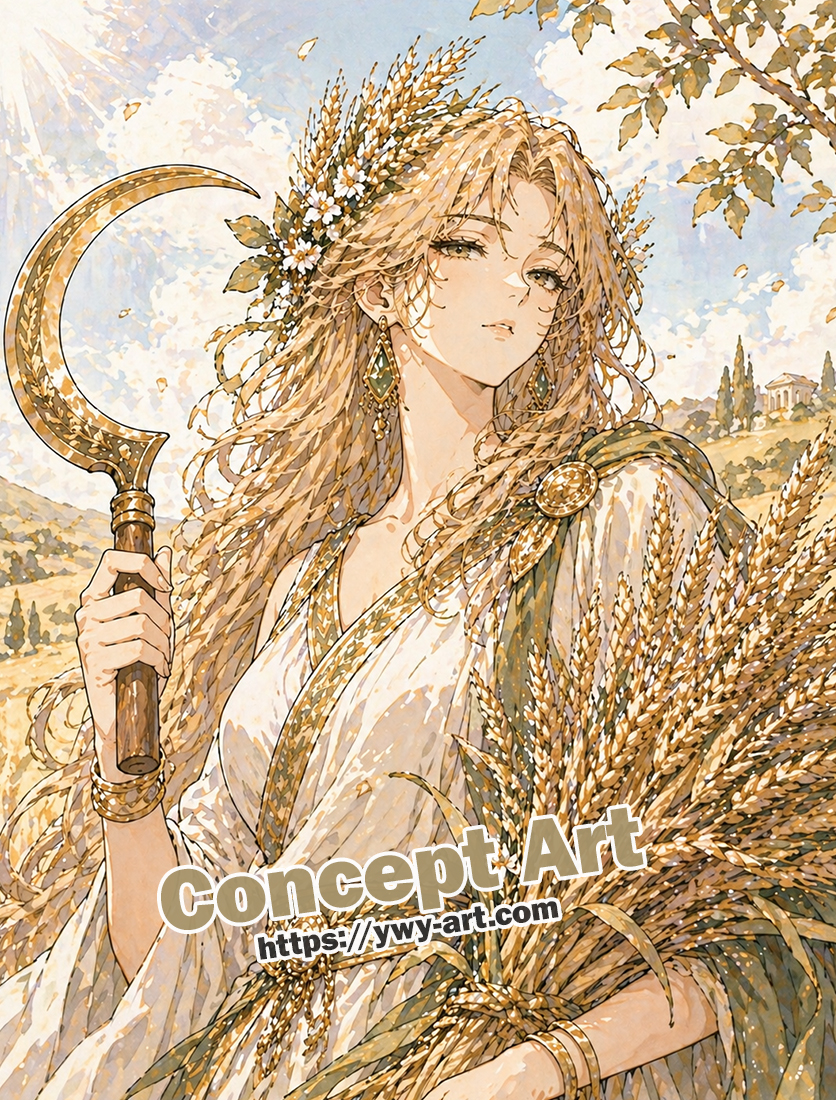
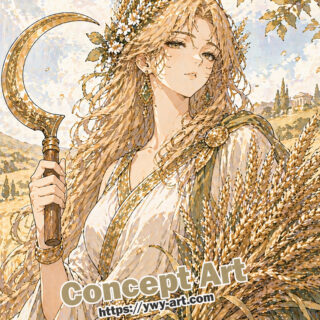
Demeter may look gentle at first, surrounded by wheat, sunlight, and open fields, but her mythology is much heavier than a simple harvest image. She is the goddess of grain, agriculture, motherhood, nourishment, and the painful bond between loss and return. In this illustration, the Harvest Sickle becomes the central artifact, held beside golden wheat under a soft sky. It feels peaceful, yes, but honestly, there is something quietly heartbreaking underneath it. Demeter’s power is not only about abundance. It is also about what happens when abundance is taken away.
Basic Profile
| Name | Demeter |
|---|---|
| Mythology | Greek Mythology |
| Gender | Female |
| Region | Ancient Greece, especially fields, farmlands, sacred groves, and Eleusis |
| Era | Ancient Greek mythic age |
| Domain | Agriculture, grain, harvest, fertility, motherhood, sacred law, seasonal cycles |
| Symbol | Wheat, sickle, torch, cornucopia, poppy, barley, bread |
| Culture / Religion | Ancient Greek religion |
| Main Role | Goddess of agriculture and the life-giving harvest |
| Associated Deity | Persephone, Hades, Zeus, Triptolemus, Iasion, Hecate |
| Common Depiction | A mature goddess holding wheat, a torch, a sickle, or a cornucopia, often connected with fields and seasonal abundance |
| Alignment | Nurturing, sorrowful, powerful, fertile, protective, and deeply tied to the rhythm of life and loss |
Overview
Demeter is one of the most important goddesses in Greek mythology because she rules over something humans cannot live without: food. Grain, bread, cultivated fields, and the harvest all belong to her world. Her power is not flashy like lightning or dramatic like the sea, but it is fundamental. Without Demeter’s blessing, kingdoms do not simply become poor. They starve.
That makes her a very different kind of divine figure. Demeter’s strength is rooted in growth, patience, and repetition. Seeds are planted. Rain falls. Fields ripen. Wheat is cut. Bread is made. Life continues. This cycle may look ordinary from the outside, but ancient people understood how sacred it was. A failed harvest could change everything.
Her most famous myth is the abduction of Persephone by Hades. When Demeter loses her daughter, her grief becomes cosmic. She refuses to let the earth bear fruit, and the world begins to wither. This is one of the strongest emotional stories in Greek mythology because it connects a mother’s sorrow with the changing of the seasons. Winter is not only cold weather. It becomes the visible shape of Demeter’s mourning.
In this artwork, the Harvest Sickle captures both sides of her identity. It is a tool of abundance, used to gather grain. But it is also a blade, and that gives it a more serious feeling. Harvest means life, but it also means cutting. Demeter’s mythology lives in that tension: growth and separation, nourishment and grief, return and waiting.
The Artifact: Harvest Sickle
The Harvest Sickle is a natural artifact for Demeter because it represents the moment when cultivated life becomes food. Wheat standing in the field is promise. Wheat cut by the sickle becomes harvest. That simple transformation is one of the oldest and most important human rituals.
A sickle is not a weapon in the usual heroic sense, but it still has power. It marks the boundary between growth and gathering. It cuts, but the cutting is necessary. That makes it different from a sword. A sword often ends life in conflict. A sickle cuts in order to sustain life. For Demeter, that distinction matters.
The curved shape of the sickle also carries symbolic weight. It echoes the cycle of seasons, the curve of the moon, and the repeated rhythm of agricultural life. Planting and harvest return again and again. Joy and grief also return. Demeter’s sickle is not about one single dramatic victory. It is about the recurring labor that keeps the world alive.
In this illustration, the golden sickle is held beside bundles of wheat, making the artifact feel both practical and sacred. It does not float above the scene like a distant magical object. It belongs in the hand. That grounded feeling fits Demeter beautifully. Her divinity is close to soil, bread, sweat, and family.
Mythological Background
The central myth of Demeter and Persephone explains the cycle of the seasons. Persephone is taken to the underworld by Hades, and Demeter searches for her in grief. During that search, she neglects the earth, and crops stop growing. The gods eventually intervene because humanity cannot survive without grain.
Persephone’s return is not complete, however. Because she has eaten pomegranate seeds in the underworld, she must spend part of the year below with Hades and part of the year above with Demeter. When Persephone returns, Demeter’s joy brings growth back to the earth. When she descends again, Demeter mourns, and the land becomes barren or quiet.
This myth is powerful because it does not treat nature as a machine. It gives the seasons emotion. Spring becomes reunion. Winter becomes absence. Harvest becomes the fragile gift of a world that can bloom again, but only after loss has been endured.
Demeter is also deeply connected to the Eleusinian Mysteries, one of the most famous religious traditions of ancient Greece. These secret rites were linked to Demeter, Persephone, death, rebirth, and the hope that human life might have a deeper pattern beyond ordinary suffering. The exact details were kept hidden, but the emotional core seems clear: descent is not always the end, and return may still be possible.
Symbolism and Meaning
The Harvest Sickle represents nourishment through labor. It reminds us that abundance does not arrive without effort. Fields must be prepared, seeds must be planted, and the harvest must be gathered at the right time. Demeter’s power is generous, but it is not effortless.
The wheat in the image symbolizes life, food, prosperity, and continuity. Grain is small, but civilization grows around it. Bread feeds families, armies, cities, and temples. In that sense, Demeter’s wheat is not only a plant. It is the foundation beneath human society.
The sickle also carries the idea of necessary endings. To harvest, something must be cut. That can feel harsh, but it is part of the cycle. Demeter’s myth teaches that life is not a straight line of constant growth. It includes absence, waiting, cutting, storing, and returning.
Her expression in the artwork is calm, but not empty. She feels distant, almost tired, as if she carries both the warmth of harvest and the memory of loss. That makes the piece stronger. It is not only a pretty field scene. It has emotional weight under the gold.
Coloring Notes
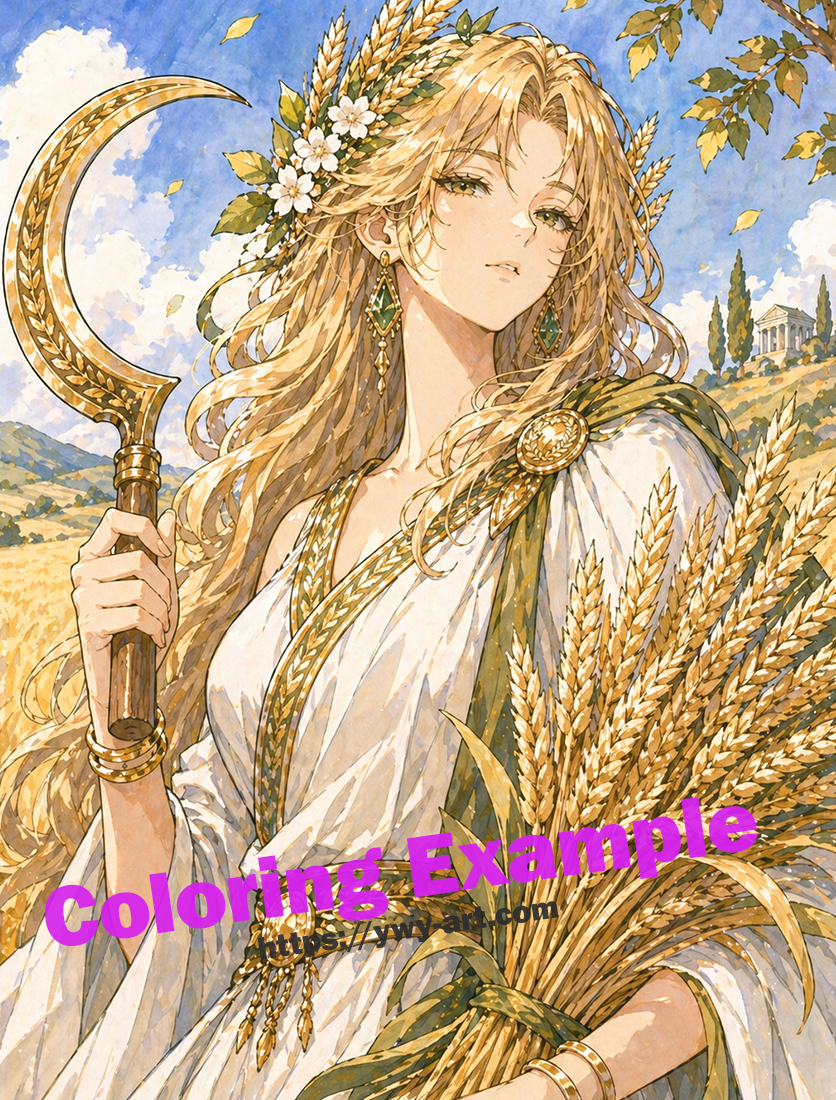
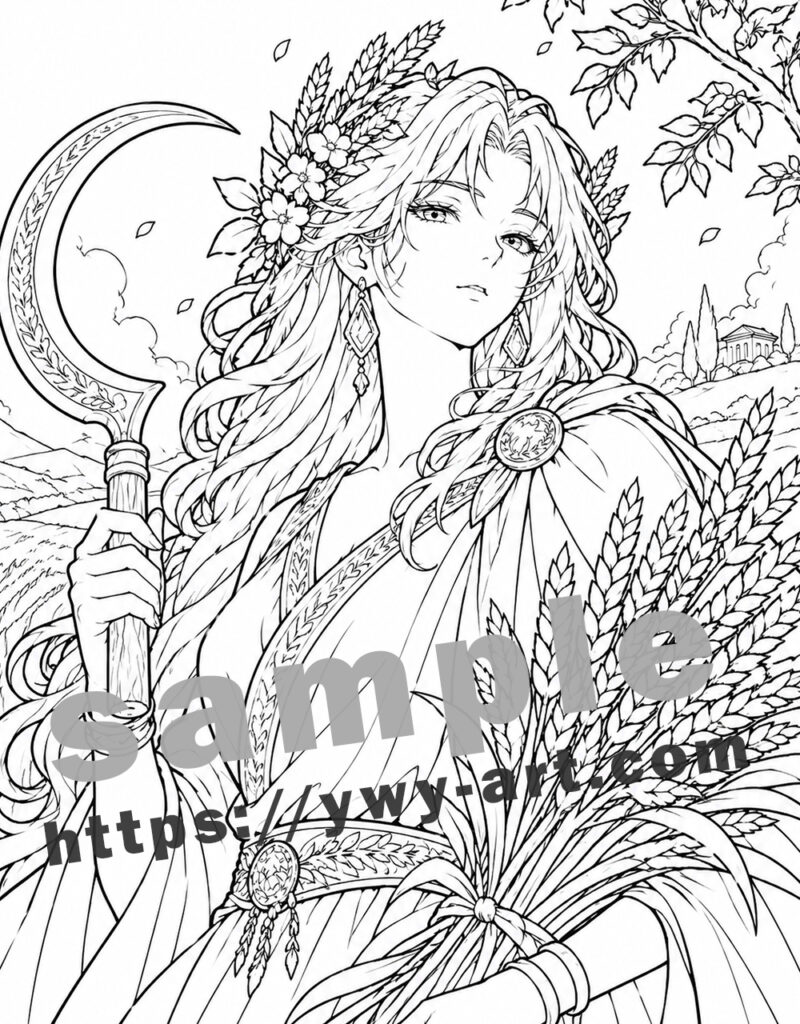
This page works beautifully with warm harvest colors. Golden yellow, wheat brown, olive green, cream, soft white, and pale sky blue can create a bright agricultural atmosphere. The wheat should probably carry the richest golden tones, while Demeter’s clothing can stay lighter to keep the image open and gentle.
For the Harvest Sickle, antique gold or warm bronze will work well. Adding slightly darker brown shadows along the inner curve can help the blade feel solid without making it too harsh. A few bright highlights on the outer edge will keep the artifact readable against the pale background.
The wheat bundle is a strong secondary focus. Try using several related tones instead of one flat yellow: pale straw, ochre, honey, and light brown. This will make the grain heads feel layered and natural. The leaves can lean olive green or muted yellow-green to balance the warmth.
Demeter’s hair can be colored in blonde, honey gold, soft brown, or wheat-like tones. If you want a more divine impression, leaving some near-white highlights in the hair will make it feel touched by sunlight. Her skin should stay warm and natural, with soft shadows rather than harsh contrast.
The background can remain airy. Pale blue sky, soft clouds, and distant fields will support the main subject without making the page too busy. The key is to let the sickle and wheat stand out as the symbolic center, while the rest of the scene feels like a world sustained by Demeter’s presence.
Quick Creative Reference
| Element | Creative Direction |
|---|---|
| Best For | Agricultural mythology, harvest themes, mother goddess imagery, seasonal symbolism |
| Visual Keywords | Demeter, harvest sickle, wheat, grain, golden field, fertility, seasons |
| Mood | Warm, fertile, gentle, sorrowful, sacred, quietly powerful |
| Recommended Colors | Golden yellow, wheat brown, olive green, cream, pale blue, antique gold, soft white |
| Main Focus | The sickle as a symbol of harvest, nourishment, seasonal cycles, and necessary transformation |
| Coloring Tip | Use varied wheat tones around the bundle and keep the sickle edge highlighted so the artifact stays clear. |
Compare with Similar Deities
| Name | Mythology | Main Domains | Overall Image |
|---|---|---|---|
| Demeter | Greek | Agriculture, grain, harvest, motherhood, seasons | A life-giving goddess whose grief and joy shape the fertility of the earth |
| Ceres | Roman | Grain, agriculture, motherhood, fertility | The Roman counterpart of Demeter, strongly associated with crops, bread, and cultivated life |
| Persephone | Greek | Spring, underworld, rebirth, seasonal return | Demeter’s daughter, whose descent and return explain the rhythm of growth and barrenness |
| Isis | Egyptian | Motherhood, magic, protection, renewal, fertility | A powerful mother goddess connected to restoration, protection, and sacred life force |
Closing
Demeter Harvest Sickle is a gentle-looking artifact piece, but it carries a deep mythological core. The sickle is not only a farming tool. It is the blade that turns growth into nourishment, promise into bread, and season into memory. Demeter’s power is warm, but it is not simple. She reminds us that life depends on cycles, and every harvest carries both gratitude and loss.
Step into the world of mythology..
Available on Amazon Mythology Artifacts Series: Symbols of Power Coloring Book Open in a new tab




























コメント