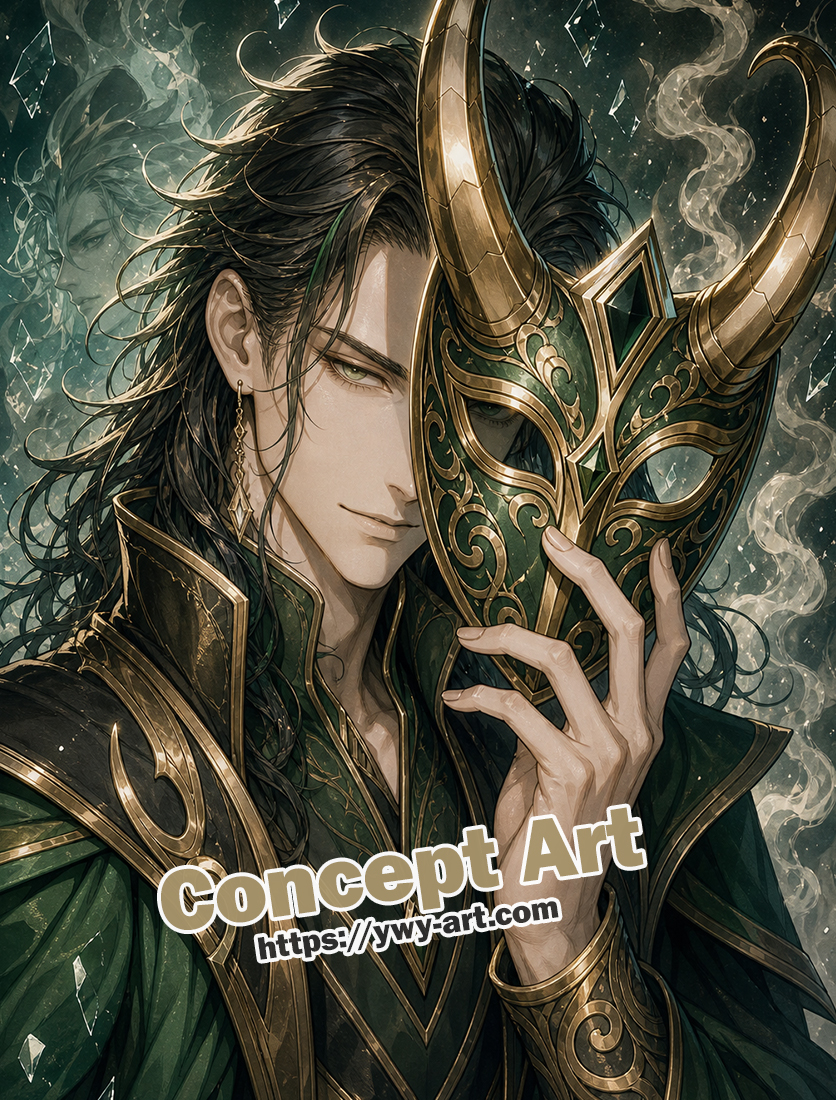
Loki Trickster Mask
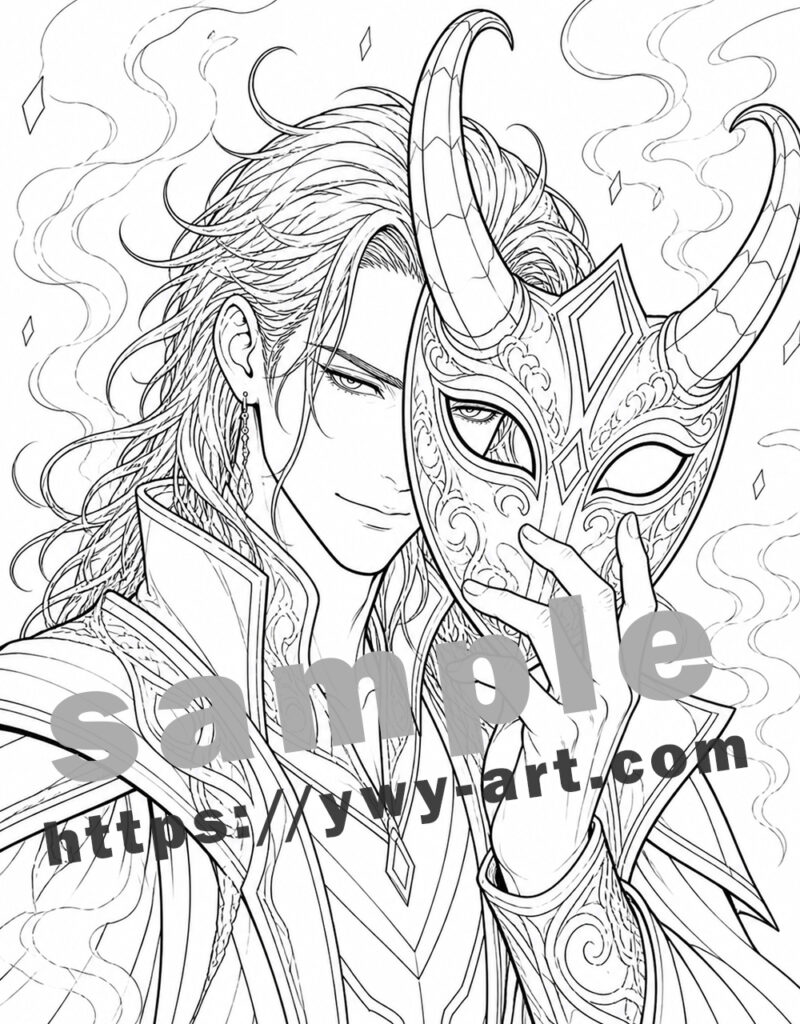
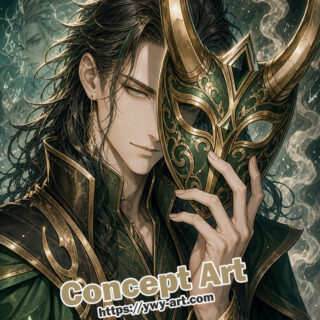
Loki is one of those mythological figures who refuses to stay in one clear category. He is a helper, a liar, a troublemaker, a shape-shifter, a father of monsters, and sometimes the reason the gods survive a disaster he helped create. In this illustration, the Trickster Mask becomes the central artifact, held between Loki’s face and the viewer like a beautiful warning. It looks elegant, but honestly, it also feels dangerous in a very quiet way. With Loki, the mask is never just decoration. It is the question of which face is real.
Basic Profile
| Name | Loki |
|---|---|
| Mythology | Norse Mythology |
| Gender | Male, though Loki frequently crosses forms and boundaries in myth |
| Region | Norse mythic world, especially Asgard, Jötunheimr, and liminal spaces between gods and giants |
| Era | Viking Age mythic tradition and earlier Germanic storytelling layers |
| Domain | Trickery, transformation, chaos, cleverness, deception, boundary-crossing, disruption |
| Symbol | Mask, serpent, flame, shapeshifting forms, knots, green and gold motifs, hidden face |
| Culture / Religion | Norse mythology |
| Main Role | Trickster figure whose actions both help and endanger the gods |
| Associated Deity | Odin, Thor, Sigyn, Angrboda, Hel, Fenrir, Jörmungandr, Baldr |
| Common Depiction | A clever and unpredictable figure, often imagined with sharp features, elegant clothing, serpentine motifs, or a masked presence |
| Alignment | Unstable, clever, seductive, dangerous, creative, destructive, and impossible to fully trust |
Overview
Loki is one of the most fascinating figures in Norse mythology because he does not behave like a normal god. He lives among the Aesir, speaks with them, travels with them, and often helps them. At the same time, he brings trouble into their world again and again. He is not simply an enemy from outside. He is the problem inside the hall.
That makes Loki very different from a giant who attacks Asgard directly. Loki’s danger comes from intimacy. He knows the gods. He understands their pride, weaknesses, rules, and blind spots. He can joke with them, advise them, insult them, rescue them, and betray them. That flexibility is exactly what makes him so hard to control.
Loki is also a master of transformation. He changes shape in several myths, becoming animals and taking forms that break ordinary boundaries. This shape-shifting is not only a magical skill. It is the core of his identity. Loki is never fully fixed. He is movement between categories: god and giant, male and female, helper and destroyer, comic figure and cosmic threat.
In this artwork, the Trickster Mask captures that unstable identity beautifully. The mask covers part of the face, but it also reveals something. The horns, green tones, gold edges, and smoke-like atmosphere suggest hidden intention. Loki is not hiding because he is weak. He is hiding because uncertainty is his weapon.
The Artifact: Trickster Mask
The Trickster Mask is a creative artifact built from Loki’s strongest symbolic themes: deception, transformation, performance, hidden identity, and the shifting border between truth and lie. A mask is the perfect artifact for Loki because it is both concealment and expression. It hides the face, but it also creates a new one.
A mask does not only deceive others. It can also change the person who wears it. When someone puts on a mask, they may speak differently, move differently, or become brave enough to say what they normally hide. That is very Loki. His power is not just lying. It is changing the rules of the situation until everyone else is unsure what is happening.
The horned shape of the mask gives it a mythic and slightly monstrous feeling. It can suggest animal force, giant blood, or demonic theatricality, depending on how the viewer reads it. The green and gold colors fit Loki well because they feel elegant but poisonous, royal but unstable.
The mask is also linked to performance. Loki’s myths often feel like scenes where he plays a role: the helpful companion, the witty speaker, the disguised infiltrator, the mocker at the feast, the victim of punishment, or the father of disaster. The Trickster Mask gathers all of these roles into one object.
Mythological Background
Many of Loki’s stories begin with trouble and end with an unexpected solution. In the myth of Sif’s hair, Loki cuts off the golden hair of Thor’s wife, causing rage and danger. To repair the damage, he goes to the dwarves and causes the creation of several divine treasures, including Sif’s new hair, Odin’s spear Gungnir, Freyr’s ship Skíðblaðnir, and Thor’s hammer Mjölnir. Loki creates the problem, but he also becomes the route to a greater result.
That pattern appears often. Loki’s cleverness can save the gods, but it rarely comes without risk. He bargains, cheats, manipulates, and improvises. He is not the steady wisdom of Odin or the direct strength of Thor. Loki is the sideways path, the loophole, the answer nobody fully trusts but sometimes desperately needs.
His darker side becomes much more serious in the story of Baldr. Baldr is loved by the gods and protected from harm by oaths taken from nearly everything in the world. Loki discovers that mistletoe has been overlooked, and through deception, he causes Baldr’s death. This is not harmless mischief. It becomes one of the great turning points leading toward Ragnarök.
Loki is also the father of terrifying beings: Fenrir the wolf, Jörmungandr the World Serpent, and Hel, ruler of the realm of the dead. Through these children, Loki becomes connected not only with trickery, but with the forces that will eventually help destroy the divine order. His chaos is not temporary. It has descendants.
After Baldr’s death, Loki is punished terribly. He is bound beneath the earth, and venom drips onto him while his wife Sigyn catches what she can in a bowl. When she turns away to empty it, the venom strikes him, and his writhing causes earthquakes. This punishment transforms Loki from comic disruptor into a chained apocalyptic force waiting for release.
Symbolism and Meaning
The Trickster Mask represents identity as something unstable. Most divine artifacts show what a god rules: thunder, sea, fire, harvest, law. Loki’s mask shows something harder to hold. It shows the power of becoming someone else, saying one thing while meaning another, and making truth slippery.
The mask also symbolizes the danger of cleverness without loyalty. Intelligence itself is not evil. In fact, Loki’s cleverness saves the gods many times. But when cleverness is separated from trust, it becomes corrosive. It can solve today’s problem while creating tomorrow’s catastrophe.
The half-hidden face in the artwork is especially effective. Loki is not completely concealed. One eye, one expression, one hint of a smile remains visible. That partial reveal is more unsettling than a fully hidden face. It suggests that he wants to be seen, but only on his terms.
The smoke and green atmosphere around the mask can be read as illusion, magic, poison, or uncertainty. Nothing feels fully solid. That visual softness around a sharp artifact works well for Loki. His danger often begins as something amusing, beautiful, or clever before it turns into something much harder to escape.
The mask can also be read as a mirror. Loki exposes what others hide: pride, hypocrisy, desire, fear, and weakness. That may be why trickster figures are so uncomfortable. They lie, but they also reveal truths that polite order tries to ignore.
Coloring Notes
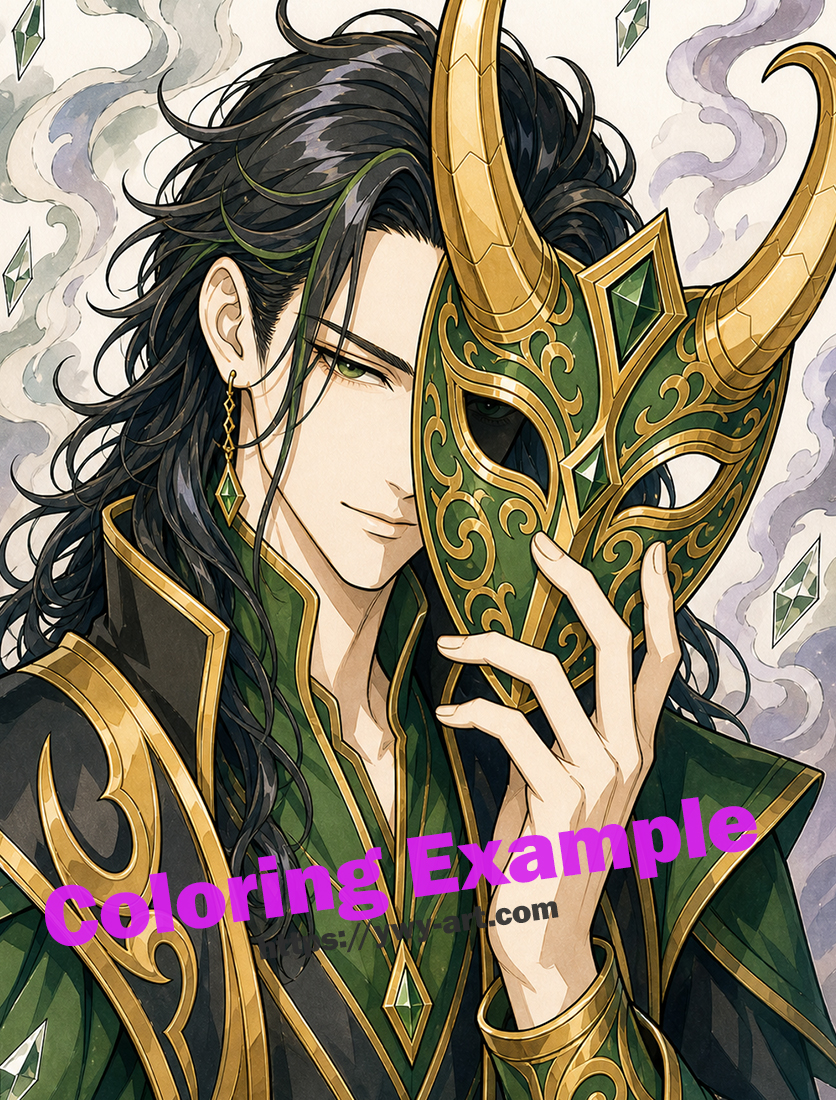
This page works beautifully with a dark green and antique gold palette. Deep emerald, black-green, muted gold, bronze, smoky gray, pale skin tones, and cold highlights can create a strong Loki atmosphere. The Trickster Mask should remain the main focus, so its edges and gemstones need clean contrast.
For the mask, dark green with gold trim will work especially well. The horned areas can be shaded with bronze, aged gold, or darker metallic tones. If the mask has gemstone details, emerald, black sapphire, or deep teal can add mystery without making the artifact too bright.
Loki’s clothing can use black, forest green, deep olive, and gold accents. These colors keep the design elegant but dangerous. His face should stay slightly lighter than the surrounding hair and mask so the half-revealed expression remains readable.
The smoke or mist in the background can be colored with gray-green, blue-gray, or muted teal. Keeping it soft will help the mask and hand stand out. The hand is important because it shows control: Loki is not trapped behind the mask. He is choosing how much of himself to reveal.
Small highlights on the gold edges will make the whole image feel sharper. But it is better not to brighten every ornament equally. Loki works best when the viewer’s eye moves between the mask, the visible eye, and the fingers holding the artifact.
Quick Creative Reference
| Element | Creative Direction |
|---|---|
| Best For | Trickster mythology, dark elegance, masked portraits, deception themes, shapeshifting symbolism |
| Visual Keywords | Loki, Trickster Mask, horns, green gold, smoke, hidden face, illusion, shapeshifter |
| Mood | Elegant, dangerous, clever, seductive, unstable, mysterious |
| Recommended Colors | Deep emerald, black-green, antique gold, bronze, smoky gray, muted teal, pale highlights |
| Main Focus | The mask as a symbol of deception, transformation, performance, and unstable identity |
| Coloring Tip | Keep the mask edges and visible eye sharply contrasted so the image feels controlled, secretive, and slightly threatening. |
Compare with Similar Figures
| Name | Mythology | Main Domains | Overall Image |
|---|---|---|---|
| Loki | Norse | Trickery, transformation, chaos, deception, boundary-crossing | A brilliant and dangerous trickster who helps, harms, and eventually helps unravel the divine order |
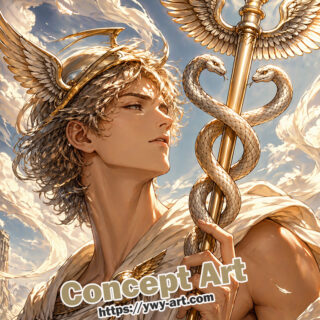
| Hermes | Greek | Messages, travel, trade, trickery, boundaries | A clever messenger god whose trickery is usually lighter, more mobile, and more integrated into divine order |
| Prometheus | Greek | Forethought, fire, rebellion, human progress | A Titan trickster-benefactor whose deception serves humanity and challenges divine authority |
| Anansi | West African / Akan | Stories, trickery, wisdom, survival, clever speech | A spider trickster figure who uses intelligence, language, and cunning to shift power in unexpected ways |
Closing
Loki Trickster Mask is a strong artifact piece because it turns deception into something visible. The mask is beautiful, sharp, and unsettling, just like Loki’s role in myth. It does not simply hide him. It shows how dangerous it can be when identity becomes flexible and truth becomes a tool. Loki’s power is not thunder, fire, or law. It is the smile behind the mask, and the moment you realize you may already be part of the trick.
Step into the world of mythology..
Available on Amazon Mythology Artifacts Series: Symbols of Power Coloring Book Open in a new tab
コメント