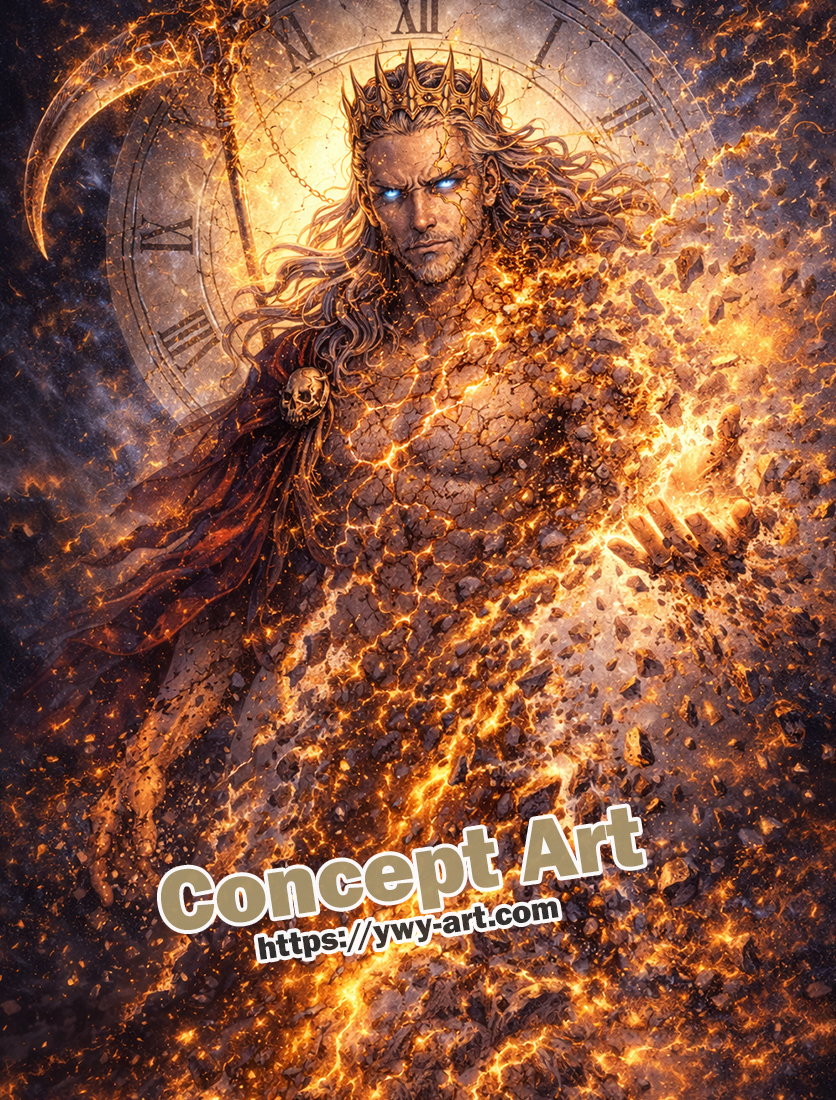
Cronus — Fallen Eternity
At the final stage of the Titanomachy, Cronus no longer stands as an unchallenged ruler of time, but as a collapsing force struggling against its own end. The battlefield has already been torn apart by divine power, yet Cronus remains—not to win, but to resist what cannot be stopped.
Basic Profile
| Name | Cronus |
|---|---|
| Mythology | Greek Mythology |
| Gender | Male |
| Region | Ancient Greece |
| Era | Mythological Age |
| Domain | Time, Eternity, Cosmic Order |
| Symbol | Scythe, Clock, Cracked Time Fragments |
| Culture / Religion | Greek Mythology |
| Main Role | Leader of the Titans, Ruler of Time |
| Rank | Titan King |
| Position in Titanomachy | Final resisting force against Zeus’s judgment |
| Associated Deity | Rhea, Zeus, Titans |
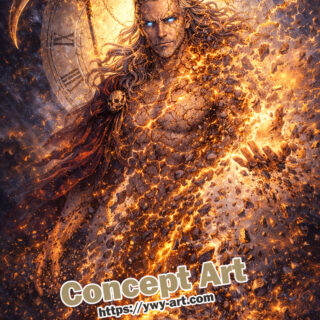
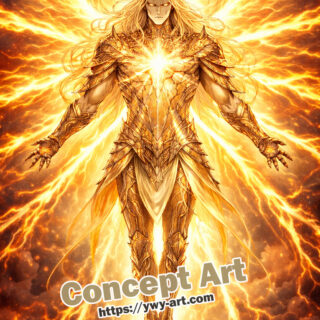
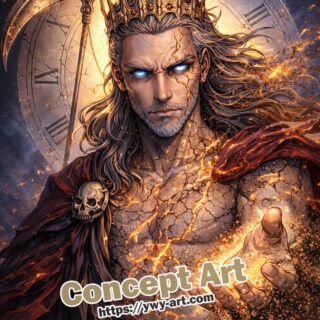
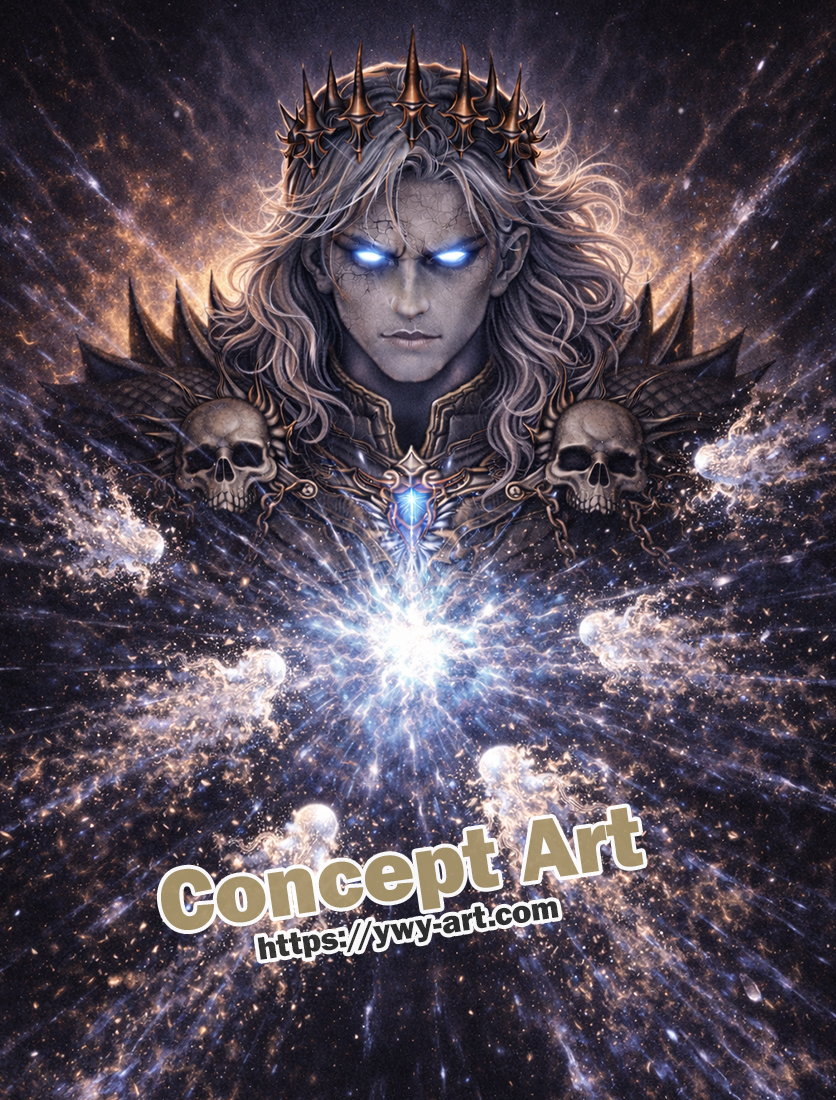
| Common Depiction | Cracking figure with time energy leaking from within |
| Alignment | Chaotic Neutral |
| Creative Reference | Shattered eternity, crumbling time, defiance against inevitability |
Overview
Cronus is the Titan who once ruled over all existence through the control of time itself. Unlike the Olympians, whose power lies in elemental force or divine authority, Cronus defined the very flow of reality. Time did not pass—it obeyed him.
In the Titanomachy, this control becomes the central conflict. As Zeus rises to challenge the Titans, Cronus initially represents an unbreakable system. However, this scene captures the moment where that system begins to collapse. His power does not disappear instantly—it fractures, revealing the instability beneath what once seemed eternal.
Characteristics
- Embodiment of time rather than a controller of it
- Maintains composure even as his form collapses
- Power manifests as distortion and fragmentation
- Resists inevitability rather than seeking victory
- Represents the breaking point of absolute control
Symbolism and Meaning
Cronus symbolizes the illusion of permanence. His rule over time suggests absolute stability, yet this scene reveals that even time itself can fracture. The cracks across his body are not physical damage, but the visible failure of continuity.
“Fallen Eternity” represents a paradox—something meant to last forever reaching its limit. This reflects a core mythological theme: that no force, no matter how absolute, can remain unchanged when confronted by a greater inevitability.
Quick Creative Reference
| Best For | Final resistance scenes, collapsing power, tragic antagonists |
|---|---|
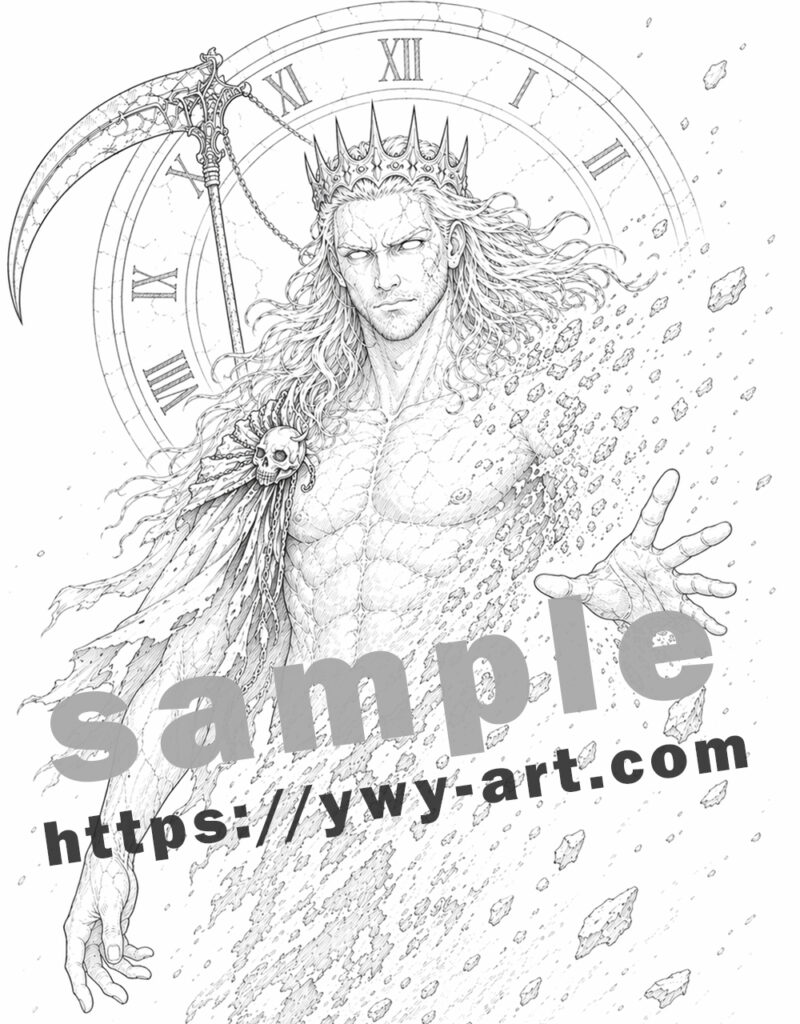
| Visual Keywords | Cracked body, time fragments, dissolving particles, broken clock |
| Mood | Falling, inevitable, defiant |
| Useful Themes | End of eternity, resistance, collapse, inevitability |
Compare with Similar Deities
| Name | Mythology | Main Domains | Overall Image |
|---|---|---|---|
| Saturn | Roman | Time, Agriculture | Roman counterpart of Cronus, more symbolic and less catastrophic |
| Aion | Greek | Eternal Time | Abstract representation of endless time without decay |
| Shiva | Hindu | Destruction, Time | Cosmic destroyer who resets existence rather than resisting it |
The Collapse of Time
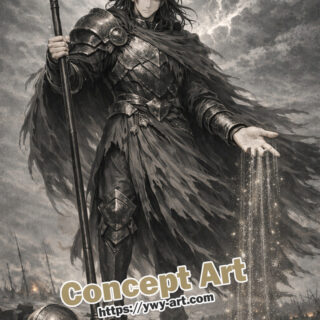
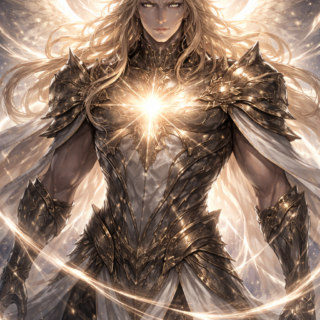
This scene depicts the moment when Cronus can no longer sustain control over time. The cracks spreading across his body represent the breakdown of continuity, where past, present, and future no longer align.
Rather than losing instantly, his power destabilizes, creating a visual expression of time itself falling apart.
Defiance Against the End
Cronus does not retreat or surrender. Even as his form disintegrates, he gathers what remains of his power to resist the inevitable conclusion brought by Zeus.
This transforms him from a dominant ruler into a tragic figure—one who fights not to win, but to endure a moment longer.
Conflict with Zeus
In contrast to Zeus’s decisive judgment, Cronus represents resistance. Their clash is not simply power against power, but inevitability against defiance.
This scene captures the exact point where resistance reaches its limit, marking the final phase of the Titanomachy.
The Unraveling
Cronus does not fall like a defeated warrior. Instead, he unravels. His existence loses cohesion as time itself escapes his control.
This distinction elevates the scene beyond a simple defeat, turning it into a conceptual ending where a fundamental force ceases to function.
Coloring Variations
- Burning Time: Use glowing orange and gold within the cracks to represent leaking time energy.
- Cosmic Decay: Apply dark blues and purples in the background for contrast.
- Fading Existence: Gradually reduce saturation toward the dissolving areas.
Coloring Tips
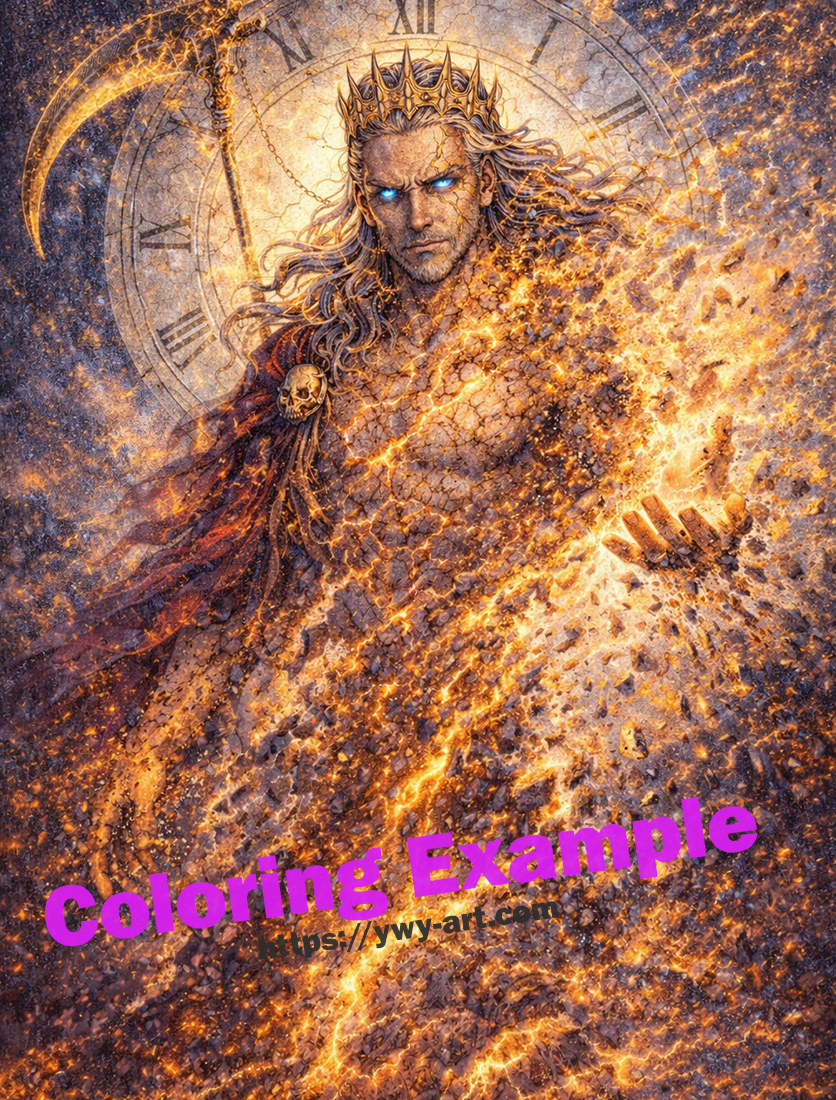
Focus on contrast between the glowing cracks and the darker outer areas. Leave the brightest sections lighter to emphasize energy escaping from within.
Layer colors gradually to create depth, especially around fragmented areas, to simulate disintegration.
Use subtle gradients rather than hard transitions to represent the fading nature of Cronus’s form.
Japanese Summary
クロノスは時間そのものを支配していたティタンであり、このシーンではその支配が崩壊していく瞬間が描かれている。もはや勝利を目指す存在ではなく、終わりに抗う存在として立っている。
ティタノマキアにおいて彼は最終抵抗の象徴であり、ゼウスの裁定に対して最後まで崩れながらも抗い続ける。この構図が戦いの終焉をより強く印象付けている。
時間の崩壊
体に走る亀裂は単なる損傷ではなく、時間の連続性そのものが破綻していることを示している。流れは維持できず、崩れ落ちていく。
これは時間という概念が機能しなくなる瞬間である。
終わりへの抵抗
クロノスは崩壊しながらも立ち続ける。その姿は敗北ではなく、抗いの象徴として描かれる。
この対比により、ゼウスとの関係性がより明確になる。
解けていく存在
最終的にクロノスは倒れるのではなく、ほどけるように消えていく。これは通常の敗北とは異なる終わり方である。
そのため、このシーンは単なる戦闘ではなく、概念の終焉として成立している。
塗りのポイント
亀裂部分には明るいオレンジや黄色を使い、内部から光が漏れているように表現する。外側は暗めにするとコントラストが強くなる。
崩れていく部分は色を薄くしていくことで、消失感を演出できる。
Explore Our Coloring Book Series
Explore more mythological climaxes and powerful endings in our coloring book series.
Each illustration captures a decisive moment where legends reach their conclusion.
Step into the world of mythology..
Available on Amazon Titanomachia: The War Before the Olympians Open in a new tab

コメント