The cloud-crowned meeting place where the Olympian gods turn victory into government
- Assembly
- Divine Government
- Immortality
- Mountain
- Olympians
- Origin
- Divine Occupation
- Major Myths
- Cult / Tradition
- Legacy
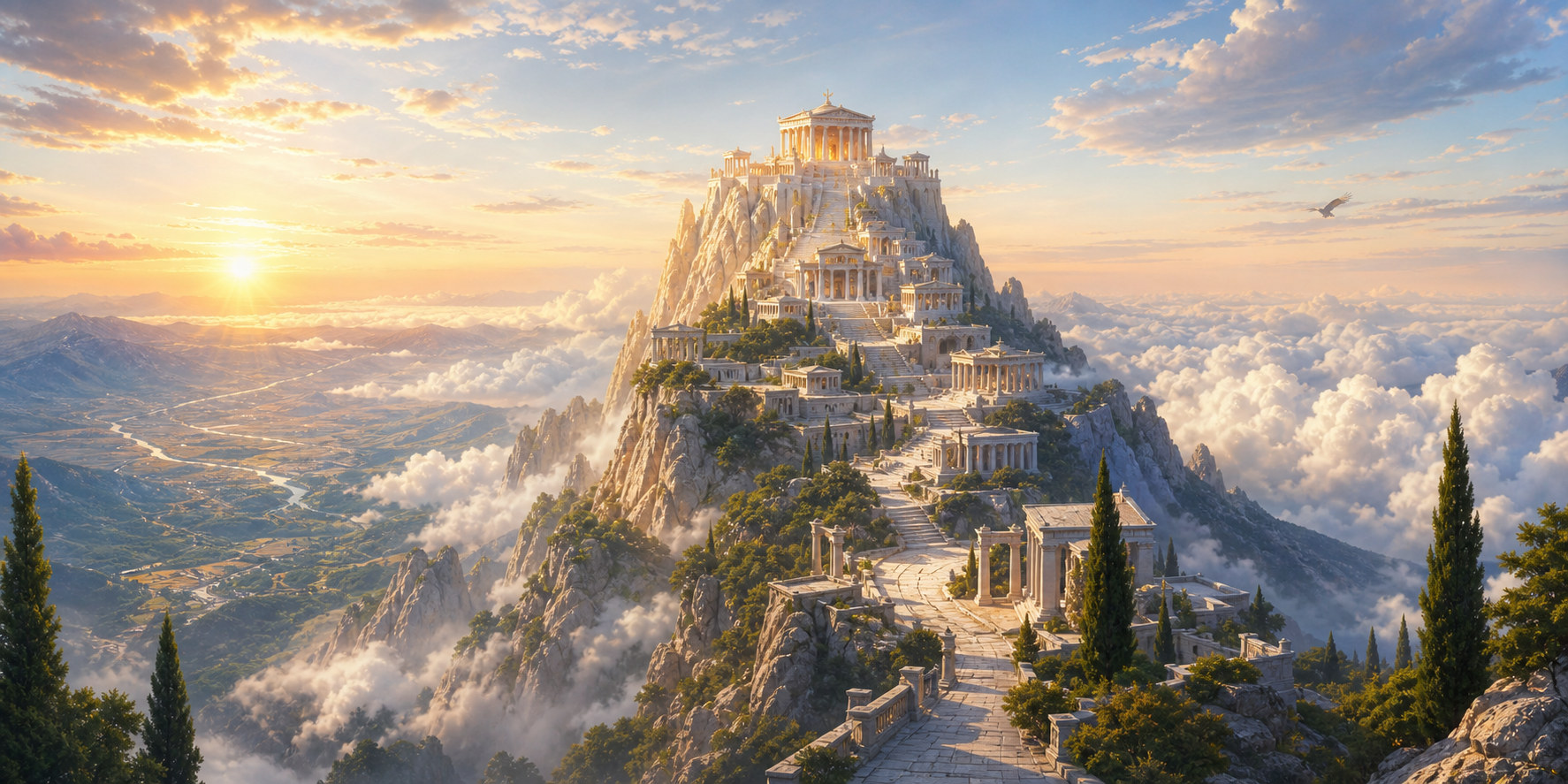
Mount Olympus is both Greece’s highest mountain and the mythic home of the Olympian gods. In epic poetry it functions as a divine palace complex and council seat, where Zeus rules, gods debate mortal affairs, and the victories of the Titanomachy become an enduring political order.
More Than the Home of the Gods
Mount Olympus is one of the most famous places in Greek mythology, often described simply as “the home of the gods.” That phrase is accurate, but incomplete. Olympus is also a court, council chamber, fortress, dining hall, stable, threshold between mortal and divine experience, and the political center of the Olympian order.
Its importance becomes clearer when placed beside the Titanomachy. The younger gods do not merely defeat Cronus and scatter after the war. They create a shared center from which disputes can be heard, honors distributed, alliances maintained, and mortal events watched. Olympus is where victory becomes government.
The Real Mountain and the Mythic Realm
Mount Olympus is a real mountain massif in northern Greece and the highest mountain in the country. Ancient imagination did not erase that geography; it elevated it. Clouds, inaccessible peaks, sudden weather, and immense height made the mountain a natural boundary between the ordinary world and a realm beyond mortal reach.
Mythic Olympus is not always described like a distant planet or separate universe. The gods travel between it and earthly locations. Messengers depart from its halls, wounded deities return for comfort, and Zeus looks outward from its heights. It is both a real place magnified by sacred imagination and a divine environment ordinary travelers cannot simply enter.
The Gates and Halls of Olympus
Epic tradition imagines golden gates guarded by the Horae, goddesses connected with seasons and the proper order of time. Within are the palace of Zeus, separate dwellings for other gods, courtyards, halls, and stables for immortal horses.
The architectural language matters. Olympus is not a wilderness hiding unpredictable spirits. It resembles an idealized royal complex. Its walls and halls make divine hierarchy visible, while its gates express controlled access. Who is invited inside? Who speaks before Zeus? Who leaves in anger? These questions turn architecture into mythology.
The Council of the Gods
On Olympus, gods assemble to debate war, fate, punishment, and the affairs of heroes. Zeus calls meetings, but the other gods do not become silent servants. Hera challenges him, Athena argues for favored heroes, Poseidon pursues his own grievances, and divine factions form around events such as the Trojan War.
This makes Olympus dramatically useful. It allows stories on earth to be mirrored by conflicts above. A battle between mortals may depend on a quarrel in the divine court, while a private resentment among gods can reshape an entire human journey.
Feasting, Nectar, and Immortal Life
Olympus is also a place of feasts, music, nectar, and ambrosia. These scenes distinguish divine life from human scarcity and mortality. The gods possess beauty, abundance, and freedom from ordinary aging—but they do not possess perfect peace.
Even at the table, rivalries remain. Laughter, insult, persuasion, desire, and resentment move through the court. Olympus therefore offers a compelling paradox: immortality removes death, but it does not remove personality.
Who Truly Belongs on Olympus?
The phrase “the Twelve Olympians” suggests a fixed membership, yet ancient lists could vary. Hestia and Dionysus may exchange places in later schemes, and Hades is usually excluded because his realm lies below even though he belongs to the same ruling generation.
This uncertainty makes Olympus more interesting, not less. It was a flexible religious and poetic center rather than a modern organization with one permanent membership chart. A reader who asks “Who are the twelve?” quickly discovers regional cults, different lists, and changing traditions.
Olympus and the Three Brothers
After the Titanomachy, Zeus received the sky, Poseidon the sea, and Hades the underworld. Olympus is most closely associated with Zeus, but it remains a shared divine meeting place rather than simply his private property.
Poseidon can enter the council even while ruling the sea. Hades is connected to the ruling family but remains rooted in the underworld. Their different relationships with Olympus reveal how geography expresses power: Zeus presides from above, Poseidon moves through a vast surrounding domain, and Hades governs the unseen world beneath.
A Place Above Human Weather
Poetic descriptions often imagine the divine summit as untouched by ordinary storm, rain, or snow, filled instead with clear brightness. This is striking because Zeus himself rules weather. The mountain can be wrapped in cloud from a human viewpoint while the divine court exists in calm beyond it.
The image creates one of mythology’s strongest invitations to curiosity: what appears hidden by cloud from below may be perfectly clear from above.
Olympus in Later Imagination
Artists and storytellers repeatedly reinvented Olympus as a marble palace, celestial city, shining summit, or impossible royal landscape. Roman tradition transferred much of its imagery to Jupiter and the Roman gods, while modern fantasy often turns it into a visible supernatural capital.
Yet its oldest narrative function remains powerful. Olympus is where divine personalities become a society. Without it, Greek mythology would still contain powerful gods; with it, those gods inhabit a world readers can enter, navigate, and leave by following the next dispute.
Questions That Open the Next Path
- Who built the halls of the gods? Traditions about divine craft lead toward Hephaestus and the architecture of immortality.
- Who counts as an Olympian? Different lists open paths to Hestia, Dionysus, and the complex position of Hades.
- How did Olympus become the ruling center? The answer returns to the Titanomachy and the weapons that secured victory.