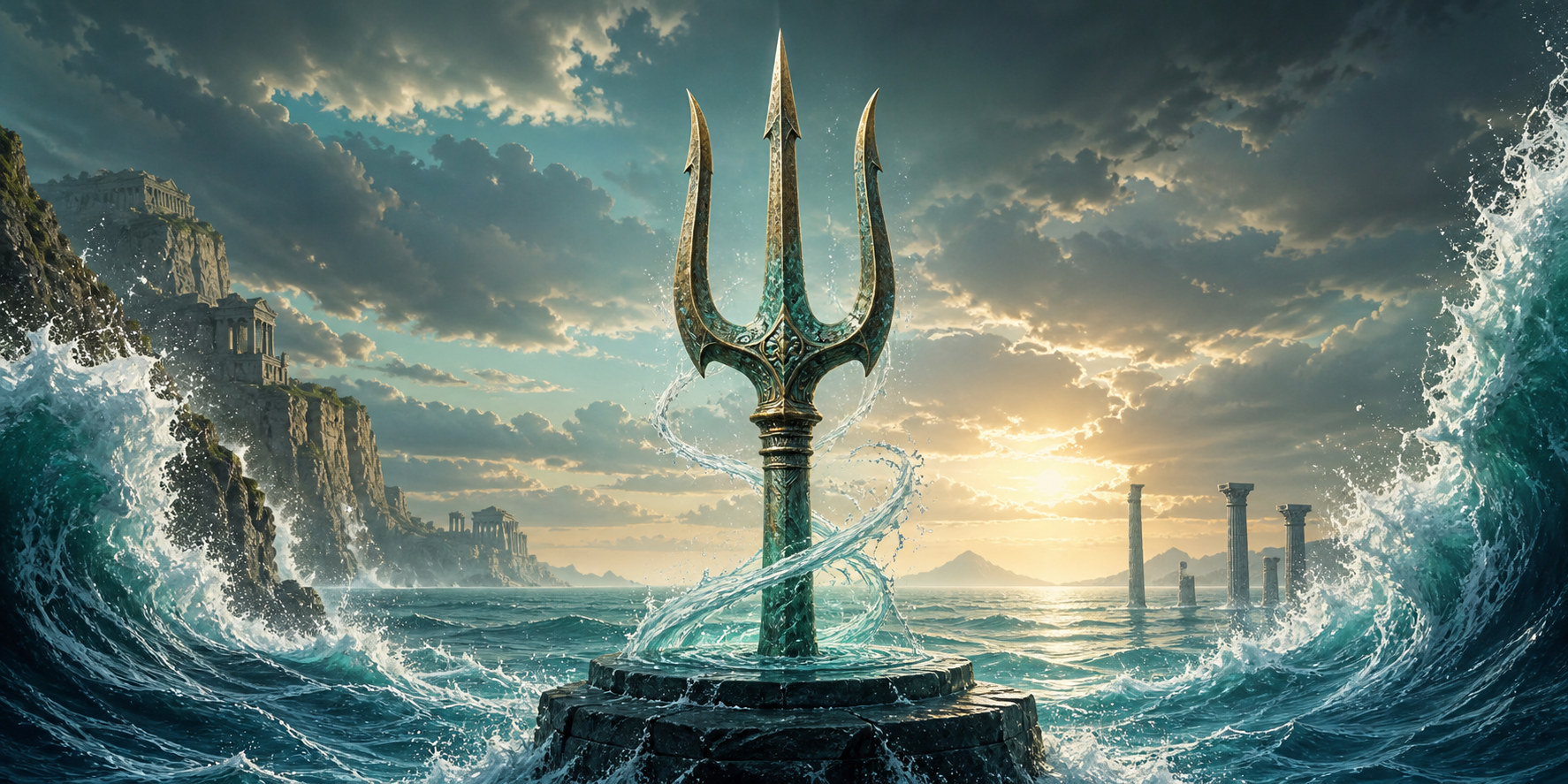
The three-pronged sign of Poseidon’s command over sea, springs, horses, and the shaking earth
- Earthquakes
- Horses
- Poseidon
- Sea
- Storms
- Origin
- Creation
- Major Appearance
- Later Tradition
- Legacy
The Trident is the defining weapon and emblem of Poseidon. Given by the Cyclopes during the Titanomachy, its three prongs unite the god’s powers over sea, earthquakes, springs, and horses, turning a fishing spear into the unmistakable sign of an elemental ruler.
The Sign by Which Poseidon Is Known
The Trident is so closely tied to Poseidon that ancient images can become difficult to identify when the object is missing. Zeus and Poseidon may both appear as mature, powerful, bearded gods; the Thunderbolt declares one, and the Trident declares the other.
Its shape comes from a practical three-pronged spear used in fishing, but myth enlarges that tool until it can command oceans and shake continents. The transformation is characteristic of Greek mythology: an object drawn from lived experience becomes a visible language for divine power.
The Gift of the Cyclopes
According to the systematic account preserved by Pseudo-Apollodorus, the Cyclopes gave Poseidon the Trident after Zeus released them from Tartarus. At the same moment Zeus received the Thunderbolt and Hades the Helmet of Invisibility.
The three objects form one of mythology’s most meaningful sets. They were forged before the brothers divided the cosmos, yet each seems to anticipate the realm its bearer would later receive. Did the weapons reveal their destinies, or did the gods grow into the identities their weapons made possible?
A Weapon for Sea and Earth
Poseidon rules the sea, but he is also the Earth-Shaker. A strike of the Trident can be imagined raising storms, breaking rock, opening the ground, or releasing water. This broadens the artifact far beyond a nautical symbol.
The sea and earthquake may seem like separate powers, yet both represent unstable boundaries. Coastlines move, waves cross the line between land and water, and earthquakes make solid ground behave like a storm. The Trident binds these experiences into one emblem.
The Contest for Athens
In the famous contest for Athens, Poseidon struck the rock of the Acropolis and produced a sign of his power—often described as a salt spring or sea-water well. Athena offered the olive tree, and the city chose her gift.
The story does not make the Trident weak. It asks what kind of power a city values. Poseidon offers elemental force and maritime identity; Athena offers cultivation, continuity, and civic usefulness. Following this single strike leads into the rivalry between two gods and the question of how myth explains the personality of a city.
Springs, Horses, and Sudden Openings
Other stories connect a blow of Poseidon’s Trident with the creation of springs or passages in rock. The weapon can make hidden water emerge, turning destruction into revelation.
Poseidon’s ancient relationship with horses adds another layer. The Trident is not a horse weapon, but both symbols express speed, force, and barely controlled motion. Sea foam, galloping hooves, and trembling ground belong to the same imaginative world.
Was the Trident Always Forged by the Cyclopes?
Greek mythology rarely preserves only one account. Later traditions sometimes associate the making of Poseidon’s Trident with the Telchines, mysterious sea-connected craftsmen and magicians of Rhodes.
This variation is valuable. Rather than forcing every source into one neat version, Project Mythos can use the disagreement as a path: why do divine objects attract competing makers? What did the Cyclopes represent that the Telchines represented differently?
Trident and Thunderbolt
The Trident and Thunderbolt are visual opposites. Zeus’s weapon descends from sky to earth in a single violent strike. Poseidon’s rises from the sea or drives into the ground through three points. One asserts judgment from above; the other channels pressure from below and around.
Together they reveal how the brothers divided not only the cosmos, but also different forms of natural terror.
From Poseidon to Neptune
Roman Neptune inherited the Trident, and the symbol spread through fountains, monuments, coins, maritime emblems, and modern representations of the sea. It remains instantly readable even when Poseidon himself is absent.
That endurance shows the artifact’s success as design. Three prongs are enough to evoke an entire domain: oceans, storms, earthquakes, horses, drowned cities, and the god whose anger could make sailors fear the horizon.
Questions That Open the Next Path
- Why did Athena defeat Poseidon in the contest for Athens? The answer opens the mythology of civic identity and sacred gifts.
- Who truly forged the Trident? Comparing Cyclopes and Telchines reveals competing traditions of divine craftsmanship.
- Why is a sea god also the Earth-Shaker? Poseidon’s deeper origins connect ocean, horses, springs, and earthquakes.