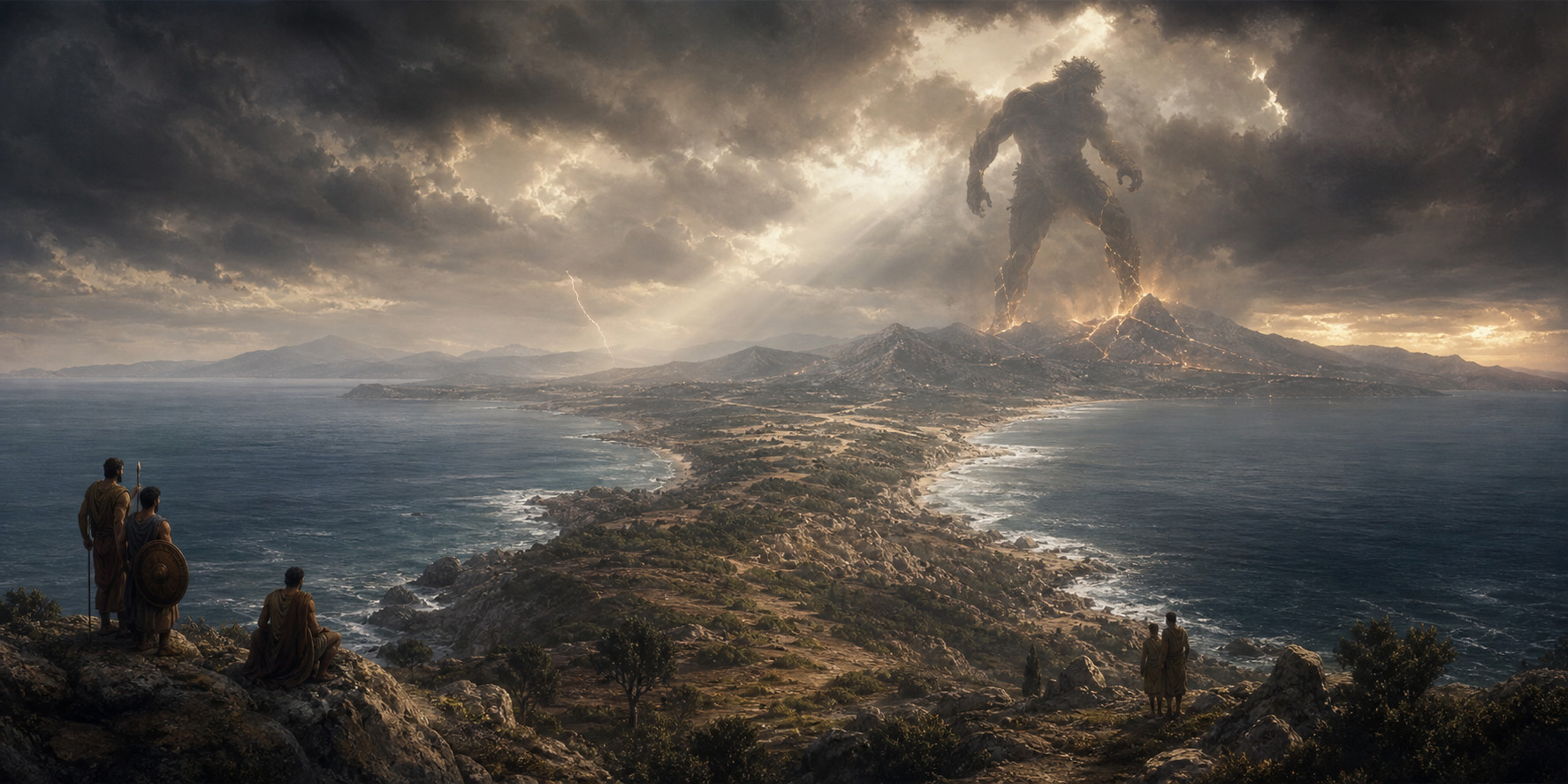
The Chalcidic peninsula whose earth revives its Giant champion until Heracles crosses the boundary.
- Alcyoneus
- Athena
- Chalcidice
- Giants
- Heracles
- Phlegra
- Origin
- Divine Occupation
- Major Myths
- Cult / Tradition
- Legacy
Pallene is an ancient peninsula of Chalcidice associated with Phlegra and the Giants. In Apollodorus, Alcyoneus revives whenever he falls on his native land, so Athena tells Heracles to drag him beyond Pallene before the Giant can die.
Pallene is both a real peninsula and a mythic condition of battle. Ancient geography places it in Chalcidice, while Gigantomachy tradition remembers it as Phlegra, a land of Giants. For Alcyoneus, native ground is not merely scenery: it restores him whenever he falls. Heracles can defeat the Giant only by dragging him beyond Pallene, turning a border in the landscape into the decisive weapon.
The Western Peninsula of Chalcidice
Strabo describes Pallene as a peninsula extending into the Aegean from Chalcidice, joined by a narrow isthmus. He names cities including the settlement once called Potidaea and later Cassandreia, along with Aphytis, Mende, Scione, and Sane. The geographic Pallene belongs to northern Greece, not to an abstract realm outside the world.
Its long coastline, narrow entrance, and mountainous interior give it a clear natural boundary. Myth can therefore make leaving Pallene an intelligible action. A hero does not merely move a body a few steps; he crosses the edge of a defined land whose shape ancient audiences could imagine.
Pallene and the Name Phlegra
Ancient writers connect Pallene with the earlier name Phlegra, the Burning Land, and with traditions of the Giants. Strabo reports that Giants were said to have lived there. Other authors place Phlegra or the Gigantomachy elsewhere, including volcanic landscapes in Italy.
The competing locations should remain visible. Pallene is one powerful localization of a war told across the Greek and Roman world, not the only possible battlefield. The name Phlegra allowed fiery, violent, or volcanic places to claim a connection with the assault on the gods.
Birthplace of Alcyoneus
Apollodorus says Alcyoneus cannot die while he fights in the land of his birth. The text identifies Giants as born in Phlegra according to one tradition and in Pallene according to another, then makes Pallene the boundary that matters in the Giant’s death.
This condition joins person and place more tightly than ordinary homeland loyalty. Pallene actively sustains Alcyoneus. When he falls after Heracles’s arrow, contact with the ground allows him to revive. The battlefield repairs its own defender.
The Cattle of the Sun
Alcyoneus is also said to have driven away the cattle of Helios from Erytheia. The episode draws the Giant into the far-reaching adventures of Heracles and helps explain why the hero confronts him. Sources differ about how this cattle story fits the larger Gigantomachy.
Pallene becomes the place where a conflict carried across the world meets a local rule. The stolen cattle connect sea-spanning heroic travel with the Giant’s native ground. The result is not a simple invasion map but a convergence of traditions around one formidable opponent.
Athena Reads the Landscape
Heracles shoots Alcyoneus, but the Giant revives when he touches Pallene. Athena advises the hero to drag him outside the land. Her counsel identifies the true defense before another attack is wasted. Strategy begins by recognizing that the ground, not armor, is the source of survival.
The solution resembles other Heraclean victories in which strength must be redirected by knowledge. Moving Alcyoneus remains a physical feat, but its meaning comes from crossing the correct boundary. Athena converts geography into method.
A Mortal in the War of Gods
The gods receive an oracle that the Giants cannot be destroyed by gods alone. Heracles is summoned as the required mortal ally. Pallene is therefore the site where divine and mortal action must cooperate, just as Zeus’s lightning and Heracles’s arrows combine against other Giants.
Alcyoneus’s territorial immortality adds another condition to the oracle. It is not enough to bring a mortal into the war; that mortal must also understand where death is possible. The place makes the general rule of the Gigantomachy specific.
Real Land and Mythic Battlefield
Strabo records attempts to interpret stories of Giants as memories of former peoples, while still preserving the mythic association. Such ancient rationalization is part of the reception history, not a replacement for the battle narrative. Pallene could be viewed simultaneously as known geography and legendary ground.
Modern maps identify the peninsula now commonly called Kassandra. That continuity helps readers locate Pallene, but Project Mythos does not claim that one recoverable battle site proves the Gigantomachy. The value lies in seeing how real contours gave myth a boundary with narrative force.
What Pallene Means
Pallene makes place an active participant. Alcyoneus’s power is relational: he is invincible only while native earth supports him. The story imagines belonging as literal renewal and exile as the removal of a supernatural defense.
The same landscape also shows why strategy matters in Project Mythos. Heracles wins neither by endlessly shooting nor by denying the Giant’s strength. He changes the terms of the encounter. A narrow border becomes more decisive than a larger weapon.
Where the Story Leads
Follow Alcyoneus to the Giant sustained by Pallene, Athena to the counsel that reveals his weakness, and Heracles to the mortal role required by the oracle. Porphyrion and the Giants widen the conflict from one territorial champion to the assault on Olympus.
Gigantomachy links Pallene to other claimed battlefields and to ancient visual programs of gods fighting serpent-legged enemies. Phlegra opens a path into the way one myth can attach itself to several fiery landscapes without losing the importance of each local tradition.
Trivia
- Pallene is the ancient name of a peninsula in Chalcidice, associated with modern Kassandra.
- Some ancient sources identify Pallene with the earlier place-name Phlegra.
- Alcyoneus dies only after Heracles moves him beyond his native land.