The lion-haunted valley where Heracles gains his armor and later athletes gather for Zeus.
- Eurystheus
- Heracles
- Molorchus
- Nemean Games
- Nemean Lion
- Zeus
- Origin
- Divine Occupation
- Major Myths
- Cult / Tradition
- Legacy
Nemea is the northeastern Peloponnesian landscape of Heracles's first labor and the sanctuary of the Nemean Games. Its lion cave, Molorchus tradition, Zeus sanctuary, and Opheltes foundation story connect heroic danger with hospitality, ritual, and athletics.
Nemea gathers several kinds of Greek memory into one valley. It is the country terrorized by the invulnerable lion, the landscape of Heracles’s first labor, and the sanctuary later known for games held in honor of Zeus. The lion’s cave, Molorchus’s hospitality, the story of the child Opheltes, and the historical festival do not form one simple episode, but together they show how myth, road, ritual, and athletics can accumulate around a place.
A Valley between Regions
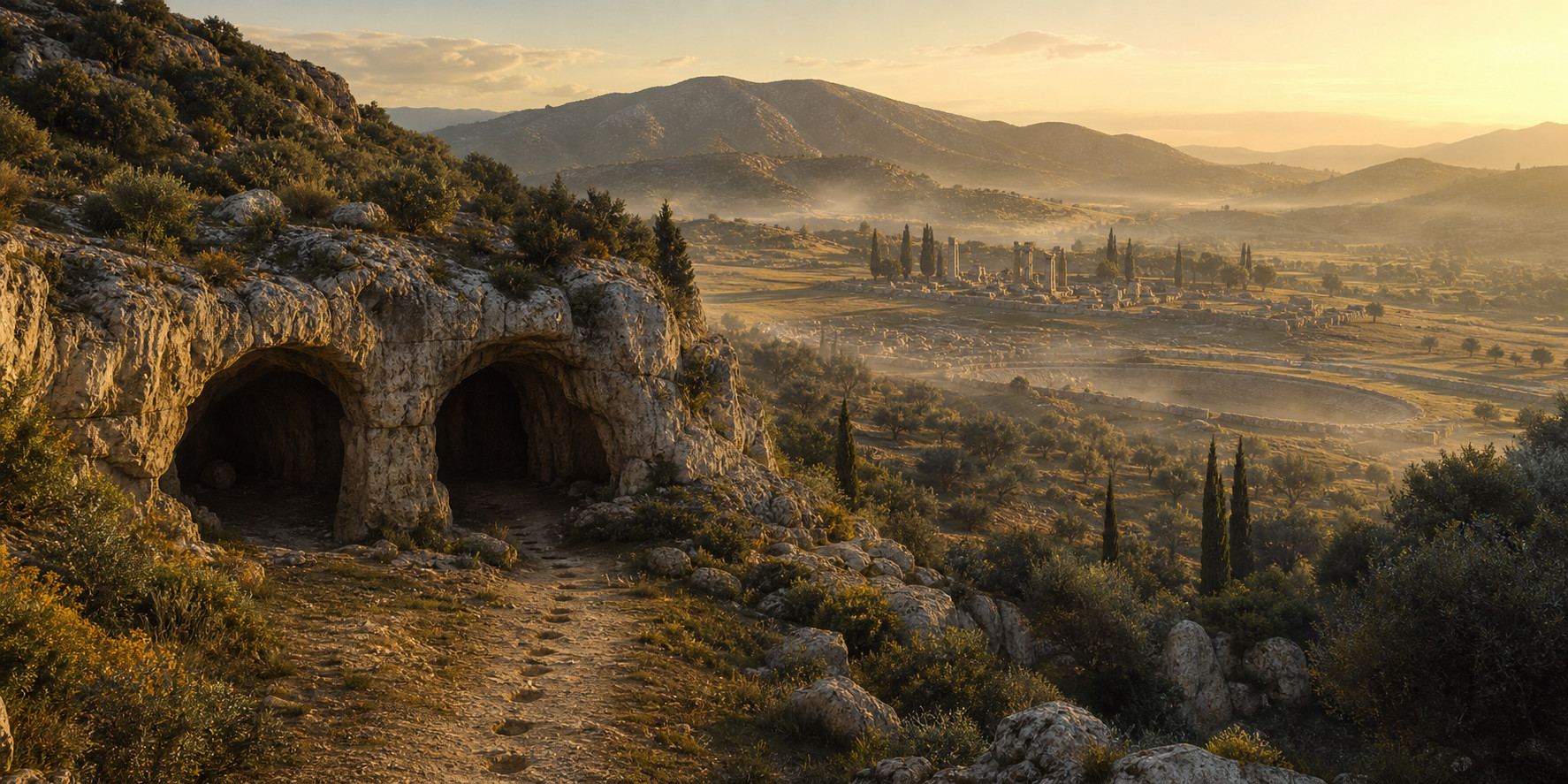
Ancient Nemea lies in the northeastern Peloponnese, between the territories and roads of Argos, Corinth, and Cleonae. Hills and narrow approaches shape the valley. The setting can feel enclosed while still standing on routes used by travelers, armies, pilgrims, and competitors.
This geography suits a monster story. A powerful animal in caves and ravines can control movement beyond a single village. Hesiod describes the lion holding sway over Nemea, Tretus, and Apesas, making the danger regional rather than confined to one den.
The Lion in the Hills
Hera raises or settles the Nemean Lion as a woe to humankind and a danger connected with Heracles. Its hide cannot be pierced by ordinary weapons. Nemea is therefore the first place in the Labors where heroic equipment fails and close observation becomes necessary.
The lion’s control of the landscape matters as much as its body. Herds and travelers must avoid its range; the cave offers more than one exit. Heracles changes the place by blocking one mouth and entering through the other, turning a dangerous refuge into a boundary he can control.
Cleonae and Molorchus
Apollodorus places Heracles with Molorchus at Cleonae before the hunt. The poor host prepares to sacrifice, but Heracles asks him to wait thirty days. If the hero returns, they will honor Zeus the Savior; if he dies, Molorchus may honor Heracles as a hero.
The episode brings a human household into the labor. Nemea is not empty wilderness waiting for a famous figure. Local people measure time, danger, hospitality, and uncertainty while Heracles is away. The return with the lion skin transforms private waiting into ritual celebration.
The Double-Mouthed Cave
Apollodorus describes a cave with two entrances. Heracles blocks one and approaches through the other, preventing the lion from escaping. The physical form of the cave explains the tactic more clearly than a generic lair could.
Ancient and modern visitors have proposed caves around the wider Nemean and Cleonaean landscape as the mythic site. Such identifications are part of local reception, but the literary cave remains a narrative structure first: two openings, one sealed route, and a confined struggle where weapons no longer decide the outcome.
From Lion Skin to Heroic Identity
After strangling the lion, Heracles removes the impervious hide and wears it. The landscape of Nemea supplies the armor that follows him through later labors and art. One local monster becomes the visual signature of a hero known across the Mediterranean.
The transformation does not erase Nemea. Every lion-skin image carries the first labor forward. The cave and hills may disappear from the artwork, but the place remains inside the object worn on the hero’s body.
Opheltes and the Nemean Games
A separate but influential Nemean tradition centers on the infant Opheltes, later called Archemorus. The Seven against Thebes ask his nurse Hypsipyle for water; when the child is set down, a serpent kills him. Funeral games are established in his memory in one account of the festival’s origin.
Other traditions credit Heracles with founding or reorganizing games after the lion labor. The different foundation stories should remain distinct. Both connect athletic gathering with death, victory, and ritual memory, but they enter Nemea through different narrative cycles.
Sanctuary of Nemean Zeus
The historical sanctuary at Nemea was dedicated to Zeus and hosted one of the major Panhellenic festivals. Athletes and spectators came for competitions held on a recurring cycle. Temple, altar, stadium, and roads turned the valley into an organized sacred landscape.
The Zeus of the games should not be reduced to a background label for Heracles. Athletic rules, sacrifice, civic administration, and regional politics gave the sanctuary a life beyond the lion story. Mythic and historical Nemea overlap without becoming identical.
A Place of First Tests
Within the Twelve Labors, Nemea is the beginning. It teaches Heracles that invulnerability can make standard weapons irrelevant and that victory may require controlling space before controlling an opponent. The lion skin then equips him for everything that follows.
Within the athletic tradition, Nemea is also a place where excellence becomes public and repeatable. A one-time monster fight and recurring games offer two different measures of achievement. Both depend on entering the valley, accepting rules, and returning with a changed status.
Where the Story Leads
Follow the Nemean Lion to the cave and invulnerable hide, Heracles to the Twelve Labors, and Eurystheus to the command that begins the cycle. Molorchus remains a future human-scale entry into hospitality, waiting, and the ritual recognition of victory.
Opheltes, Hypsipyle, and the Seven against Thebes lead toward another mythic network, while Zeus and the Nemean Games lead toward sanctuary and ancient athletics. Nemea is valuable precisely because these paths share a landscape without collapsing into one story.
Trivia
- Hesiod places the lion’s territory around Nemea, Tretus, and Apesas.
- The first labor gives Heracles the lion skin used throughout later art.
- Ancient traditions connect the Nemean Games with both Opheltes and Heracles.